
Thousands of people have read Fr. Seraphim’s books, but relatively few people heard him speak. Some of his formal lectures, which he wrote out for the most part, have been published. The following, however, was an informal talk and, while slightly abridged due to space considerations, it has been deliberately left unedited to preserve its simplicity of style, which so well reflects Fr. Seraphim’s unpretentious and unaffected character. He had a brilliant intellect, but, far from advertising the fact, his primarily emphasis was on the need to develop an Orthodoxy of the heart. The talk was given in Bright Week, 1981, to the St. Seraphim Orthodox Christian Student Fellowship at UC Santa Cruz, whose spiritual director, (now) Abbot Anastassy, kindly gave us permission to reprint the transcript from the “Journal of the Old Cathedral of the Holy Virgin Joy of All Who Sorrow,” July-Sept. 1994.
Orthodox America, Vol. XV, No. 2 (Issue 134), August 1994
Introduction

Today I would like to speak on a subject which is very relevant to our times: the end of the world; more particularly, the signs being fulfilled in our times which point to the end of the world.
There have been a number of times in the past when this subject was of great interest. In fact, you can even call them “apocalyptic” times. The Apostles themselves felt that their times were very apocalyptic. (Later I will present some of the statements they made in the Scriptures which show that they really expected the end of all things to be very close.) At various other times—for example, in the West, around the year 1000—there was a great expectation of the end. In Russia near the end of the 15th century, again there was a period when the end was expected shortly[1]. This was because the year 1492, according to the chronology of the Old Testament, was the year 7000 from the creation of the world. And many people in our own times have this same feeling that time is running out, that something big is going to happen. Often this is bound up with the number 2,000. That is, we have come to the end of two millennia of Christianity; a millennium is thought of as a big thing, a whole thousand years, and two of them means some great crisis must be approaching; and many people place this in the terms of the end of the world[2]. Of course, that does not necessarily mean anything, since we don’t know the day, or the hour, or the year when the world is going to end[3]. I will try, however, to go into what our attitude should be toward this expectation of the end.
Nowadays, when you think about “apocalyptic awareness,” you think of Protestant sectarians of various kinds, who have definite ideas about what is going to happen at the end of this age. It is not only religious thinkers, however, but also ordinary secular philosophers who talk about the end of the world in a very bold way. I will give you an example, one who should be close to us because he is an Orthodox writer: Alexander Solzhenitsyn. He has been outside of Russia since 1974, and has written about life in the Soviet Union and especially in the Soviet labor camps, the infamous Gulag. He is not what one would consider a “mystical” or “vague” thinker, or someone who’s up in the clouds; he is very down-to-earth.
Almost three years ago he gave a talk at the Harvard University commencement[4], in which he spoke boldly to the people of the West (just as before that he had spoken boldly to Soviet leaders), telling them that their civilization is collapsing and is in danger of being taken over by Communism, that modern humanism is not deep enough to satisfy the human soul, and that it is no model that can be followed by Russia if Russia should overthrow Communism. At the end of this address he used the following words to express his idea of the depth of the crisis which is now occurring in the world:
“If the world has not come to its end, it has approached a major turn in history, equal in importance to the turn from the Middle Ages to the Renaissance.”
Here he speaks seriously of the possibility of the “end of the world,” based on his observations that it is impossible for men to live long without deep spiritual roots, which have been uprooted in the East by Communism and in the West by worldly humanism.
In his other writings, Solzhenitsyn, like many realistic thinkers today, speaks of specific reasons, quite apart from the spiritual ones, why he thinks that such a period of great crisis is facing humanity. He mentions things that you will find in any serious analysis of today’s news: namely, such things as the nearness of the exhaustion of the earth’s resources (if they are used at the present rates); the disastrous pollution of air and water and soil (which is much worse in Russia than in America); the overpopulation of the world and the approaching disastrous shortage of food which seems to be coming; and, of course, the development of weapons in the last few decades, which makes the virtual annihilation of human life possible.
All this relates to the physical signs of an approaching great crisis, the end of the modern age, and perhaps the end of the world itself. But much more remarkable than these are the spiritual signs that are multiplying in our times. This is what I would like to mostly talk about.
Our Christian Attitude
First of all, I would like to ask a question: What should be the attitude of a committed Orthodox Christian toward this whole idea of the end of the world, and toward the signs which are preparing for it? Should we dismiss all this as some kind of superstition, hysteria, and so forth?
No, we should not. We have, first of all, the answer given by our Lord Jesus Christ Himself in the Gospel. Just two days before He was to go to His Passion, His disciples came to Him on the Mount of Olives and asked Him: “Tell us, when shall these things be?”—that is, the destruction of the temple, which He had just mentioned. Then they asked Him: “And what shall be the sign of Thy coming, and of the end of the world?” [5]. Our Saviour at that moment did not reject the question, as He did at other times when the disciples asked things they should not be asking, such as when James and John asked if they would be able to sit next to Him in the Kingdom of Heaven[6]. On the contrary, He allowed them to ask the questions, and He answered them. These answers take up the entire twenty-fourth chapter of the Book of St. Matthew (where the historical events before the end of the world are set forth), and the twenty-fifth chapter (where He teaches most fully on the coming Judgment and on how to prepare for His coming). In a shorter form, these are also set forth in the Gospels of Mark and Luke. Some of these prophecies refer directly to the destruction of Jerusalem and the temple, which happened several decades after the Crucifixion, but the rest refer to the end of the whole world.
In His answer, our Lord gives the following main points. First of all, beware of deception, of following false Christs. Then there will be various signs, such as wars, famines, earthquakes—and all these are not the end but rather the beginning of the tribulation. Then there will be the moral signs: the persecutions of Christians; the increase of evil; the growing coldness of love, which is one of the main signs that Christianity is dying, because the sign of a Christian, as our Lord told us, is that he has love for others[7]. Then another sign is that the Gospel is to be preached to the whole world, after which the end will come[8]. Another sign is that there will be a terrible tribulation, i.e. apart even from all the things He has mentioned already: wars, famines, earthquakes. And “the abomination of desolation will be in the holy place” (we must understand this according to the interpretation handed down by the Holy Fathers, which I will speak about); and “the days will be shortened . . . for the sake of the elect”.
Then again He warns about false Christs and false prophets, and about “great signs and wonders” which, “if possible, will lead astray even the elect,” i.e. not only will terrible physical events happen, but there will also be deceptions which are so subtle that even the elect themselves might be fooled.
Then the sign of the coming of Christ: it will be sudden, from above, and not like His first coming. The signs of the very end are that “the sun shall be darkened, the moon shall not give its light, the stars will fall from heaven”; and then Christ Himself will appear in the heavens with the sign of the Cross.
But He tells us that the day and hour of His coming are not for us to know. Nonetheless, we should pay attention. He gives us the parable of the fig tree: when we see its branches putting forth leaves, we know that summer is nigh; and, likewise, when we watch the signs and see these things beginning to happen, then we know that the times are ripe, that the end is drawing near.
Therefore, we are to watch not for a specific day or time, but rather for the signs of the end so that we can be prepared. We are especially to be prepared against deception, which is involved with one of the great events to happen at the end of the world: the coming of Antichrist, which we will discuss shortly.
The answers to Christians, therefore, is to watch and be ready for that time[9]. The twenty-fifth chapter of the Gospel of Matthew is taken up with several images/ parables about how we are to watch. There is the parable of the five foolish and five wise virgins[10]: the latter are those who have theirs wicks trimmed, that is, who have obtained the grace of the Holy Spirit, who are practicing the Christian life rather than just learning the Faith and then not doing anything about it. Another parable is that of the talents[11].
As I mentioned earlier, the age of the Apostles—the first century—was full of the expectation that Christ would soon return. Today it is a little difficult for us even to imagine how the Apostles could be so filled with fervor for Christ that they could go to all the ends of the world; but they literally did. The Apostle Thomas went to India, and some say even as far as China; St. Andrew went north to Scythia, which is now Russia; St. Aristobulus and others went to England; St. Matthew and others went south to Abyssinia. The whole civilized world at that time was covered by the Apostles, because they had the idea that the world was coming soon to an end and that they were to go out to all the lands and preach the Gospel. Already by the time of the destruction of Jerusalem by the Romans in A.D. 70, the Gospel had been preached to virtually all the known inhabited world. From that time on began the bringing forth of fruits in all those countries in which the seed of the Gospel had been planted.
And we see, if we take any one particular country that received the Gospel, how over the centuries it brought forth fruits. It had saints, the lives of people were completely changed, and there was a total difference between the time that country was pagan and the time it accepted Orthodox Christianity. If you take any country in the West, such as Britain or France, or in the East, such as Byzantium or Syria or Russia, you will see that this is the case.
There are a number of Scriptural passages in which the Apostles mention the coming of the end. For example, in Hebrews 10:37, St. Paul quotes the prophet Habakkuk[12]: “Yet a very little while, and He that cometh shall come, and shall not tarry.” [13] And again, in Philippians 4:4-5, St. Paul writes: “Rejoice in the Lord always. . . The Lord is at hand.” [14] St. John mentions in 1 John 2:18: “Little children, it is the last hour.” [15] At the end of the Book of the Apocalypse, Christ Himself says, “Yea, I come quickly”; and then St. John says, “Amen. Yea, come, Lord Jesus” [16]. The Apostle Peter says in 1 Peter 4:7: “The end of all things is at hand.” [17] Elsewhere, answering those who said that the end was a long time in coming, St. Peter says in his famous statement that “one day is with the Lord as a thousand years, and a thousand years is one day,” and that the Lord is only being patient with us until we repent[18]. And then, immediately after that, he gives us a full description of the actual end of the world by fire.
So, from that very time, those who were fervent Christians had a definite idea: the world is soon coming to an end. Of course, nineteen centuries have passed since that time. Does that mean that the Apostles were mistaken? Or that anyone else who thinks so is also mistaken, and we should put away all ideas that the end of the world is at hand, that Christ is coming soon? No, it does not mean this. It means that we are to understand this in the right way, and the right way is the spiritual way. If we ourselves are leading a conscious spiritual life, conducting the unseen warfare against our own fallen nature and against the demons who are against us, then we will be constantly expecting the coming of Christ into our soul. With our death, of course, we are to meet Christ. Anyone who has this kind of feeling in his soul – for him it is quite natural to expect soon the coming of Christ.
The only danger is if you go overboard and begin to try to place dates, to calculate exactly when it is going to happen, to be too concerned about specific events which are occurring and too quick to place them in categories so that they fit into chapters of the Apocalypse. For example, a famous book came out a few years ago, entitled The Late Great Planet Earth. In twenty years it will be outmoded; the author [Hal Lindsey] will have to go through and make a new book and fit all the things he talked about into new events. It does not pay to go overboard on these details. Our approach has to be a little broader, a little higher, but just as fervent.
Of course, the big mistake made by the people who go overboard in these details occurs when they fall into the heresy of chiliasm: the expectation of Christ coming to earth for a thousand years[19]. This is a very troublesome heresy was widespread even in the early history of the Church and was condemned by the Second Ecumenical Council [in A.D. 381. That was when the phrase was put in the Creed: “… and His Kingdom shall have no end.” [20]
The idea of chiliasm arose out of a misinterpretation of Apocalypse chapter 20, which says the devil was bound for a thousand years and Christ came and reigned with His saints. If you just read the text straight through without stopping and interpreting it according to what the Holy Fathers have said about it, you can get the idea that there is to be a period of a thousand years between two future comings of Christ. This means you have to have two different Judgments. In fact, the Protestants do: they have a “Great White Throne Judgment,” and some other kind of Judgment. This confuses the whole picture of Christian eschatology.
In the universal interpretation of the Orthodox Holy Fathers, however, there is no mystery about this. The reign of Christ with His saints is occurring now. This is the Church. This is the life of grace in the Church with the Sacraments, which Protestants, not having, do not understand. The life in the Church is such a blessed state—because we are with Christ, we have His grace, we have His Body and Blood within us—that this is like Paradise[21]. And this is what people call the millennium. The “thousand years” means a whole period. One thousand is a round number: 10x10x10in symbolical language means the fullness of time between the First Coming and the Second Coming of Christ. If you expect a specific thousand-year period, then you are very anxious for this period to come[22]. You begin to multiply all kinds of signs which you see, and with the slightest little thing that happens you begin to cry out, “This is a sign of the end!” And it may not be at all. Or it may be one of those signs which occur throughout history, like the sign that there will be many antichrists. St. John the Theologian says that even from the time when he was living there were already many antichrists. Therefore, that is not the sign that the world is right now approaching its last ten years; rather, it means that this is one of the spiritual signs which is preparing for the end of the world[23].
Spiritual Signs of the End
St. Paul himself, who was very filled with awareness of the coming end of the world and the second coming of Christ, warns Christians even in his time not to be excited about the end of the world. He says in II Thessalonians 2:1-4: “Be not quickly shaken in mind or troubled . . . as though the day of the Lord is just at hand. Let no one deceive you: that day will not come except the falling away come first and the man of lawlessness be revealed, the son of perdition.” [24]
This is a very important sign of the end: the falling away or apostasy and the coming of the man of lawlessness, which is Antichrist. On this subject I would like focus quite a bit of our attention. This concept of apostasy is a key one with which to understand the events of our times. It is too big of a topic to go into completely now. But briefly: a student of history, looking at the whole past two thousand years of history, especially Western history, can see a continuous thread of development. And in these last nine hundred or thousand years, you can see the various strands which go to make up our modern history and modern civilization. The civilization of today is shaped by the events and developments of yesterday.
When Solzhenitsyn speaks about the coming of a great world crisis or even the end of the world, he is referring to the fact that this historical current, which has been going on for the last thousand years at least, is now coming to its end. There is no place further for it to go: it must either change drastically or destroy mankind. Solzhenitsyn traces it back to the end of the Middle Ages[25]. Actually, it goes back further. If you examine it historically, I think you can see that it traces back to the time when Rome fell away from the Church, i.e. the year 1054, the middle of the 11th century. Something happened in the West: the West chose to go its own way.
This breaking away on the part of Rome was the beginning of what can be called the mainstream of apostasy. Apostasy means “falling away,” even a very small falling away. If you look at Rome in the 12th century, it was still fairly close to Orthodoxy. Nonetheless, it had begun to deviate in its various ideas about the importance of the Pope, and so forth.
Once this movement of apostasy began, it went step by step, very logically, to produce the world we see today. Rome broke off because worldly ideas of Church government—the papacy—became dominant. And once the Roman Church was independent of the Churches in the East, these innovations began to enter the life of Rome until it became, over the centuries, increasingly different from Orthodoxy.
Worldliness in the Western world produced the pagan Renaissance, and the departures in the Roman Church from the true Christian practices of the earlier Church (most notably the Roman Catholic idea of “indulgences” and especially the selling of them) produced the Protestant Reformation, which gradually threw out almost all of the ancient Christian traditions together with the various superstitions and false practices against which it was supposedly rebelling.
This, in turn, produced the reaction which we know as the Age of Enlightenment, the eighteenth century, which threw out religion altogether and tried to base life upon human reason and common sense. This is basically what civilization is trying to live on today. And this is what has produced the Communism out of which Solzhenitsyn came, and against which he is protesting. Communism is the last and most consistent form of trying to make life on earth solely fitting human ideas, not divine ones.
If Rome had not fallen away from Orthodoxy and started this whole process of apostasy, world history would have been much different. We can see even now that in the Eastern Orthodox countries like Greece and Russia did not have a Renaissance, or a Reformation, or even an Enlightenment period, as did the West. And if they are now bound up with the same kind of worldview as is the West, it is because they have in the last century or two finally accepted all these ideas and been poisoned by them. Therefore, they have become part of the whole world which is now involved in one single civilization, i.e. Western civilization—which is, as Solzhenitsyn rightly sees, in its dying phase.
In the same passage in which St. Paul mentions the apostasy[26], he gives a second name for this movement. He calls it the “mystery of iniquity,” or the “mystery of lawlessness.” He says: “The mystery of lawlessness is already at work,” preparing for Antichrist, who is the “man of lawlessness.” If we look around at our 20th century civilization, the word “lawlessness” or “anarchy” is perhaps the chief characteristic that identifies it.
A few examples: In modern art, by the beginning of the 20th century, all the various schools of modern art dissolved into what can only be called a “lawless” state: Cubism, Futurism, ending in just blocks on the canvas—or, what Jackson Pollock was doing twenty-five years ago: standing in the midst of a large canvas, he would get “inspired,” dip his paint brushes in pails, and throw the paint (and sometimes whatever came into his hands) on the canvas. You cannot seriously call it art if you consider what the ancient masters created was art, because they were meticulous and careful and there was a whole art or science to what they did.
Therefore, you can say that, compared to ancient art or even the more recent art of previous centuries, this is a kind of lawlessness, because the artist are letting themselves go and doing what is against all the laws.
In modern music it is the same way. An historian of music—Alfred Frankenstein—wrote a complete history of Western music, and when he came to the 20th century he stopped and said: I cannot write anymore, because what comes from here on is no longer music as I know it. That is, he appreciated that there was something there, but he said it does not obey the laws that music obeyed up until the end of the 19th century; therefore, it is something else; let somebody else write about it. Because, again, some kind of lawlessness, a new principle, entered into life.
Once you get this far, really, there is no place else to go—that’s the end of that. That is why Solzhenitsyn has this feeling that something is coming to an end, because you cannot keep going down. Something else has to happen. Either there has to be an explosion—a totally new principle has to enter in, like when Christianity came in Roman times and totally transformed everything—or else, if something new does not happen, then the whole civilization simply winds down, and that is the end of it.
In the realm of moral teaching, it is quite noticeable, especially in the last twenty years or so, how lawlessness has become the norm. Even people in high positions within the clergy of liberal denominations—usually of Catholics, Protestants, and so forth—are sometimes quite willing to justify all kinds of things which before would have been considered immoral; now they are considered according to a new morality — “situation ethics,” and so forth.
Solzhenitsyn mentioned specifically in his Harvard Talk what happened in New York City three years ago when electricity was cut off. He said: “The center of your democracy and of your culture is left without electric power for a few hours only, and all of a sudden crowds of American citizens start looting and creating havoc. The smooth surface film must be very thin, then, the social system quite unstable and unhealthy. ” Of course, that’s one of those events which does show what is underneath, because often conventional behavior goes on as long as something extraordinary does not happen.
And when a crisis happens, or just a simple thing like the lights go out… Forty years ago, when the lights went off in America, the people would help each other out, would light candles and so forth. And now, instead they go and break windows, they loot, take everything they can get to themselves, kill people, get away with it…
Something is gone… has changed in this short period of time.
This is a sign of what St. Paul calls the “mystery of lawlessness,”—a mystery in that it is something which is not fully revealed in this world; it is something which comes from the other world. The “mystery of righteousness” is the whole story of how God came from heaven and became incarnate in order to save us. The “mystery of lawlessness” is the opposite: it is a mystery coming up from hell, which breaks into this world and changes it. Therefore, this is the mystery of lawlessness or anarchy which is preparing for the coming of the “man of lawlessness,” who is Antichrist.
Even in politics and government—which make no sense at all unless you have the idea of order—this idea of lawlessness is entering in. If you look at how the world is divided, you see that almost half of the world now is in the Communist camp. And Communism, if you look at it objectively, is a very strange form of political/economic order, because it makes no sense. As far as politics is concerned, it is tyranny, which the Communists claim to be against. As far as economics is concerned, it does not work, and yet the whole point of installing it is to make it work better than capitalism. Therefore, from the point of view of those who introduced Communism into the world governments, it makes no sense because it does not accomplish what it means to accomplish and because it produces the slave states that Solzhenitsyn writes about very eloquently. And yet it takes over the world. The rest of the world seems to be falling into this, or at least powerless to stop the movement of Communism. What is the reason for that?
Communism as the Precursor of Antichrist
Now I will say a word about Communism. It is not simply a system of politics or economics. Politically, it holds together only by terror, by the Gulag. In fact, everyone who wants to understand what is happening in the world today should, must read Solzhenitsyn’s book, The Gulag Archipelago. It tells exactly what life was like in Russia for sixty years and in other countries for thirty years or less, and what is coming to the rest of the world. It is written very humanely. Solzhenitsyn does not have any bitterness about what happened; he has suffered through it himself and gives a very accurate description of what it is all about. Economically, it fails. Solzhenitsyn points out that the Tsarist government exported wheat, while the Soviets have to import wheat—to name just one of their failures.
But how can people believe in this Marxist system? If you do believe in it, you have to admit that it is a very strange philosophy. It is not an ordinary philosophy, such as that it is better to have the people vote or that it is better to have one monarch over many people; it is not simple like that at all. It is like a dream world, a fantasy world. It is exactly like the movements which were common in the 16th century, the Anabaptist movements. Someone would proclaim himself to be Jesus Christ or the prophet of Jesus Christ and go out, and people would begin to follow him. He would cause a big uprising, there would be a peasant revolt, and finally the prince would come along and chop them all down, and everybody would be peaceful again. But in the meantime, he had gotten the whole country excited, and people had thought that some kind of great religious thing was happening.
Communism has this same idea. If you examine it, it is actually a chiliastic idea—that Paradise is coming to earth, just ahead of us. It is very interesting to read about the beginning of the Communist movement in the 19th century, because the writings of its early “prophets,” such as Fourier in France, are absolutely fantastic nonsense. Fourier talks about the coming age of world peace and prosperity, when all the fountains will be overflowing with pink lemonade, and we will pick meat chops from trees, and all kinds of fantastic things. One wonders how people could take this seriously. But they did.
Even Marx was inspired by this in the beginning, until he finally became mature and saw that, since this was all made up of fairy tales, he had to place it on a “scientific” basis. Therefore, he developed what is called “scientific materialism.” He then set forth the means of bringing this into reality by overthrowing the bourgeois governments. But when he comes into power, what is his answer? He promises actually the same thing that those people were promising. Even Lenin, at the foundation of Russian Communism, had this idea: first of all, there is the revolution—you change society, overthrow and kill all the kings, the middle class, and so forth; you take all their possessions, and give power to the workers. (That’s a very vague thing: the “workers.” The workers were the first to go to prison.) You give power to the “people” somehow, but actually it is only a few who take it over for them, holding it for them, as it were, because they are not yet able to take care of it themselves. And after a certain number of years this so-called Dictatorship of the Proletariat withers away, and then people become peaceful, happy, contented, and there are no more problems.
Someone even asked Lenin what would happen if somebody were to have a religious idea or want to go back to the old-fashioned ways of doing things. They asked him: “Won’t you need a police department at least?” And he said: “There will be no need for a police department because the people themselves will be so changed under the new conditions of society that, when anybody has a non-social idea, he will be automatically squashed like a bug by the people themselves.” In other words, the people will be so happy that they will take the initiative in squashing others, and there will be no need for police, or armies, or anything of the sort. This is an absolute fairy tale! And this is what Communist ideology is based upon. It is a very strange political philosophy. It partakes of the same principle of lawlessness; it is a kind of lawlessness which pretends to be orderly. It is a forerunner of the coming of Antichrist.
The reason why Communism takes over the world is not because it is much “smarter” than capitalism or democracies or anything of the sort. It is because in the West there is a spiritual vacuum, and when this vacuum is present Communism simply marches in, taking one little territory after the other until, at present, it has conquered nearly half the world.
But Communism does not have the final answer because it is a very negative thing. In fact, if you look at what has been happening in Russia in the last ten or twenty years, you can see that there is a full revolt, as far as the people’s mentality is concerned; it is against this whole system of Communism. Although the dictatorship is just as strong as ever, and although the secret police is very strong and is everywhere, nonetheless, the people are rising up more and more. That is, they are rising up not in armed revolt but in their minds, and are becoming independent. This means that sooner or later the whole system is going to collapse.
And so Communism does not have the answer; it cannot conquer the whole world and then bring peace and happiness as it claims it can. But in the meantime it is preparing for one very important thing which has to happen before the end of the world can come, and that is that there has to be one, unified world government from which Christianity has somehow been kicked out. And that Communism has been doing very successfully.
Other Signs—the U.N., Israel, False Miracles
However, in order to supply people with a “spiritual” basis for one world government, there has to be something higher than Communism. A spiritual philosophy is needed to unite all men. The chiliastic philosophy of the “free world” supplies a part of this element, and in the idea of the United Nations, for example, we see something which looks like a spiritual answer.
The U.N. claims to be for the foundation of one world government which will not be a tyranny, based not on any particular idea like Communism, but on something very vague, with no particular Christian basis. In fact, about twenty years ago they built a meditation chapel in the U.N. building, and at that time they had a big discussion about what would be the object of worship in it. If you have a Cross, you’re immediately branded as Christian; you can’t have anything Moslem or Hindu because again you’re also identified. It has to be above all religions. Finally they decided upon a black stone block. If you go there and bow down to it, it is like bowing down to an idol. But this indicates a very vague kind of religious interest. But such a vague thing is exactly what the devil likes to grab hold of. In any particular religious belief you may be mistaken, but at least you put your heart to it, and God can forgive all kinds of mistakes. But if you do not have any particular religious belief and you give yourself over to some kind of vague idea, then the demons come in and begin to act.
Another sign that the end times are approaching is the present state of the Jews in Israel, in the city of Jerusalem. According to the prophecies of Scriptures and the Holy Fathers of the Orthodox Church, Jerusalem will be the world capital of Antichrist, and there he will rebuild the temple of Solomon where he will be worshipped as God. There are events that are to come right before the very end of the world.
Of course, it is very significant that only since 1948 has Jerusalem been once more in the hands of the Jews, and only since 1967 has the place where the temple was, the Mosque of Omar, been in their hands, since this had been in the part held by the Moslems. Therefore, all that prevents them—that is, technically—from building the temple is to destroy this Mosque of Omar. If they can destroy the mosque, they can erect the temple on this site.
If you were to ask anyone who is aware at all of political events in the world a question: “What would be the ideal city to have as the world capital if there’s going to be a world empire?”—it is obvious what the answer would be in most people’s minds. It cannot be New York, because that is the center of capitalism; it cannot be Moscow, because that is the center of Communism. It cannot even be Rome, because Roman Catholicism is still some kind of limited tradition. The logical place is Jerusalem, because there three religions come together, three continents come together. It is the most logical place where could be peace, brotherhood, and harmony: all those things which look good, but unless they have a solid Christian foundation are not God-pleasing—those things which can be used by Antichrist.
Another aspect of the Jewish question is that many young Jews are becoming interested in Christianity, because among Jews also there is the same kind of religious seeking and problems that occur among other people. Some of them are being converted to Christianity, and some of them are coming to Orthodoxy. This is already a sign, a preparation for the fact that at the end of time the Jews will be restored to Christianity, to Christ. St. Paul expresses this by saying that, if the falling away of the Jews meant “riches” to the Gentiles—because when the Jews fell away the Gentiles were invited into the Church—then the restoration of Israel will be like a rising from the dead. And this event will come right before the end.
We should say a word about Antichrist. He is not simply a cruel dictator who is anti-Christian. I think most people, when they think of Antichrist, think of someone like Hitler, who was a persecutor, or Stalin, who persecuted Christians and was against religion. But that is not what Antichrist is, though he has that aspect. “Anti” means not just “against”; it means “in place of.” He will be someone who will come and take the place of Christ; it says quite clearly that he will be in the temple of Jerusalem, worshipped as God. You don’t go and worship an ordinary dictator; at least, the whole world could not very easily do that. But he will come as a world dictator who is accepted as God, as someone very positive; thus he will try, in every possible way, to imitate Christ, to take the place of Christ.
Therefore, the Apostle emphasize very strongly in their warning about the end of the world that we must beware of deception. St. Paul says in II Thessalonians 2:9-11: “The coming of the lawless one, by the activity of Satan, will be with all power and sings and lying wonders. . . God shall send (that is, allow) a strong delusion, that men should believe a lie.” That is, it will be something very deceiving. In fact, we know that the elect themselves might be deceived if the times will not be cut short.
Christ Himself warns, in speaking of the last days, that “false Christs and false prophets will arise and show great signs and wonders so as to lead astray, if possible, even the elect” (Matt. 24:24)[27]. And in the Apocalypse, St. John states that the last times will be characterized by “demonic spirits working wonders.” [28] Therefore, one of the sings of the coming of the end is the multiplication of demonic signs and wonders, i.e. false miracles and things of that sort.
Do we see any signs of satanic activity, miracles and signs that are leading people astray today? Yes, this has become one of the leading characteristics especially of the last decades. I mean in particular, for example, the increase in the last several decades of outright Satanism—Satan-worship—which only in these last twenty years or so has achieved such openness and notoriety. People openly call themselves witches.
Eastern Religions, Psychics, UFOs
Another example is the greatly increased interest in Eastern religions, which in these past two or three decades have become tremendously fashionable. Now there are Western-born, American and English gurus and Zen masters, and so forth. And people take it quite seriously. All these Eastern things have become quite an American institution, with people bowing down to the ground before Maharaj-ji and others who proclaim themselves to be God. This has been quite unheard of until the last two or three decades. And these are ordinary, idealistic Americans who are quite capable of bowing to the ground before Maharaj-ji.
In Western Christianity—because the element of the true worship of God which Orthodoxy preserved has been lost—there has occurred a reaction, which takes the form of the searching after signs. This is very strong in the “charismatic” movement. Quite a few spectacular things happen: people speak in tongues, they give so-called prophecies, there are some kind of “healings,” and so on. These are not in accordance with what we Orthodox Christians know of real spiritual life. It is a whole false outlook on spiritual life, which causes people to seen these things and to attain them.
And of course, there “transcendental meditation” and other such ways of seeking “peace”—a this-worldly feeling of contentment which has nothing to do with true spiritual striving
Then one could name all kinds of occult and paranormal phenomena which are so prevalent in our times. Research into various kinds of extrasensory perception (ESP) is very strong in the Soviet Union, probably much more so than in America. In the Soviet Union, people who claim to be atheists allow and in fact promote research into things like mental telepathy, hypnotism, faith-healing, prophecies, auras of plants and humans, the action of mind over matter, etc. They take special photographs, attempting to see the boundary between matter and psyche. All kinds of weird things come up in the midst of these experiments.
One contemporary psychic, Uri Geller, whom you have probably heard about, is able to bend spoons by looking intently at them, and he claims he gets his power from beings in outer space.
Some people, of course, hear about this and laugh. They think it is very funny that people are so stupid as to think things like that. But the phenomena which are occurring are quite real. The explanations which people use to explain them have a remarkable similarity to what we Orthodox Christians know in the ancient Lives of Saints—especially the descriptions of phenomena given by people who claim to be abducted by UFO, spacecrafts and so forth. Whatever you might think about these stories, what they describe is exactly what we have heard described in Lives of Saints as to how demons operate, i.e. their remarkable ability to switch from matter to psyche, to instantly vanish or appear, or to move very quickly from one place to the other. This is the way the demons operate, and this is the way these so-called space beings operate also. It is very interesting that demons come back into modern history through this means.
All these are signs of occult or strange spiritual attitudes, which produce what nowadays cannot be called anything but miracles, i.e. something which does not accord with the normal way of natural processes. This is just what is needed to prepare the world for the acceptance of Antichrist, who will come with a great deception, with demonic wonders and miracles in order to deceive people.
Many followers of the charismatic movement—who do not of course believe in occultism, and in fact are very much against it—nevertheless accept very strange phenomena as being in a Christian context. Many of these people believe that what they are seeing is an outpouring of the Holy Spirit. In fact, our times have been called the “New Age of the Holy Spirit.” People think this is a sign that Christ is coming soon; however, the actual prophecies of the Scriptures, as well as Holy Fathers of the early Church, indicate exactly the opposite. Christ Himself said in Luke 8:18: “When the Son of man returns, will He find faith on the earth?” That is, the true flock of Christ, at the end, will be very small, and most of the people who call themselves Christians will follow Antichrist. The idea of the “New Age of the Holy Spirit” is, again, a chiliastic idea, looking forward to a this-worldly adaptation of Paradise. And it’s been troubling the western world since the 12th century – appeared for the first time in the world of Francis of Assisi.
Positive Signs
All that we have described are very negative signs, and, of course, a Christian is supposed to be prepared for the most negative things possible. Nonetheless, we should also be prepared and look out for the positive signs of the end of the world.
First of all, one of the positive signs is Israel. Of course, the state of Israel is a totally neutral thing, but the very fact that it looks as though there is beginning in the Jewish people some kind of stirring, as though the process of coming back to Christ may be beginning—that is a very hopeful, very positive thing. This is what St. Paul wrote about, saying that he would rather be in hell for the sake of his people if only they would wake up and receive Christ[29], Who came for them first of all. When they finally come to Christ, that means it is the end of the world, because all the peoples have been called in, and they are the last ones, the faithful remnant, to come back.
Then there is the movement of conversion to Orthodox Christianity which we see in many parts of the world. In Africa, for example, just in the last fifty years there has been a tremendous movement of conversion of people in Uganda, Kenya, Tanzania, the Congo (Zaire), and other countries. They are very, very pious and faithful to Orthodoxy. It is just such simple-hearted people that Christ wants, and it is such people who are coming into the Orthodox Church now.
The same thing is happening in other countries. In fact, right here in America we see that more and more people are waking up. Often for no apparent reason, they are finding out that Orthodoxy is the real Church. This is happening also in Western Europe and in other countries.
Then there is suffering Russia. This is a subject that deserves many talks by itself. It is certainly a remarkable thing that this country, which for over sixty years now has suffered under Communism, under atheism, has endured. According to all the Communist laws, since religion is only a superstitious remnant of the past, there should be no religion left after all the old ladies die. But now, after sixty years have passed and all the old ladies (at the time of the Revolution) have died, religion is coming back stronger than ever. Something is therefore wrong with the Communists’ idea, and this “something” is that they do not realize that the soul wants God, wants Christ. Therefore, this people has for sixty years endured the yoke of atheism—which is a very powerful thing, with the whole of society based upon godlessness—and now, having stuck it out, they are coming back to believe in God.
Solzhenitsyn says about Russia and other countries which have endured Communism: “Through intense suffering our country has now achieved a spiritual development of such intensity that the Western system, in its present state of spiritual exhaustion, does not look attractive. . . A fact which cannot be disputed is the weakening of human beings in the West, while in the East they are becoming firmer and stronger. Six decades for our people and three decades for the people of Eastern Europe—during that time we have been through a spiritual training far in advance of Western experience” [30](from the Harvard speech).
Fr. Dimitry Dudko, in particular, says very similar things. He makes a very important point also: When someone once told him how much better it was to be in the West because there they have freedom and are able to practice their Christianity in freedom, he said: “But there they have spirituality with comfort. Here we have spirituality with suffering, and therefore it’s deeper.” On the basis of suffering and martyrdom there can come a seed of Christianity, because “the blood of the martyrs is the seed of the Church.” That is why something very deep is happening in the Russian people and those who have suffered under Communism.
In this hopefulness coming from Russia, which is waking up to its Christian roots, we have a very practical lesson: Russia, during these last sixty years, has gone through the experience of living in catacombs, under persecution, in torture chambers, with the refined torture techniques of the modern Gulag—and the people have survived. We have records of how they survived: we know how they were tortured and how they got through it. Therefore, if this persecution comes here, we already have a beginning, something to rely on; we even have more hope that we can endure the same thing that they endured.
Finally, the whole outlook of Orthodox Christianity is a positive one. Even in the earliest times, when the whole Roman world was against the Church and simply hunted out Christians from the catacombs and put them to torture and death, the Christians went to their death singing. Therefore, since the essence of our faith is that we are preparing ourselves for the world to come, our outlook is basically positive. All the negative things, all the evil things which the devil can devise against us and which men’s evil will can torture us with—these are small compared with the joy which is to come in the Kingdom of Heaven.
Of course, today we have more than ever before the experience of all the past centuries of Orthodox saints, Holy Fathers, martyrs, ascetics: all those who have lived for Christ in this world, from all the different lands, in the west, the east, the north, and the south. This experience is ours to know, and it gives answers to basically all the contemporary questions which arise. We can have living contact with the saints of all ages, as well as with those who are suffering today for Christ, such as the many people who are in prison camps in the Soviet Union. It is very encouraging to see how they do not give up in the midst of all kinds of tortures. They are really extremely courageous, and this gives courage and inspiration to us, that we also can be faithful to Christ. In the conditions we have now of freedom, there is no excuse for us not to be offering our struggle to God.
Q&A Session
Question: I was reading today a passage in J. D. Salinger’s book in which he refers to the book of The way of a pilgrim and he talks about as a common view the attempt to link together certain aspects of orthodox spirituality or life with perhaps the eastern meditations, or to try to compare all religions, noting that they have certain common features. This particular one was that they compare the Jesus prayer to the sayings that the Buddhists have. How do you respond to that when this comment arises? i know that they are different.
Answer: There are some things which are naturally religious. The human being is naturally religious, and that is why all those religions of mankind are so natural, and why they are so widespread, because man wants to worship something higher and there are certain ways which help him to do this.
Therefore, it is not a surprising thing that some things which we have in orthodoxy which are natural to the human being can be found in other religions also, such as prayer beads for counting prayers. The very fact of saying the Jesus prayer or a Buddhist prayer, or something like that, that sort of belongs to the natural side; or, making prostrations or venerating images. This is all akin.
There is a second question, however, which is: where does this get you? Are you worshiping the true god or the false “god”? It is quite clear from the Christian scriptures from going back to the hebrew scriptures, the original revealed religion, that the hebrews were constantly tempted by idolatry. The side which gets for us heaven is whether you have true religion, whether you are actually worshipping god in the way he wants to be worshipped in truth.
And that is where orthodoxy differs from all other religions. And if there comes a final question, you can even say that it is good to bow down to an idol, in a sense—though if an orthodox person does that it is a serious sin—but for a person who does not know any better, it is better for a person to bow down before an idol than to be bowing down before Marx or money; at least he is exercising some kind of natural religious thing. Later on that person might awaken, find out about christ, and be converted to the true religion. But that bowing down to the idol is not going to save his soul. Orthodox Christianity is that religion which god gave to take all the natural religious instincts which you might have and direct them to the right goal, who is god in heaven.
Question: Are the jews going to destroy the mosque of Omar and try setting up another temple?
Answer: Well, it’s their problem what they’re going to do with it. One thing is human intentions, and the second thing is how god wants it to come out. They tried before to rebuild the temple in Jerusalem.
Question: Are they going to return to using the book of Leviticus and go back to all the laws?
Answer: I don’t know. I would think they would try to do as much as possible. If the whole idea of building the temple is to get back to that old religion, I suppose they would try to imitate it as closely as they could. But, of course, in modern times they would undoubtedly find they would have to change all kinds of things. And when antichrist himself comes to sit there, he will have his own ideas, to make it acceptable for everybody else.
It is difficult to know how the exact form might come out, but when it is all fulfilled, you will see it is exactly the way it was predicted. If men, however, try to do something before the time when God wants it to be done, then it simply will not work. That was the attempt of Julian the apostate. he wanted to build the temple to prove that Christ was wrong when he said that one stone would not be left upon another[31]. Julian commanded the jews to begin building their temple, and they began building. It is a very well-authenticated historical fact, found in several of the early church historians, that they would build, and at night everything would fall down, and everyone would see balls of fire coming out of the earth. Nowadays, historians say they must have been digging oil wells or something. Obviously, there was something there preventing this project from going on, and they finally gave up. Then Julian himself was killed, and the whole thing came to nothing. The times were not ripe for that to happen, so it could not happen. Of course, today the times are much more ripe for that.
There were two saints of the Old Testament who did not die: Enoch was translated, and he was not found; and Elijah went up in the fiery chariot. Therefore, they will come back as the two witnesses and preach against antichrist. There could be others like that, too. In fact, there are traditions about St. John the Theologian [returning in the last times]. There is also a prophecy of St. Seraphim of Sarov that he would come back at that time; but he died, so he would come back resurrected. The two mentioned in the apocalypse, however, are Enoch and Elijah[32].
Question: Are they just going to try and tell the people that this is the antichrist and not Christ?
Answer: According to tradition, they have two functions. Elijah will speak to the jews. It says in the gospel that they asked Jesus if Elijah had come yet[33]. Some said that John the Baptist was Elijah, who was supposed to come to reconcile the fathers to the children[34]. And Jesus said that he had come in a certain sense, that is, in a spiritual sense. Most people, however, would not accept this. Therefore, the real Elijah comes at the end of time to reconcile the fathers (the jews) to the sons (the gentiles). And Enoch will speak to the rest of the people. In other words, it will be quite clear at that time that antichrist has come and that these are the two prophets telling that this is antichrist.
Question: Speaking of the false miracles which you mentioned, just recently I saw on a television program called “that’s incredible,” catholic priest who participates in the “charismatic movement” and who performs a “healing service” where he flings so-called holy water at some people, and they fall down like they are paralyzed. He does miraculous healings, etc. they showed a little bit of his service, and it looked just like a comedy routine. He was up there laughing and giggling, and telling jokes. It was absurd.
Answer: That’s what happens when you fit in “miracles” with our modern way of life. Fortunately, orthodoxy is very difficult to fit into this pattern, since we are so old-fashioned and different that it is very difficult to get it so up-to-date that people will follow it like a fashion. That preserves us in many ways.
Question: If antichrist and the mystery of iniquity will produce imitations of Christ’s revelation, then surely antichrist will have his “church”—only it will not in any way be like the church of Christ. How do you see the World Council of Churches—the council of churches of this world—as part of this mystery of iniquity?
Answer: well, it it trying to prepare for that. It is the religious equivalent to the United Nations, trying to build up a religious unity which is not on the basis of Christ.
Question: The vagueness of that U.N. obelisk of which you spoke—i was there in 1976. It is a dark, black rock. It kind of reminds me of the “least common denominator deity” that “ecumenism” is producing: we all believe in “christ” in whom we have no common opinion whatsoever.
Answer: And even beyond Christ, because now they welcome non-Christian groups, dialogue with non-Christian religions, including any sort of any kind of religious belief which while in a certain sense it is true, you cannot make anything positive out of that. Therefore, antichrist will come to offer some kind of catalyst to get all the elements together, and all will bow down to him since he supplies what they want.
The russian writer Soloviev—a very interesting man, though a little crazy, in some ways, at the end of the last century in his last few years became very changed. In fact, he felt very strange going to church, because he felt that the age of the catacombs was about to return. And he felt he should be going underground to church. While he was under this impulse in the last year or two of his life, he wrote a book called “Three conversations on antichrist and the end of the world” in which he sets forth like a novel the coming of antichrist.
He places it in the 21st century, with world wars, in which a great man-leader arises who first becomes president of Europe and by acclamation is made the president of the world for life, and then the world emperor, and he reunites everyone on the basis of the roman empire, and decides that he has to have a religious unity also. so he calls a world ecumenical council in Jerusalem, and there he offers to all people all that they ever desired if only they will sort of acknowledge and bow down to him.
For the protestants he opens a kind of special academy to explore the scriptures from all different points of view and biblical criticism; for the roman catholics he creates some kind of papal institute or some such; and to the orthodox he offers, in a restored Hagia Sophia in Constantinople, a museum of all possible orthodox antiquities, in which every kind of beautiful thing which orthodoxy ever had will be placed in the museum. And this is supposed to satisfy the orthodox people.
Therefore everyone will be satisfied and will all bow down and worship him. Of course, that means that you will be satisfied with this external thing, which, from an external point of view represents your religion. Anyone who is attracted merely by glittering censors, incense and beautiful vestments, he, first of all, will fall down before antichrist.
Question: How do you see the orthodox presence in America in terms of these apocalyptic things? What is the apocalyptic significance of orthodoxy in america?
Answer: I don’t think there is anything more significant about America than perhaps any other country, like Uganda, but I think it is definitely significant that people in America are waking up to orthodoxy. People who have never had any relationship with orthodoxy are led to it, simply because they heard the word preached, and they begin to wake up to see it. In a country that is totally Christianized, supposedly, they wake up and see that all that is called Christianity is not really Christianity; and they want orthodoxy. That could very well be one of the signs of the end.
Of course, there are different kinds of ends. There is the time when a country is coming to its end, like the period before communism came to Russia. At that time a great spiritual revival was actually occurring. They had great saints, such as St. John of Kronstadt and the many elders of Optina. Many holy monks and bishops were living at that time, and many people were very fervent. But the whole society was sort of against it: it had become so westernized-almost anti-Christian-that the revival was finally submerged. If you look at it from the point of view of a spiritual revival, however, there definitely was such a revival going on.
Therefore, the more you see that kind of thing happening here, the more you begin to wonder whether something is not coming to an end for us, too. And, of course, that is going to be bound up with the end of everything-because things right now seem to be stepping up their tempo, both in Russia and in America, and in the whole world situation. It looks as though we are heading for some momentous events quite close in the future.
We should not, of course, get carried away by historical events. Basically, Christianity is to save your soul; and, therefore, each person finds out about the truth and starts right here and now to live a life according to the church’s commandments. That is the first thing we should always have in mind. And if somebody next to you also finds out about it, perhaps somebody down the street, and then there is a whole group of people, that is all the better-it helps you to struggle more yourself.
In Russia, the gulag and all that happened was aimed at destroying Christianity; and to some extent this succeeded, because it is with great difficulty that people find out about Christianity now. And in the west, all the indifference, tolerance, freedom, and prosperity also help to destroy any kind of strong Christianity. The end result is not much different. As Solzhenitsyn says, however, in the east they have become stronger: after communism they have become stronger than we in the west who have all this freedom. But we should not be satisfied with being weaker. We should offer to God our struggle.
Question: Are there any references made to the government using a stamp on the hand or forehead with which to purchase food or necessities. So you think that would go along with the coming of the one world government?
Answer: It has been done before. In 1812, when Napoleon invaded Russia, when they returned there was no food, and so everyone was stamped on the wrist or top of the wrist with a number and without that number they could not get any food. And Adolph Hitler also did something like that, though I think it was not a number but rather some kind of sign. That idea has always been practiced. It is, in a sense, a natural thing. If you are short of papers, or no means of identification, you would have to mark a person on the forehead or hand or something like that.
Question: Is there any reference in the Revelation about this would happen in the end of times?
Answer: Yes. That’s the number of the beast[35]. It’s the number 6 6 6, in which we are not supposed to inquire into very much, there are many speculations… Although six is the number of the earth. It’s a whole number of the earthly values, one might say. When the time comes will see what it means. The number of the beast is supposed to be on the right hand or the forehead.
There’s three beasts mentioned in the Apocalypse. One is the devil. One is the human being – the antichrist. And one is the false prophet. He will be there to prepare humanity to worship the beast. It sort of a natural thing he does, helping him out, to make sure they know who the beast is. And undoubtedly he will be 33 years old – 30 years old when he will come to reign.
Question: Father, could you please address the topic of the so-called “rapture“?
Answer: It is a very basic, simple mistake. The “rapture” is mentioned by St. Paul in which he states that the “believers will be caught up in the clouds,” [36] and the protestants take that as being the “rapture.” In a sense, it is true that the believers will be caught up in the clouds”—but only at the end of the world when Christ comes. The protestants, however, develop it like they do the idea of “the millennium”: they take it and develop it into an entirely separate teaching which is in conflict with the rest of scripture.
This passage in fact means that when Christ comes in the clouds with the sign of the cross, and the world begins to end, as St. Peter says: “…the world begins to go up in flames,” and those who are still alive will begin to be caught up in the clouds; the dead will arise from the tombs and that is the rapture.
The protestants, however, say that before this they will stand or sit there in the clouds and watch all the suffering going on upon the earth for an indefinite amount of time. There is nothing they can base this on. And this teaching only appeared in their writings in 1840, I think.
Question: So it is a false idea that they will be spared from all tribulation that is to come at the end?
Answer: Yes. In fact theirs is an anti-scriptural idea. Because if the temptations are so great that “even the elect would be deceived” if the time were not cut short, then the elect must be right there suffering with the rest. But in Daniel, it is very interesting as there are two aspects: one is a prophecy about the end of the world; the second is the prophecy about the coming of the tyrant, Antiochus Epiphanes, who actually did that: he went to the temple had himself proclaimed god, and everyone bowed down to him in the early 3rd century B.C. so we have already an image of an historical event which prefigures this.
Question: Could you tie in the ideas of monastic life with the apocalyptic vision?
Answer: On the most simple level, a monk is one who is supposed to be expecting death, the end. Therefore, he takes seriously the words, “behold, I come quickly” and prepares himself to be in such a state that when Christ comes he is ready. In that sense, monasticism is apocalyptic.
Of course, everybody is supposed to be like that if you are a Christian. We should not think that only monks are responsible for living a Christian life; such an idea is not true; a monk is just like everyone else. Everyone must wake up. If you look at the early church there is no distinction as to who was a monk and who was a layman—they all recognized the truth of the Gospel, and they saw that it was urgent, to be lived immediately.
Question: Could the current orthodox jurisdictional separation in this country be, in a sense a form of chastisement for the west, or is there another way to look at it? Is it a sign of evil or could it be in the end used to better ourselves? How is one to start to look at the jurisdictional situation?
Answer: There are several points of view. I think, first of all, you can say that a large part of it is owing to human weakness. Another part, I think, is owing to the fact that this movement of apostasy is so strong in the world that it is very easy for people in position of authority in the church—in fact the higher you get and the bigger your organization, the easier it is to go along with the times—and, therefore, if the jurisdictions are not getting along so well, perhaps one or two of them might be able to stay behind the rest. I think that is what is happening now, between our Russian church abroad and most of the other jurisdictions; we are sort of left behind.
There are many reasons why we are separate—not entirely separate, but sort of cool on the official level; this in a way preserves us, and the fact that we are preserved now enables people outside to look back and see that there is still some kind of standard of orthodoxy and that what our leaders are doing is not the proper way, and so it helps out.
What the end result will be from that I do not know, but I think it makes more people aware that there is not just one big orthodox church which is following the roman catholic church which is following the protestants which is following the jews which is following the Unitarians in a vicious circle.
So I think we should not be terribly upset about things like that; for one thing, it is human nature, but as long as it does not harden into some kind of thing which has people calling each other heretics, and so on. In this sense, it could be a kind of positive thing.
And in the end, when critical times come, then I think it will be seen how useful it was that there were some groups which stayed behind, and some bishops and priests who stayed in a sort of backward point of view in order to be of help when a crisis comes. Because it is true that many orthodox hierarchs are going much too far in following Rome which is following the western confessions. It will come to a disaster before very long.
Question: could you address some aspects of science fiction and you had a chance to write about in your book, “orthodoxy and the religion of the future”?
Answer: yes, anything in particular?
Question: Bishop Ignatius Brianchaninov writes that modern man expects an “encounter” of one sort or another; and of course, we get that in the titles of these movies: “close encounters of the third kind,” whose creatures you describe in your book as “. . . barely disguised demons.” Could you tie-in this aspect of the mentality of supposedly atheistic modern man as a “sign of the times”?
Answer: Well, I think that things like science fiction—which is only one aspect of it—is the way through which totally atheistic, unbelieving man can come back to religion, which, however, is not the religion that saves your soul, that requires your soul to repent, to some kind of vague religious interest, which are perfectly in harmony with the spirit of the times, with worldliness, and therefore that belongs to antichrist.
It is remarkable, if you look at many of the Star Trek series, the things which are performed by these space creatures are merely demonic tricks, which you can read in the Lives of the Saints. And it is interesting that if you read them from the lives of the saints they would laugh at you; but not so if you read them in science fiction stories. They might not take it entirely seriously as reality; Nonetheless, that is the way it begins. First you sort of accept it as a fantasy and, if not you then the next generation begins to take it more seriously as reality. Thus it finally enters into the atmosphere as something quite plausible.
Question: I recall that when the space shuttle landed, an engineer said, “we are just on the brink of Star Wars; we really are.”
Answer: There is a lot of fantasy in statements like that, because they have not found a single person out there. Many people have written about this. In fact, in the last several years there has been a whole rash of books about UFOs sightings with explanations.
For example, one profesor at stanford university, a frenchman named Jacques Vallèe, along with dr. Allen Hynek—both of whom are experts in these phenomena and the religious side of them—have come to the conclusion: there is nobody out there at all; that it is some sort of staged performance by somebody in the “fourth dimension” right here on earth. If you read this from an orthodox perspective and ask “who is in the fourth dimension right here on earth?” —that fits the description of demons. That is exactly what demons are. Their book is entitled “The edge of reality”. It is very interesting how scientists can get involved with religious things by, first of all, simply approaching some kind of fantasy from a scientific point of view, and it sort of enters into people’s consciousness as something harmless.
Question: Now we see such an out-pouring of ideas and attitudes which are not Christian and are even anti-Christian, and some of the things of which we may not be consciously aware but are in the air, what are some practical things which orthodox Christians can do to resist these and become more aware of them?
Answer: I think we should be reading more orthodox literature, both the Lives of the Saints and the writings of the Fathers on the more practical side, especially, of Christian life, so that we will have an idea of what are the basic kinds of temptations which come to people who are struggling a Christian life. And that will help us even in new kinds of situations as we fit it into the type to which it belongs. And the more you are doing that the more you are prepared to face temptations which are happening now.
Another thing is to try to look at the things which go on in the world around you with a critical point of view; that it is not simply accepting whatever is in fashion since the times are always evil and now more than ever, there is bound to be some kind of a wrong reason for it to be in fashion. Therefore, you should instantly distrust some kind of new fashionable thing, and do not give your whole trust to it.
That does not mean you have to be entirely sour about everything, but cautious. As St. Paul says, you have to be walking circumspectly, redeeming the time for the days are evil[37]. If that was true during his time, it is so much more the case now when evil has built up so much.
Since we live in a civilization which is very advanced in the sense of providing instant comfort and all kinds of convenient things, there is a certain kind of paralysis which can come over one, a certain kind of hypnotism. You must be aware of anything which makes you extremely passive; for example, television: if you watch television too much it produces this kind of feeling of passively waiting for the next thing which will come to you. It is spiritually a very dangerous state. I think you must be aware of anything that can produce some kind of passive state in us which can lead to hypnotic suggestions. I think if you are doing those things, plus leading a normal Christian life and saying prayers according to the prayer book, attending church when you can, making prostrations, venerating icons, that is normal things which orthodox Christians do; all these things help guard against all the evil which is in the air.
Question: You have been involved with hinduism, is that correct?
Answer: Not so much with hinduism but rather with buddhism.
Question: How do you regard these eastern masters who have achieved some union with “the impersonal”? Do you regard it as being deceived by demons? What is the origin of this impersonalist concept?
Answer: Well, the origin of that concept comes from people, who do not want to meet the personal God, because he definitely requires things of you. But I think in many cases people who say they have this experience have some kind of illusion or wishful thinking, which is very much helped by this feeling of zen meditation: you quiet yourself down, and if you have not got anything really deep inside you which wants to come out, you can get yourself into such a quiet state that you think you met god.
Question: So are they satisfied with an insufficient spiritual state?
Answer: i would say it is like spiritual immaturity, sort of “half-grown-up” or something like that. But I think that if there is anything passionate inside of you, finally you will go crazy.
Question: It is not a direct pulling away from god but rather a stopping at the threshold.
Answer: Of course, they have many ideas which are against the Christian God, so i don’t know how a person comes back from that to find the true god; he is going to have a difficult time doing it. For example, the way they describe the meditation at this Shasta abbey, I can see that for a person who wants to avoid problems and not be confused, can sort of finally talk himself into a state of being absolutely quiet and think he is happy.
Everything “oriental” which comes to America is given an American coloration; our own problems enter into it, and the answer it brings reflects whatever is needed by Americans.
Question: One of your citations of the new spiritually of roman catholicism after the schism of 1054 concerns Francis of Assisi. Could you comment?
Answer: He seems to be the beginning of what happened in the west. It was only 100 years after the schism, and there are several elements in his life which do not ring true from the orthodox point of view.
For example, the time he made the great fuss about eating meat when he was sick, and when he got well he made a big point of going through the streets and telling the people “you all think I’m a holy man, look at me, I ate meat!” and someone was running after him, whipping him, pouring ashes on his head, and making a big demonstration. That is not sober. That means you are showing off your evil, which means that you are proud: some kind of pride is involved.
Or especially when he got the “stigmata”: he is the first one to receive the stigmata. And he received those by asking Christ to let him suffer just like he did. And simply an orthodox Christian could not ask such a thing! If you are wholly in the spirit of orthodox worship you do not ask to suffer like Christ because he suffered once and it is not your doing; it would never occur to you. But he wanted to be “like Christ” and, therefore, he received some kind of thing which came through his hands; apparently some kind of psychic phenomenon.
Even some of the writers of his life go further. They say that when Francis died, “god the father did not know at which to be more pleased, at his first son, Christ, or his second son, Francis.” That is, of course, the writer of the life, who goes even beyond Francis himself.
I think this already shows that an element of deception entered into his life, and there is already enough that you can see the beginning and later on it gets more developed.
Question: You mentioned Augustine, but are not some of his ideas considered heretical by the Orthodox Church?
Answer: He is not called “heretical,” though he is known for his exaggerations, especially his doctrine of grace. That is, he did not formulate it in the eastern way: he overemphasized so much grace of God that he did not have room for man’s freedom. When he was attacked on this, he said, « of course I do believe in man’s freedom.” But nonetheless he could not fit it into his system.
Therefore if you want to understand about divine grace and free will you should read St. john Cassian who lived at the same time and taught the correct teaching. Of course, there were other fathers, such as St. Gregory who also made mistakes. You cast aside the ideas which are wrong; the ideas which are good you keep. In his case, his repentance is very profound, very moving.
Fr. Seraphim, I think that we should perhaps take a break at this point and then celebrate vespers.
Alright, very good. We will have a little refreshment and then serve vespers for St. Athanasius the Great.
The main heresy at the time of St. Athanasius was the heresy of Arius, which is very similar to that of many modern protestants, who teach that Christ is actually not God but only a man who somehow – in various ways he would express it – adopted the power of God, but was not God himself come in the flesh, but merely a man who had more or less divine power.
Therefore, if this is true, it means Christ was like another prophet, though he was better than all the prophets, but still just another man. The whole idea of God coming to earth to take away the sins of man is therefore done away with.
St. Athanasius thus rose up against this heresy, as did many other fathers at that time. And he was very firm in not giving into it. The result of which he was five times chased out of the See in Alexandria and subjected to all kinds of persecutions, and suffered for confessing the true orthodox faith which he handed down, therefore, to us in our days.
Let us remember him with love and remember also that he is alive. These holy fathers are not simply people who lived in ancient times but are now with God in the kingdom of heaven and hear our prayers and praises to them. Therefore, consider the praises and services written many centuries ago, let us try to understand the words and offer our praises to him, and of course through him, we offer our praises to Christ, who is wondrous in his saints.
[1] As Fr. Seraphim explained when giving this talk in 1978, this was because the year 1492, according co the chronology in the Septuagint (Greek) version of the Old Testament, was the year 7OOO from the creation of the world. Like the Byzantine Calendar, the Russian Calendar had the creation of the world as its starring point, until this was changed during the Westernizing reforms of Peter I in the eighteenth century.
[2] In his written outline of this talk (hereafter cited as « Outline« ), Fr. Seraphim expanded on this point: “Christianity has a powerful effect on men’s minds-it totally transformed civilization after the fall of Rome and the ancient pagan world, and to a large extent it governs the way men think even if they think themselves non-Christian, anti-Christian, or totally liberated from the Christian way of life and thought. And so the coming of the end of the second Christian millennium, together with the world-shaking events of the twentieth century, have produced in the air an apocalyptic mood – a mood of expecting some great change or crisis or even the end of the whole world; and this mood will probably increase right up to the year 2000.”
[3] Heaven and earth shall pass away, but my words shall not pass away. But of that day and hour knoweth no man, no, not the angels of heaven, but my Father only. But as the days of Noe were, so shall also the coming of the Son of man be. For as in the days that were before the flood they were eating and drinking, marrying and giving in marriage, until the day that Noe entered into the ark, And knew not until the flood came, and took them all away; so shall also the coming of the Son of man be. Then shall two be in the field; the one shall be taken, and the other left. Two women shall be grinding at the mill; the one shall be taken, and the other left. Watch therefore: for ye know not what hour your Lord doth come. Matthew 24 35-42
[4] This talk, entitled « A World Split Apart, » was delivered on June 8, 1978.
[5] And Jesus went out, and departed from the temple: and his disciples came to him for to shew him the buildings of the temple. And Jesus said unto them, See ye not all these things? verily I say unto you, There shall not be left here one stone upon another, that shall not be thrown down. And as he sat upon the mount of Olives, the disciples came unto him privately, saying, Tell us, when shall these things be? and what shall be the sign of thy coming, and of the end of the world? And Jesus answered and said unto them, Take heed that no man deceive you. For many shall come in my name, saying, I am Christ; and shall deceive many. And ye shall hear of wars and rumours of wars: see that ye be not troubled: for all these things must come to pass, but the end is not yet. For nation shall rise against nation, and kingdom against kingdom: and there shall be famines, and pestilences, and earthquakes, in divers places. All these are the beginning of sorrows. Then shall they deliver you up to be afflicted, and shall kill you: and ye shall be hated of all nations for my name’s sake. And then shall many be offended, and shall betray one another, and shall hate one another. And many false prophets shall rise, and shall deceive many. And because iniquity shall abound, the love of many shall wax cold. Matthew 24 1-12
[6] And he said unto them, What would ye that I should do for you? They said unto him, Grant unto us that we may sit, one on thy right hand, and the other on thy left hand, in thy glory. But Jesus said unto them, Ye know not what ye ask: can ye drink of the cup that I drink of? and be baptized with the baptism that I am baptized with? And they said unto him, We can. And Jesus said unto them, Ye shall indeed drink of the cup that I drink of; and with the baptism that I am baptized withal shall ye be baptized: But to sit on my right hand and on my left hand is not mine to give; but it shall be given to them for whom it is prepared. Mark 10 36-40
[7] Little children, yet a little while I am with you. Ye shall seek me: and as I said unto the Jews, Whither I go, ye cannot come; so now I say to you. A new commandment I give unto you, That ye love one another; as I have loved you, that ye also love one another. By this shall all men know that ye are my disciples, if ye have love one to another. John 13 33-35
[8] And this gospel of the kingdom shall be preached in all the world for a witness unto all nations; and then shall the end come. When ye therefore shall see the abomination of desolation, spoken of by Daniel the prophet, stand in the holy place, (whoso readeth, let him understand:) Then let them which be in Judaea flee into the mountains: Let him which is on the housetop not come down to take any thing out of his house: Neither let him which is in the field return back to take his clothes. And woe unto them that are with child, and to them that give suck in those days! But pray ye that your flight be not in the winter, neither on the sabbath day: For then shall be great tribulation, such as was not since the beginning of the world to this time, no, nor ever shall be. And except those days should be shortened, there should no flesh be saved: but for the elect’s sake those days shall be shortened. Then if any man shall say unto you, Lo, here is Christ, or there; believe it not. For there shall arise false Christs, and false prophets, and shall shew great signs and wonders; insomuch that, if it were possible, they shall deceive the very elect. Behold, I have told you before. Wherefore if they shall say unto you, Behold, he is in the desert; go not forth: behold, he is in the secret chambers; believe it not. For as the lightning cometh out of the east, and shineth even unto the west; so shall also the coming of the Son of man be. For wheresoever the carcase is, there will the eagles be gathered together. Immediately after the tribulation of those days shall the sun be darkened, and the moon shall not give her light, and the stars shall fall from heaven, and the powers of the heavens shall be shaken: And then shall appear the sign of the Son of man in heaven: and then shall all the tribes of the earth mourn, and they shall see the Son of man coming in the clouds of heaven with power and great glory. And he shall send his angels with a great sound of a trumpet, and they shall gather together his elect from the four winds, from one end of heaven to the other. Now learn a parable of the fig tree; When his branch is yet tender, and putteth forth leaves, ye know that summer is nigh: So likewise ye, when ye shall see all these things, know that it is near, even at the doors. Matthew 24 14-33
[9] Watch therefore: for ye know not what hour your Lord doth come. But know this, that if the goodman of the house had known in what watch the thief would come, he would have watched, and would not have suffered his house to be broken up. Therefore be ye also ready: for in such an hour as ye think not the Son of man cometh. Matthew 24 42-44
[10] Then shall the kingdom of heaven be likened unto ten virgins, which took their lamps, and went forth to meet the bridegroom. And five of them were wise, and five were foolish. They that were foolish took their lamps, and took no oil with them: But the wise took oil in their vessels with their lamps. While the bridegroom tarried, they all slumbered and slept. And at midnight there was a cry made, Behold, the bridegroom cometh; go ye out to meet him. Then all those virgins arose, and trimmed their lamps. And the foolish said unto the wise, Give us of your oil; for our lamps are gone out. But the wise answered, saying, Not so; lest there be not enough for us and you: but go ye rather to them that sell, and buy for yourselves. And while they went to buy, the bridegroom came; and they that were ready went in with him to the marriage: and the door was shut. Afterward came also the other virgins, saying, Lord, Lord, open to us. But he answered and said, Verily I say unto you, I know you not. Watch therefore, for ye know neither the day nor the hour wherein the Son of man cometh. Matthew 25 1-13
[11] For the kingdom of heaven is as a man travelling into a far country, who called his own servants, and delivered unto them his goods. And unto one he gave five talents, to another two, and to another one; to every man according to his several ability; and straightway took his journey. Then he that had received the five talents went and traded with the same, and made them other five talents. And likewise he that had received two, he also gained other two. But he that had received one went and digged in the earth, and hid his lord’s money. After a long time the lord of those servants cometh, and reckoneth with them. And so he that had received five talents came and brought other five talents, saying, Lord, thou deliveredst unto me five talents: behold, I have gained beside them five talents more. His lord said unto him, Well done, thou good and faithful servant: thou hast been faithful over a few things, I will make thee ruler over many things: enter thou into the joy of thy lord. He also that had received two talents came and said, Lord, thou deliveredst unto me two talents: behold, I have gained two other talents beside them. His lord said unto him, Well done, good and faithful servant; thou hast been faithful over a few things, I will make thee ruler over many things: enter thou into the joy of thy lord. Then he which had received the one talent came and said, Lord, I knew thee that thou art an hard man, reaping where thou hast not sown, and gathering where thou hast not strawed: And I was afraid, and went and hid thy talent in the earth: lo, there thou hast that is thine. His lord answered and said unto him, Thou wicked and slothful servant, thou knewest that I reap where I sowed not, and gather where I have not strawed: Thou oughtest therefore to have put my money to the exchangers, and then at my coming I should have received mine own with usury. Take therefore the talent from him, and give it unto him which hath ten talents. For unto every one that hath shall be given, and he shall have abundance: but from him that hath not shall be taken away even that which he hath. And cast ye the unprofitable servant into outer darkness: there shall be weeping and gnashing of teeth. Matthew 25 14-30
[12] I will stand upon my watch, and set me upon the tower, and will watch to see what he will say unto me, and what I shall answer when I am reproved. And the LORD answered me, and said, Write the vision, and make it plain upon tables, that he may run that readeth it. For the vision is yet for an appointed time, but at the end it shall speak, and not lie: though it tarry, wait for it; because it will surely come, it will not tarry. Habakkuk 2 1-3
[13] Cast not away therefore your confidence, which hath great recompence of reward. For ye have need of patience, that, after ye have done the will of God, ye might receive the promise. For yet a little while, and he that shall come will come, and will not tarry. Now the just shall live by faith: but if any man draw back, my soul shall have no pleasure in him. But we are not of them who draw back unto perdition; but of them that believe to the saving of the soul. Hebrews 10 35-39
[14] Therefore, my brethren dearly beloved and longed for, my joy and crown, so stand fast in the Lord, my dearly beloved. I beseech Euodias, and beseech Syntyche, that they be of the same mind in the Lord. And I intreat thee also, true yokefellow, help those women which laboured with me in the gospel, with Clement also, and with other my fellowlabourers, whose names are in the book of life. Rejoice in the Lord alway: and again I say, Rejoice. Let your moderation be known unto all men. The Lord is at hand. Be careful for nothing; but in every thing by prayer and supplication with thanksgiving let your requests be made known unto God. And the peace of God, which passeth all understanding, shall keep your hearts and minds through Christ Jesus. Philippians 4 1-7
[15] For all that is in the world, the lust of the flesh, and the lust of the eyes, and the pride of life, is not of the Father, but is of the world. And the world passeth away, and the lust thereof: but he that doeth the will of God abideth for ever. Little children, it is the last time: and as ye have heard that antichrist shall come, even now are there many antichrists; whereby we know that it is the last time. They went out from us, but they were not of us; for if they had been of us, they would no doubt have continued with us: but they went out, that they might be made manifest that they were not all of us. 1 John 2 16-19
[16] I Jesus have sent mine angel to testify unto you these things in the churches. I am the root and the offspring of David, and the bright and morning star. And the Spirit and the bride say, Come. And let him that heareth say, Come. And let him that is athirst come. And whosoever will, let him take the water of life freely. For I testify unto every man that heareth the words of the prophecy of this book, If any man shall add unto these things, God shall add unto him the plagues that are written in this book: And if any man shall take away from the words of the book of this prophecy, God shall take away his part out of the book of life, and out of the holy city, and from the things which are written in this book. He which testifieth these things saith, Surely I come quickly. Amen. Even so, come, Lord Jesus. The grace of our Lord Jesus Christ be with you all. Amen. Revelation 22 16-21
[17] For for this cause was the gospel preached also to them that are dead, that they might be judged according to men in the flesh, but live according to God in the spirit. But the end of all things is at hand: be ye therefore sober, and watch unto prayer. 1 Peter 4 6-7
[18] This second epistle, beloved, I now write unto you; in both which I stir up your pure minds by way of remembrance: That ye may be mindful of the words which were spoken before by the holy prophets, and of the commandment of us the apostles of the Lord and Saviour: Knowing this first, that there shall come in the last days scoffers, walking after their own lusts, And saying, Where is the promise of his coming? for since the fathers fell asleep, all things continue as they were from the beginning of the creation. For this they willingly are ignorant of, that by the word of God the heavens were of old, and the earth standing out of the water and in the water: Whereby the world that then was, being overflowed with water, perished: But the heavens and the earth, which are now, by the same word are kept in store, reserved unto fire against the day of judgment and perdition of ungodly men. But, beloved, be not ignorant of this one thing, that one day is with the Lord as a thousand years, and a thousand years as one day. The Lord is not slack concerning his promise, as some men count slackness; but is longsuffering to us-ward, not willing that any should perish, but that all should come to repentance. But the day of the Lord will come as a thief in the night; in the which the heavens shall pass away with a great noise, and the elements shall melt with fervent heat, the earth also and the works that are therein shall be burned up. Seeing then that all these things shall be dissolved, what manner of persons ought ye to be in all holy conversation and godliness, Looking for and hasting unto the coming of the day of God, wherein the heavens being on fire shall be dissolved, and the elements shall melt with fervent heat? Nevertheless we, according to his promise, look for new heavens and a new earth, wherein dwelleth righteousness. 2 Peter 3 1-13
[19] Outline: « Chiliasm, a heresy fought and condemned by the early Fathers of the Church, constantly comes up again in sectarian circles, especially in times of historical uncertainty and crisis. This is the teaching of a reign of Christ on earth before the end of the world: a reign of peace and prosperity under Christ, Who will reign with His elect in Jerusalem and conquer all foes. »
[20] This phrase was introduced into the Creed with the specific intention of countering the chiliastic teaching of the heretic Apollinarius.
[21] Outline: “This is the life of grace in the Church with the Sacraments, which Protestants, not having, do not understand.”
[22] Outline: “Expectation of this kind of coming of Christ [i.e. of Christ reigning as an earthly ruler for a thousand years] has led to fantasies and bloodshed, from the time of the Middle Ages to now: ‘charismatic’ leaders persuade their followers either that they are Christ, or that they are preparing for Him. This is an exact fulfillment of Christ’s prophecy of fake Christs who will not come from the heavens at the end of the world. In recent times, Jehovah’s Witnesses, Seventh-Day Adventists, and many other sectarian groups have preached this doctrine, often predicting the exact year and day of the end of the world—which never comes on schedule—or preparing for a great ‘world leader’ who will bring peace on earth. This ‘world leader’ will be the Antichrist, about whom the Scriptures prophesy exactly. Fantasies of the coming ‘millennium’ are one of the chief ways mankind is preparing for the Antichrist.
“Our times are full of this chiliasm or millenarianism. This is the basis of the Communist ideology of the perfect state on earth that will come when the ‘dictatorship of the proletariat’ finally ends. Such fantasies always result in tyranny in the name of a religious or philosophical ideal,
“Chiliastic views themselves are not a particular sign of the end. They existed in the Middle Ages, the Renaissance, and in more modern times; but they have never been more widespread than today, not merely among small groups of sectarians, but among political and religious leaders of humanity. This I will talk about a little later as one of the signs of the end.
[23] Outline: “Now let us turn to some of the spiritual signs of the end. Most of these signs are bound up with the figure of Antichrist, the world ruler at the end of time, the last great enemy of Christ. Many people have a very superficial idea about him: Luther thought it was the Pope, others have a caricatural idea of him as simply a vicious dictator. We must go deeper than this, and especially distinguish between the general spirit of Antichrist, the many lesser antichrists who have this spirit to some degree, and the Antichrist himself, who will come only at the very end of time and rule the whole world. St. John says (1 John 2:18): ‘As ye have heard that Antichrist is coming, so now many antichrists have come; therefore we know that it is the last hour.’ That is, just because we have seen many with the spirit of Antichrist in the past—those who have fought against Christ, like some Roman emperors, and especially those who have tried to deceive Christians by means of some fake teaching and seeming miracles—this does not mean there will not be a single Antichrist at the end of the world. These many small antichrists should prepare us for the coming of the great Antichrist.”
[24] Now we beseech you, brethren, by the coming of our Lord Jesus Christ, and by our gathering together unto him, That ye be not soon shaken in mind, or be troubled, neither by spirit, nor by word, nor by letter as from us, as that the day of Christ is at hand. Let no man deceive you by any means: for that day shall not come, except there come a falling away first, and that man of sin be revealed, the son of perdition; Who opposeth and exalteth himself above all that is called God, or that is worshipped; so that he as God sitteth in the temple of God, shewing himself that he is God. 2 Thessalonians 1-4
[25] Humanism and Its Consequences
How has this unfavorable relation of forces come about? How did the West decline from its triumphal march to its present debility? Have there been fatal turns and losses of direction in its development? It does not seem so. The West kept advancing steadily in accordance with its proclaimed social intentions, hand in hand with a dazzling progress in technology. And all of a sudden it found itself in its present state of weakness.
This means that the mistake must be at the root, at the very foundation of thought in modern times. I refer to the prevailing Western view of the world which was born in the Renaissance and has found political expression since the Age of Enlightenment. It became the basis for political and social doctrine and could be called rationalistic humanism or humanistic autonomy: the proclaimed and practiced autonomy of man from any higher force above him. It could also be called anthropocentricity, with man seen as the center of all.
The turn introduced by the Renaissance was probably inevitable historically: The Middle Ages had come to a natural end by exhaustion, having become an intolerable despotic repression of man’s physical nature in favor of the spiritual one. But then we recoiled from the spirit and embraced all that is material, excessively and incommensurately. The humanistic way of thinking, which had proclaimed itself our guide, did not admit the existence of intrinsic evil in man, nor did it see any task higher than the attainment of happiness on earth. It started modern Western civilization on the dangerous trend of worshiping man and his material needs. Everything beyond physical well-being and the accumulation of material goods, all other human requirements and characteristics of a subtler and higher nature, were left outside the area of attention of state and social systems, as if human life did not have any higher meaning. Thus gaps were left open for evil, and its drafts blow freely today. Mere freedom per se does not in the least solve all the problems of human life and even adds a number of new ones.
[26] Remember ye not, that, when I was yet with you, I told you these things? And now ye know what withholdeth that he might be revealed in his time. For the mystery of iniquity doth already work: only he who now letteth will let, until he be taken out of the way. And then shall that Wicked be revealed, whom the Lord shall consume with the spirit of his mouth, and shall destroy with the brightness of his coming: Even him, whose coming is after the working of Satan with all power and signs and lying wonders, And with all deceivableness of unrighteousness in them that perish; because they received not the love of the truth, that they might be saved. 2 Thessalonians 2 6-10
[27] But pray ye that your flight be not in the winter, neither on the sabbath day: For then shall be great tribulation, such as was not since the beginning of the world to this time, no, nor ever shall be. And except those days should be shortened, there should no flesh be saved: but for the elect’s sake those days shall be shortened. Then if any man shall say unto you, Lo, here is Christ, or there; believe it not. For there shall arise false Christs, and false prophets, and shall shew great signs and wonders; insomuch that, if it were possible, they shall deceive the very elect. Matthew 24 20-24
[28] And I saw three unclean spirits like frogs come out of the mouth of the dragon, and out of the mouth of the beast, and out of the mouth of the false prophet. For they are the spirits of devils, working miracles, which go forth unto the kings of the earth and of the whole world, to gather them to the battle of that great day of God Almighty. Behold, I come as a thief. Blessed is he that watcheth, and keepeth his garments, lest he walk naked, and they see his shame. Revelation 16 13-15
[29] I say the truth in Christ, I lie not, my conscience also bearing me witness in the Holy Ghost, That I have great heaviness and continual sorrow in my heart. For I could wish that myself were accursed from Christ for my brethren, my kinsmen according to the flesh: Who are Israelites; to whom pertaineth the adoption, and the glory, and the covenants, and the giving of the law, and the service of God, and the promises; Whose are the fathers, and of whom as concerning the flesh Christ came, who is over all, God blessed for ever. Amen. Romans 9 1-5
[30] Not a Model
But should I be asked, instead, whether I would propose the West, such as it is today, as a model to my country, I would frankly have to answer negatively. No, I could not recommend your society as an ideal for the transformation of ours. Through deep suffering, people in our country have now achieved a spiritual development of such intensity that the Western system in its present state of spiritual exhaustion does not look attractive. Even those characteristics of your life which I have just enumerated are extremely saddening.
A fact which cannot be disputed is the weakening of human personality in the West while in the East it has become firmer and stronger. Six decades for our people and three decades for the people of Eastern Europe; during that time we have been through a spiritual training far in advance of Western experience. The complex and deadly crush of life has produced stronger, deeper, and more interesting personalities than those generated by standardized Western well-being. Therefore, if our society were to be transformed into yours, it would mean an improvement in certain aspects, but also a change for the worse on some particularly significant points. Of course, a society cannot remain in an abyss of lawlessness, as is the case in our country. But it is also demeaning for it to stay on such a soulless and smooth plane of legalism, as is the case in yours. After the suffering of decades of violence and oppression, the human soul longs for things higher, warmer, and purer than those offered by today’s mass living habits, introduced as by a calling card by the revolting invasion of commercial advertising, by TV stupor, and by intolerable music.
[31] And Jesus went out, and departed from the temple: and his disciples came to him for to shew him the buildings of the temple. And Jesus said unto them, See ye not all these things? verily I say unto you, There shall not be left here one stone upon another, that shall not be thrown down. Matthew 24 1-2
[32] And there was given me a reed like unto a rod: and the angel stood, saying, Rise, and measure the temple of God, and the altar, and them that worship therein. But the court which is without the temple leave out, and measure it not; for it is given unto the Gentiles: and the holy city shall they tread under foot forty and two months. And I will give power unto my two witnesses, and they shall prophesy a thousand two hundred and threescore days, clothed in sackcloth. These are the two olive trees, and the two candlesticks standing before the God of the earth. And if any man will hurt them, fire proceedeth out of their mouth, and devoureth their enemies: and if any man will hurt them, he must in this manner be killed. These have power to shut heaven, that it rain not in the days of their prophecy: and have power over waters to turn them to blood, and to smite the earth with all plagues, as often as they will. And when they shall have finished their testimony, the beast that ascendeth out of the bottomless pit shall make war against them, and shall overcome them, and kill them. And their dead bodies shall lie in the street of the great city, which spiritually is called Sodom and Egypt, where also our Lord was crucified. And they of the people and kindreds and tongues and nations shall see their dead bodies three days and an half, and shall not suffer their dead bodies to be put in graves. And they that dwell upon the earth shall rejoice over them, and make merry, and shall send gifts one to another; because these two prophets tormented them that dwelt on the earth. And after three days and an half the Spirit of life from God entered into them, and they stood upon their feet; and great fear fell upon them which saw them. And they heard a great voice from heaven saying unto them, Come up hither. And they ascended up to heaven in a cloud; and their enemies beheld them. Revelation 11 1-12
[33] And as they came down from the mountain, Jesus charged them, saying, Tell the vision to no man, until the Son of man be risen again from the dead. And his disciples asked him, saying, Why then say the scribes that Elias must first come? And Jesus answered and said unto them, Elias truly shall first come, and restore all things. But I say unto you, That Elias is come already, and they knew him not, but have done unto him whatsoever they listed. Likewise shall also the Son of man suffer of them. Then the disciples understood that he spake unto them of John the Baptist. Matthew 17 9-13
[34] Remember ye the law of Moses my servant, which I commanded unto him in Horeb for all Israel, with the statutes and judgments. Behold, I will send you Elijah the prophet before the coming of the great and dreadful day of the LORD: And he shall turn the heart of the fathers to the children, and the heart of the children to their fathers, lest I come and smite the earth with a curse. Malachi 4 4-6
[35] And he causeth all, both small and great, rich and poor, free and bond, to receive a mark in their right hand, or in their foreheads: And that no man might buy or sell, save he that had the mark, or the name of the beast, or the number of his name. Here is wisdom. Let him that hath understanding count the number of the beast: for it is the number of a man; and his number is Six hundred threescore and six. Revelation 13 16-18
[36] But I would not have you to be ignorant, brethren, concerning them which are asleep, that ye sorrow not, even as others which have no hope. For if we believe that Jesus died and rose again, even so them also which sleep in Jesus will God bring with him. For this we say unto you by the word of the Lord, that we which are alive and remain unto the coming of the Lord shall not prevent them which are asleep. For the Lord himself shall descend from heaven with a shout, with the voice of the archangel, and with the trump of God: and the dead in Christ shall rise first: Then we which are alive and remain shall be caught up together with them in the clouds, to meet the Lord in the air: and so shall we ever be with the Lord. Wherefore comfort one another with these words. 1 Thessalonians 4 13-18
[37] Wherefore he saith, Awake thou that sleepest, and arise from the dead, and Christ shall give thee light. See then that ye walk circumspectly, not as fools, but as wise, Redeeming the time, because the days are evil. Wherefore be ye not unwise, but understanding what the will of the Lord is. Ephesians 5 14-17
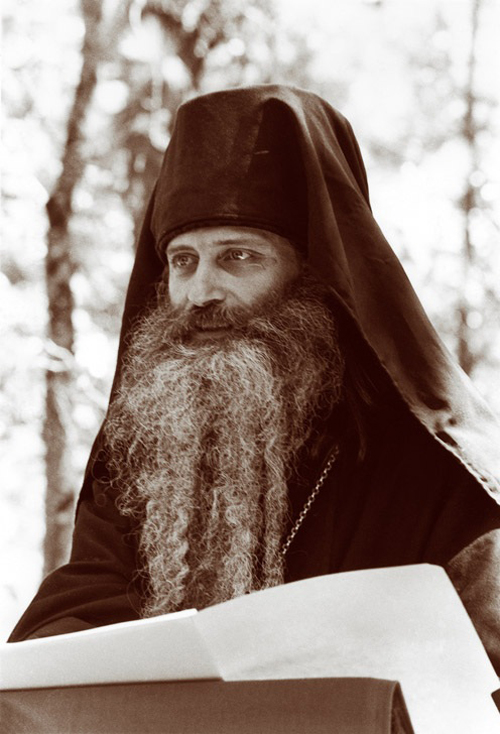
Sources
Audio recording
Orthodox America – Issue 134
Starting on the Royal Path
Transfiguration of Our Lord Parish Site
Signs of the Times by Fr. Seraphim Rose / The Orthodox Word, Vol. 34, Nos. 3-4 (200-201), May-August, 1998, pp. 133-155
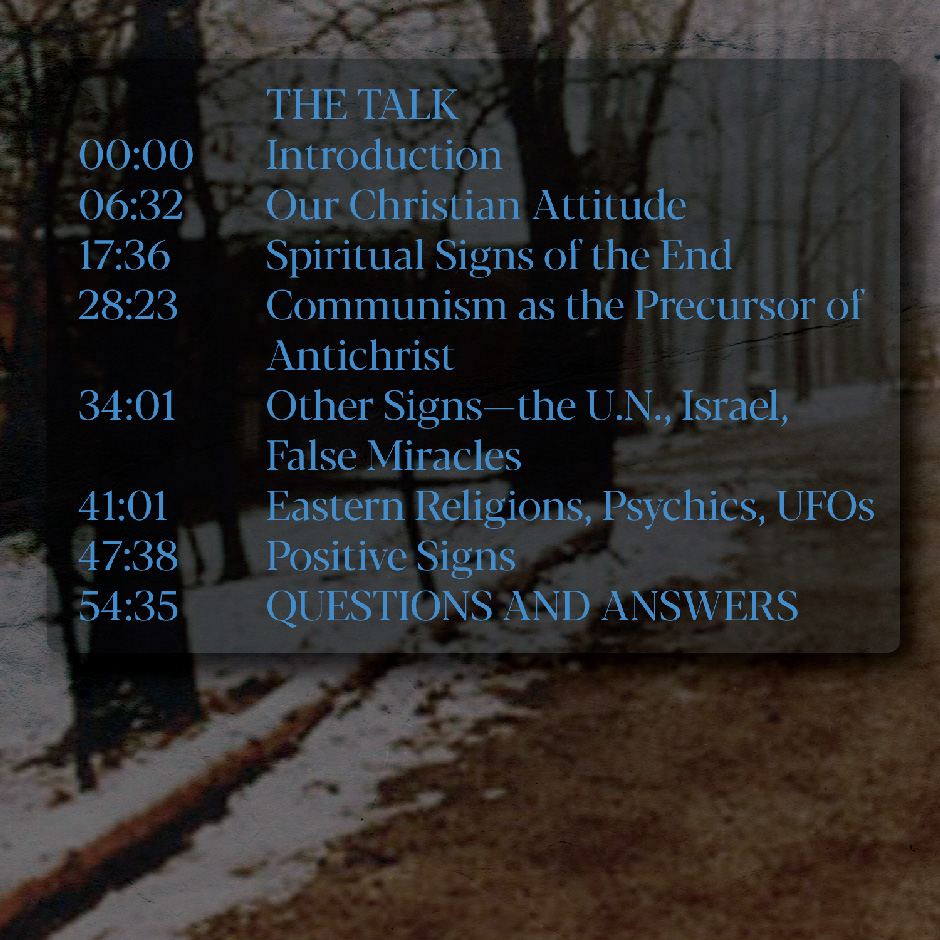

St. Seraphim of Platina – Contemporary Signs of the End of the World

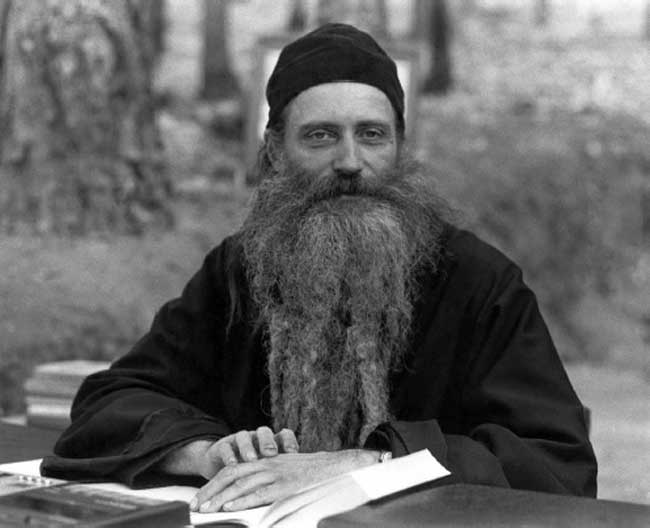


Pas de commentaire