
Chapter Four: The Creation of Man
1:26-27 Then God said Let us make man in our image, after our likeness, and let them have dominion over the fish of the sea, and over the birds of the air, and over the cattle, and over all the earth, and over every creeping thing that creeps upon the earth. So God created man in his own image, in the image of God He created him; male and female He created them.
We have seen that the creation of the Six Days is the work of the Holy Trinity, and in particular that the Father commands: “Let there be!” and the Son creates.
In the creation of man, however, a special consultation, as it were, is made between the Persons of the Trinity. Of this St. Basil says:
“Let us make man”… This word was not yet used for any of the organized beings; there was light, and the commandment was simple: “God said. Let there be light.” The heaven was made, and there was no deliberation for the heaven… Here, man is not yet, and there is a deliberation over man. God did not say, as for the other beings: “Let man be!” Recognize the dignity that belongs to you. He did not cause your origin by a commandment, but there was a consultation in God in order to know how to introduce into life this living being worthy of honor… Why did God not say, “Make,” but “Let us make man”? It is so that you might recognize the sovereignty. He desires that in bringing your attention on the Father, you would not deny the Son; He desires you to know that the Father has created by the Son and that the Son has created by the will of the Father, and that you should glorify the Father in the Son, and the Son in the Holy Spirit. . . (But) He did not say: “And they created,” so that you might not draw from this a pretext for polytheism [1].
Similarly, St. John Chrysostom says:
Why, when the heaven was created, was it not said: “Let us make,” but rather: Let there be heaven, let there be light, and so concerning each part of creation; but here only is there added: “Let us make,” by which is expressed counsel, deliberation, and communication with someone equal in honor? Who is it that is to be created that he is granted such honor? It is man—a great and wondrous living being, and for God more precious than all the creation… There was counsel, deliberation, and communication, not because God has need of counsel—may this not be!—but in order by the very means of expression to show us the dignity of what is created… And Who is it to Whom God says: “Let us make man”? It is the Wonderful Counselor, Mighty God, Prince of Peace, Father of the age to come [2], the Only-begotten Son of God Himself. To Him He says: “Let us make man in our image, after our likeness.” He did not say: “In mine and thine,” or “in mine and yours,” but “in our image,” indicating a single image and a single likeness [3].
St. Gregory the Theologian speaks very poetically about the creation of man as a mixture of the higher and lower worlds that God had already created. First:
He gave being to the world of thought [i.e., the world of intellectual beings, angels), as far as I can reason on these matters, and estimate great things in my own poor language. Then, when this first Creation was in good order, He conceives a second world, material and visible; and this a system of earth and sky and all that is in the midst of them; an admirable creation indeed when we look at the fair form of every part, but yet more worthy of admiration when we consider the harmony and unison of the whole, and how each part fits in with every other in fair order… This was to show that He could call into being not only a nature akin to Himself (i.e. the angelic, invisible world), but also one altogether alien to Him. For akin to Deity are those natures which are intellectual, and only to be comprehended by mind; but all of which sense can take cognizance are utterly alien to It; and of these the furthest removed from It are all those which are entirely destitute of soul and power of motion. Mind, then, and sense, thus distinguished from each other, had remained within their own boundaries, and bore in themselves the magnificence of the Creator-Word, silent praisers and thrilling heralds of His mighty work. Not yet was there any mingling of both, nor any mixture of these opposites, tokens of a greater wisdom and generosity in the creation of natures; nor as yet were the whole riches of goodness made known. Now the Creator-Word, determining to exhibit this, and to produce a single living being out of both (the invisible and the visible creation, I mean) fashions Man; and taking a body from already existing matter, and placing in it a Breath taken from Himself (which the Word knew to be an intelligent soul, and the image of God), as a sort of second world, great in littleness, He placed him on the earth, a new Angel, a mingled worshipper, fully initiated into the visible creation, but only partially into the intellectual; king of all upon earth, but subject to the King above; earthly and heavenly, temporal and yet immortal; visible and yet intellectual; half-way between greatness and lowliness; in one person combining spirit and flesh; spirit because of the favor bestowed on him, flesh on account of the height to which he had been raised; the one that he might continue to live and glorify his benefactor, the other that he might suffer, and by suffering be put in remembrance, and be corrected if he became proud in his greatness; a living creature, trained here and then moved elsewhere; and to complete the mystery, deified by its inclination to God [4].
What is this image of God? Different Holy Fathers have emphasized different aspects of the image of God in man: some have mentioned man’s dominion over the lower creation (which is mentioned specifically in the text of Genesis); others, his reason; still others, his freedom. St. Gregory of Nyssa sums up the meaning of the image of God most concisely:
He creates man for no other reason than that He is good; and being such, and having this as His reason for entering upon the creation of our nature, He would not exhibit the power of this goodness in an imperfect form, giving our nature some one of the things at His disposal, and grudging it a share in another: but the perfect form of goodness is here to be seen by His both bringing man into being from nothing, and folly supplying him with all good gifts. But since the list of individual good gifts is a long one, it is out of the question to apprehend it numerically. The language of Scripture therefore expresses it concisely by a comprehensive phrase, in saying that man was made “in the image of God”: for this is the same as to say that He made human nature participant in all good; for if the Deity is the fullness of good, and this is His image, then the image finds its resemblance to the Archetype in being filled with all good [5].
What is the difference between the “image” and the “likeness” of God in man? The Holy Fathers explain that the image is given to us in foil and cannot be lost; the likeness, however, was given in the beginning only potentially, and man himself was to work on attaining its perfection. St. Basil the Great teaches:
“Let us make man in our image, after our likeness.” We possess the one by creation, we acquire the other by free will. In the first structure it is given us to be born in the image of God; by free will there is formed in us the being in the likeness of God… “Let us make man in Our image”: Let him possess by creation what is in the image, but let him also become according to the likeness. God has given the power for this; if He had created you also in the likeness, where would your privilege be? Why have you been crowned? And if the Creator had given you everything, how would the kingdom of heaven have opened for you? But it is proper that one part is given you, while the other has been left incomplete: this is so that you might complete it yourself and might be worthy of the reward which comes from God [6].
In the very passage of Genesis which describes the creation of man, it is said that he was created “male and female.” Is this distinction, then, part of the image of God? St. Gregory of Nyssa explains that the Scripture refers here to a twofold creation of man:
That which was made “in the image” is one thing, and that which is now manifested in wretchedness is another. “God created man,” it says; “in the image of God created He him.” There is an end of the creation of that which was made “in the image”: then it makes a resumption of the account of creation, and says, “male and female created He them.” I presume that everyone knows that this is a departure from the Prototype: for “in Christ Jesus,” as the Apostle says, “there is neither male nor female.” Yet the phrase declares that man is thus divided. Thus the creation of our nature is in a sense twofold: one made like to God, one divided according to this distinction: for something like this the passage darkly conveys by its arrangement, where it first says, “God created man, in the image of God created He him,” and then, adding to what has been said, “male and female created He them,”—a thing which is alien from our conception of God. I think that by these words Holy Scripture conveys to us a great and lofty doctrine; and the doctrine is this. While two natures—the Divine and incorporeal nature, and the irrational life of brutes—are separated from each other as extremes, human nature is the mean between them (this is similar to the idea of St. Gregory the Theologian we have already quoted): for in the compound nature of man we may behold a part of each of the natures I have mentioned—of the Divine, the rational and intelligent element, which does not admit the distinction of male and female; of the irrational, our bodily form and structure, divided into male and female: for each of these elements is certainly to be found in all that partakes of human life. That the intellectual element, however, precedes the other, we learn as from one who gives in order an account of the making of man; and we learn also that his community and kindred with the irrational is for man a provision for reproduction… He Who brought all things into being and fashioned man as a whole by His own will to the Divine image… saw beforehand by His all-seeing power the failure of their will to keep a direct course to what is good, and its consequent declension from the angelic life, in order that the multitude of human souls might not be cut short by its fall… He formed for our nature that contrivance for increase which befits those who had fallen into sin, implanting in mankind, instead of the angelic majesty of nature, that animal and irrational mode by which they now succeed one another [7].[8]
Thus the image of God, which, as all the Holy Fathers teach, is to be found in the soul and not the body of man, has nothing to do with the division into male and female. In God’s idea of man, one might say—man as he will be in the Kingdom of Heaven—there is neither male nor female; but God, foreknowing man’s fall, made this division which is an inseparable part of man’s earthly existence.
However, the reality of sexual life did not come about before the fall of man. St. John Chrysostom, commenting on the passage, “Now Adam knew Eve his wife, and she conceived” [9]—which occurred after the fall—says:
After the disobedience, after the banishment from paradise, then it was that married life began. Before the disobedience, the first people lived like angels, and there was no talk of cohabitation. And how could this be, when they were free of bodily needs? Thus, in the beginning life was virginal; but when, because of the carelessness (of the first people) disobedience appeared and sin entered the world, virginity fled away from them, since they had become unworthy of such a great good, and in its place there entered into effect the law of married life [10].
And St. John Damascene writes:
Virginity was practiced in paradise. . . After the fall, . . . to keep the race from dwindling and being destroyed by death, marriage was devised, so that by the begetting of children the race of men might be preserved. But they may ask: What, then, does “male and female” mean, and “increase and multiply”? To which we shall reply that the “increase and multiply” does not mean increasing by the marriage union exclusively, because if they had kept the commandment unbroken forever, God could have increased the race by some other means. But, since God, Who knows all things before they come to be, saw by His foreknowledge how they were to fall and be condemned to death, He made provision beforehand by creating them male and female and commanding them to increase and multiply [11].
In this as in other respects, as we shall see later, man—like the rest of the creation—before the fall was in a state different from that after the fall, even though there is a continuity between these two states provided by God’s foreknowledge of the fall.
It should not be thought, however, that any of the Holy Fathers looked upon marriage as a “necessary evil” or denied that it is a state blessed by God. They regard it as a good thing in our present state of sin, but it is a good thing that is second to the higher state of virginity in which Adam and Eve lived before their fall, and which is shared even now by those who have followed the counsel of the Apostle Paul “to be even as I am” [12]. St. Gregory of Nyssa, the very Father who teaches so dearly the origin of marriage in our kinship with the beasts, also defends the institution of marriage in the dearest fashion. Thus, in his treatise “On Virginity,” he writes:
Let no one think that we depreciate marriage as an institution. We are well aware that it is not a stranger to God’s blessing. . . But our view of marriage is this: that, while the pursuit of heavenly things should be a man’s first care, yet if he can use the advantages of marriage with sobriety and moderation, he need not despise this way of serving the stare. . . Marriage is the last stage of our separation from the life that was led in Paradise; marriage is the first thing to be left; it is the first station, as it were, for our departure to Christ [13].
1:28 And God blessed them, and God said to them, Be fruitful and multiply, and fill the earth and subdue it; and have dominion over the fish of the sea and over the birds of the air and over every living thing that moves upon the earth.
“Be fruitful and multiply” are the very words already addressed by God to the creatures of the water[14] and indicate man’s kinship with the lower creation and, through his fall, with their mode of sexual generation. But there is also a deeper meaning to these words. St. Basil writes:
There are two kinds of increase: that of the body, and that of the soul. The increase of the soul is the development of knowledge with the aim of perfection; the increase of the body is the development from smallness to normal stature. To the animals deprived of reason He therefore said “increase” according to bodily development, in the sense of completing nature; but to us He said “increase” according to the interior Man, in the line of progress that leads to God. This is what Paul did, stretching out towards that which is ahead, forgetting that which he leaves behind [15]. Such is the increase in spiritual things… “Multiply”: This blessing concerns the Church. Let the Divine word not be limited to a single individual, but let the Gospel of salvation be preached throughout the earth. “Multiply”: to whom is this order addressed? —To those who give birth according to the Gospel… Thus, these words apply equally well to the animals deprived of reason, but they acquire a particular meaning when we have to do with the being who is in the image with which we have been honored [16].
Man is to “have dominion,” also, not only over the external creation, but also over the beast-like passions that lurk within him. St. Basil writes:
You have dominion over every kind of savage beast. But, you will say, do I have savage beasts within me? Yes, many of them. It is even an immense crowd of savage beasts that you carry within yourself. Do not take this as an insult. Is not anger a small wild beast when it barks in your heart? Is it not more savage than the first dog that comes? And is not the trickery that crouches in a treacherous soul more ferocious than the bear of the caverns?… What kind of savage beast do we not have within us?… You were created to have dominion; you are the master of the passions, the master of savage beasts, the master of serpents, the master of birds… Be master of the thoughts within you in order to become master of all beings. Thus, the power which was given us through living beings prepares us to exercise dominion over ourselves. [17]
The beast-like passions are within us owing to our kinship with the animal creation through our fall. St. Gregory of Nyssa writes:
As brute life first entered into the world, and man, for the reason already mentioned, took something of their nature (I mean the mode of generation), he accordingly took at the same time a share of the other attributes contemplated in that nature; for the likeness of man to God is not found in anger, nor is pleasure a mark of the superior nature; cowardice also, and boldness, and the desire of gain, and the dislike of loss, and all the like, are fir removed from that stamp which indicates Divinity. These attributes, then, human nature took to itself from the side of the brutes [18].
This is a very profound teaching. The people who believe in evolutionary ideas say, “Man comes from monkeys; therefore, you’re an animal-like creature.” There is something similar being said here: that we are a mingled creation, part heavenly, part earthly. In the earthly side, God made allowance for the animal-like mode of reproduction; and thus we see how animalistic we are when we let passions control us. We have these “animals” within ourselves, but we also have the heavenly side, to which we are striving to get back[19].
1:29-30 And God said. Behold I have given you every plant yielding seed which is upon the face of all the earth, and every tree with seed in its fruit; you shall have them for food And to every beast of the earth, and to every bird of the air, and to every thing that creeps on the earth, everything that has the breath of life, I have given every green plant for food And it was so.
Here we are told that in the beginning, when the earth and all its creatures were still new and man had not fallen, not only men, but even the beasts, were given only green plants for food; the beasts were not meant to be, and in the beginning were not, carnivorous. Of this St. Basil says:
Let the Church neglect nothing: everything is a law. God did not say: “I have given you the fishes for food, I have given you the cattle, the reptiles, the quadrupeds.” It is not for this that He created, says the Scripture. In fact, the first legislation allowed the use of fruits, for we were still judged worthy of paradise. What is the mystery which is concealed for you under this? To you, to the wild animals and the birds, says the Scripture, fruits, vegetation, and herbs (are given)… We see, however, many wild animals who do not eat fruits. What fruit does the panther accept to nourish itself? What fruit can the lion satisfy himself with? Nevertheless, these beings, submitting to the law of nature, were nourished by fruits. But when man changed his way of life and departed from the limit which had been assigned him, the Lord, after the flood, knowing that men were wasteful, allowed them the use of all foods: “Eat all that in the same way as edible plants” [20]. By this allowance, the other animals also received the liberty to eat them. Since then the lion is a carnivore, since then also vultures watch for carrion. For the vultures were not yet looking over the earth at the very moment when the animals were born; in fact, nothing of what had received designation or existence had yet died so that the vultures might eat them. Nature had not yet divided, for it was in all its freshness; hunters did not capture, for such was not yet the practice of men; the beasts, for their part, did not yet tear their prey, for they were not carnivores… But all followed the way of the swans, and all grazed on the grass of the meadow. . . Such was the first creation, and such will be the restoration after this. Man will return to his ancient constitution in rejecting malice, a life weighed down with cares, the slavery of the soul with regard to daily worries. When he has renounced all this, he will return to that paradisal life which was not enslaved to the passions of the flesh, which is free, the life of closeness to God, a partaker of the life of the angels [21].
This life of the original creation, it should be noted, is not the life of paradise, into which man has not yet been led; it is the life of the earth outside of paradise, which God has already blessed as man’s dwelling-place after his fall. St. Ephraim the Syrian writes of this:
God blessed our first ancestors on the earth, because, even before they sinned He prepared the earth for their dwelling; for, before they sinned, God knew that they would sin… He blessed (man) before settling him in paradise, on the earth, so that by the blessing, which was preceded by His goodness, He might weaken the power of the curse which soon struck the earth [22].
In the beginning, therefore, before man’s fall, the whole earth was like a kind of paradise. St. Symeon the New Theologian teaches:
God, in the beginning, before He planted Paradise and gave it over to the first-created ones, in five days set in order the earth and what is on it, and the heaven and what is in it. And on the sixth day He created Adam and placed him as lord and king of the whole visible creation. Then there was not yet paradise. But this world was from God as a kind of Paradise, although it was material and sensuous… God gave it over to the authority of Adam and all his descendants, as the divine Scripture says (Gen. 1:26-30)… God gave over to man at the beginning this whole world as a kind of Paradise… Adam was made with a body that was incorrupt, although material and not yet spiritual, and was placed by the Creator God as an immortal king over an incorrupt world, not only over Paradise, but also over the whole of creation which was under the heavens. . . This whole creation in the beginning was incorrupt and was created by God in the manner of Paradise. But later it was subjected by God to corruption, and submitted to the vanity of men [23].
1:31 And God saw everything that He had made, and behold, it was very good. And there was evening and there was morning, a sixth day.
The first chapter of Genesis is entirely devoted to the Six Days of Creation. In chapter two, the creation of man is described in more detail. One might say that chapter one describes the creation of humanity, both in the exalted sense as God’s image, and in its divided, earthly aspect as male and female; while in chapter two the specific creation of the first man Adam and the first woman Eve is set forth. Some of the other creations of the Six Days are also mentioned in chapter two, but not in the strict chronological order of the first chapter. We should keep this in mind to avoid the elementary mistakes of rationalist critics who find “contradictions” between these two chapters and suppose there must be different authors of them.
2:4-6 These are the generations of the heavens and of the earth when they were created in the day that the Lord God made the earth and the heavens, and every plant of the field before it was in the earth, and every herb of the field before it grew: for the Lord God had not caused it to rain upon the earth, and there was not a man to till the ground But there went up a mist from the earth, and watered the whole face of the ground.
This is a brief description of the state of the world before the appearance of man, emphasizing that without God there would have been nothing, that He brought everything into being out of nothing. St. John Chrysostom comments on this passage:
When (the Scripture) speaks of heaven and earth, it understands everything together that is in heaven and on earth. Therefore, just as in the account of the creatures (in chapter one) it does not speak about all of them in order, but having mentioned the most important, it does not relate to us about each one in detail—so also this whole book, although it contains in itself much else, it calls the book of “the generations of the heaven and of the earth,” allowing us to conclude from the mention of them that in this book is to be included every— thing visible that is in heaven and on earth… The Holy Spirit shows… what occurred first and what afterwards, and likewise the fact that the earth produced its seeds by the word and command of the Lord and began to give birth without needing either the cooperation of the sun, nor the moisture of rain, nor the tilling of man, who was not yet created… This (passage) means that what had not existed previously received existence, and what had not been appeared suddenly by His word and command… All this is so that we might know that the earth, for the germination of its seeds, had no need of the cooperation of other elements, but the command of the Creator was sufficient for it [24].
2:7 Then the Lord God formed man of dust from the ground, and breathed into his nostrils the breath of life; and man became a living being.
Here we are given as much as we can know of the how of man’s creation. There can be no doubt that the Holy Fathers understood by “dust” the literal dust of the earth; but when they speak of the “hands” of God which “took” this dust, they mean to emphasize the great cate of God and His direct action in this work. Blessed Theodoret[25] writes:
When we hear in the account of Moses that God took dust from the earth and formed man, and we seek out the meaning of this utterance, we discover in it the special good disposition of God towards the human race. For the great prophet notes, in his description of the creation, that God created all the other creatures by His word, while man He created with His own hands. . . We do not say that the Divinity has hands… but we affirm that every one of these expressions indicates a greater care on God’s part for man than for the other creatures [26].
St. Basil states that this verse emphasizes how different in his origin is man from the animals:
Above, the text says that God created; here it says how God created. If the verse had simply said that God created, you could have believed that He created [man] as He did for the beasts, for the wild animals, for the plants, for the grass. This is why, to avoid your placing him in the class of wild animals, the Divine word has made known the particular art which God has used for you: “God took of the dust of the earth”.[27]
The same Father tells of the difference between the “creation” of man and his “fashioning”:
God created the inward man, and fashioned the outward man. Fashioning is suited to the day, and creation to that which is in the image. Thus, the flesh was fashioned, but the soul was created [28]. The creation of man indicates both his greatness and his nothingness: “God took of the dust of the earth and fashioned man.” In this world I have discovered the two affirmations that man is nothing and that man is great. If you consider nature alone, he is nothing and has no value; but if you regard the honor with which he has been treated, man is something great… If you consider what it is that (God) took, what is man? But if you reflect on the One Who fashioned, what a great thing is man! Thus at the same time he is nothing because of the material, and great because of the honor [29].
In the usual interpretation of the Holy Fathers, what was “breathed” into man was his soul. St. John Chrysostom writes:
“And the Lord God formed man of the dust of the ground, and breathed into his nostrils the breath of life!” Moses used such a crude manner of speaking because he was speaking to people who could not listen to him otherwise, as we are able to do; and also to show us that it was pleasing to God’s love of mankind to make this thing created out of earth a participant of the rational nature of the soul, through which this living creature was manifest as excellent and perfect. “And He breathed into his nostrils (face?) the breath of life”: that is, the inbreathing communicated to the one created out of earth the power of life, and thus the nature of the soul was formed. Therefore Moses added: “And man became a living soul”; that which was created out of dust, having received the inbreathing, the breath of life, “became a living soul.” What does “a living soul” mean? An active soul, which has the members of the body as the implements of its activities, submissive to its will [30].
St. Seraphim of Sarov has a rather different interpretation of this passage of Scripture; in his “Conversation with Motovilov” he states that what was made from the dust of the earth was the entire human nature—body, soul, and spirit (“spirit” being the higher pan of the soul)—and that what was breathed into this nature was the grace of the Holy Spirit [31]. This is a different perspective on the creation of man (found in few other Fathers), and does not really contradict the usual interpretation that it was the soul that was breathed into man; those who hold the latter view also believe that man was created in the grace of God.
St. Gregory the Theologian speaks of the exalted nature of man, the highest part of whose nature comes not from earth but directly from God:
The soul is the breath of God, and while being heavenly, it endures being mixed with what is of the dust. It is a light enclosed in a cave, but still it is divine and inextinguishable… The Word spoke, and having taken a pan of the newly created earth, with His immortal hands formed my image and imparted to it His life; because He sent into it the Spirit, which is a ray of the invisible Divinity [32].
Such expressions, however, should not lead us to the false opinion that the soul itself is Divine, or a pan of God. St. John Chrysostom writes about this:
Certain senseless ones, being drawn away by their own conceptions, without thinking of anything in a God-befitting manner, and without paying any attention to the adaptation of the expressions (of Scripture), dare to say that the soul has proceeded from the Essence of God. O frenzy! O folly! How many paths of perdition has the devil opened up for those who will to serve him!… Thus, when you hear that God “breathed into his face the breath of life,” understand that, just as He brought forth the bodiless powers, so also He was pleased that the body of man, created out of dust, should have a rational soul which could make use of the bodily members [33].
There are those today who would like to use the order of man’s creation in this verse to “prove” that man “evolved” from lower beasts: that his body or earthly nature came first in time, and his soul or state of being in God’s grace came second. Such an interpretation is quite impossible if we accept the Patristic understanding of man’s creation.
To begin with, we have seen that in the Patristic view the “days” of creation—whatever their precise “length” may have been—were very short periods of time; that God’s work in each of the days was swift, indeed, instantaneous; that at the end of the Six Days the world was still “new” and not yet given over to corruption and death.
Secondly, the Holy Fathers themselves insist that the creation of man is not to be understood chronologically; it is rather an ontological description that tells the makeup of man, but not the chronological order in which it occurred. When St. John Chrysostom stares that “before” the inbreathing man was a “lifeless dummy” [34], or St. Seraphim states that he was not a “lifeless dummy” but a living and active human being—we must understand the word “before” in the ontological sense of “without.” But the creation of man itself—both body and soul, together with the grace in which man was made—was instantaneous. The Fathers found it necessary to set forth this teaching quite explicitly because in ancient times there were two opposed but equally false teachings on this subject: one, that of the Origenists who sated that souls “pre-existed” the creation of bodies and only entered their bodies as a “fall” from a higher state; and the other, that the body pre-existed the soul and was therefore of a nobler nature. St. John Damascene teaches:
From the earth He formed his body and by His own inbreathing gave him a rational and understanding soul, which last we say is the divine image. . . The body and the soul were formed at the same time—not one before and the other afterwards, as the ravings of Origen would have it [35].
And St. Gregory of Nyssa teaches in more detail (referring both to the original creation of man and the conception of individual men today), after refuting the opposite error of Origen:
Others, on the contrary, marking the order of the making of man as stated by Moses, say that the soul is second to the body in order of time, since God first took dust from the earth and formed man, and then animated the being thus formed by His breath: and by this argument they prove that the flesh is more noble than the soul, that which was previously formed than that which was afterwards infused into it… Nor again are we in our doctrine to begin by making up man like a clay figure, and to say that the soul came into being for the sake of this; for surely in that case the intellectual nature would be shown to be less precious than the clay figure. But as man is one, the being consisting of soul and body, we are to suppose that the beginning of his existence is one, common to both parts, so that he should not be found to be antecedent and posterior to himself, if the bodily element were first in point of time, and the other were a later addition… For as our nature is conceived as twofold, according to the apostolic teaching, made up of the visible man and the hidden man, if the one came first and the other supervened, the power of Him that made us will be shown to be in some way imperfect, as not being sufficient for the whole task at once, but dividing the work, and busying itself with each of the halves in turn [36].
The idea of the “evolution” of man from a lower animal cannot be harmonized with the Patristic and Scriptural view of man’s creation, but requires a sharp break with it: If man “evolves” solely according to the laws of nature, then his rational nature, his soul, the image of God, differs not qualitatively but only quantitatively from the beasts; he is then a creature only of the earth, and there is no room for the Patristic view that he is partly of earth and partly of heaven, a “mixture” of two worlds, to use the phrase of St. Gregory the Theologian. But if, to escape such earthly thinking, a Christian evolutionist admits a Divine creation of man’s soul—“when his body was ready for it, ‘as some say—then he not only parts company with scientific thinkers, who will not admit “Divine’ acts into their conceptual framework, but he also presents no consistent Christian outlook, mixing scientific speculations with ‘revealed’ knowledge in a most haphazard way. In the Patristic-Scriptural view, the entire Six Days of Creation is a series of Divine acts; in the uniformitarian scientific view, the origins of things (as far back as scientists think they can be traced) are nothing but natural processes. These two views are as opposed as any two views can be, and any mixture of the two must be purely arbitrary and fanciful.
Chapter Five: Paradise (Genesis 2:8-24)
2:8 And the Lord God planted a garden in Eden, in the east; and there he put the man whom He had formed.
In the garden (“paradise” in Greek) where Adam dwelt before his fall, we approach a subject that is subtle and mystical, and at the same time is a necessary key to understanding the whole of Christian teaching. This Paradise, as we shall see, is not merely something that existed before the fall; it exists even now and has been visited by some while still alive on this earth; and it is also (in a somewhat different form) the goal of our whole earthly life—the blessed state to which we are striving to return and which we shall enjoy in its fullness (if we are among the saved) at the end of this fallen world.
Our knowledge of Paradise, therefore, is in a sense fuller than our knowledge of the world of the Six Days of creation; but at the same time it is of a mystical nature that renders “precise” statements about it very difficult to make.
Let us see here what the Holy Fathers say about it.
St. Ambrose reminds us, in the first chapter of his treatise on “Paradise,” that we must be very careful in discussing the “place” of Paradise and its nature:
On approaching this subject I seem to be possessed by an unusual eagerness in my quest to clarify the facts about Paradise, its place, and its nature to those who are desirous of this knowledge. This is all the more remarkable since the Apostle did not know whether he was in the body or out of the body, yet he says that he “was caught up to the third heaven”. And again he says: “I know such a man—whether in the body or out of the body I do not know, God knows—that he was caught up into paradise and heard secret words that man may not repeat” [37]…. If Paradise, then, is of such a nature that Paul alone, or one like Paul, could scarcely see it while alive, and still was unable to remember whether he saw it in the body or out of the body, and moreover, heard words that he was forbidden to reveal—if this be true, how will it be possible for us to declare the position of Paradise which we have not been able to see and, even if we had succeeded in seeing it, we would be forbidden to share this information with others? And, again, since Paul shrank from exalting himself by reason of the sublimity of the revelation, how much more ought we to strive not to be too anxious to disclose that which leads to danger by its very revelation! The subject of Paradise should not, therefore, be treated lightly [38].
Nevertheless, despite the difficulty of speaking about it, there are certain things we can know about Paradise, as interpreted by the Holy Fathers.
First of all, it is not merely a spiritual phenomenon which may be beheld now in vision as the Apostle Paul beheld it (of which more below); it is also a part of the history of the earth. The Scripture and Holy Fathers teach that in the beginning, before the fall of man, Paradise was right here on earth. St. Ambrose writes:
Take note that God placed man (in Paradise) not in respect to the image of God, but in respect to the body of man. The incorporeal does not exist in a place. He placed man in Paradise, just as He placed the sun in heaven [39].
Likewise, St. John Chrysostom teaches:
Blessed Moses registered even the name of this place (Eden), so that those who love to speak empty words could not deceive simple listeners and say that Paradise was not on earth but in heaven, and rave with similar mythologies…. As you hear that “God planted a garden eastward in Eden,” the word “plant” understand of God in a God-befitting way, that is, that He commanded; but regarding the following words, believe that Paradise precisely was created and in the very place where the Scripture has assigned it…. And the word “plant” let us understand as if it had been said: He commanded man to live there, so that his view of Paradise and his stay there might furnish him a great satisfaction and might arouse him to a feeling of gratitude [40].
2:9 And out of the ground the Lord God made to grow every tree that is pleasant to the sight and good for food, the tree of life also in the midst of the garden, and the tree of the knowledge of good and evil.
The connection of Paradise with the earth is understood by St. Ephraim in such a literal way that he specifies, in his Commentary on Genesis, that as a place of trees it was created on the Third Day with the rest of the vegetable creation [41].
But what connection can there be between this earthly Paradise with its growing trees, and the obviously spiritual Paradise that St. Paul beheld? We may see an answer to this question in the description of Paradise by a Holy Father of the highest spiritual life, St. Gregory the Sinaite, who visited Paradise in the same state of divine vision as St. Paul:
Eden is a place in which there was planted by God every kind of fragrant plant. It is neither completely incorruptible, nor entirely corruptible. Placed between corruption and incorruption, it is always both abundant in fruits and blossoming with flowers, both mature and immature. The mature trees and fruits are converted into fragrant earth which does not give off any odor of corruption, as do the trees of this world. This is from the abundance of the grace of sanctification which is constantly poured forth there [42].
A number of cases are known in the Lives of saints and righteous people of literal fruits being brought back by those who have been lifted up to Paradise—for example, the apples which St. Euphrosynus the Cook brought back and which were eaten by the pious as some holy thing with a nature quite different from that of ordinary earthly fruits [43].
Therefore, Paradise, while originally a reality of this earth, akin to the nature of the world before the fall of man, is of a “material” which is different from the material of the world we know today, placed between corruption and incorruption. This exactly corresponds to the nature of man before his fall— for the “coats of skins” which he put on when banished from Paradise (as we shall see) symbolically indicate the cruder flesh which he then put on. From that time on, in his cruder state, man is no longer capable of even seeing Paradise unless his spiritual eyes are opened and he is “raised up” like St. Paul. The present “location” of Paradise, which has remained unchanged in its nature, is in this higher realm, which also seems to correspond to a literal “elevation” from the earth; indeed, some Holy Fathers state that even before the fall Paradise was in an elevated place, being “higher than all the rest of the earth”. [44]
Concerning the two trees—one of life and one of the knowledge of good and evil—we shall speak later.
2:10-14 A river flowed out of Eden to water the garden, and there it divided and became four rivers. The name of the first is Pishon; it is the one which flows around the whole land of Havilah, where there is gold; and the gold of that land is good; bellium and onyxstone are there. The name of the second river is Gilion; it is the one which flows around the whole land of Cush (Sept.: “Ethiopia”). And the name of the third river is Tigris, which flows east of Assyria. And the fourth river is the Euphrates.
This passage emphasizes that Paradise before the fall was located in a definite place on earth. The Fathers forbid merely allegorical interpretations of these four rivers. Thus, St. John Chrysostom says:
Perhaps those who love to speak from their own wisdom here also will not allow that the rivers are actually rivers or the waters precisely waters, but will instill in those who decide to listen to them that they (under the name of rivers and waters) represented something else. But I beg you, let us not pay attention to these people, let us close our hearing against them, and let us believe the Divine Scripture [45].
These four rivers are generally understood by the Fathers to be the Tigris, Euphrates, Nile and Danube (or, according to others, the Ganges); the area of the earthly Paradise, therefore, is in the cradle of ancient civilization. St. John Chrysostom says of this passage (in another treatise):
From this know that Paradise was not a small garden which had an insignificant area. It is watered by such a river that from its fullness come out four rivers [46].
It would be fruitless to speculate how the one river of Paradise divided into four rivers which, as we know them today, have four distinct sources. The world of today is so different from the world before the fall, and even before the flood in Noah’s time, that such geographical questions are not to be traced out.
What is more difficult for our modern mentality, formed by literalistic science, to puzzle out is how the Fathers can speak without distinguishing between Paradise as a geographical location (before the fall), and Paradise as a spiritual habitation of the righteous (at the present time). Thus, St. John Chrysostom, in the same treatise just quoted, speaks of the one river of Paradise being so abundant because it was prepared also for the later Patriarchs, Prophets, and other saints (beginning with the thief on the Cross[47]) who are to inhabit it[48]. Evidently our modern ideas have become too dualistic: we divide things too easily into “spirit vs. matter,” whereas the reality of Paradise partakes of both.
2:15 The Lord God took the man and put him in the garden of Eden to till and keep it.
In this passage, as interpreted by the Fathers, we may see something of the spiritual occupation of Adam in Paradise. Before the fall there was no need for a physical tilling or cultivation of Paradise; this refers to Adam’s spiritual state. St. John Chrysostom writes [49]:
“To till.” What was lacking in Paradise? And even if a tiller was needed, where was the plow? Where were the other implements of agriculture? The “tilling” (or “working”) of God consisted in tilling and keeping the commandments of God, remaining faithful to the commandment…. Just as to believe in God is the work of God [50], so also it was a work to believe the commandment that if he touched (the forbidden tree) he would die, and if he did not touch it, he would live. The work was the keeping of the spiritual words…. “To till and to keep it,” it is said. To keep it from whom? There were no thieves, no passersby, no one of evil intent. To keep from whom? To keep it for oneself; not to lose it by transgressing the commandment; to keep Paradise for oneself, observing the commandment [51].
St. Gregory the Theologian opens up a deeper understanding of this “work” of Paradise:
This being He placed in Paradise… to till the immortal plants, by which is perhaps meant the Divine conceptions, both the simpler and the more perfect [52].
And, in general, the ascetic Fathers refer the “tilling” and “keeping” to the spiritual work of prayer. Thus, St. Nilus of Sora, commenting on this interpretation by the ancient Father, St. Nilus of Sinai, writes:
Now this Saint brings forth from antiquity that one should till and keep; for the Scripture says that God created Adam and placed him in Paradise to till and keep Paradise. For here this St. Nilus of Sinai calls prayer the tilling of Paradise, and the guarding against evil thoughts after prayer he calls keeping.
And Blessed Paisius Velichkovsky, commenting in his turn on these two Holy Fathers, writes:
From these testimonies it is clear that God, having created man according to His image and likeness, conducted him into a Paradise of sweetness to till the immortal gardens, that is, the most pure, exalted, and perfect Divine thoughts, according to St. Gregory the Theologian. And this means nothing else than that he remained, as being pure in soul and heart, in contemplative, grace-filled prayer, sacredly working in the mind alone, that is, in the sweetest vision of God, and that he manfully preserved this, it being the work of Paradise, as the apple of his eye, lest it ever decrease in his soul and heart. Wherefore, great is the glory of sacred and Divine mental prayer, whose verge and summit, that is, beginning and perfection, were given to man by God in Paradise, and so it is from there that it has its beginning [53].
2:16-17 And the Lord God commanded the man, saying, You may freely eat of every tree of the garden, but of the tree of the knowledge of good and evil you shall not eat, for in the day that you eat of it you shall die.
If one is tempted to find allegory in the account of creation and Paradise, nowhere is the temptation stronger than with regard to the two trees: one of “life” and one of “the knowledge of good and evil.” Yet the whole “realism” of the Patristic interpretation of Genesis, as well as the fact that Paradise was (and is) indeed a “garden” with material (or semi-material) trees, point to the fact that these trees were actually trees; and, as we have already seen, this very fact is emphasized by St. Gregory Palamas, speaking for St. Gregory the Theologian and other Fathers.
The account of the temptation in Paradise, therefore, is not an allegory—a spiritual lesson clothed in the tale of a garden—but an historical account of what actually happened to our first ancestors. What happened, of course, was primarily a spiritual event, just as Adam’s dwelling in Paradise was primarily a spiritual dwelling (as we shall see more clearly below); but the way in which this spiritual event occurred was indeed through the tasting of the fruit of a “forbidden tree.”
St. John Damascene well describes the double aspect, material and immaterial, of Adam’s dwelling in Paradise:
Some have imagined Paradise to have been material, while others have imagined it to have been spiritual. However, it seems to me that, just as man was created both sensitive and intellectual, so did this most sacred domain of his have the twofold aspect of being perceptible both to the senses and to the mind. For, while in his body he dwelt in this most sacred and superbly beautiful place, as we have related, spiritually he resided in a loftier and far more beautiful place. There he had the indwelling God as a dwelling place and wore Him as a glorious garment. He was wrapped about with His grace, and, like some one of the angels, he rejoiced in the enjoyment of that one most sweet fruit which is the contemplation of God, and by this he was nourished. Now, this is indeed what is fittingly called the tree of life, for the sweetness of divine contemplation communicates a life uninterrupted by death to them that partake of it [54].
Again, St. Damascene says that Adam in Paradise,
while in his body he lived on earth in the world of sense, in his spirit he dwelt among the angels, cultivating thoughts of God and being nurtured on these. He was naked because of his innocence and his simplicity of life, and through creatures he was drawn up to their only Creator, in Whose contemplation he rejoiced and took delight [55].
The purpose of man’s dwelling in Paradise and eating of “every tree” was obviously not merely to be satisfied with the delights of this marvellous place, but to look and strive towards something higher; the very presence of the tree of the knowledge of good and evil, and of the commandment not to eat of it, indicates a challenge and a test which man must pass through before ascending higher. St. Damascene thus sets forth the ascension to perfection which was set forth before Adam in Paradise:
God says: “Of every tree of Paradise thou shalt eat,” meaning, I think: By means of all created things be thou drawn up to Me, their Creator, and from them reap the one fruit which is Myself, Who am the true Life; let all things be fruitful life to thee and make participation in Me to be the substance of thy own existence; for thus thou shalt be immortal…. He made him a living being to be governed here according to this present life, and then to be removed elsewhere, that is, to the world to come, and so to complete the mystery by becoming divine through reversion to God—this, however, not by being trans- formed into the Divine substance, but by participation in the Divine illumination [56].
Thus Paradise—and indeed the whole earthly life of man—was made by God, in the phrase of St. Basil, “primarily as a place of training and a school for the souls of men” [57]. Man was given in the beginning a path of ascent from glory to glory, from Paradise to the status of a spiritual dweller of heaven, through the training and testing which God might send him, beginning with the commandment not to taste of the one tree of the knowledge of good and evil. Man was placed in Paradise as in a state between that of heaven, where only the purely spiritual may dwell, and the corruptible earth—which came about, as we shall see, because of his fall.
What, then, was the tree of the knowledge of good and evil, and why was it forbidden to Adam? In the classical interpretation of St. Gregory the Theologian, God gave Adam in Paradise:
a Law, as a material for his free will to act upon. This law was a commandment as to what plants he might partake of, and which one he might not touch. This latter was the Tree of Knowledge; not, however, because it was evil from the beginning when planted; nor was it forbidden because God grudged it to us—let not the enemies of God wag their tongues in that direction, or imitate the serpent. But it would have been good if partaken of at the proper time; for the tree was, according to my theory, Contemplation, which it is only safe for those who have reached maturity of habit to enter upon, but which is not good for those who are still somewhat simple and greedy; just as neither is solid food good for those who are yet tender and have need of milk [58].
And St. John Damascene writes:
The tree of knowledge of good and evil is the power of discernment by multiple vision, and this is the complete knowing of one’s own nature. Of itself it manifests the magnificence of the Creator and it is good for them that are full-grown and have walked in the contemplation of God—for them that have no fear of changing, because in the course of time they have acquired a certain habit of such contemplation. It is not good, however, for such as are still young and are more greedy in their appetites, who, because of the uncertainty of their perseverance in the true good and because of their not yet being solidly established in their application to the only good, are naturally inclined to be drawn away and distracted by their solicitude for their own bodies [59].
To sum up the Orthodox teaching on the two trees of Paradise, St. John Chrysostom writes:
The tree of life was in the midst of Paradise as a reward; the tree of knowledge as an object of contest and struggle. Having kept the commandment regarding this tree, you will receive a reward. And behold the wondrous thing. Everywhere in Paradise every kind of tree blossoms, everywhere they are abundant in fruit; only in the center are there two trees as an object of battle and exercise [60].
2:18-20 And the Lord God said, It is not good that the man should be alone; I will make a help meet for him. And out of the ground the Lord God formed every beast of the field, and every fowl of the air; and brought them unto Adam to see what he would call them: and whatsoever Adam called every living creature, that was the name thereof. And Adam gave names to all cattle, and to the fowl of the air, and to every beast of the field but for Adam there was not found a help meet for him.
In this passage, again, we should not look for the “contradiction” some rationalist scholars think they have found, as though the text describes the creation of the animals after the creation of man, contradicting the order of creation in the first chapter. The subject of this passage is the naming of the animals by Adam, and only incidentally does the text mention that these animals had already been created by God, and that they were not the “help meet” for Adam, which could only be someone of the same nature as he (woman, as mentioned in the next passage).
The animals are “brought” to Adam because their place is not in Paradise but in the earth outside; Paradise is meant for the dwelling of man alone—a pre-indication that man alone of all earthly creatures is meant for the heavenly kingdom to which he can ascend from Paradise through keeping the commandments of God. St. John Damascene writes that Paradise:
Was a divine place and a worthy habitation for God in His image. And in it no brute beasts dwelt, but only man, the handiwork of God [61].
And St. John Chrysostom teaches:
Adam was given the whole earth, but his chosen dwelling was Paradise. He could also go outside of Paradise, but the earth outside of Paradise was assigned for the habitation not of man, but of the irrational animals, the quadrupeds, the wild beasts, the crawling things. The royal and ruling dwelling for man was Paradise. This is why God brought the animals to Adam—because they were separated from him. Slaves do not always stand before their lord, but only when there is need for them. The animals were named and immediately sent away from Paradise; Adam alone remained in Paradise [62].
The Holy Fathers interpret the naming of the animals by Adam quite literally, and see in it an indication of man’s dominion over them, his undisturbed harmony with them, and a wisdom and intellect in the first man which far surpasses anything since known to man. St. Ephraim writes of this:
The words “He brought them to Adam” shows the wisdom of Adam, and the peace which existed between the animals and man before man transgressed the commandment. For they came together before man as before a shepherd filled with love; without fear, according to kinds and types, they passed before him in flocks, neither fearing him nor trembling before each other…. It is not impossible for a man to discover a few names and keep them in his memory. But it surpasses the power of human nature, and is difficult for him, to discover in a single hour thousands of names and not to give the last of those named the names of the first…. This is the work of God, and if it was done by man, it was given him by God [63].
St. John Chrysostom writes:
God does this in order to show us the great wisdom of Adam…and also so that in the giving of names might be seen a sign of dominion…. Just think what wisdom was needed to give names to so many kinds of birds, reptiles, wild and domestic animals, and other irrational creatures…to give them all names, and names belonging to them and corresponding to each kind…. Just think of how the lions and leopards, vipers and scorpions and serpents and all the other even more ferocious animals came to Adam as to a lord, with all submission, in order to receive names from him, and Adam did not fear a single one of these wild beasts…. The names which Adam gave them remain until now: God confirmed them so that we might constantly remember the honor which man received from the Lord of all when he received the animals under his authority, and might ascribe the reason for the removal (of this honor) to man himself, who lost his authority through sin [64].
Because man possesses in himself something of the animal nature, as we have seen, and this animal nature became dominant in him because of his fall, Adam’s naming of the animals also indicates the original dominance of man’s mind over this lower, passionate nature. St. Ambrose writes:
The beasts of the field and the birds of the air which were brought to Adam are our irrational senses, because beasts and animals represent the diverse passions of the body, whether of the more violent kind or even of the more temperate…. God granted to you the power of being able to discern by the application of sober logic the species of each and every object, in order that you may be induced to form a judgment on all of them. God called them all to your attention, so that you might realize that your mind is superior to all of them [65].
2:21-22 So the Lord God caused a deep sleep to fall upon the man, and while he slept took one of his ribs and closed up its place with flesh; and the rib which the Lord God had taken from the man he made into a woman and brought her to the man.
Perhaps no passage of Genesis is more a touchstone of our interpretation of the whole book than this brief passage of the creation of Eve from Adam’s rib. If we understand it “as it is written,” as the Holy Fathers did, we will have no difficulty understanding the rest of the book in the same way. But if we have difficulty understanding it in this simple way—and our modern minds almost instinctively rebel against this simple interpretation—we will undoubtedly find much else in Genesis that we have difficulty understanding as the Fathers did.
This passage is also a stumbling block for those who wish to promote the evolutionist view of the origin of life and of mankind. In this view, man (at least in his body) is a descendent of lower animals; the “father” of the first man, therefore, must have been a non-human creature closely related to the higher apes. The whole point of this evolutionary view is that man and every living being developed from more primitive organisms by natural laws now known (or hypothesized) by science; to accept the evolution of the first man from lower animals, and then provide a wife for him by the miracle of taking one of his ribs—is surely something no evolutionist could agree to. If Adam “evolved naturally” from the beasts, then Eve must have done the same; but if you accept the miraculous account of Eve’s creation as described in Genesis, you open yourself by this very fact to understand the entire Six Days of creation in the Patristic, and not the naturalistic, way.
What do the Holy Fathers say of the creation of Eve? St. Ambrose writes:
Woman was made out of the rib of Adam. She was not made of the same earth with which he was formed, in order that we might realize that the physical nature of both man and woman is identical and that there was one source for the propagation of the human race. For that reason, neither was man created together with a woman, nor were two men and two women created at the beginning, but first a man and after that a woman. God willed it that human nature be established as one. Thus, from the very inception of the human stock He eliminated the possibility that many disparate natures should arise…. Reflect on the fact that He did not take a part from Adam’s soul but a rib from his body, that is to say, not soul from a soul, but “bone of my bone and flesh of my flesh” will this woman be called [66].
St. Cyril of Jerusalem, trying to make beginning Christians understand the virgin birth of Christ, writes:
Of whom in the beginning was Eve begotten? What mother conceived her the motherless? But the Scripture saith that she was born out of Adam’s side. Is Eve then born out of man’s side without a mother, and is a child not to be born without a father, of a virgin’s womb? This debt of gratitude was due to men from womankind: for Eve was begotten of Adam, and not conceived of a mother, but as it were brought forth of man alone [67].
(We shall see later how the Church sees the parallel between Eve and the Virgin Mary, and between the miracles of the first creation and the miracles of the re-creation through Christ.)
St. John Chrysostom, while warning us that the word “took” must be understood in a way befitting God, Who has no “hands,” clearly indicates his literal interpretation of this passage:
Great are these words; they surpass every mind of man: their greatness can be understood in no other way than by beholding them with the eyes of faith…. “God caused a deep sleep to fall upon Adam, and he slept.” This was not a simple ecstasy and not a usual sleep; but since the most wise and skilled Creator of our nature wished to take from Adam one of his ribs, therefore, so that he might not feel the pain and then be hostilely disposed to the one created from his rib, lest, remembering the pain, he hate the created being, God plunged Adam into a deep sleep and, as it were commanding him to be embraced by a kind of numbness, brought upon him such a sleep that he did not feel in the least what happened…. Taking a certain small part from an already prepared creation, from this part he made a whole living being. What power does the Highest Artist, God, have to produce from this small part the composition of so many members, to arrange so many organs of sense and form a whole, perfect and complete being which could converse and, because of its oneness of nature, furnish the man great consolation! [68]
In another treatise the same Father writes:
How did Adam not feel pain? How did he not suffer? One hair is torn out of the body, and we experience pain, and even if one is immersed in a deep sleep he wakes up from the pain. Moreover, such a large member is taken out, a rib is torn out, and the sleeping one does not wake up? God removed the rib not violently, lest Adam wake up; He did not tear it out. The Scripture, desiring to show the speed of the Creator’s act, says: “He took.” [69]
And St. Ephraim writes:
The man who up to now had been awake and was enjoying the shining of the light and had not known what rest was, is now stretched out naked on the earth and given over to sleep. Probably, Adam saw in sleep the very thing that was happening to him. When in the twinkling of an eye the rib was taken out, and likewise in an instant flesh took its place, and the bared bone took on the full appearance and all the beauty of a woman—then God brought and presented her to Adam [70].
All this took place on the very day of man’s creation, the Sixth Day. To our limited minds the creation of man and woman is just as inconceivable, as miraculous, as “spectacular” as all the other creations of God when they were made in the beginning.
2:23-24 And Adam said, This is now bone of my bone and flesh of my flesh; she shall be called Woman, because she was taken out of Man. Therefore shall a man leave his father and mother, and shall cleave unto his wife; and they shall be one flesh.
Here Adam names the first woman even as he had just named the animals, indicating at the same time her oneness in nature with him, owing to her literal origin from his body, and the institution of marriage, since in prophecy he foresaw that the marriage union would be necessary because of the fall.
Commenting on this passage, St. Ephraim writes:
“This now”: that is, the one who has come to me after the animals is not such as they; they came from the earth, but she is “bone of my bone and flesh of my flesh.” Adam said this either in a prophetic way or, as noted above, according to his vision in sleep. And just as on this day all the animals received from Adam their names according to their kinds, so also the bone, made into a woman, he called not by her proper name, Eve, but by the name of woman, the name belonging to the whole kind [71].
St. John Chrysostom says of the same passage:
How did it come to his mind to say this? How did he know the future, and the fact that the human race would multiply? How did it become known to him that there would be intercourse between man and wife? After all, this occurred after the fall; but before that they lived in Paradise like angels, were not aroused by the flesh, were not inflamed by other passions either, were not weighed down by bodily needs, but being created entirely incorrupt and immortal, did not even need the covering of clothing…. And so, tell me, from whence did the idea come for him to say this? Is it not clear that, since before the transgression he was a participant of the grace of prophecy, he saw all this with his spiritual eyes [72]?
2:25 And the man and his wife were both naked, and were not ashamed.
Adam and Eve were created, like the whole of the first creation, in the bloom of youth and beauty, and already possessing the sexual distinction that would be needed in their fallen states, yet there was no desire, no passionate thought between them. This, in the view of the Fathers, is the clearest indication of their dispassionateness before the fall, and of the fact that their minds were directed first of all to the glory of the heavenly world above. St. Ephraim writes:
They were not ashamed because they were clothed with glory [73].
St. John Chrysostom teaches the same thing:
Before sin and disobedience occurred, they were clothed in the glory on high, and were not ashamed; but after the violation of the commandment there came both shame and the awareness of their nakedness [74].
God wanted us to be dispassionate like that, for that is passionlessness to the highest degree [75].
Let us now sum up the state of Adam in Paradise in the words of a recent Father, St. Seraphim of Sarov:
Adam was immune to the action of the elements to such a degree that water could not drown him, fire could not burn him, the earth could not swallow him in its abysses, and the air could not harm him by any kind of action whatever. Everything was subject to him as the beloved of God, as the king and lord of creation, and everything looked up to him, as the perfect crown of God’s creatures. Adam was made so wise by this breath of life which was breathed into his face from the creative lips of God, the Creator and Ruler of all, that there never has been a man on earth wiser or more intelligent than he, and it is hardly likely that there ever will be. When the Lord commanded him to give names to all the creatures, he gave every creature a name which completely expressed all the qualities, powers and properties given it by God at its creation. Owing to this very gift of the supernatural grace of God which was infused into him by the breath of life, Adam could see and understand the Lord walking in Paradise, and comprehend His words, and the conversation of the holy Angels, and the language of all beasts, birds, and reptiles and all that is now hidden from us fallen and sinful creatures, but was so clear to Adam before his fall. To Eve also the Lord God gave the same wisdom, strength and unlimited power, and all the other good and holy qualities [76].
To some extent man even today can return to something of this paradisal state through the grace of God, as may be seen in the lives of many saints, which abound in miracles unbelievable to worldly men. The Life of St. George, for example (April 23), who was preserved unharmed in the midst of the cruellest tortures and even deaths, reminds us of Adam’s invulnerability in Paradise.
Still, however, in his fallen state man can attain to no more than a glimpse of the state of Adam; only in the age to come will this Paradise be restored to us in its fullness, and then (if only we be among the saved) we will see what an angelic state it is (and was). St. Gregory of Nyssa writes:
The resurrection promises us nothing else than the restoration of the fallen to their ancient state; for the grace we look for is a certain return to the first life, bringing back again to Paradise him who was cast out from it. If then, the life of those restored is closely related to that of the angels, it is clear that the life before the transgression was a kind of angelic life, and hence also our return to the ancient condition of life is compared to the angels [77].
In Orthodox ascetic literature, where the aim constantly kept in view is our restoration to Paradise, the unspoiled and dispassionate nature of Adam before the fall is held up as the model and goal of our ascetic struggle. St. Abba Dorotheus writes, in the very first words of his Spiritual Instructions:
In the beginning, when God created man, He placed him in Paradise and adorned him with every virtue, giving him the commandment not to taste of the tree which was in the midst of Paradise. And thus he remained there in the enjoyment of Paradise: in prayer, in vision, in every glory and honor, having sound senses and being in the same natural condition in which he was created. For God created man according to His own image, that is, immortal, master of himself, and adorned with every virtue. But when he transgressed the commandment, eating the fruit of the tree of which God had commanded him not to taste, then he was banished from Paradise, fell away from the natural condition, and fell into a condition against nature, and then he remained in sin, in love of glory, in love for the enjoyments of this age, and of other passions, and he was mastered by them, for he became their slave through the transgression [78].
The awareness that Adam’s state in Paradise was the natural human condition, and the one to which we may hope to return by God’s grace, is one of the greatest spurs to ascetic struggle. This awareness is thus of the most practical benefit to Orthodox Christians who hope to inherit God’s Kingdom. With the fall of man, Paradise ceased to be a reality of this earth and was placed out of our reach; but through the grace of God made available to Christians through the second Adam, Christ, we may still hope to attain it.
[1] St. Basil, On the Origin of Man, 1, 3–4, pp. 171-5
[2] The people that walked in darkness have seen a great light: they that dwell in the land of the shadow of death, upon them hath the light shined. Thou hast multiplied the nation, and not increased the joy: they joy before thee according to the joy in harvest, and as men rejoice when they divide the spoil. For thou hast broken the yoke of his burden, and the staff of his shoulder, the rod of his oppressor, as in the day of Midian. For every battle of the warrior is with confused noise, and garments rolled in blood; but this shall be with burning and fuel of fire. For unto us a child is born, unto us a son is given: and the government shall be upon his shoulder: and his name shall be called Wonderful, Counsellor, The mighty God, The everlasting Father, The Prince of Peace. Of the increase of his government and peace there shall be no end, upon the throne of David, and upon his kingdom, to order it, and to establish it with judgment and with justice from henceforth even for ever. The zeal of the LORD of hosts will perform this. The Lord sent a word into Jacob, and it hath lighted upon Israel. Isaiah 9 2-8
[3] Homily II, 1–2, pp. 735-7
[4] Second Oration on Easter, chs. 6–7, pp. 424-5
[5] On the Making of Man, 16:10, p. 405
[6] On the Origin of Man, I, 16-17, pp. 207–211
[7] On the Making of Man, chs. 16, 17, pp. 405, 407
[8] That is, the whole sexual function [in man] is seen to be taken from the animal creation. It was not meant to be that way in the beginning.
[9] And Adam knew Eve his wife; and she conceived, and bare Cain, and said, I have gotten a man from the LORD. And she again bare his brother Abel. And Abel was a keeper of sheep, but Cain was a tiller of the ground. And in process of time it came to pass, that Cain brought of the fruit of the ground an offering unto the LORD. Genesis 4 1-3
[10] Homily XVIII, 4, pp. 160–161
[11] Orthodox Faith, IV,24, p. 394
[12] The wife hath not power of her own body, but the husband: and likewise also the husband hath not power of his own body, but the wife. Defraud ye not one the other, except it be with consent for a time, that ye may give yourselves to fasting and prayer; and come together again, that Satan tempt you not for your incontinency. But I speak this by permission, and not of commandment. For I would that all men were even as I myself. But every man hath his proper gift of God, one after this manner, and another after that. I say therefore to the unmarried and widows, It is good for them if they abide even as I. But if they cannot contain, let them marry: for it is better to marry than to burn. And unto the married I command, yet not I, but the Lord, Let not the wife depart from her husband: But and if she depart, let her remain unmarried, or be reconciled to her husband: and let not the husband put away his wife. 1 Corinthians 7 4-11
[13] On Virginity, chs. 8, 12, pp. 352–3, 358
[14] And God said, Let the waters bring forth abundantly the moving creature that hath life, and fowl that may fly above the earth in the open firmament of heaven. And God created great whales, and every living creature that moveth, which the waters brought forth abundantly, after their kind, and every winged fowl after his kind: and God saw that it was good. And God blessed them, saying, Be fruitful, and multiply, and fill the waters in the seas, and let fowl multiply in the earth. And the evening and the morning were the fifth day. Genesis 1 20-23
[15] Not as though I had already attained, either were already perfect: but I follow after, if that I may apprehend that for which also I am apprehended of Christ Jesus. Brethren, I count not myself to have apprehended: but this one thing I do, forgetting those things which are behind, and reaching forth unto those things which are before, I press toward the mark for the prize of the high calling of God in Christ Jesus. Philippians 3 12-14
[16] On the Origin of Man, II, 5, pp. 235-9
[17] On the Origin of Man, I, 19, pp. 217–221
[18] On the Making of Man, ch. 18, pp.407-408
[19] This paragraph is taken from Fr. Seraphim’s oral delivery of the course.
[20] And God blessed Noah and his sons, and said unto them, Be fruitful, and multiply, and replenish the earth. And the fear of you and the dread of you shall be upon every beast of the earth, and upon every fowl of the air, upon all that moveth upon the earth, and upon all the fishes of the sea; into your hand are they delivered. Every moving thing that liveth shall be meat for you; even as the green herb have I given you all things. But flesh with the life thereof, which is the blood thereof, shall ye not eat. And surely your blood of your lives will I require; at the hand of every beast will I require it, and at the hand of man; at the hand of every man’s brother will I require the life of man. Whoso sheddeth man’s blood, by man shall his blood be shed: for in the image of God made he man. Genesis 9 1-6
[21] On the Origin of Man, II, 6–7, pp. 239–245
[22] Commentary on Genesis, ch. I, pp. 304–305
[23] Hom. 45, 1 and 4, The Sin of Adam, pp. 64, 67, 75
[24] Homilies on Genesis, Homily 12, 2, pp. 95–96
[25] Blessed Theodoret, Bishop of Cyrrhus near Antioch, was a 5th-century Father who wrote commentaries on Scripture.
[26] Quoted in the Dogmatic Theology of Metr. Macarius, vol. I, pp. 430-43
[27] On the Origin of Man, II, 4, p. 233
[28] Ibid., II, 3, p. 233
[29] St. Basil, Ibid, II, 2, pp. 229-31
[30] Homilies on Genesis, Hom. XIII, 5, pp. 99–100
[31] See Little Russian Philokalia, p. 99
[32] Vol. 2, Homily 7, “On the Soul,” pp. 31, 33
[33] Homilies on Genesis, XIII, 2, pp. 103–104
[34] Homilies on Genesis, XII, 5, p. 100
[35] Orthodox Faith, II, 12, p. 235
[36] On the Making of Man, chs. 28, 29, pp. 419–421
[37] It is not expedient for me doubtless to glory. I will come to visions and revelations of the Lord. I knew a man in Christ above fourteen years ago, (whether in the body, I cannot tell; or whether out of the body, I cannot tell: God knoweth;) such an one caught up to the third heaven. And I knew such a man, (whether in the body, or out of the body, I cannot tell: God knoweth;) How that he was caught up into paradise, and heard unspeakable words, which it is not lawful for a man to utter. Of such an one will I glory: yet of myself I will not glory, but in mine infirmities. For though I would desire to glory, I shall not be a fool; for I will say the truth: but now I forbear, lest any man should think of me above that which he seeth me to be, or that he heareth of me. And lest I should be exalted above measure through the abundance of the revelations, there was given to me a thorn in the flesh, the messenger of Satan to buffet me, lest I should be exalted above measure. 2 Corinthians 12 1-7
[38] “Paradise,” ch. I, pp. 287- 288
[39] “Paradise,” I, p. 289
[40] Homilies on Genesis, Hom. XIII, 3-4, pp. 105-106
[41] II, p. 309
[42] “Chapters on Commandments and Dogmas,” 10; Russian Philokalia…
[43] Lives of Saints, Sept. 11, q.v.
[44] St. John Damascene, Orthodox Faith, II, 11, p. 230; see also St. Ephraim, Commentary on Genesis, II, p. 310
[45] Homilies on Genesis, Hom. XIII, 4, p. 107
[46] On the Creation of the World, V, 5, p. 791
[47] And one of the malefactors which were hanged railed on him, saying, If thou be Christ, save thyself and us. But the other answering rebuked him, saying, Dost not thou fear God, seeing thou art in the same condemnation? And we indeed justly; for we receive the due reward of our deeds: but this man hath done nothing amiss. And he said unto Jesus, Lord, remember me when thou comest into thy kingdom. And Jesus said unto him, Verily I say unto thee, To day shalt thou be with me in paradise. And it was about the sixth hour, and there was a darkness over all the earth until the ninth hour. And the sun was darkened, and the veil of the temple was rent in the midst. Luke 23 39-45
[48] pp. 791-792
[49] In a teaching identical to that of St. Ephraim, Commentary on Genesis, Comm. II, p. 311
[50] And when they had found him on the other side of the sea, they said unto him, Rabbi, when camest thou hither? Jesus answered them and said, Verily, verily, I say unto you, Ye seek me, not because ye saw the miracles, but because ye did eat of the loaves, and were filled. Labour not for the meat which perisheth, but for that meat which endureth unto everlasting life, which the Son of man shall give unto you: for him hath God the Father sealed. Then said they unto him, What shall we do, that we might work the works of God? Jesus answered and said unto them, This is the work of God, that ye believe on him whom he hath sent. John 6 25-29
[51] On the Creation of the World, V, 5, p.791
[52] Second Oration on Easter, VIII, p. 425
[53] The Scroll, Six Chapters on Mental Prayer, ch. 2, in The Orthodox Word, 1973, no. 1, pp. 18-19
[54] Orthodox Faith, II, 11, p. 232
[55] Orthodox Faith, II, 30, p. 265
[56] Orthodox Faith, II, 11-12, pp. 233-235
[57] Hexaemeron I, 5, p. 9
[58] Second Oration on Easter, VIII, p. 425
[59] Orthodox Faith II, 11, pp. 232-233
[60] On the Creation of the World, V, 7, pp. 793-794
[61] Orthodox Faith, II, 11, p. 230
[62] On the Creation of the World, VI, 1, p. 799
[63] Commentary on Genesis, II, p. 313-314
[64] Homilies on Genesis, XIV, 5, pp. 115-116
[65] Paradise, ch. 11, p. 329-330
[66] Paradise, chs. 10-11, pp. 327, 329
[67] Catechetical Lectures, XII, 29, p. 80
[68] Homilies on Genesis, Hom. XV, 2-3, pp. 121-122
[69] On the Creation of the World, V, 8, p. 796
[70] Commentary on Genesis, Comm. II, p. 315
[71] Commentary on Genesis, Com. II, p. 315
[72] Homilies on Genesis, Hom. XV, 4, pp. 123-124
[73] Commentary on Genesis, Com. II, p. 316
[74] Homilies on Genesis, Hom. XV, 4, pp. 123-124
[75] Orthodox Faith, II, 11, p. 231
[76] Little Russian Philokalia, pp. 81-82
[77] On the Making of Man, ch. XVII, p. 407
[78] I, 19-20
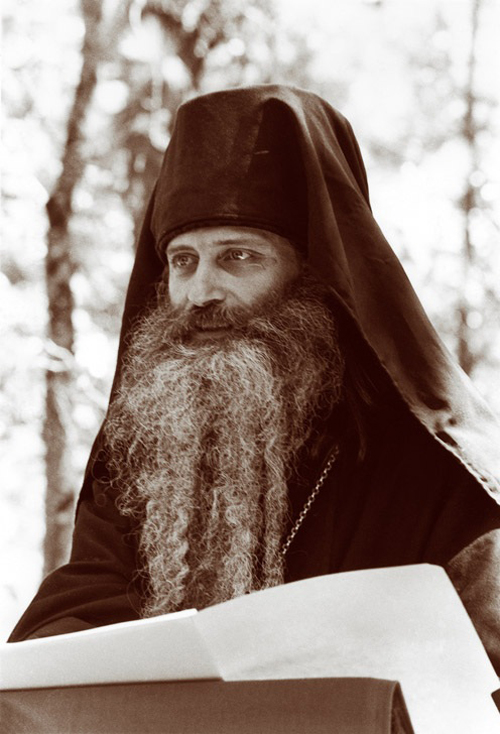
Sources
The Orthodox Word, Vol. 29, No.1 (168), Jan.-Feb., 1993, pp. 46-52
The Orthodox Word, Vol. 29, No. 3 (170), May-June, 1993, pp. 144-154
The Orthodox Word, Vol. 29, No. 4 (171), July-August, 1993, pp. 187-204
Audio recording: Orthodox Australia
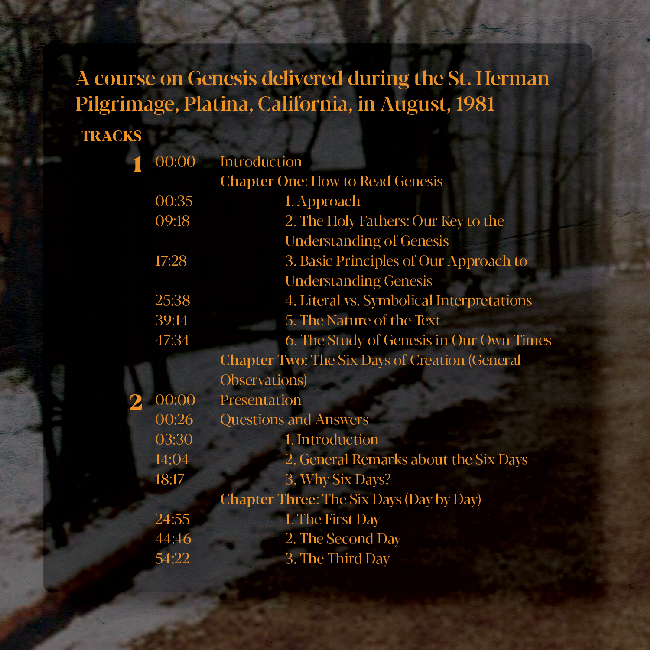
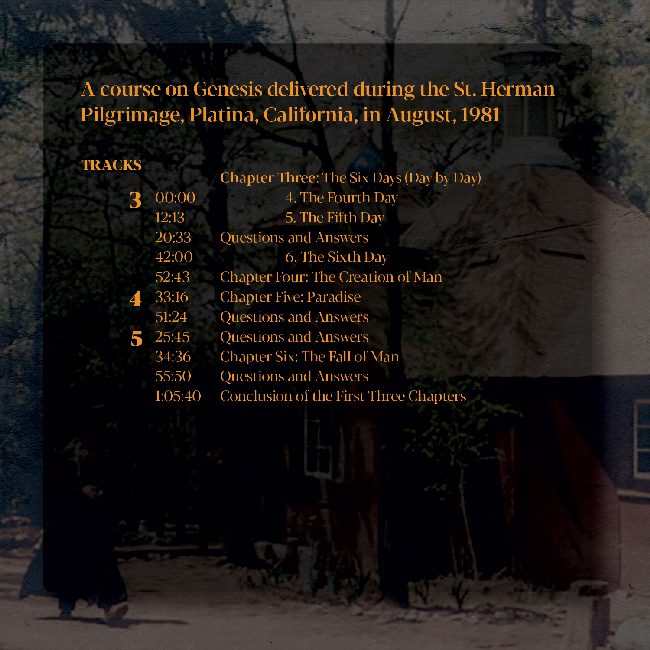

St. Seraphim of Platina – The Book of Genesis: Problems and Questions Involved in Approaching the Creation of Man

Pas de commentaire