
Chapter Six: The Fall of Man
(Genesis 3:1-16)
[Even in our fallen state, can we not be reminded of Paradise and our fall from it in the nature that surrounds us? In the animals it is not difficult to see the passions over which we should be masters, but which have largely taken possession of us; and in the peaceful murmur of the forests (where so many ascetic strugglers have taken refuge) can we not see a reminder of the Paradise of vegetation originally intended for our dwelling and food, and still existing for those able to ascend, with St. Paul, to behold it?] [1]
Prepared by the Patristic teaching on the Six Days of creation, the creation of the first man and his dwelling in Paradise, we are now ready to understand the account of his fall in the third chapter of Genesis. It is clear that, like all else in this God-inspired book, this is an historical account, but one which must be understood, first and foremost, in a spiritual sense.
3:1 Now the serpent was more subtle than any other wild creature that the Lord God had made.
With the “serpent,” once again, we find an image that our modern rationalistic mind would like to understand allegorically. But here again, the Fathers are relentlessly realistic in their interpretation. St. John Chrysostom teaches:
Do not regard the present serpent; do not regard how we flee it and feel repulsion towards it. It was not such in the beginning. The serpent was the friend of man and the closest of those who served him. And who made it an enemy? The sentence of God: “Cursed are you above all the cattle, and above all wild animals. . . I will put enmity between you and the woman” [2]. It was this enmity that destroyed the friendship. I mean not a rational friendship, but one of which an irrational creature is capable. Similar to the way that now the dog manifests friendship, not by word but by natural movements, just so did the serpent serve man. As a creature who enjoyed great closeness to man, the serpent seemed to the devil to be a convenient tool (for deception). . . Thus, the devil spoke through the serpent, deceiving Adam. I beg your love to hear my words not carelessly. The question is not an easy one. Many ask: How did the serpent speak—with a human voice, or with a serpents hissing, and how did Eve understand? Before the transgression Adam was filled with wisdom, understanding, and the gift of prophecy. . . The devil noticed both the wisdom of the serpent and Adam’s opinion of it—because the latter considered the serpent wise. And so he spoke through it, so that Adam might think that the serpent, being wise, was able to mimic the human voice also [3].
To understand why the devil should want to tempt Adam, one must understand that the “warfare” in heaven [4] has already occurred, and that the devil and his angels have already been cast out of heaven into the lower realm of earth because of their pride. The motive of the devil is envy of man, who is called to the estate the devil has lost. St. Ambrose writes:
“By the envy of the devil death came into the world” [5]. The cause of envy was the happiness of man placed in Paradise, because the devil could not brook the favors received by man. His envy was aroused because man, though formed in slime, was chosen to be an inhabitant of Paradise. The devil began to reflect that man was an inferior creature, yet had hopes of an eternal life, whereas he, a creature of superior nature, had fallen and had become part of this mundane existence [6].
3:1-6 And he said unto the woman, Yea, hath God said, Ye shall not eat of every tree of the garden? And the woman said unto the serpent, We may eat of the fruit of the trees of the garden; but of the fruit of the tree which is in the midst of the garden, God hath said, Ye shall not eat of it, neither shall ye touch it, lest ye die. And the serpent said unto the woman, Ye shall not surely die; for God doth know that in the day ye eat thereof, then your eyes shall be opened, and ye shall be as gods, knowing good and evil. And when the woman saw that the tree was good for food, and that it was pleasant to the eyes, and a tree to be desired to make one wise, she took of the fruit thereof, and did eat, and gave also unto her husband with her; and he did eat.
The childlikeness of this dialogue, and the ease with which our first parents fell into a transgression of the only commandment that had been given them, indicate the untested nature of their virtue: everything had been given them by God’s grace, but they were not yet skilled in “tilling and keeping” their inward state.
The temptation offered by the devil contains the same elements we fallen men know in our own fight against sin. He offers, first of all, not an obvious evil but something which seems good and true. Men were indeed created to be “gods and sons of the most high” [7], and were aware that from Paradise they were to ascend to a higher condition. The devil, therefore, as it were thought to himself (as St. Ambrose expresses it):
This, therefore, is my first approach, namely, to deceive him while he is desirous of improving his condition. In this way an attempt will be made to arouse his ambition [8].
In causing our first ancestors to look at the good thing of becoming like gods, the devil hoped to cause them to forget the “small” commandment which was the way God ordained them to achieve this goal.
Again, the devil attacked not through the man, but through the woman—not because the woman was weaker or more passionate, because both Adam and Eve still preserved the dispassionateness of their original nature—but for the simple reason that Adam alone had heard the command of God, whereas Eve knew it only indirectly, and thereby might be considered more likely to disobey it. St. Ambrose writes of this:
[The devil] aimed to circumvent Adam by means of the woman. He did not accost the man who had in his presence received the heavenly command. He accosted her who had learned of it from her husband and who had not received from God the command which was to be observed. There is no statement that God spoke to the woman. We know that He spoke to Adam. Hence we must conclude that the command was communicated through Adam to the woman [9].
The success of the devil’s temptation, finally, was due to his knowledge (or guess) as to what is in the heart of man himself. It was not the devil who caused Adam’s fall, but Adam’s own desire. St. Ephraim writes:
The tempting word would not have led into sin those who were tempted if the tempter had not been guided by their own desire. Even if the tempter had not come, the tree itself by its beauty would have led their desire into battle. Although the first ancestors sought an excuse for themselves in the counsel of the serpent, they were harmed more by their own desire than by the counsel of the serpent [10].
As a result of the temptation, as St. John Chrysostom describes it:
The devil led the woman into captivity, drew away her mind and caused her to think of herself above her worth, so that, being drawn away by empty hopes, she might lose even what had been given her [11].
3:7 And the eyes of them both were opened, and they knew that they were naked; and they sewed fig leaves together, and made themselves apron.
On this passage St. John Chrysostom says:
It was not the eating of the tree that opened their eyes: they had seen even before eating. But since this eating served as an expression of disobedience and violation of the commandment given by God, and for this reason they were then deprived of the glory that clothed them, having become unworthy of such great honor, the Scripture says: They ate, and their eyes were opened, and they knew that they were naked. Being deprived of the grace from on high for the transgression of the commandment, they saw also their physical nakedness, so that from the shame that took hold of them they might understand into what an abyss they had been cast by the transgression of the Master’s commandment… When you hear, “their eyes were opened,” understand this to mean that (God) gave them to feel their nakedness and the loss of the glory which they had enjoyed before the eating… Do you see that the word “opened” refers not to the bodily eyes, but to mental vision [12]?
With the opening of their eyes through the transgression, Adam and Eve have already lost the life of Paradise, even though they have not yet been banished from it; from now on their eyes will be open to the lower things of this earth, and they will see only with difficulty the higher things of God. They are no longer dispassionate, but have begun the passionate earthly life we still know today.
3:8 And they heard the voice of the Lord God walking in the garden in the cool of the day; and Adam and his wife hid themselves from the presence of the Lord God amongst the trees of the garden.
St. John Chrysostom writes of this:
What do you say? God walks? Are you going to ascribe feet to Him, and not understand anything higher? No, God does not walk—may this not be! In very fact, how can He Who is everywhere and fills all things, Whose throne is heaven and the earth His footstool—walk in Paradise? What sensible man would say this? Then what does it mean: “They heard the voice of the Lord God walking in the garden in the cool of the day (midday)”? He wished to arouse in them such a feeling of Gods closeness that it would make them uneasy, which indeed happened: They felt this, and tried to hide themselves from God, Who was approaching them [13].
And St. Ambrose writes:
In my opinion God may be said to walk wherever throughout Scripture the presence of God is implied [14].
In the dialogue that follows, we see that God comes to Adam not to condemn him or banish him from Paradise, but to bring him to his senses. St. Chrysostom writes:
He did not delay in the least, but as soon as He saw what had happened and the seriousness of the wound, He immediately hastened with a treatment, so that the wound would not become inflamed and become incurable… Pay heed to the Lords love of mankind and His extreme lack of ill will. He could, without even vouchsafing a reply to the one who had performed such a sin, have immediately subjected him to the punishment which He had already decreed beforehand for the transgression; but He is longsuffering, delays, asks and listens to the answer, and again asks, as if evoking the guilty one to justify himself in order that when the matter had been revealed He might show him His love of mankind even after such a transgression [15].
3:9 And. the Lord God called unto Adam, and said unto him, Where art thou?
Of this St. Ambrose says:
What, then, does He mean by “Adam, where art thou?” Does He not mean “in what circumstances” are you; not, “in what place”? It is, therefore, not a question, but a reproof. From what condition of goodness, beatitude, and grace, He means to say, have you fallen into this state of misery? You have forsaken eternal life. You have entombed yourself in the ways of sin and death [16].
3:10-13 And he said, I heard Thy voice in the garden, and I was afraid, because I was naked; and I hid myself. And He said, Who told thee that thou wast naked? Hast thou eaten of the tree, whereof I commanded thee that thou shouldest not eat? And the man said, The woman whom Thou gavest me to be with me, she gave me of the tree, and I did eat. And the Lord God said unto the woman, What is this that thou hast done? And the woman said, The serpent beguiled me, and I did eat.
In this dialogue the Fathers see God’s call for man to repent. St. John Chrysostom writes:
(God) asks about this not because He did not know: He knew, and knew perfectly; but in order to show His love of mankind He condescends to their weakness and calls them to confess their sin [17].
But man responds not with repentance, but with self-justification, thereby bringing punishment upon himself. St. Ephraim comments on this passage:
Instead of acknowledging what he had done himself, which acknowledgment would have been profitable for him, Adam retells what happened to him, something that was profitless for him. . . Adam does not confess his guilt, but accuses the woman… And when Adam does not wish to confess his guilt, God addresses a question to Eve and says: “What is this that thou hast done?” And Eve, instead of entreating with tears and taking the guilt upon herself, as if she does not desire to obtain forgiveness for herself and her husband, does not mention the promise given her by the serpent and how he persuaded her… When both had been questioned and it was revealed that they have neither repentance nor any true justification, God turns to the serpent, not with a question but with definite punishment. For where there was room for repentance, there was questioning; but one who is a stranger to repentance is simply given the judge’s sentence [18].
The same Father adds:
If our first ancestors had desired and had repented even after the transgression of the commandment, then, even though they would not have restored to themselves what they had before the transgression of the commandment, at least they would have been delivered from the curses that were uttered to the earth and to themselves [19].
St. Abba Dorotheus takes this dialogue as the classic example of man’s unwillingness to repent and his deep-seated desire to justify his own behavior even when it is exposed as sinful by God Himself:
After the fall, (God) gave (Adam) the opportunity to repent and be pardoned, but his neck remained unbending. For (God) came and said to him: “Adam, where art thou?” That is, from what glory into what shame have you come? And then, when He asked him why he sinned, why he transgressed, He prepared him especially so that he might say: “Forgive me.” But there was no humility! Where was the word “forgive”? There was no repentance, but the complete opposite. For he contradicted and retorted: “The woman whom Thou gavest me” (deceived me). He did not say “My wife deceived me,” but “the woman whom Thou gavest me,” as if to say: “this misfortune which Thou hast brought on my head.” For thus it always is, brethren: When a man does not wish to reproach himself, he does not hesitate to accuse God Himself. Then (God) came to the woman and said to her: And why did you not keep the commandment? As it were, He especially hinted to her: At least you say “forgive,” so your soul might be humbled and you might be pardoned. But again He (did not hear) the word “forgive.” For she also replied: “The serpent beguiled me,” as if to say: The serpent sinned, and what is that to me? What are you doing, wretched ones? Repent, acknowledge your sin, have pity on your nakedness. But neither of them wished to accuse himself; neither had the least humility. And so you see now clearly to what our state has come, into what great misfortunes we have been led by the fact that we justify ourselves, that we hold to our own will and follow ourselves [20].
3:14-15 And the Lord God said unto the serpent, Because thou hast done this, thou art cursed above all cattle, and above every beast of the field; upon thy belly shalt thou go, and dust shalt thou eat all the days of thy life. And I will put enmity between thee and the woman, and between thy seed and her seed; it shall bruise thy head, and thou shalt bruise his heel.
The Fathers, with the realism of their understanding of Genesis, interpret this punishment as applying first of all to the animal who was the instrument of man’s fall, but then also to the devil who used this creature. St. John Chrysostom writes:
But perhaps someone will say: If the counsel was given by the devil, using the serpent as an instrument, why is this animal subjected to such a punishment? This also was a work of God’s unutterable love of mankind. As a loving father, in punishing the murderer of his son, breaks also the knife and sword by which he performed the murder, and breaks them into small pieces—in similar fashion the All-good God, when this animal, like a kind of sword, served as the instrument of the devil’s malice, subjects it to a constant punishment, so that from this physical and visible manifestation we might conclude the dishonor in which it finds itself. And if the one who served as the instrument was subjected to such anger, what punishment must the other be undergoing?… The unquenchable fire awaits him [21].[22]
St. John even speculates that before the curse the serpent, without having legs, went about in an upright position similar to the way it now stands up when ready to strike[23].
The “enmity” in our fallen life, of course, much more than between man and serpent, is between man and the devil; and in a special sense the “seed of the woman” is Christ. One 19th-century Orthodox commentary on this passage says:
The first woman in the world was the first to fall into the devils net and easily gave herself into his power; but by her repentance she will shake off his power over her. Likewise, in many other women also, especially in the person of the most blessed woman, the Virgin Mary, he will meet a powerful resistance to his wiles… By the seed of the woman, which is hostile to the seed of the devil, one must understand in particular one person from among the posterity of the woman, namely He Who from eternity was predestined for the salvation of men and was born in time of a woman without a man’s seed. He subsequently appeared to the world to destroy the works of the devil [24], that is, the kingdom of the devil, filled with his servants, with his seed. . . The striking of the spiritual serpent in the head by the seed of the woman signifies that Christ will completely defeat the devil and take away from him all power to harm men… Until the Second Corning the devil will have the opportunity to harm men, including Christ Himself; but his wounds will be easily healed, like wounds in the heel, which are not dangerous because in the heel, which is covered with hard skin, there is little blood. A wound in the heel was given by the powerless malice of the devil to Christ Himself, against Whom he aroused the unbelieving Jews who crucified Him. But this wound served only for the greater shame of the devil and the healing of mankind [25].
3:16 And to the woman He said, I will greatly multiply thy pains and thy groanings; in pain thou shalt bring forth children, and thy submission shall be to thy husband, and he shall rule over thee (Septuagint).
Even while cursing the serpent, God is awaiting the repentance of Adam and Eve.
St. Ephraim writes:
God began with the despised (serpent) so that, while the anger of righteous judgment was directed against it alone, Adam and Eve might become terrified and repent, and thereby the opportunity would have been given to (Gods) goodness to deliver them from the curses of righteous judgment. But when the serpent had been cursed, and Adam and Eve did not hasten to entreaties, God uttered the punishment to them. He addressed Eve first, because by her hand sin was given to Adam [26].
St. John Chrysostom writes of Eve’s punishment:
Behold the Lord’s goodness, and what meekness He shows after such a transgression. He says: I wished that you would lead a life without sorrow and pain, free of every grief and bitterness, and filled with every satisfaction; that, being clothed in a body, you might not feel anything bodily. But since you did not make fitting use of such happiness, but the abundance of good things brought you to such great ingratitude, therefore, so that you might not be given over to yet greater self-will, I am laying upon you a bridle, and I condemn you to sorrow and groaning. I shall arrange that your giving birth to children—a source of great consolation—will begin with sorrow, so that in daily grief and sorrow in giving birth you might have a constant reminder of how great was this sin and disobedience… At first I created you equal in honor (to your husband) and wished that, being of one dignity with him, you might have communion in everything with him; and I entrusted to you, as to your husband, authority over all creatures. But since you did not make fitting use of the equality in honor, for this I am subjecting you to your husband… I subject you to him and proclaim him your lord, so that you might acknowledge his authority; since you are unable to lead, therefore, learn to be a good subject [27].
3:17—19 And unto Adam He said, Because thou hast hearkened unto the voice of thy wife and hast eaten of the tree, of which I commanded thee, saying, Thou shalt not eat of it: cursed is the ground for thy sake; in sorrow shalt thou eat of it all the days of thy life. Thorns also and thistles shall it bring forth to thee, and thou shalt eat of the herb of the field; in the sweat of thy face shalt thou eat bread, till thou return unto the ground; for out of it wast thou taken. For dust thou art, and unto dust shalt thou return.
Here Adam is given an image of the trials and tribulations of simply living in this fallen world.
[First of all, the earth is cursed for his sake. St. John Chrysostom writes:Behold the reminders of the curse! Thorns it will bring forth, He (God) says, and thistles. I will do this so that you will endure severe labor and cares and spend your whole life in sorrow, that this might be a restraint for you, that you might not dream that you are higher than your station; but that you might constantly remember your nature and might henceforth not allow yourself to come to a similar sure of deception. “Thou shalt eat of the herb of the field; in the sweat of thy face shalt thou eat bread.” See how after his (Adam’s) disobedience everything was not as it had been before in his life! I, He says, bringing you into this world, wanted you to live without afflictions, without labors, without cares, without sorrows; to be in contentment and prosperity and not be subject to bodily needs, but to be a stranger to all this and enjoy perfect freedom. But since such freedom was not of benefit to you, I will curse the earth so that henceforth it will not be as it was formerly, giving forth fruit without sowing and cultivation, but will do so only with great labor, exertion and cares. I will subject you to constant afflictions and sorrows, and force you to do everything with exhausting efforts, that these tormenting labors might be for you a constant lesson to behave modestly and know your own nature [28].
Secondly, Adam now becomes mortal, along with the creatures. St. John Chrysostom writes that, even though Adam and Eve lived a long time after their fall,
nevertheless from the moment they heard, “Dust thou art, and unto dust shalt thou return,” they received a death sentence, became mortals and, one may say, died. Indicating this, the Scripture said, “In the day that thou eatest of it [the tree] thou shalt surely die” [29]—in other words, you shall receive a sentence; you shall now be mortals [30].
The Wisdom of Solomon declares: “God made man incorruptible” [31]; but through Adam’s disobedience both he and the creatures became mortal and corruptible.
In the Epistle of St. Paul to the Romans there is a teaching about how the whole creation is “groaning” because it is subject to “vanity,” that is, to the corruption (decay) that entered the world because of the pride of one man. The creation is waiting for man to be delivered so that it itself can be restored to the original state of incorruption—when the creatures will be wandering around the forest like they are now, but incorrupt like they were in the days of Adam.
In Romans 8:19-22 we read: “For the earnest expectation of the creature waiteth for the manifestation of the sons of God. For the creature was made subject to vanity, not willingly, but by reason of him who hath subjected it in hope. Because the creature itself also shall be delivered from the bondage of corruption (decay) into the glorious liberty of the children of God. For we know that the whole creation groaneth and travaileth in pain together until now.”
The commentary of St. John Chrysostom on this passage makes the doctrine absolutely explicit:
What means “for the creature was made subject to vanity”? It became corruptible. Why, and by what cause? By your fault, O man. Because you received a body mortal and subject to sufferings, so the earth also was subject to a curse, and brought forth thorns and thistles.
Just as the creature became corruptible when your body became corruptible, so also when your body will be incorrupt, the creature also will follow after it and become corresponding to it [32].
Here, it should be noted, the word “you” means the same thing as the word “I” often does in the Orthodox Divine services: Adam (because we are all one man). St. John makes this clear in another passage:
What armed death against the whole universe? The fact that only one man tasted of the tree [33].
St. Macarius the Great says the same thing:
Adam was placed as lord and king of all the creatures…. But after his captivity, there was taken captive together with him the creation which served him and submitted to him, because through him death came to reign over every soul [34].
St. Symeon the New Theologian is also very explicit that the material creation—and not just Paradise—before Adam’s fall was incorrupt and without death. As we saw earlier, he writes that Adam was originally “placed by the Creator God as an immortal king over an in-corrupt world, not only over Paradise, but also over the whole creation which was under the heavens.” In the same Homily he goes on to say that, after Adam’s transgression,
God did not curse Paradise… but He cursed only the whole rest of the earth, which also was incorrupt and brought forth everything by itself… And thus it was fitting in all justice for the one who had become corrupt and mortal by reason of the transgression of the commandment, to live upon the corruptible earth and eat corruptible food… Then also all creatures, when they saw that Adam was banished from Paradise, no longer wished to submit to him, the criminal… But God restrained all these creatures by His power, and in His compassion and goodness He did not allow them immediately to strive against man, and He commanded that the creation should remain in submission to him, and having become corrupt, should serve corrupt man for whom it had been created…. Do you see that this whole creation in the beginning was incorrupt and was created by God in the manner of Paradise? But later it was subjected by God to corruption, and submitted to the vanity of men [35].
The Fathers also mention that the sentence of death, which took effect at the fall, was not just a punishment. It was also a good, because once man fell, if he were to still be immortal, there would be no way out for him. Imagine being in a state of being unable to redeem yourself, unable to get to Paradise, and then living and living and living, with no hope of getting out of this state. Death puts an end to sin. The fact that we are afraid of death already wakes us up to begin to struggle. Even if we forget about Paradise, we will be afraid of death and begin to struggle, to overcome our fallen nature.
Cyril of Alexandria (†444) writes about the meaning of disease and death in fallen man:
Man, having received as his lot an exhausting fast and sorrows, was given over to illnesses, sufferings, and the other bitter things as to a kind of bridle. Because he did not sensibly restrain himself in that life which was free from labors and sorrows, he is given over to misfortunes so that by sufferings he might heal in himself the disease which came upon him in the midst of blessedness. By death the Giver of the Law stopped the spread of sin, and in the very chastisement reveals His love for mankind. Inasmuch as he, in giving the commandment, joined death to the transgression of it, and inasmuch as the criminal thus fell under the chastisement, so He arranged that the chastisement itself might serve for salvation. For death dissolves this animal nature of ours and thus, on the one hand, stops the activity of evil, and on the other delivers a man from illnesses, frees him from labors, puts an end to his sorrows and cares, and stops his bodily sufferings. With such a love for mankind has the Judge mixed the chastisement [36].
Finally, St. Symeon the New Theologian writes of how, through the Crucifixion and Resurrection of Jesus Christ, the sentence of death is abolished:
The decree of God, “Dust thou art, and unto dust shalt thou return,” just like everything else laid upon mankind after the fall, will be in effect until the end of the age. But by God’s mercy, through the power of the extraordinary sacrifice of Christ, in the future age it will no longer have any effect, when the general resurrection will occur, which resurrection could not possibly occur unless the Son of God Himself had risen from the dead, Who had died for the abolition of the above-mentioned decree and for the resurrection of the entire human nature[37].28
In the general resurrection, all of creation will be delivered from corruption together with man, just as it once became subject to corruption because of him. St. Symeon writes:
When man again will be renewed and become spiritual, incorrupt and immortal, then also the whole creation, which had been subjected by God to man to serve him, will be delivered from this servitude, will be renewed together with him, and become incorrupt and as it were spiritual… It is not fitting for the bodies of men to be clothed in the glory of resurrection and to become incorrupt before the renewal of all creatures. But just as in the beginning, first the whole creation was created incorrupt, and then from it man was taken and made, so also it is fitting that again first all the creation should become incorrupt, and then the corruptible bodies of men also should be renewed and become incorrupt, so that once more the whole man might be incorrupt and spiritual and that he might dwell in an incorruptible, eternal, and spiritual dwelling [38].][39]
3:20 And Adam called his wife’s name Eve because she was the mother of all living.
Eve means “life.” Adam now gives her a particular name in addition to the name Woman.
3:21 Unto Adam also and to his wife did the Lord God make them coats of skins, and clothed them.
St. Gregory of Nyssa says this means that they literally put on “coats of skins,” but it also means, figuratively, that they became clothed in a different kind of flesh; that is, their nature was changed.
3:22—23 And the Lord God said, Behold the man is become as one of Us, to know good and evil. And now, lest he put forth his hand and take also of the tree of life and eat and live forever, therefore, the Lord God sent him forth from the Garden of Eden, to till the ground from whence he was taken.
The Lord says “as one of Us,” referring to Himself in plural: the Holy Trinity. He casts Adam out so that Adam would not eat of the Tree of Life, which we see also in the Book of Apocalypse (Revelation): the Tree of Life in the center of Paradise. Eating of this Tree would make man immortal without being good, and God does not want that; therefore, He casts him out.
3:24 And He cast out Adam and caused him to dwell over against the Garden of Delight, and stationed the Cherubim and the fiery sword that turns about to keep the way of the tree of life [40].
As we said in the first talk, St. Macarius of Egypt interprets this mystically, saying that this is what happens to every soul when Paradise is closed to it. But it also means exactly what it says: that there is a Cherubim with a flaming sword.
We have now covered the first three chapters of Genesis, from which is taken the basic theology of the Church about the origin of man and, therefore, his goal. The services are filled with this theology, especially the services to the Cross. On September 14th, the Feast of the Exaltation of the Cross, there are a number of very good verses which show how the Church views what happened in Paradise and what happened when Christ came. They compare the tree of which Adam tasted with the Tree which was the Cross. One of the verses for Great Vespers says:
Come, O ye peoples, let us venerate the blessed Wood, through which the eternal justice has been brought to pass. For he who by a tree deceived our forefather Adam, is by the Cross himself deceived; and he who by tyranny gained possession of the creature endowed by God with royal dignity, is overthrown in headlong fall. By the Blood of God the poison of the serpent is washed away; and the curse of a just condemnation is loosed by the unjust punishment inflicted on the Just. For it was fitting that wood should be healed by wood, and that through the Passion of One Who knew not passion should be remitted all the sufferings of him who was condemned because of wood [41].
It is very profound and moving when you read verses like this, knowing the theology of Paradise and the future age.
In the Sessional Hymn of Matins of that same service, we sing:
In Paradise of old, the wood [i.e., of the tree] stripped me bare, for by giving its fruit to eat, the enemy brought in death. But now the wood of the Cross that clothes men with the garment of life has been set up in the midst of the earth, and the whole world is filled with boundless joy [42].
Another canticle:
O thrice-blessed Tree, on which Christ the King and Lord was stretched! Through thee the beguiler fell who tempted mankind with the tree. He was caught in the trap set by God, Who was crucified upon thee in the flesh, granting peace unto our souls [43].
And the Ninth Song, Irmos:
Today the death that came to man through eating of the tree is made of no effect through the Cross. For the curse of our mother Eve that fell on all mankind is destroyed by the fruit of the pure Mother of God, whom all the powers of heaven magnify [44].
The Canon of the Feast of Epiphany, composed by St. John Dam-ascene, tells us that the devil introduced death into the creation, but that Christ has overcome him:
He who once assumed the appearance of a malignant serpent and implanted death in the creation, is now cast into darkness by Christ’s coming in the flesh [45].
That is briefly the theology of the beginning of all things, Paradise, original Adam, his fall and the state to which we have to try to get back by the Second Adam Who is Christ.
[If you interpret all these events in the early history of mankind as simply an allegory, as a pretty story which says something else entirely, you will be deprived of a true understanding of Paradise. For example, many Roman Catholic theologians say that the idea of Paradise does not fit in with the findings of modern anthropology; therefore, we have to reinterpret everything from the conclusion that man evolved from lower animals. Original sin, they say, must mean that as soon as man became sufficiently developed to become aware of himself, and therefore to become man, this awareness was like a fall. They cannot fit Paradise into this scheme, because in Paradise man was a divinized being.It is very important for us to see these two entirely opposed conceptions. The first view is that man was created directly by God with a superhuman intelligence, with that original nature from which we fell away and to which we are called back. The other view is that man comes up from lower creatures. The second view, of course, leads to a philosophy of moral relativism, because if we were once something else, some kind of ape-like creature, then we are going to be something else—we are heading for Superman. (Most evolutionists say in so many words that collective humanity will become Superman.) This view also leads to religious ideas like those of Teilhard de Chardin, who says that the whole world is evolving into a higher state, that the world itself is like the bread which is being transmuted into the other world, and then it all becomes Christ. Of course, that is like pantheism, like some frightful heresy—which is exactly what Antichrist needs in order to come to reign. People will think they are gods while actually having this animalistic philosophy.
When we hold to the view of the Holy Fathers, we see that Christ actually died on the Cross. It is a real, physical event, not an image or allegory; and at the same time it has spiritual consequences, bringing about a change in man’s condition. It gives us salvation: not figurative salvation, but actual salvation. In the same way, Adam tasted of a tree and thereby lost Paradise. This, too, was a physical event with spiritual consequences, changing man’s condition.][46]
[1] From the notes of St. Seraphim of Platina
[2] And the eyes of them both were opened, and they knew that they were naked; and they sewed fig leaves together, and made themselves aprons. And they heard the voice of the LORD God walking in the garden in the cool of the day: and Adam and his wife hid themselves from the presence of the LORD God amongst the trees of the garden. And the LORD God called unto Adam, and said unto him, Where art thou? And he said, I heard thy voice in the garden, and I was afraid, because I was naked; and I hid myself. And he said, Who told thee that thou wast naked? Hast thou eaten of the tree, whereof I commanded thee that thou shouldest not eat? And the man said, The woman whom thou gavest to be with me, she gave me of the tree, and I did eat. And the LORD God said unto the woman, What is this that thou hast done? And the woman said, The serpent beguiled me, and I did eat. And the LORD God said unto the serpent, Because thou hast done this, thou art cursed above all cattle, and above every beast of the field; upon thy belly shalt thou go, and dust shalt thou eat all the days of thy life: And I will put enmity between thee and the woman, and between thy seed and her seed; it shall bruise thy head, and thou shalt bruise his heel. Unto the woman he said, I will greatly multiply thy sorrow and thy conception; in sorrow thou shalt bring forth children; and thy desire shall be to thy husband, and he shall rule over thee. And unto Adam he said, Because thou hast hearkened unto the voice of thy wife, and hast eaten of the tree, of which I commanded thee, saying, Thou shalt not eat of it: cursed is the ground for thy sake; in sorrow shalt thou eat of it all the days of thy life; Thorns also and thistles shall it bring forth to thee; and thou shalt eat the herb of the field; In the sweat of thy face shalt thou eat bread, till thou return unto the ground; for out of it wast thou taken: for dust thou art, and unto dust shalt thou return. Genesis 3 7-19
[3] On the Creation of the World, VI, 2, pp. 800–801
[4] And there appeared a great wonder in heaven; a woman clothed with the sun, and the moon under her feet, and upon her head a crown of twelve stars: And she being with child cried, travailing in birth, and pained to be delivered. And there appeared another wonder in heaven; and behold a great red dragon, having seven heads and ten horns, and seven crowns upon his heads. And his tail drew the third part of the stars of heaven, and did cast them to the earth: and the dragon stood before the woman which was ready to be delivered, for to devour her child as soon as it was born. And she brought forth a man child, who was to rule all nations with a rod of iron: and her child was caught up unto God, and to his throne. And the woman fled into the wilderness, where she hath a place prepared of God, that they should feed her there a thousand two hundred and threescore days. And there was war in heaven: Michael and his angels fought against the dragon; and the dragon fought and his angels, And prevailed not; neither was their place found any more in heaven. And the great dragon was cast out, that old serpent, called the Devil, and Satan, which deceiveth the whole world: he was cast out into the earth, and his angels were cast out with him. Revelation 12 1-9
[5] For God created man to be immortal, and made him to be an image of his own eternity. Nevertheless through envy of the devil came death into the world: and they that do hold of his side do find it. Wisdom 2 23-25
[6] Paradise, ch. 12, pp. 332–333
[7] (A Psalm of Asaph.) God standeth in the congregation of the mighty; he judgeth among the gods. How long will ye judge unjustly, and accept the persons of the wicked? Selah. Defend the poor and fatherless: do justice to the afflicted and needy. Deliver the poor and needy: rid them out of the hand of the wicked. They know not, neither will they understand; they walk on in darkness: all the foundations of the earth are out of course. I have said, Ye are gods; and all of you are children of the most High. But ye shall die like men, and fall like one of the princes. Arise, O God, judge the earth: for thou shalt inherit all nations. Psalm 82 / 11th Kathisma)
[8] Paradise, ch. 12, p. 333
[9] Paradise, ch. 12, p. 333
[10] Commentary on Genesis, ch. 3, p. 318
[11] Homilies on Genesis, Hom. XVI, 4, p. 132
[12] Homilies on Genesis, Hom. XVI, 5, pp. 133–134
[13] Homilies on Genesis, Hom. XVII, 1, p. 138
[14] Paradise, 14, p. 346
[15] Homilies on Genesis, Hom. XVII, 2–3, pp. 140–142
[16] Paradise, ch. 14, p. 348
[17] Homilies on Genesis, Hom. XVII, 5, p. 145
[18] Commentary on Genesis, Com. Ill, pp. 329–330
[19] Ibid., p. 326
[20] Spiritual Instructions, I, pp. 26–27
[21] And the King shall answer and say unto them, Verily I say unto you, Inasmuch as ye have done it unto one of the least of these my brethren, ye have done it unto me. Then shall he say also unto them on the left hand, Depart from me, ye cursed, into everlasting fire, prepared for the devil and his angels: For I was an hungred, and ye gave me no meat: I was thirsty, and ye gave me no drink: I was a stranger, and ye took me not in: naked, and ye clothed me not: sick, and in prison, and ye visited me not. Then shall they also answer him, saying, Lord, when saw we thee an hungred, or athirst, or a stranger, or naked, or sick, or in prison, and did not minister unto thee? Then shall he answer them, saying, Verily I say unto you, Inasmuch as ye did it not to one of the least of these, ye did it not to me. And these shall go away into everlasting punishment: but the righteous into life eternal. Matthew 25 40-46
[22] Homilies on Genesis, Hom. XVII, 6, p. 146
[23] On the Creation of the World, VI, 7, p. 813
[24] Little children, let no man deceive you: he that doeth righteousness is righteous, even as he is righteous. He that committeth sin is of the devil; for the devil sinneth from the beginning. For this purpose the Son of God was manifested, that he might destroy the works of the devil. Whosoever is born of God doth not commit sin; for his seed remaineth in him: and he cannot sin, because he is born of God. 1 John 3 7-9
[25] Bishop Bessarion, Commentary on Church-Service Parables, St. Petersburg, 1894, vol. I, pp. 56–57
[26] Commentary on Genesis, Com. III, p. 332
[27] Homilies on Genesis, Hom. XVII, 7–8, pp. 149–150
[28] Homilies on Genesis, Hom. 17:9, p. 152
[29] And the LORD God took the man, and put him into the garden of Eden to dress it and to keep it. And the LORD God commanded the man, saying, Of every tree of the garden thou mayest freely eat: But of the tree of the knowledge of good and evil, thou shalt not eat of it: for in the day that thou eatest thereof thou shalt surely die. And the LORD God said, It is not good that the man should be alone; I will make him an help meet for him. Genesis 2 15-18
[30] Ibid., p. 153
[31] For if the just man be the son of God, he will help him, and deliver him from the hand of his enemies. Let us examine him with despitefulness and torture, that we may know his meekness, and prove his patience. Let us condemn him with a shameful death: for by his own saying he shall be respected. Such things they did imagine, and were deceived: for their own wickedness hath blinded them. As for the mysteries of God, they knew them not: neither hoped they for the wages of righteousness, nor discerned a reward for blameless souls. 23 For God created man to be immortal, and made him to be an image of his own eternity. Nevertheless through envy of the devil came death into the world: and they that do hold of his side do find it. Wisdom 2 18-25
[32] St. John Chrysostom, Homilies on Romans, Homily 14:5, p. 665
[33] Ibid., Homily 10 :2, p. 595
[34] St. Macarius the Great, Fifty Spiritual Homilies, Homily 11, pp. 85-86
[35] St. Symeon the New Theologian, Homily 45, in The Sin of Adam, pp. 67-69, 75. [In the new edition, published under the title The First-Created Man, this passage is found on pp. 91-94, 103]
[36] St. Cyril of Alexandria, “On the Incarnation of the Lord.”
[37] St. Symeon the New Theologian, The Sin of Adam, p. 62 [The First-Created Man, p. 83]
[38] Ibid., pp. 69, 73 [The First-Created Man, pp. 94, 100]
[39] From the notes of St. Seraphim of Platina
[40] Septuagint
[41] Mother Mary and Archimandrite Kallistos Ware, trans., The Festal Menaion, p. 134
[42] Ibid., p. 146
[43] Ibid., p. 147
[44] Ibid., p. 151
[45] Ibid., p. 369
[46] From the notes of St. Seraphim of Platina
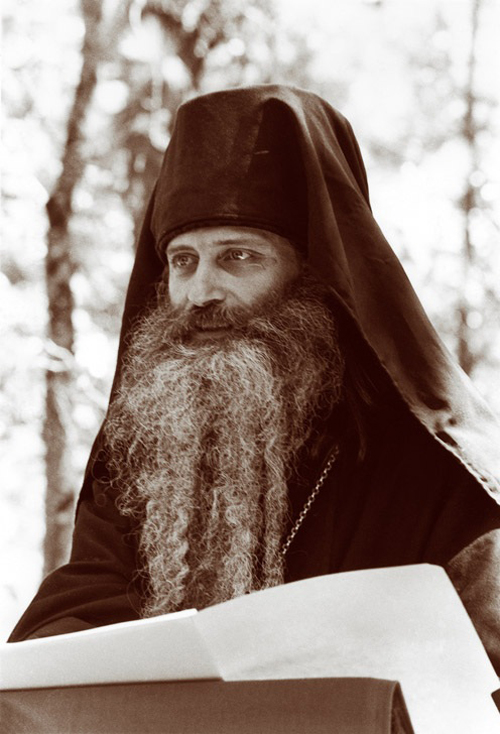
Sources
The Orthodox Word, Vol. 30, No. 1 (174), January-February, 1994, pp. 43-52.
Fr. Seraphim Rose, Genesis, Creation and Early Man – The Orthodox Vision, Saint Herman of Alaska Brotherhood, Platina, 2000, pp. 205-216
Audio recording: Orthodox Australia
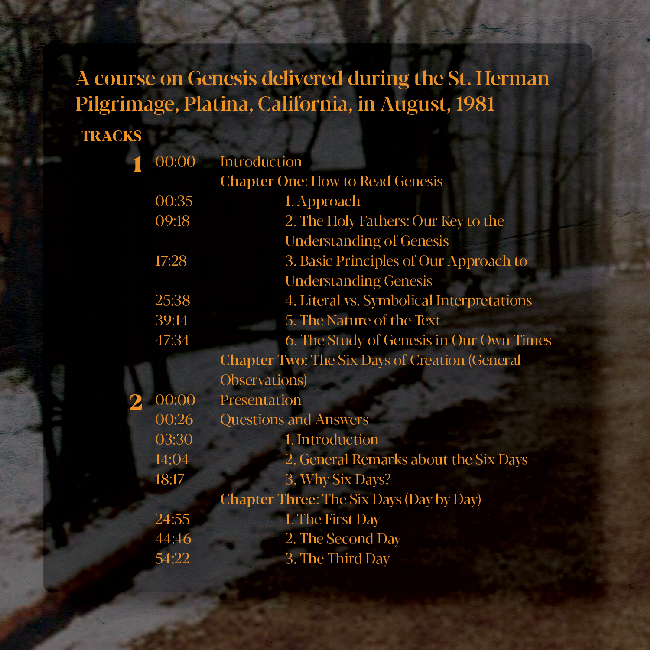
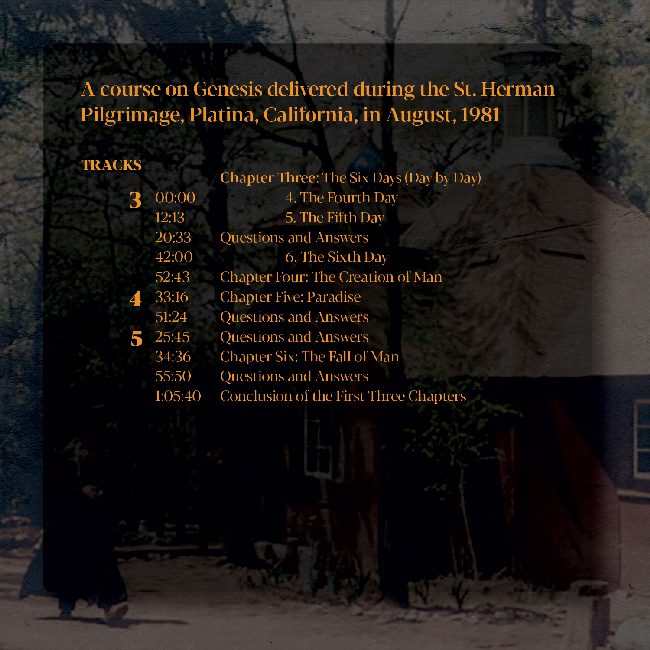

St. Seraphim of Platina – The Book of Genesis: Problems and Questions Involved in Approaching the Creation of Man


Pas de commentaire