
To the very end of this age there shall not be lacking Prophets of the Lord God, as also servants of satan. But in the last times those who truly will serve God will succeed in hiding themselves from men and will not perform in their midst signs and wonders as at the present time, but they will travel by a path of activity intermixed with humility, and in the Kingdom of Heaven they will be greater than the Fathers who have been glorified by signs. For at that time no one will perform before the eyes of men miracles which would infame men and inspire them to strive with zeal for ascetic labors… Many, being possessed by ignorance, will fall into the abyss, going astray in the breadth of the broad and spacious path.
Prophecy of St. Niphon of Constantia, Cyprus (4th century)[1]

A. A “Pentecost without Christ”
For orthodox christians present-day “tongues,” like those described in the New Testament, are also a “sign”: but now they are a sign, not of the beginning of the Gospel of salvation for all people, but of its end. The sober Orthodox Christian will not find it difficult to agree with the apologists of the “charismatic revival” that this new “outpouring of the spirit” may mean indeed that “the consummation of the age is at hand” [2]. Now the Spirit speaketh expressly, that in the latter times some shall depart from the faith, giving heed to seducing spirits, and doctrines of devils[3]. In the last days we shall see the spirits of devils, working miracles[4].
The Holy Scriptures and Orthodox Fathers clearly tell us that the character of the last times will not at all be one of a great spiritual “revival,” of an “outpouring of the Holy Spirit,” but rather one of almost universal apostasy, of spiritual deception so subtle that the very elect, if that were possible, will be deceived, of the virtual disappearance of Christianity from the face of the earth. When the Son of man cometh, shall He find faith on the earth?[5]
The “charismatic revival,” the product of a world without sacraments, without grace, a world thirsting for spiritual “signs” without being able to discern the spirits that give the signs, is itself a “sign” of these apostate times. The ecumenical movement itself remains always a movement of “good intentions” and feeble humanitarian “good deeds”; but when it is joined by a movement with “power” indeed with all power and signs and lying wonders[6], then who will be able to stop it? The “charismatic revival” comes to the rescue of a foundering ecumenism, and pushes it on to its goal. And this goal, as we saw in the introduction to this series of articles[7], is not merely. “Christian” in nature—the “refounding of the Church of Christ,” to use the blasphemous utterance of Patriarch Athenagoras—that is only the first step to a larger goal which lies entirely outside of Christianity: the establishment of the “spiritual unity” of all religions, of all mankind.
However, the followers of the ’charismatic revival’ believe their experience is “Christian”; they will have nothing to do with occultism and Eastern religions; and they doubtless reject outright the whole comparison in the preceding pages of the “charismatic revival” with spiritism. Now it is quite true that religiously the “charismatic revival” is on a higher level than spiritism, which is a product of quite gross credulity and superstition; that its techniques are more refined and its phenomena more plentiful and more easily obtained; and that its whole ideology gives the appearance of being “Christian”—not Orthodox, but something that is not far from Protestant fundamentalism with an added “ecumenical” coloring.
And yet we have seen that “charismatic” experience, and particularly the central experience of the “Baptism of the Holy Spirit,” is largely if not entirely a pagan experience, much closer to “spirit-possession” than to anything Christian. We know also that Pentecostalism was born on the fringes of sectarian “Christianity,” where very little remains of genuine Christian attitudes and beliefs, and that it was actually “discovered” as the result of a religious experiment, in which Christians do not participate. But it was not until quite recently that it was possible to find a clear testimony of the non-Christian character of “charismatic” experience in the words of a “charismatic” apologist. This apologist informs us that the experience of the “Baptism in the Holy Spirit” can indeed be had without Christ.
This writer tells the story of a person who had received the “Baptism” with speaking in tongues and was encouraging everyone to seek it. Yet he admitted that repentance had not been part of his experience and that not only had he not been delivered from sinful habits, but even had no particular desire to be delivered from them. The writer concludes: “A pentecost without repentance—a pentecost without Christ—that is what some are experiencing… They have heard of tongues, they wish to identify with a status experience, so they seek someone to lay on hands for a quick, cheap, easy impartation which bypasses Christ and His Cross.” Nonetheless, this writer admits that speaking in tongues is undeniably “the initial consequence or confirmation” of the “Baptism in the Holy Spirit” [8]. We know that “solidarity in faith” is required for the “Baptism” experience, to such an extent that one Catholic Pentecostal recommends that “spectators, curious onlookers, however well-intentioned, are to be asked to leave,” because of “the great value in solidarity in expectant faith of everyone present” [9]. But of what character must this intense “faith” be if the “Baptismal” experience can be given to those who merely seek a cheap, easy status experience? It is evidently not necessarily faith in Christ. What is Pentecostalism if there can be a “Pentecost without Christ”? Is it not precisely the common denominator of “spiritual experience” which is needed for the new world religion? Is it not an element of that “new mysticism” which, as Berdyaev foresaw, “will be deeper than religions and ought to unite them”? Is it not perhaps the key to the “spiritual unity” of mankind which the ecumenical movement has sought in vain?
B. The “New Christianity”

There may be those who will doubt that the “charismatic revival” is a form of mediumism; that is only a secondary question of the means or technique by which the “spirit” of the “charismatic revival” is communicated. But that this “spirit” has nothing to do with Orthodox Christianity is abundantly clear. And in fact this “spirit” follows almost to the letter the “prophecies” of Nicholas Berdyaev concerning a “New Christianity.” [10] It completely leaves behind the “monastic ascetic spirit of historical Orthodoxy,” which most effectively exposes its falsity. It is not satisfied with the “conservative Christianity which directs the spiritual forces of man only towards contrition and salvation,” but rather, apparently believing like Berdyaev that such a Christianity is still “incomplete,” adds a second level of “spiritual” phenomena, not one of which is specifically Christian in character (although one is free to interpret them as “Christian”), which are open to people of every denomination with or without repentance, and which are completely unrelated to salvation. It looks to “a new era in Christianity, a new and deep spirituality, which means a new outpouring of the Holy Spirit”—in complete contradiction of Orthodox tradition and prophecy.
This is truly a “New Christianity”—but the specifically “new” ingredient in this “Christianity” is nothing original or “advanced,” but merely a modern form of the devil’s age-old religion of shamanistic paganism. The Associate Editor of the Logos recommends Nicholas Berdyaev as a “prophet” precisely because he was “the greatest theologian of spiritual creativeness” [11]. And indeed, it is precisely the shamans of every primitive tribe who know how to get in contact with and utilize the primordial “creative” powers of the universe—those “spirits of earth and sky and sea” which the Church of Christ recognizes as demons, and in serving which it is indeed possible to attain to a “creative” ecstasy and joy (the “Nietzschean enthusiasm and ecstasy” to which Berdyaev felt so close) which are unknown to the weary and half-hearted “Christians” who fall for the “charismatic” deception. But there is no Christ here. God has forbidden contact with this “creative,” occult realm into which “Christians” have stumbled through ignorance and self-deception. The “charismatic revival” will have no need to enter a “dialogue with non-Christian religions,” because, under the name of “Christianity,” it has already embraced non-Christian religion and is itself the new religion (or a trial version of it) which Berdyaev foresaw, strangely combining “Christianity” and paganism.
The strange “Christian” spirit of the “charismatic revival” is clearly identified in the Holy Scriptures and the Orthodox patristic tradition. According to these sources, world history will culminate in an almost superhuman “Christian” figure, the false Messiah or Antichrist. He will be “Christian” in the sense that his whole function and his very being will center on Christ, Whom he will imitate in every respect possible, and he will be not merely the greatest enemy of Christ, but in order to deceive Christians will appear to be Christ, come to earth for a second time and ruling from the restored Temple in Jerusalem.
Let no one deceive you by any means, for that day shall not come except there come a falling away (apostasy) first, and that man of sin be revealed, the son of perdition, who opposeth and exalteth himself above all that is called God, or that is worshiped; so that he as God sitteth in the temple of God, showing himself that he is God … even him whose coming is after the working of Satan with all power and signs and lying wonders, and with all deceivableness of unrighteousness in them that perish; because they received not the love of the truth, that they might be saved. And for this cause God shall send them strong delusion, that they should believe a lie: that they all might be damned who believed not the truth, but had pleasure in unrighteousness[12].
The Orthodox teaching concerning Antichrist is a large subject in itself and cannot be presented here. But if, as the followers of the “charismatic revival” believe, the last days are indeed at hand, it is of crucial importance for the Orthodox Christian to be informed of this teaching concerning one who, as the Saviour Himself has told us, together with the “false prophets” of that time, shall show great signs and wonders, insomuch that, if it were possible, they shall deceive the very elect[13]. And the “elect” are certainly not those multitudes of people who are coming to accept the gross and most unscriptural delusion that “the world is on the threshold of a great spiritual awakening,” but rather the “little flock” to which alone our Saviour has promised: It is your Father’s good pleasure to give you the Kingdom[14]. Even the true “elect” will be sorely tempted by the “great signs and wonders” of Antichrist; but most “Christians” will accept him with— out any question, for his “New Christianity” is precisely what they seek.
C. “Jesus Is Coming Soon”
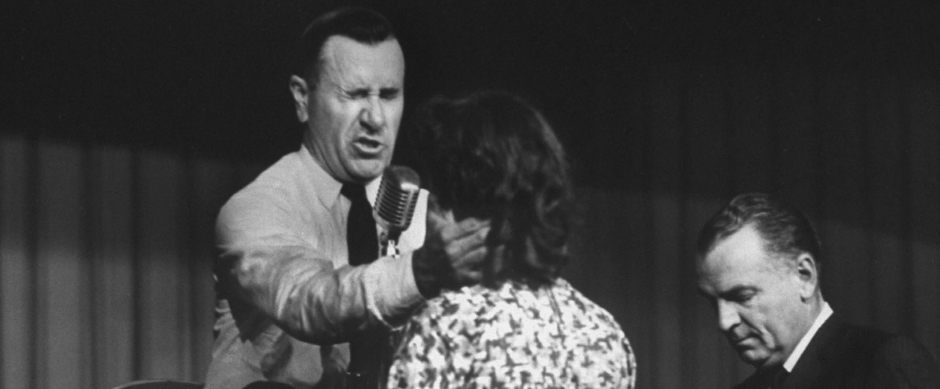
Just in the past few years, significantly, the figure of “Jesus” has been thrust into strange prominence in America. On stage and in films long-standing prohibitions against portraying the person of Christ have been abrogated. Sensationally popular musicals present blasphemous parodies of His life. The “Jesus Movement,” which is largely “charismatic” in orientation, spreads spectacularly among teenagers and young people. The crudest form of American popular music is “Christianized” at mass “Jesus-Rock Festivals,” and “Christian” tunes for the first time in the century become the most popular in the land. And underlying this whole strange conglomeration of sacrilege and absolute unenlightened worldliness is the constantly reiterated expression of seemingly everyone’s expectation and hope: “Jesus is coming soon.”
In the midst of this psychic and “religious” devastation of the American land, a symptomatic “mystical” occurrence has been repeating itself in the lives of widely-separated Americans. An editor of a “charismatic” magazine relates how he first encountered this occurrence as told by someone at a gathering of like-minded people:
“My friend and his wife were driving up to Boston on Route 3, when they stopped to pick up a hitchhiker. He was young and had a beard, but he wasn’t dressed like a hippie. He got in the back seat without saying much, and they drove on. After a while, he quietly said, “The Lord is coming soon.” My friend and his wife were so startled that they each turned around to look at him. There was no one there. Badly shaken, they pulled into the first gas station they came to. They had to tell someone else, no matter what the reaction. As the attendant listened, he didn’t laugh. Instead, all he said was, “You’re the fifth car to come in here with that story.” ’
“As I listened, in spite of the hazy sunlight, a chill began to creep up my backbone. Yet that was only the beginning. One by one, around the circle, others were led to recount similar incidents, until there were six all told, across the length and breadth of the country, and all had taken place within the past two years”—in Los Angeles, Philadelphia, Duluth (thirteen reports to the police in one night), New Orleans; sometimes the hitchhiker is a man, sometimes a woman. Later an Episcopalian priest told the editor of his own identical experience in upstate New York. To the editor, this all indicates that in fact “Jesus is coming soon.” [15].
The careful observer of the contemporary religious scene—especially in America, where the most popular religious currents have originated for over a century—cannot fail to notice a very decided air of chiliastic expectation. And this is not only true of “charismatic” circles, but even of the traditionalist or fundamentalist circles that have rejected the “charismatic revival.” Thus, traditionalist Catholics believe the chiliastic fantasies of an “Age of Mary” based on the pseudo-revelations of Fatima, and this is only one variant on the standard Latin heresy of “sanctifying the world,” or, as Archbishop Thomas Connolly of Seattle expressed it ten years ago, “transforming the modern world into the Kingdom of God in preparation for His return.” Protestant evangelists such as Billy Graham, in their mistaken private interpretation of the Apocalypse, await the “millenium” when “Christ” will reign on earth. Other evangelists in Israel find that their millenarian interpretation of the “Messiah” is just what is needed to “prepare” the Jews for his coming[16]. And the arch-fundamentalist Carl McIntire prepares to build a life-size replica of the Temple of Jerusalem in Florida (near Disneyworld!), believing that the time is at hand when the Jews will build the very “Temple to which the Lord Himself will return as He promised” [17]. Thus, even anti-ecumenists find it possible to prepare to join the unrepentant Jews in welcoming the false Messiah—Antichrist—in contrast to the faithful remnant of Jews who will accept Christ as the Orthodox Church preaches Him, when the Prophet Elijah returns to earth.
It is therefore no great consolation for a sober Orthodox Christian who knows the Scriptural prophecies concerning the last days, when he is told by a “charismatic” Protestant minister that “it’s glorious what Jesus can do when we open up to Him. No wonder people of all faiths are now able to pray together” [18]; or by a Catholic Pentecostal that the members of all the denominations now “begin to peer over those walls of separation only to recognize in each other the image of Jesus Christ” [19]. Which “Christ” is this for whom an accelerated program of psychological and even physical preparation is now being made throughout the world? —Is this our true God and Saviour Jesus Christ, Who founded the Church wherein men may find salvation? Or is it the false Christ who will come in his own name[20] and unite all who reject or pervert the teaching of the one Church of Christ, the Orthodox Church?
Our Saviour Himself has warned us:
Then if any man shall say unto you, Lo, here is the Christ, or Here; believe it not. For there shall arise false Christs, and false prophets, and shall show great signs and wonders, so as lo lead astray, if possible, even the elect. Behold I have told you beforehand. If therefore they shall say unto you. Behold, he is in the wilderness, go not forth; Behold, he is in the inner chambers, believe it not. For as the lightning com—eth forth from the east, and is seen even unto the west, so shall be the coming of the Son of man[21].
The Second Coming of Christ will be unmistakeable: it will be sudden, from heaven[22], and it will mark the end of this world. There can be no “preparation” for it—save only the Orthodox Christian preparation of repentance, spiritual life, and watchfulness. Those who are “preparing” for it in any other way, who say that he is anywhere “here”—especially “here” in the Temple of Jerusalem—or who preach that “Jesus is coming soon” without warning of the great deception that is to precede His Coming: are clearly the prophets of Antichrist, the false Christ who must come first and deceive the world, including all ’Christians’ who are not or do not become truly Orthodox. There is to be no “millenium.” For those who can receive it, the “millenium” of the Apocalypse[23] is now: the life of grace in the Orthodox Church for the whole “thousand years” between the First Coming of Christ and the time of Antichrist[24]. That Protestants should expect the “millenium” in the future is only their confession that they do not live in it in the present—that is, that they are outside the Church of Christ and have not tasted of Divine grace.
D. Must Orthodoxy Join the Apostasy?

Today some Orthodox priests, led by Fr. Eusebius Stephanou, would try to persuade us that the “charismatic revival,” even though it began and mostly continues outside the Orthodox Church, is nonetheless “Orthodox,” and we are even warned, “Don’t be left out.” But no one who has studied this movement in the works of its leading representatives, many of whom have been quoted above, can have any doubt that this “revival,” in so far as it is “Christian” at all, is entirely Protestant in its origin, inspiration, intent, practice, “theology,” and end. It is a form of Protestant “revivalism,” which is a phenomenon that preserves only a fragment of anything genuinely Christian, substituting for Christianity an emotional “religious” hysteria whose victim falls into the fatal delusion that he is “saved.” If the “charismatic revival” differs from Protestant revivalism, it is only in adding a new dimension of crypto-spiritistic phenomena which are more spectacular and more objective than mere subjective revivalism.
This evident fact is only strikingly confirmed by an examination of what Fr. Eusebius Stephanou tries to pass off for an “Orthodox awakening” in his periodical The Logos.
This Orthodox priest informs his readers that “it is the Protestant evangelists—not the Orthodox—that are doing so much to lead men to Jesus Christ,” whereas “the Orthodox Church is not sharing in the modern-day Christian awakening”.[25] He declares that Orthodox Christians must imitate the Protestants in holding “city-wide crusades in public auditoriums and stadiums” [26], and he himself now travels about holding revivalistic “rallies.” At one of these rallies “many Protestants were present. Several in attendance made a public rededication of their lives to Christ” [27]. In another place he gives this “public rededication” its proper Protestant name: he makes Orthodox Christians answer his “altar call” which is accompanied by the usual revivalistic “sobs and tears” [28]. Fr. Eusebius himself, with typical revivalistic immodesty, informs us that “I thank and praise God for shedding some of the light of His Spirit into my soul in response to the unceasing prayers I have been sending up night and day” [29]; and later he openly declares himself to be a “prophet” [30]. He mentions nothing whatever of the Orthodox interpretation of apocalyptic events, and yet he repeats Billy Graham’s fundamentalist Protestant interpretation of the “Rapture” that is to precede the “millenium”: “The Great Tribulation day approaches. If we remain true to Christ we will surely be caught up to be with Him at the sound of the glad rapture-shout and we will be spared the horrible destruction which is to fall upon the world” [31] [32]. And yet not even all fundamentalists are agreed on this error, (23) which has no foundation in Holy Scripture[33] and removes from those who follow it all necessity for watchfulness against the deceit of Antichrist, from which they imagine they will be spared.
All of this is not even pseudo-Orthodoxy; it is just plain Protestantism, and not even the best kind of Protestantism. One looks in vain in the Logos of Fr. Eusebius Stephanou for an indication that his “awakening” is inspired by the sources of the Orthodox ascetic tradition: the Lives of Saints, the ascetic Fathers, the Church’s cycle of services, the Orthodox interpretation of Holy Scripture. Some Orthodox “charismatics,” it is true, make use of some of these sources—but alas! they mix them together with “many other books written by devout Christians involved with the Charismatic movement” [34] and thus read them “charismatically”: like all sectarians, reading into Orthodox writings what they have learned from their new teaching, which comes from outside the Church. If they were well grounded in the Orthodox sources they would know that an Orthodox Christian, for the sake of his soul’s salvation, does not seek guidance from heterodox writings, in which there is no grace of the Holy Spirit. In the “Conversation” of St. Seraphim of Sarov (whom the Orthodox “charismatics” quote without the parts here italicized), this great Saint tells us: “The grace of the Holy Spirit which was given to us all, the faithful of Christ, in the sacrament of Holy Baptism, is sealed by the sacrament of Chrismation on the chief parts of our body, as appointed by the Holy Church, the eternal keeper of this grace.” And again: “The Lord listens equally to the monk and the simple Christian layman provided that both are Orthodox.” [35]
The grace of the Holy Spirit is given only in the Orthodox Church; and clearly, only those who have received it can speak about it. Then why this search for guidance from the heterodox, when we have our own true guidance? Why the adaptation from them of new religious practices and this blasphemous parody of a sacrament, the “laying on of hands,” when we have our own Divinely-instituted sacraments and rites? Why this pompous, vain— glorious talk of being “spirit-filled” on the part of people who are obviously ignorant and inexperienced in the first principles of Holy Orthodoxy? We know why the heterodox do these things: because they have no sacraments and no grace of the Holy Spirit. But Orthodox priests?
Our Lord Jesus Christ and His Prophets have told us clearly that our time is not to be one of many great signs and wonders, save those of the devil. But to our age another opportunity and gift have been given: confession of God’s truth. This opportunity is given today not only to those living under the atheist tyrannies behind the Iron Curtain or under the pseudo-Orthodox State in Greece, but also to every Orthodox Christian living in the Free World. Ours is an age of unparalled apostasy and blasphemy coming from those who sit on bishops’ thrones, led in the Free World by the heretics Athcnagoras and Iakovos, who openly state that the Orthodox Church is not the Church of Christ. It is noticeable that the Orthodox participants in the “charismatic revival” are not to be found in the battle against the great heresy of our time, ecumenism; indeed, they look with disdain upon our present-day Orthodox confessors who “preoccupy” themselves with “the spectre of ecumenism” [36]. It is clear that the Orthodox “charismatics” feel themselves to be above this battle, and several of the “charismatic” priests have no qualms in commemorating and concelebrating with the blatant heretic Iakovos, thus showing to the world that they share his heresy and place themselves, like him, outside the Church of Christ. They imagine that it is possible to receive the gifts of the Holy Spirit without confessing the unique and saving truth of Holy Orthodoxy, in which they evidently do not believe, inasmuch as they derive their inspiration and their new teaching from the heterodox, telling us that God is “temporarily bypassing the divinely established institutions of His one Church” [37]!. But no one who knows Orthodoxy could seek for the Holy Spirit in Protestant and Pentecostal writings; no one who practices Orthodoxy (for those who have the desire, there is the spiritually rich daily cycle of Orthodox services) could have a need or desire for a Protestant-type “prayer meeting”; no one who knows the lives and examples of our ancient and more recent Orthodox saints could find anything to imitate in the “charismatic” shamans of our day. Only abysmal ignorance and a stepping away from God’s grace given in the Orthodox Church could have led the Orthodox “charismatics” to tell us in effect that Orthodoxy is not enough, that we must follow a “New Christianity” that comes from outside the Church.
The Orthodox priests who have been drawn into the “charismatic revival” insist that it is the only alternative to the deadness, bickering, worldliness, and narrow unenlightened “ethnocentrism” that do indeed characterize a great number of the nominally Orthodox parishes in America. Alas, the blind would lead the blind! Could the apostate bishops themselves have devised a better religious circus by means of which to still the confessing voice of conscience of their priests and flocks and lead them into the very pit which they themselves approach? What Orthodox “charismatic” priest or layman can possibly object to the Unia with those very Protestants and Catholics with whom, as the interdenominational “charismatic” song goes, they are already “one in the Spirit, one in the Lord,” and who have led them and inspired their “charismatic” experience? The “charismatic revival” is only the experiential side of the prevailing “ecumenical” madness—a counterfeit Christianity that betrays Christ and His Holy Church. The “spirit” that has inspired the “charismatic revival” is the spirit of Antichrist, or more precisely, those “spirits of devils” of the last times whose “miracles” prepare the world for the false Messiah.
E. “Little Children, It Is the Last Hour” (I John 2:18)
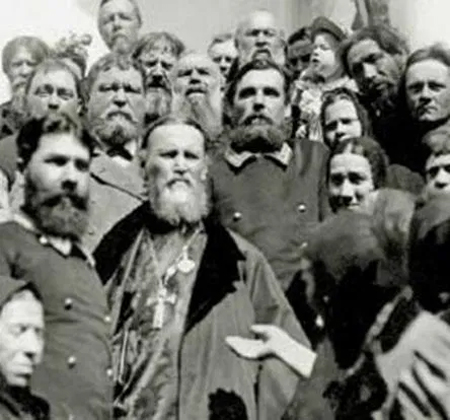
Unknown to the fevered Orthodox “revivalists,” the Lord God has preserved in America, even as in the days of Elijah the Prophet, seven thousand men who have not bowed the knee to Baal[38] — an unknown number of true Orthodox Christians who arc neither spiritually dead, as the Orthodox “charismatics” complain that their flocks have been, nor pompously “spirit-filled.” as these same flocks become under “charismatic” suggestion. They are not carried away by the movement of apostasy nor by any false “awakening,” but continue rooted in the holy and saving Faith of Holy Orthodoxy in the tradition the Holy Fathers have handed down to them, watching the signs of the times and travelling the narrow path to salvation. Many of them follow the last group of Orthodox bishops left on the American continent, the hierarchs of the Russian Church Outside of Russia; but there are also some left in other Orthodox “jurisdictions,” largely unseen, awaiting God’s more evident will for them; and there are still others outside of the Orthodox Church who by God’s grace, their hearts being open to His call, will doubtless yet be joined to genuine Holy Orthodoxy. These “seven thousand” are the foundation of the future and only Orthodoxy of America.
And outside of genuine Orthodoxy the darkness only grows. Judging from the latest “religious” news, the “charismatic revival” may well be only the faint beginning of a whole “age of miracles.” Many Protestants who have discerned the fraud of the “charismatic revival” now accept as “the real thing” the spectacular “revival” in Indonesia where, we are told, there are really occurring “the selfsame things that one finds reported in the Acts of the Apostles.” In the space of three years 200,000 pagans have been converted to Protestantism under constantly miraculous conditions: No one does anything except in absolute obedience to the “voices” and “angels” who are constantly appearing, usually quoting Scripture by number and verse; water is turned into wine every time the Protestant communion service comes around; detached hands appear from nowhere to distribute miraculous food to the hungry; a whole band of demons is seen to abandon a pagan village because a “more powerful” one (“Jesus”) has come to take their place; “Christians” have a “count-down” for an unrepentant sinner, and when they come to “zero” he dies; children are taught new Protestant hymns by voices that come from nowhere (and repeat the song twenty times so the children will remember); “God’s tape-recorder” records the song of a children’s choir and plays it back in the air for the astonished children; fire comes down from the sky to consume Catholic religious images (“the Lord” in Indonesia is very anti-Catholic); 30,000 have been healed; “Christ” appears in the sky and “falls” on people in order to heal them; people are miraculously transported from place to place and walk on water; lights accompany evangelists and guide them at night, and clouds follow them and give them shelter during the day; the dead are raised[39].
About the latter “miracle,” a correspondent of The Orthodox Word writes, “In Indonesia the cases of ’raising the dead’ (about twelve, I think) have been well documented. But two people we know (whom we believe to be both rational and honest and who say that they have had personal contact with such ’resurrected men’) claim they are not human beings at all, but human bodies that were entered into and activated by demons after the person died. The term they use is ‘hominoid.’”
Interestingly, in some parts of the Indonesian ‘revival’ the element of ‘speaking in tongues’ is almost totally absent and is even forbidden (although it is present in many places), and the element of mediumism seems sometimes to be replaced by a direct intervention of fallen spirits. It may well be that this new ‘revival,’ more powerful than Pentecostalism, is a more developed stage of the same ‘spiritual’ phenomenon (just as Pentecostalism itself is more advanced than spiritism) and heralds the imminence of the dreadful day when, as the ‘voices’ and ‘angels’ in Indonesia also proclaim, ‘the Lord’ is to come—for we know that Antichrist will prove to the world that he is ‘Christ’ by just such ‘miracles.’
In an age of almost universal darkness and deception, when for most “Christians” Christ has become precisely what Orthodox teaching means by Antichrist, the Orthodox Church of Christ alone possesses and communicates the grace of God. This is a priceless treasure the very existence of which is not so much as suspected even by the ‘Christian’ world. The ‘Christian’ world, indeed, joins hands with the forces of darkness in order to seduce the faithful of the Church of Christ, blindly trusting that the ‘name of Jesus’ will save them even in their apostasy and blasphemy, mindless of the fearful warning of the Lord:
Many will say to Me in that day, Lord, Lord, have we not prophesied, in Thy name? and in Thy name have cast out devils? and in Thy name done many wonderful works? And then will I profess unto them, I never knew you: depart from Me, ye that work iniquity [40].
St. Paul continues his warning about the coming of Antichrist with this command:
Therefore, brethren, stand fast, and hold the traditions which ye have been taught, whether by word, or our epistle [41]. There be some that trouble you, and would pervert the gospel of Christ. But though we, or an angel from heaven, preach any other gospel unto you than that which we have preached unto you, let him be anathema. As we said before, so say I now again: If any preach any other gospel unto you than that ye have received, let him be anathema [42].
The Orthodox answer to every new ‘revival,’ and even to the final terrible ‘revival’ of Antichrist, is this Gospel of Christ, which the Orthodox Church alone has preserved unchanged in an unbroken line from Christ and His Apostles, and the grace of the Holy Spirit which the Orthodox Church alone communicates, and only to her faithful children, who have received in Chrismation and kept the true seal of the gift of the Holy Spirit. Amen.
Sources Cited in the Text
Burdick, Donald W., Tongues—To Speak or not to Speak. Moody Press, 1969.
Christenson, Larry, Speaking in Tongues. Dimension Books, Minneapolis, 1968.
Du Plessis, David J., The Spirit Bade Me Go. Logos International,, Plainfield New Jersey, 1970.
Ford, J. Massingberd, The Pentecostal Experience. Paulist Press, N.Y., 1970.
Gelpi, Donald L., S.J., Pentecostalism, A Theological Viewpoint. Paulist Press, New York, 1971.
Harper, Michael, Life in the Holy Spirit. Logos Books, Plainfield, N.J. 1966.
Koch, Kurt, The Strife of Tongues. Kregel Publications, Grand Rapids, 1969.
Lillie, D. G., Tongues under Fire. Fountain Trust, London, 1966.
Ortega, Ruben, compiler, The Jesus People Speak Out. David C. Cook Publishing Co., Elgin, Ill., 1972.
Ranaghan, Kevin and Dorothy, Catholic Pentecostals. Paulist Press, 1969.
Sherrill, John L., They Speak with Other Tongues. Spire Books, Old Tappan, New Jersey, 1965.
Williams, J. Rodman, The Era of the Spirit. Logos International, 1971.
[1] Published in Russian with the Writings of Sts. Barsanuphius the Great and John, Moscow, 1855, pp. 654–655.
[2] Fr. Eusebius Stephanou in Logos, April, 1972, p. 3
[3] Now the Spirit speaketh expressly, that in the latter times some shall depart from the faith, giving heed to seducing spirits, and doctrines of devils; Speaking lies in hypocrisy; having their conscience seared with a hot iron; Forbidding to marry, and commanding to abstain from meats, which God hath created to be received with thanksgiving of them which believe and know the truth. For every creature of God is good, and nothing to be refused, if it be received with thanksgiving: For it is sanctified by the word of God and prayer. 1 Timothy 4 1-5
[4] And the sixth angel poured out his vial upon the great river Euphrates; and the water thereof was dried up, that the way of the kings of the east might be prepared. And I saw three unclean spirits like frogs come out of the mouth of the dragon, and out of the mouth of the beast, and out of the mouth of the false prophet. For they are the spirits of devils, working miracles, which go forth unto the kings of the earth and of the whole world, to gather them to the battle of that great day of God Almighty. Behold, I come as a thief. Blessed is he that watcheth, and keepeth his garments, lest he walk naked, and they see his shame. And he gathered them together into a place called in the Hebrew tongue Armageddon. Revelation 16 12-16
[5] And the Lord said, Hear what the unjust judge saith. And shall not God avenge his own elect, which cry day and night unto him, though he bear long with them? I tell you that he will avenge them speedily. Nevertheless when the Son of man cometh, shall he find faith on the earth? Luke 18 6-8
[6] And then shall that Wicked be revealed, whom the Lord shall consume with the spirit of his mouth, and shall destroy with the brightness of his coming: Even him, whose coming is after the working of Satan with all power and signs and lying wonders, And with all deceivableness of unrighteousness in them that perish; because they received not the love of the truth, that they might be saved. 2 Thessalonians 2 8-10
[7] The Orthodox Word, 1971, no. 3, p. 138.
[8] Harry Lunn, in Logos Journal, Nov.-Dec., 1971, pp. 44, 47
[9] Ranaghan, p. 236
[10] See The Orthodox Word, 1972, no. 1, pp. 38–39
[11] Logos, March, 1972, p. 8
[12] 2 Thessalonians 2 3-4, 9–12
[13] Then if any man shall say unto you, Lo, here is Christ, or there; believe it not. For there shall arise false Christs, and false prophets, and shall shew great signs and wonders; insomuch that, if it were possible, they shall deceive the very elect. Behold, I have told you before. Wherefore if they shall say unto you, Behold, he is in the desert; go not forth: behold, he is in the secret chambers; believe it not. For as the lightning cometh out of the east, and shineth even unto the west; so shall also the coming of the Son of man be. Matthew 24 23-27
[14] And seek not ye what ye shall eat, or what ye shall drink, neither be ye of doubtful mind. For all these things do the nations of the world seek after: and your Father knoweth that ye have need of these things. But rather seek ye the kingdom of God; and all these things shall be added unto you. Fear not, little flock; for it is your Father’s good pleasure to give you the kingdom. Sell that ye have, and give alms; provide yourselves bags which wax not old, a treasure in the heavens that faileth not, where no thief approacheth, neither moth corrupteth. For where your treasure is, there will your heart be also. Luke 12 29-34
[15] David Manuel, Jr., in Logos Journal, Jan.-Feb., 1972, p. 3
[16] See for example Gordon Lindsay. Israel’s Destiny and the Coming Deliverer, Christ for the Nations Publ. Co.; Dallas, Texas, pp. 28–30.
[17] Christian Beacon, Nov. 11, 1971; Jan. 6, 1972
[18] Harold Bredesen, in Logos Journal, Jan.-Feb., 1972, p. 24
[19] Kevin Ranaghan in Logos Journal, Nov.-Dec., 1971, p. 21
[20] Search the scriptures; for in them ye think ye have eternal life: and they are they which testify of me. And ye will not come to me, that ye might have life. I receive not honour from men. But I know you, that ye have not the love of God in you. I am come in my Father’s name, and ye receive me not: if another shall come in his own name, him ye will receive. How can ye believe, which receive honour one of another, and seek not the honour that cometh from God only? Do not think that I will accuse you to the Father: there is one that accuseth you, even Moses, in whom ye trust. John 5 39-45
[21] Matthew 24 23-27
[22] And when he had spoken these things, while they beheld, he was taken up; and a cloud received him out of their sight. And while they looked stedfastly toward heaven as he went up, behold, two men stood by them in white apparel; Which also said, Ye men of Galilee, why stand ye gazing up into heaven? this same Jesus, which is taken up from you into heaven, shall so come in like manner as ye have seen him go into heaven. Then returned they unto Jerusalem from the mount called Olivet, which is from Jerusalem a sabbath day’s journey. Acts 1 9-12
[23] And I saw thrones, and they sat upon them, and judgment was given unto them: and I saw the souls of them that were beheaded for the witness of Jesus, and for the word of God, and which had not worshipped the beast, neither his image, neither had received his mark upon their foreheads, or in their hands; and they lived and reigned with Christ a thousand years. But the rest of the dead lived not again until the thousand years were finished. This is the first resurrection. Blessed and holy is he that hath part in the first resurrection: on such the second death hath no power, but they shall be priests of God and of Christ, and shall reign with him a thousand years. And when the thousand years are expired, Satan shall be loosed out of his prison, And shall go out to deceive the nations which are in the four quarters of the earth, Gog and Magog, to gather them together to battle: the number of whom is as the sand of the sea. Revelation 20 4-8
[24] Such is the Orthodox teaching of Sts. Basil the Great, Gregory the Theologian, Andrew of Caesarea, and many other Fathers. See Archbishop Averky, Guide to the Study of the New Testament, Part II (in Russian), Jordanville, N.Y., 1956, pp. 434–438.
[25] Feb., 1972, p. 19
[26] Feb., 1972, p. 3
[27] March, 1972, p. 5
[28] April, 1972, p. 4
[29] Feb., 1972, p. 19
[30] April, 1972, p. 3
[31] Compare Billy Graham, World Aflame, Doubleday (Pocket Cardinal Ed.), New York, 1966, p. 178; C. H. Mackintosh, The Lord’s Coming, Moody Press, Chicago, pp. 30–31; and many other fundamentalists.
[32] April, 1972, p. 22
[33] 1 Thessalonians 4 16-17 refers to the Second Coming of Christ, which according to the Holy Fathers comes after the ‘tribulation’ and the reign of Antichrist.
[34] Logos, March, 1972, p. 16
[35] Orthodox Life, Jordanville, 1953, no 1, pp. 18 and 28.
[36] Logos, April, 1972, p. 9
[37] Logos, Jan., 1972, p. 14
[38] I say then, Hath God cast away his people? God forbid. For I also am an Israelite, of the seed of Abraham, of the tribe of Benjamin. God hath not cast away his people which he foreknew. Wot ye not what the scripture saith of Elias? how he maketh intercession to God against Israel, saying, Lord, they have killed thy prophets, and digged down thine altars; and I am left alone, and they seek my life. But what saith the answer of God unto him? I have reserved to myself seven thousand men, who have not bowed the knee to the image of Baal. Even so then at this present time also there is a remnant according to the election of grace. Romans 11 1-5
[39] See Kurt Koch. The Revival in Indonesia, Kregel Publications, 1970; and Mel Tari, Like a Mighty Wind, Creation House, Carol Stream, Ill., 1971.
[40] Matthew 7 22-23
[41] But we are bound to give thanks alway to God for you, brethren beloved of the Lord, because God hath from the beginning chosen you to salvation through sanctification of the Spirit and belief of the truth: Whereunto he called you by our gospel, to the obtaining of the glory of our Lord Jesus Christ. Therefore, brethren, stand fast, and hold the traditions which ye have been taught, whether by word, or our epistle. Now our Lord Jesus Christ himself, and God, even our Father, which hath loved us, and hath given us everlasting consolation and good hope through grace, Comfort your hearts, and stablish you in every good word and work. 2 Thessalonians 2 13-17
[42] I marvel that ye are so soon removed from him that called you into the grace of Christ unto another gospel: Which is not another; but there be some that trouble you, and would pervert the gospel of Christ. But though we, or an angel from heaven, preach any other gospel unto you than that which we have preached unto you, let him be accursed. As we said before, so say I now again, If any man preach any other gospel unto you than that ye have received, let him be accursed. For do I now persuade men, or God? or do I seek to please men? for if I yet pleased men, I should not be the servant of Christ. But I certify you, brethren, that the gospel which was preached of me is not after man. For I neither received it of man, neither was I taught it, but by the revelation of Jesus Christ. Galatians 1 6-12

by Saint Seraphim of Platina [†1982]
The Orthodox Word, 1972, Vol. 8, No. 2 (43) March-April, pp. 52-66, 71-95


Pas de commentaire