
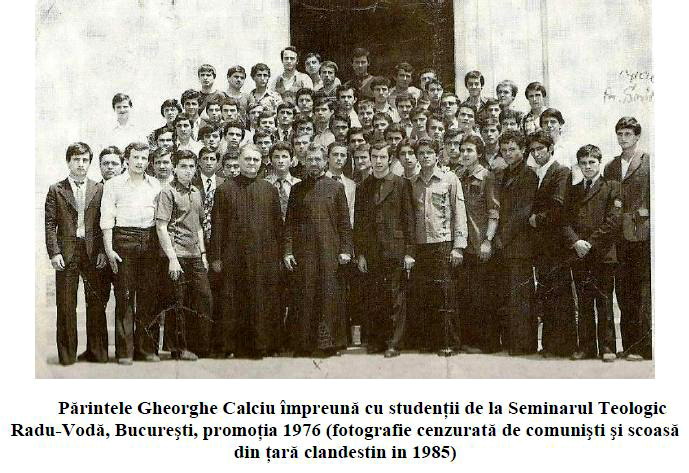
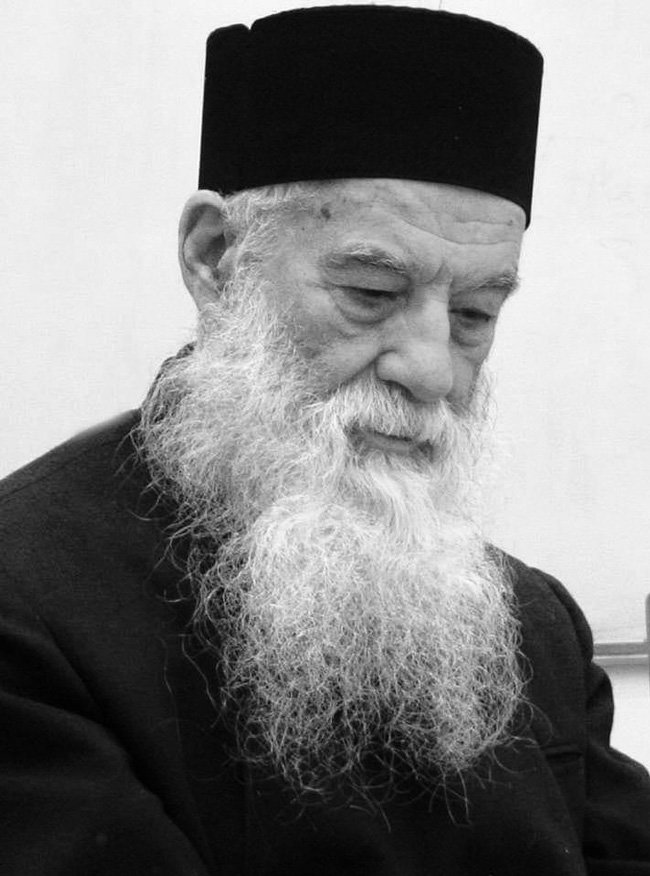
Sermons to young people by Father George Calciu-Dumitreasa.
Given at the Chapel of the Romanian Orthodox Church Seminary, Bucharest
FIFTH MEDITATION
April 5, 1980
Thou art a priest forever after
the order of Melchisadec.
Hebrews 5 6 [1]
Perhaps you have been asking yourself, my young friend, why I have even been addressing you, and by what authority? What right do I have to give this message which is disturbing you and obliging you to face up to disturbing questions? Why have I come to confirm you in your own misunderstood terror and to open up to you certain perspectives which are both new and unexpected? Why do I also break down your fragile balance of defenses?
Probably by uncovering for you the purity and innocence which you did not recognize, I have made you even more vulnerable in this wicked world. I have made you more open to suffering, and it is natural that you should ask what is the purpose of suffering. Is it a finality, a blind happening, a fate traced by the stars, a blinding ocean in which you swim without hope of reaching any shore?
I speak to you in the name and authority of Christ and His Church, in the name of the priesthood to which Christ called me, because nothing in this world is an interplay of unconscious, arbitrary happenings. All things stem from a cause and hold fast towards an end which stands outside this world. The cause is God, the end is God. He is the Beginning and the End, the Alpha and Omega.
But what is this world? What certainty does it offer us, what happiness awaits us at the unknown corners of life, like comfort in misfortune? I will not begin with death, nor life, nor with the beginning nor the end; but with the given: that which happens to us every day.
Have you asked yourself, young person, what is your purpose in the world and whether everything is reduced simply to that? If we were born to be slaves of matter—and this is only a philosophical proposition—then the end of your life is slavery. If your freedom is reduced to need and logic—which in the last analysis is the same thing-then your freedom is slavery. If all our knowledge is reduced to a sterile and never-realized understanding of the laws of matter, our knowledge is slavery. If your love is reduced to the struggle for existence, and our sacrifice is for the perpetuating of the species, then these things too are but slavery. And finally, if all our convictions spring from an imposed, official doctrine, then they too are slavery. And in all this series, young friend, where is the place for your soul?
You sense that there exists, away from all the materialism with which you have been intoxicated, and far from the atheism which has been imposed upon you like a violent ideology, something vaster, more authentic and yet closer to you personally than all that which suffocates you in this materialist bath. Your spirit within you propels you towards that “something”, as towards a world only envisioned and suspected.
This world, like the blue sky glistening in the sun, sees its own image through the grid of prohibitions which this society raises up to you.
Know, friend, that neither an atheist ideology, nor the materialist order, no matter how authoritatively it might be imposed upon you, is in any state to raise up an absolutely impregnable wall against you and the spiritual world. The soul cannot be made prisoner. This is a law which the materialists refuse to recognize at their own peril. On the spiritual level there is no captivity without hope.
Your teachers speak to you of atheism and secretly go to church. Behold a crack through which the golden light of the spiritual dimension reaches you. Your ideological leaders thunder and lighten against religion, uttering the most foul curses, yet at the moment of disaster they make the sign of the cross, asking for God’s help—as, for example, during the earthquake of March 4, 1977. Behold another crack through which the soul escapes the suffocating locker which the official ideology builds up by and by. In atheist meetings those obliged to speak condemn those who believe or who were caught in the criminal act of going to church. Yet away from the lying words, far from their false-toned platform proclamations, you discern their fear of being discovered as also having a religious belief. The lie in which they so lamentably swim breaks down once more the wall of your incarceration, and you say as the sweet light breaks through: “Whence this unnatural light? It is a light foreign to this world.”
I spoke to you about these things in my previous four sermons, I will continue to speak further about them—for I am a priest of Christ. God has discovered us through the sacramental love of His works, and Jesus has commanded me to make it known to you so that you will not say further: “I did not know it.”
I speak to you that you might know that you can fly, and that only spiritual flight is truly exalted. The flight of materialism is flight with broken wings. The Church of Christ has come out of the catacombs. She shines blindingly on the soil of this country which is highly esteemed in our hearts.
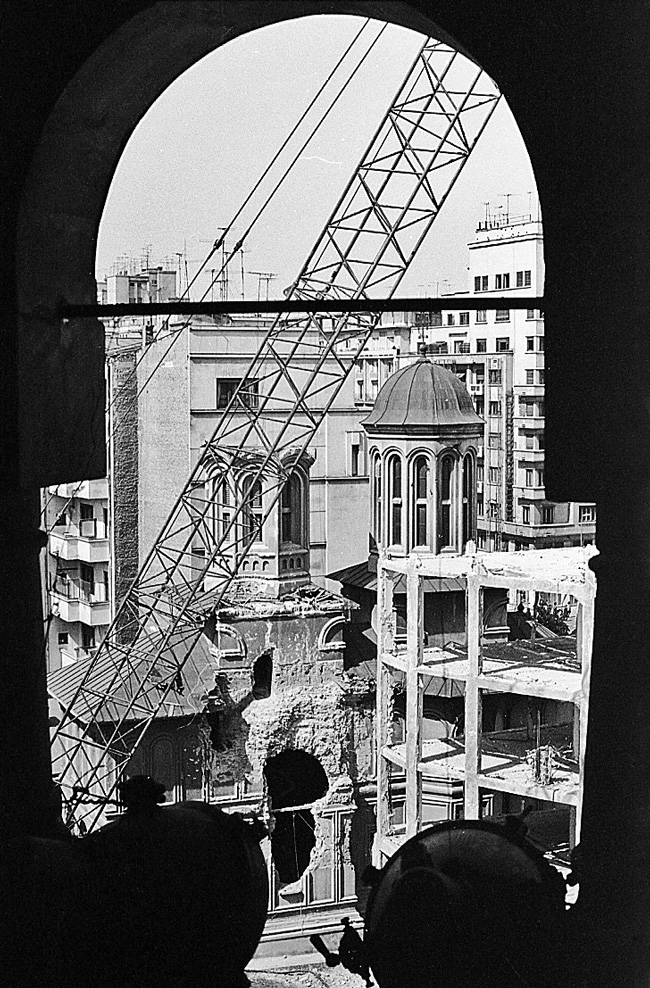
The Enea Church was destroyed—but who among us, Romanian and Christian, can forget it? A beer hall, a symbol of a concept which considers the Church a plague, will be put in its place. A beerhall—so once more the people will be happy! Woe to the architect who builds there, binding his name forever with the destruction of something that was a demonstration of the Romanian genius of construction and faith. Woe to the officials who believe that they can win glory and power by destroying a church and building a beerhall. Woe to the concept that considers an Agapia Inn more valuable than the Agapia Monastery. Woe to those who consider that the Romanian Patriarchate is a piece of history which can be placed in a museum, and who have not understood that it has a real life which is always present. It is not a historical relic but a living soul.
Woe to those who bow to force, allowing destruction which will never be accepted by history.
I have said all these things to you because I am a priest. And because we are priests and we listen to the command of God which says that a burning light cannot be hid under a bushel but must shine before all [2]. I have said these things, young friends, that you might judge if it is right before God to listen to men rather than God [3]. For He Who gave Himself upon the Cross for the salvation of the world, commanded us not to hide the divine truth. I have said all these things to you that you might understand that through faith we shatter walls and break down the bonds of prejudice and abuse, even if we shall have tribulation in this world [4].
There is a continual battle between good and evil, between right and wrong, between freedom and captivity of ideas, between purity and corruption. All these battles take place on the one single field of combat—the heart of man. I, the priest of Christ, address this heart; for as Pascal has said: “The heart has its own way of thinking, which reason ignores.”
What, then does the priesthood mean? It means to be an enduring witness to human suffering and to take it upon your own shoulders. To be the one who warms the leper at the breast and who gives to the miserable life through the breath from his own mouth. To be a strong comfort to every unfortunate one, even when you yourself are overwhelmed with weakness. To be a ray of shining light to unhappy hearts when your own eyes long ago ceased to see any light. To carry mountains of suffering on your shoulders, while your own being screams out with the weight of its own suffering.
Your flesh rebels and says: “This is absurd, impossible. Where is such a man, where is the priest you describe so that I may put my own suffering upon him?” Yet nevertheless he exists! From time to time there awakens within us the priest of Christ who, like the Good Samaritan, will kneel down by the side of the man fallen among thieves and, putting him upon his own donkey, will bring him to the Church of Jesus for healing. From time to time the priest of Christ in us forgets ourselves and comforts you, the man of suffering. Who else could be moved by your suffering?
Who else would bear your burden, say words of comfort to you? From whom else would you hear the words of Christ to you today: “Come to me, all who are burdened and heavy ladened.”
I have seen you, my young friend, bullied by your elders, mocked and insulted for the simple crime of being young. I spoke to you then as one in weakness and pain, as a sensitive and defenseless being. Then I saw you, to my horror and joy, bow and kiss my hand, humbling yourself in your unexpected gesture which flowed from the depth of your wounds. For you did not kiss my hand, but that of a priest of Christ who brought you comfort.
Because you have overcome death, to which atheist doctrine had condemned you, because you have been exalted above the ruins of fallen materialism through your youth and faith, I speak to you the words which Jesus spoke through the Apostle to the Gentiles. They sound absurd to the prisoner of matter and materialism, to those who substitute beerhalls for churches and indecency for suffering. But to you they will resound full of spiritual meaning and truth.
The preaching of the Cross is to them that perish foolishness; but unto us which are saved, it is the power of God. For it is written, I will destroy the wisdom of the wise, and will bring to nothing the understanding of the prudent. Where is the wise? where is the scribe? where is the disputer of this world? [5]
Where are all these men, my friends? There are none of them left. But you have remained here alive and whole in the Church of Christ, a holy people, won by God, a foundation stone on which the Orthodox spirit of the Romanian people is built. You are its single salvation and preservation through this age.
SIXTH MEDITATION
April 12, 1978
Verily, verily I say unto you. If
a man keep My saying, he shall
never see death.
John 8 51 [6]

We will talk today, friends, about death and resurrection. What a dissonance to your ears which know only of death and life! You know nothing, my dear friends, but the logical meaning of affirmations. Forcibly held by the materialist strait-jacket, you know that water flows to the valleys, that fire burns and clouds contain electrical current. But this information is intended to make you sleep easy, with your ears bent to obedience and your senses restricted to what is given to you. The universal remedy is offered to you like a slice of apple pie.
The deans of atheist ideologies have received inspiration which has placed them in possession of absolute truth: the substitution of one glaring error for another only a little less fantastic. The only problem is that each new error is imposed on you as an absolute truth. The attempt to criticize an ideological truth is a dangerous heresy. The official guardians of atheism begin at once to hunt the witch.
The poles of our existence stretch between life and death. That is what every materialist concept states. You, O man, are destined to be born and die as a caprice of nature, or as a simple joke of passion. You have no destiny. You follow the law of necessity and quantity, which through some miracle becomes quality, and you must accept this as the only law governing your life and death.
This means that you are the most unfortunate being on earth, for neither plants nor animals have any consciousness of life and death. But you do. You know that you live, and you especially know that you will die. Your whole life unfolds under the somber perspective of death. If our modern world has not increased at all the chances for life, it has multiplied infinitely the possibilities for death. Civilization and Death, the tragic horsemen of the Apocalypse have been ravaging our planet for centuries. And no angel of resurrection is evident on the horizon. No archangel shakes the heavens with his thunderous voice, commanding the horsemen to cease.
In the material heaven of the atheist, which defines your horizon for you, there are written the funeral words: “Nothing exists but life and death”. And after them a striking prohibition: “It is forbidden to believe in the resurrection!”
Friend, what has atheism given you in exchange for its dispossessing you of faith in the resurrection? What holy gift has it given you for taking away from you Jesus the Risen One? To what serene celebration has it called you when it put you to work on Easter and Christmas? What purification and spiritual rest has it outlined for you after the Christian celebrations were soiled with the dirt of denigration and violent verbal slogans? At another time, men sought to live out God’s time, dimensions stretching out towards infinity; today we speak of “meetings.”
At another time we reconciled ourselves at Easter to our fellow men with the words of the Paschal hymn: “Let us embrace one another. Let us say ‘Brother’ to those who hate us. Let us forgive all things for the sake of the Resurrection.” Today on Pascha we are issued rustic amusements, with alcoholic orgies which inevitably end up in violence.
You know, friends, that an idea is valid, not through the fact that it exists, but through its positive effects. So judge for yourself, my friend; compare and appreciate. But above all, commit yourself. For you must choose between good and evil; meekness and violence; life and death.
But now I want to take you with me onto another plain. To go on this unexpected flight you must renounce the prejudices which material sense has planted in your mind. You must purify your heart of passions which your educators have cultured within you with such care since your childhood, calling them by shining and virtuous names. You must wipe out faithlessness and atheism; hatred and lack of respect for men; servility and violence; cowardice and arrogance. And thus purified, you will be directed to the great festival of the Resurrection.
You must understand that the Resurrection of Christ is a renewal of the universe. Through your transformation the whole world is changed. At the Lord’s Supper, when Jesus announced His approaching sufferings, these suffering words were to assume a mystical and saving value for the whole world. You must understand that suffering leads to death, but death leads to resurrection.
Yet if there be no resurrection, if the only reality is death, then we are more unfortunate than stones. For in seeing things without faith, our life endures but from birth until death, which could be a day, or it could be 70 years; for from the moment of your birth you are old enough to die. What sense, then, has this short interval in face of the foreverness of death? To die like an animal means, simply and purely, to die. Like a stone loosened from its pile, or a calf struck by the axe of the butcher in the slaughterhouse. Such a death has nothing human in it. It is a nightmare. For beyond it there is no light, only terrible darkness. Human life, in its essence, is a tragedy because of the death and suffering which go with it.
Whether a believer or not, no man can escape that ultimate judgment which momentarily precedes the agony of death and which is the tribunal of our own conscience. Who among us will feel totally innocent at that judgment? Death with its somber absence of perspective terrifies us because absence of faith has weakened us and because, in the general fear which rules the world, death does not appear as liberator but as the supreme terror. For we have dehumanized death by violating the idea of God, and matter itself cannot dominate the spirit except by force.
The greatest and most emphatic atheists of our century, who have both made of matter a god, and of atheism a new mystical way, and have also used every means of persuasion to kill God in you, young friend, are themselves afraid of their own disappearance in an incurable, metaphysical fear. Thus they build monuments to themselves, attaching themselves to their earthly remains with a stupefying devotion. Tragically, they try to substitute their aspirations for eternity with these stones. The drama of their idolized lives ends in a more idolatrous death. They have lived in terror of suffering and have desired a sudden death. Yet death itself is an unbearable suffering because of its uselessness. They were not spared even this ultimate act of solidarity with mankind, namely death.
Indeed Jesus has given us a death without fear, a reconciliation between death and happiness. For He has brought to us the assurance that death is not the end, but a beginning. The beginning of eternal life is life through the resurrection.
To love someone is to say: “You will not die.” And you believe what you say. Yet this blind, irrational, inarguable faith is in fact the only fundamental truth which we feel with genuine profundity in our loving. I speak of all loves. The mother, caressing her child, says to him with a faith that carries mountains: “You will not die.” And she believes it. The beloved who buries a dear one with words of passion which melt the coffin, says in effect: “You will not die,” and she believes it.
Man’s darkened history knows one moment of sunshine, which since then has been poured over humanity, bathing it in the light of knowledge. I speak of the Sun of Righteousness, Christ Incarnate. The Son of God came into the world to save. What necessity could determine the Divine Perfection, Who knows no need, to become man? Nothing, save love. Only love is free and a liberating virtue. Not passion- love, but agape-love, which is compassion-love. For God so loved the world, that He gave His Only-begotten Son, that whosoever believeth in Him should not perish, but have ever-lasting life [7].
Thus Jesus became Love Incarnate, tangible love, crucified love. It was so hard for men to believe what they saw—for perfect love stood before them in human form. They wanted to verify its authenticity as if through fire, to contest if love would preserve its identity to the end. Jesus passed the examination to which mankind subjected Him.
Remember friends, His words from the Cross: Father, forgive them, for they know not what they do [8]. What greater proof of love could anyone give than this? And if you believe it when you tell your loved one “You will not die,” why do you not believe the words of supreme love when it promises you eternal life?
Verily, verily, I say unto you, he that believeth My word, and believeth on Him that sent Me, hath everlasting life, and shall not come into condemnation, but is passed from death to life. [9]
You believe, and you know that in truth you believe, and I also know, even if what you believe is not very clear, my friend. Yet to those who make in your young conscience room for the practice of violent doctrines, and to those who incarcerate your soul in the narrow forms of atheism, your faith is a reality which frightens them more than anything else.
Ideas are preserved through their truth. They do not need violence to persevere. An idea which is maintained through force and violence is deeply undermined by the falsehood within it. If materialists do not speak of death, it is because they are afraid of it and they pass over it in silence, just as they pass over all ideas which cannot be falsified.
Why was March 4 passed over in silence one year after the earthquake in 1977? Because death obliges you to think of God, of the life you have led and your moral responsibility. And so they fear your capacity for intuiting metaphysical truth and your spiritual freedom—just as much as they fear death.
I speak to you about death as your single possibility for resurrection. For without resurrection both life and death become nonsense, absurd. The love of God is the guarantee of our resurrection, and the resurrection is the fundamental of our faith in God and in Jesus Christ, His Son. It is the sublime and glorious occasion of a vital affirmation, an invitation to an amnesty of the past, as one French journalist described it during Catholic Easter. It is an invitation to a commitment in the future.
“Let us forgive all things because of the resurrection.” Any other attitude means death. He who died, the Same has also risen, and those who saw Him testified to the fact because they sealed it with their own suffering and death. Let us not doubt the truth of their accounts.
In the end of the Sabbath, as it began to dawn toward the first day of the week … behold, there was a great earthquake: for the angel of the Lord descended from heaven and came and rolled back the stone from the door, and sat upon it. His countenance was like lightning, and his raiment white as snow. [10]
This is the majestic depiction of the resurrection of the Lord, the One Who broke the bonds of death and brought to man the fearless perspective of the resurrection.
From now on young man, be not afraid of death. For Christ is risen, being the first fruit of the resurrection [11].
From the moment you discover this truth, your life has meaning. It will not finish up between four sides of a coffin and stay there—a fact which would make our lives a useless mockery. But passing through death, it issues forth to the glory of the resurrection. Go, young man, and tell this news to all; let the face of the angel of resurrection light shine—for the angel in you, which I uncovered in my first address, has overcome the world in you. Tell those who until now have oppressed your divine soul: “I believe in the resurrection,” and you will see them coil in fear, for your faith has overcome them. They will fret and shout to you that this world is your paradise and your instincts are your heaven.
But you should not stop, but go on, shining and pure, giving the light of that resurrection on the first of Sabbaths to all. You, my friend, are the one, unique bearer of your divinization in Jesus Christ, and with yourself you raise up the entire Romanian people to the height of its own resurrection. From death to life; and from earth to heaven!
[1] So also Christ glorified not himself to be made an high priest; but he that said unto him, Thou art my Son, to day have I begotten thee. As he saith also in another place, Thou art a priest for ever after the order of Melchisedec. Who in the days of his flesh, when he had offered up prayers and supplications with strong crying and tears unto him that was able to save him from death, and was heard in that he feared; Though he were a Son, yet learned he obedience by the things which he suffered; And being made perfect, he became the author of eternal salvation unto all them that obey him; Called of God an high priest after the order of Melchisedec. Hebrews 5 5-10
[2] Ye are the salt of the earth: but if the salt have lost his savour, wherewith shall it be salted? it is thenceforth good for nothing, but to be cast out, and to be trodden under foot of men. Ye are the light of the world. A city that is set on an hill cannot be hid. Neither do men light a candle, and put it under a bushel, but on a candlestick; and it giveth light unto all that are in the house. Let your light so shine before men, that they may see your good works, and glorify your Father which is in heaven. Matthew 5 13–16
[3] But when they had commanded them to go aside out of the council, they conferred among themselves, Saying, What shall we do to these men? for that indeed a notable miracle hath been done by them is manifest to all them that dwell in Jerusalem; and we cannot deny it. But that it spread no further among the people, let us straitly threaten them, that they speak henceforth to no man in this name. And they called them, and commanded them not to speak at all nor teach in the name of Jesus. But Peter and John answered and said unto them, Whether it be right in the sight of God to hearken unto you more than unto God, judge ye. For we cannot but speak the things which we have seen and heard. So when they had further threatened them, they let them go, finding nothing how they might punish them, because of the people: for all men glorified God for that which was done. Acts 4 15–21
[4] Jesus answered them, Do ye now believe? Behold, the hour cometh, yea, is now come, that ye shall be scattered, every man to his own, and shall leave me alone: and yet I am not alone, because the Father is with me. These things I have spoken unto you, that in me ye might have peace. In the world ye shall have tribulation: but be of good cheer; I have overcome the world. John 16 31–33
[5] For Christ sent me not to baptize, but to preach the gospel: not with wisdom of words, lest the cross of Christ should be made of none effect. For the preaching of the cross is to them that perish foolishness; but unto us which are saved it is the power of God. For it is written, I will destroy the wisdom of the wise, and will bring to nothing the understanding of the prudent. Where is the wise? where is the scribe? where is the disputer of this world? hath not God made foolish the wisdom of this world? For after that in the wisdom of God the world by wisdom knew not God, it pleased God by the foolishness of preaching to save them that believe. 1 Corinthians 1 17–21
[6] Then answered the Jews, and said unto him, Say we not well that thou art a Samaritan, and hast a devil? Jesus answered, I have not a devil; but I honour my Father, and ye do dishonour me. And I seek not mine own glory: there is one that seeketh and judgeth. Verily, verily, I say unto you, If a man keep my saying, he shall never see death. John 8 48–51
[7] Jesus answered and said unto him, Art thou a master of Israel, and knowest not these things? Verily, verily, I say unto thee, We speak that we do know, and testify that we have seen; and ye receive not our witness. If I have told you earthly things, and ye believe not, how shall ye believe, if I tell you of heavenly things? And no man hath ascended up to heaven, but he that came down from heaven, even the Son of man which is in heaven. And as Moses lifted up the serpent in the wilderness, even so must the Son of man be lifted up: That whosoever believeth in him should not perish, but have eternal life. For God so loved the world, that he gave his only begotten Son, that whosoever believeth in him should not perish, but have everlasting life. For God sent not his Son into the world to condemn the world; but that the world through him might be saved. He that believeth on him is not condemned: but he that believeth not is condemned already, because he hath not believed in the name of the only begotten Son of God. And this is the condemnation, that light is come into the world, and men loved darkness rather than light, because their deeds were evil. For every one that doeth evil hateth the light, neither cometh to the light, lest his deeds should be reproved. But he that doeth truth cometh to the light, that his deeds may be made manifest, that they are wrought in God. John 3 10–21
[8] And when they were come to the place, which is called Calvary, there they crucified him, and the malefactors, one on the right hand, and the other on the left. Then said Jesus, Father, forgive them; for they know not what they do. And they parted his raiment, and cast lots. And the people stood beholding. And the rulers also with them derided him, saying, He saved others; let him save himself, if he be Christ, the chosen of God. And the soldiers also mocked him, coming to him, and offering him vinegar, And saying, If thou be the king of the Jews, save thyself. Luke 23 33–37
[9] Then answered Jesus and said unto them, Verily, verily, I say unto you, The Son can do nothing of himself, but what he seeth the Father do: for what things soever he doeth, these also doeth the Son likewise. For the Father loveth the Son, and sheweth him all things that himself doeth: and he will shew him greater works than these, that ye may marvel. For as the Father raiseth up the dead, and quickeneth them; even so the Son quickeneth whom he will. For the Father judgeth no man, but hath committed all judgment unto the Son: That all men should honour the Son, even as they honour the Father. He that honoureth not the Son honoureth not the Father which hath sent him. Verily, verily, I say unto you, He that heareth my word, and believeth on him that sent me, hath everlasting life, and shall not come into condemnation; but is passed from death unto life. Verily, verily, I say unto you, The hour is coming, and now is, when the dead shall hear the voice of the Son of God: and they that hear shall live. John 5 19–25
[10] In the end of the sabbath, as it began to dawn toward the first day of the week, came Mary Magdalene and the other Mary to see the sepulchre. And, behold, there was a great earthquake: for the angel of the Lord descended from heaven, and came and rolled back the stone from the door, and sat upon it. His countenance was like lightning, and his raiment white as snow: And for fear of him the keepers did shake, and became as dead men. And the angel answered and said unto the women, Fear not ye: for I know that ye seek Jesus, which was crucified. He is not here: for he is risen, as he said. Come, see the place where the Lord lay. And go quickly, and tell his disciples that he is risen from the dead; and, behold, he goeth before you into Galilee; there shall ye see him: lo, I have told you. And they departed quickly from the sepulchre with fear and great joy; and did run to bring his disciples word. Matthew 28 1–8
[11] For if the dead rise not, then is not Christ raised: And if Christ be not raised, your faith is vain; ye are yet in your sins. Then they also which are fallen asleep in Christ are perished. If in this life only we have hope in Christ, we are of all men most miserable. But now is Christ risen from the dead, and become the firstfruits of them that slept. For since by man came death, by man came also the resurrection of the dead. For as in Adam all die, even so in Christ shall all be made alive. 1 Corinthians 15 16–22
Translation by Keston College, Kent, England
The Orthodox Word, Vol. 18, No. 2, March-April 1982, pp. 78-89


Pas de commentaire