
Chapter Three: The Six Days
(Day by Day)
(Genesis 1:1-25; 2:1-3)
4. The Fourth Day (Genesis 1:14-19)
1:14-19 And God said, Let there be lights in the firmament of the heavens to separate the day from the night, and let them be for signs and for seasons and for days and years, and let them be lights in the firmament of the heavens to give light upon the earth. And it was so. And God made the two great lights, the greater light to rule the day, and the lesser light to rule the night; He made the stars also. And God set them in the firmament of the heavens to give light upon the earth, to rule over the day and over the night, and to separate the light from the darkness. And God saw that it was good. And there was evening and there was morning, a fourth day.
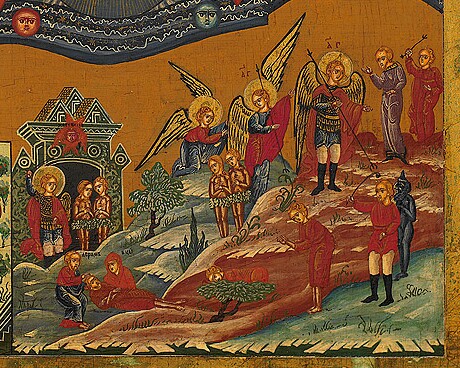
The Fourth Day of creation is a source of great embarrassment for those who would like to fit the Six Days into an evolutionary framework. There is absolutely no way this can be done if the sun was actually created on the Fourth Day.
For this reason, such apologists for the evolutionary interpretation have to believe that the sun was really created on the First Day with the heavens, but only appeared on the Fourth Day—apparently after the cloud covering of the earth during the first three days had lifted.
But we should remind ourselves once more that the first chapters of Genesis are not an account of the natural development of the earth according to the laws now governing this development, but an account of the miraculous beginnings of all things. We are not free to rearrange the Days of Genesis to fit our theories; we must rather humble our understanding so as to comprehend what the sacred text actually says. And here as always the Holy Fathers are our key to this comprehension. How did they understand the Fourth Day?
The Holy Fathers are unanimous in affirming that the sun and the heavenly luminaries were created on the Fourth Day; they did not merely appear then [1]. There is no reason why, if the text of Genesis permitted it, the Fathers could not have accepted the seemingly more “natural explanation” that the light of the sun illuminated the first three days of creation, but that the orb of the sun only became visible from earth on the Fourth Day. That they universally reject this explanation can only mean that the text of Genesis does not allow it.
St. John Chrysostom writes: “He created the sun on the fourth day so that you might not think that it produces the day.” [2]
St. Basil teaches:
The heavens and the earth had come first; after them, light had been created, day and night separated, and in turn, the firmament and dry land revealed. Water had been collected into a fixed and definite gathering. The earth had been filled with its proper fruits; for, it had brought forth countless kinds of herbs, and had been adorned with varied species of plants. However, the sun did not yet exist, nor the moon, lest men might call the sun the first cause and father of light, and lest they who are ignorant of God might deem it the producer of what grows from the earth… If the creation of light had preceded, why, now, is the sun in turn said to have been made to give light?… At the time (the First Day) the actual nature of light was introduced, but now this solar body has been made ready to be a vehicle for that first-created light… And do not tell me that it is impossible for these to be separated. I certainly do not say that the separation of light from the solar body is possible for you and me, but that that which we are able to separate in thought can also be separated in actuality by the Creator of its nature… “Let them serve,” He says, “for the fixing of days,” not for making days, but for ruling the days. For, day and night are earlier than the generation of the luminaries [3].
Look first upon the firmament of heaven which was made before the sun; look first upon the earth which began to be visible and was already formed before the sun put in its appearance; look at the plants of the earth which preceded in time the light of the sun. The bramble preceded the sun; the blade of grass is older than the moon. Therefore, do not believe that object to be a god to which the gifts of God are seen to be preferred. Three days have passed. No one, meanwhile, has looked for the sun, yet the brilliance of light has been in evidence everywhere. For the day, too, has its light which is itself the precursor of the sun [4].
But Divine revelation, as interpreted by the Holy Fathers, tells us the contrary: that the earth comes first, both in time and in significance, and the sun comes second. If our minds were not so chained to the intellectual fashions of the times, if we were not so fearful of being thought “behind the times,” we would not have such difficulty in opening our minds to this alternative explanation of the world’s beginnings.
In the Scriptural-Patristic view the earth, as the home of man, the pinnacle of God’s creation, is the center of the universe. Everything else—no matter what the scientific explanation of its present state and movement, or the physical immensity of it in comparison to the earth—is secondary, and was made for the sake of the earth, that is, for man. Our God is of such power and majesty that we need not doubt that in a single momentary exercise of His creative might He brought into being this whole earth—large to us, but only a speck in the whole universe—and that in another moment of His power He made the whole immensity of the stars of heaven. He could do vastly more than that if He willed; in the inspired text of Genesis He has left us the barest outline of what He did do, and this account is not required to accord with our human speculations and guesses.
In our days it has become fashionable and easy to believe that everything “evolved,” by absolutely uniform laws which we can now observe, from a primordial blob of energy or matter; if one needs “God” to explain anything, it is only to be the “creator” of this blob, or the initiator of the “big bang” that supposedly has produced everything there is. Today it requires a broader mind, less chained to “public opinion,” to begin to see the enormity of the creative acts of God as described in Genesis. The Holy Fathers—the most “sophisticated” and “scientific” minds of their time—can be the unchainers of our fettered minds.
But surely, it might be asked, the creations of God must make sense from the “natural” point of view also. Why, therefore, did God create such an enormous body as the sun to serve such a small body as the earth? Couldn’t He have conserved this energy and made a sun more in accordance with the scale of the earth?
One could, of course, conceive of a sun much smaller than the one we know and much closer to the earth, while preserving its apparent size as seen from the earth. But such a sun would expend its energy many times more rapidly than our present sun does. Evidently God made the sun the size and the distance from earth it needs to have if it is to give to earth the amount of light and heat it requires to support life to the end of this age, when the sun shall be darkened [5].
We may also see another, a mystical reason, for the fact that the light precedes the sun in the days of creation. Here, admittedly, we have no Fathers to quote, and we offer this interpretation as our own opinion.
We will see below that the separation of man into male and female was not part of the original “image” in which God created him; and we know that it will not be part of man’s nature in the eternal kingdom of heaven, for in the resurrection they neither marry, nor are given in marriage, but are as the angels of God in heaven [6]. Rather, God made the division into male and female foreseeing the fall of man and that the increase of mankind would require a passionate mode of generation.
Might it not be, then, that the sun and moon are also not part of God’s original “image” of His creation, but were only created to mark the days and months and years of man’s fallen estate? The original light, created on the First Day, had no need of a body to contain it. At the end of the world shall the sun be darkened, and the moon shall not give her light, and the stars shall fall from heaven [7]; and in the kingdom of heaven, as on the First Day of Creation, there will be once more light without the sun and moon—for the city had no need of the sun, neither of the moon, to shine in it; for the glory of the Lord did lighten it [8].
But these are mysteries at which we can do no more than guess.
5. The Fifth Day (Genesis 1:20-23)
1:20-23 And God said, Let the waters bring forth swarms of living creatures, and let birds fly above the earth across the firmament of the heavens. So God created the great sea monsters and every living creature that moves, with which the waters swarm, according to their kinds, and every winged bird according to its kind. And God saw that it was good. And God blessed them, saying, Be fruitful and multiply, and fill the waters in the seas, and let birds multiply on the earth. And there was evening and there was morning, a fifth day.
In his commentary on the Fifth Day of creation, St. John Chrysostom emphasizes the preciseness and accurateness of the order in which the creation is described.
The blessed Moses, instructed by the Spirit of God, teaches us with such detail … so that we might clearly know both the order and the way of the creation of each thing. If God had not been concerned for our salvation and had not guided the tongue of the Prophet, it would have been sufficient to say that God created the heaven, and the earth, and the sea, and living creatures, without indicating either the order of the days or what was created earlier and what later…. But he distinguishes so clearly both the order of creation and the number of days, and instructs us about everything with great condescension, in order that we, coming to know the whole truth, would no longer heed the false teachings of those who speak of everything according to their own reasonings, but might comprehend the unutterable power of our Creator [9].
Just as He said of the earth only: « Let it bring forth, » and there appeared a great variety of flowers, herbs, and seeds, and all occurred by His word alone, so here also He said: « Let the waters bring forth swarms of living creatures, and let birds fly above the earth across the firmament of the heavens »—and instantly there were so many kinds of crawling things, such a variety of birds, that one cannot number them in words [10].
St. Basil writes:
All water was in eager haste to fulfill the command of its Creator, and the great and ineffable power of God immediately produced an efficacious and active life in creatures of which one would not even be able to enumerate the species, as soon as the capacity for propagating living creatures came to the waters through His command [11].
And St. Ambrose:
At this command the waters immediately poured forth their offspring. The rivers were in labor. The lakes produced their quota of life. The sea itself began to bear all manner of reptiles… We are unable to record the multiplicity of the names of all those species which by Divine command were brought to life in a moment of time. At the same instant substantial form and the principle of life were brought into existence… The whale, as well as the frog, came into existence at the same time by the same creative power [12].
Here, as in the creation of all living things, God creates the first of each kind:
God orders the firstlings of each kind to be brought forth, seeds, as it were, for nature; and their numbers are controlled by successive progeny, whenever they must increase and become numerous[13].
Here, therefore, let us examine the meaning of the expression, repeated on each of the three days in which life is created, “each according to its kind.”
There can be no doubt whatever that the Holy Fathers understood, clearly and unanimously, that on these three days God created all the kinds of creatures that we know today. This can be seen in their often-repeated assertions that God creates immediately and instantly, that it is His word alone that brings the creatures into being, that it is not a natural property of the waters or earth to bring forth life. On the latter point St. Basil writes (speaking of the Sixth Day):
When He said: “Let it bring forth,” (the earth) did not produce what was stored up in it, but He Who gave the command also bestowed upon it the power to bring forth. Neither did the earth, when it heard, “Let it bring forth vegetation and the fruit trees, » produce plants which it had hidden in it; nor did it send up to the surface the palm or the oak or the cypress which had been hidden somewhere down below in its womb. On the contrary, it is the divine Word that is the origin of all things made. “Let the earth bring forth »; not, let it put forth what it has, but, let it acquire what it does not have, since God is enduing it with the power of active force [14].
The Holy Fathers have a very definite teaching on the “kinds” of creation. Let us only bear in mind here that we need not define precisely the limits of these kinds.” The “species” of modern taxonomy (the science of classification) are sometimes arbitrary and do not necessarily correspond to the “kinds” of Genesis; but in general one might say that the Fathers understand as included in a “kind” those creatures capable of producing a fertile offspring, as will be seen in what follows.
St. Basil teaches that the “kinds” of Genesis (except, of course, for those that may have become extinct) maintain their nature to the end of time:
There is nothing truer than this, that each plant either has seed or there exists in it some generative power. And this accounts for the expression “of its own kind.” For the shoot of the reed is not productive of an olive tree, but from the reed comes another reed; and from seeds spring plants related to the seeds sown. Thus, what was put forth by the earth in its first generation has been preserved until the present time, since the species persisted through constant reproduction [15].
And further:
The nature of existing objects, set in motion by one command, passes through creation without change, by generation and destruction, preserving the succession of the species through resemblance, until it reaches the very end. It begets a horse as the successor of a horse, a lion of a lion, and an eagle of an eagle; and it continues to preserve each of the animals by uninterrupted successions until the consummation of the universe. No length of time causes the specific characteristics of the animals to be corrupted or extinct, but, as if established just recently, nature, ever fresh, moves along with time [16].
In the pine cone nature seems to express an image of itself; it preserves its peculiar properties which it received from that divine and celestial command and it repeats in the succession and order of the years its generation until the end of time is fulfilled [17].
And the same Father says even more decisively:
The Word of God permeates every creature in the constitution of the world. Hence, as God had ordained, all kinds of living creatures were quickly produced from the earth. In compliance with a fixed law they all succeed each other from age to age according to their aspect and kind. The lion generates a lion; the tiger, a tiger; the ox, an ox; the swan, a swan; and the eagle, an eagle. What was once enjoined became in nature a habit for all time. Hence the earth has not ceased to offer the homage of her service. The original species of living creatures is reproduced for future ages by successive generations of its kind [18].][19]
The attempts of breeders, both of animals and plants, in all ages to make a new species by mating individuals of different species produces (when it succeeds) a result that only proves the Patristic maxim of the constancy of species: these “hybrids” are always and invariably sterile and cannot reproduce themselves. St. Ambrose uses this example to warn men against “unnatural unions” which go against the laws which God established in the Days of Creation:
What pure and untarnished generations follow without intermingling one after another, so that a thymallus produces a thymallus; a sea-wolf, a sea-wolf. The sea-scorpion, too, preserves unstained its marriage bed… Fish know nothing of union with alien species. They do not have unnatural betrothals such as are designedly brought about between animals of two different species as, for instance, the donkey and the mare, or again the female donkey and the horse, both being examples of unnatural union. Certainly there are cases in which nature suffers more in the nature of defilement rather than that of injury to the individual. Man as an abettor of hybrid barrenness is responsible for this. He considers a mongrel animal more valuable than one of a genuine species. You mix together alien species and you mingle diverse seeds [20].
The distinctness and integrity of the « seeds” of each of the “kinds” of creation is so much a part of Scriptural and Patristic thought that it serves in the Gospel as the basis for the Parable of our Lord regarding the distinctness of good and evil, virtue and sin. St. Ambrose uses this parable [21] to illustrate the integrity of the seeds of each “kind”:
There is no danger that the precept of God, to which nature has accustomed itself, may become void in future time by a failure of propagation, since today the integrity of the stock is still preserved in the seeds. We know that cockle and the other alien seeds which often are interspersed among fruits of the earth are called “weeds” in the Gospel. These, however, belong to a special species and have not degenerated into another species by a process of mutation from the seed of the wheat plant. The Lord told us that this is so when He said; ‘The Kingdom of Heaven is like a man who sowed good seed in his field, but while men were asleep, his enemy came and sowed weeds among the wheat.” We gather from this that weeds and wheat certainly seem to be distinct both in name and in kind. Hence, the servants, too, said to the householder: “Sir, didst thou not sow good seed in thy field? How then does it have weeds?” He said to them: “An enemy hath done this.” One is the seed of the devil; the other, that of Christ which is sown in accordance with justice. Therefore, the Son of Man sowed one and the devil sowed the other. For that reason the nature of each is distinct, since the sowers are opposed. Christ sows the kingdom of God, whereas the devil sows sin. How, therefore, can this kingdom be of one and the same race as sin? “This is the kingdom of God,” He says, as though a man should cast seed into the earth”.[22]
The idea of the consistency of nature and the integrity and distinctness of its « kinds” runs throughout Patristic literature. It serves as a model, for example, of the resurrection of the human body. St. Ambrose writes, in his treatise on the resurrection:
Nature in all its produce remains consistent with itself…. Seeds of one kind cannot be changed into another kind of plant, nor bring forth produce differing from its own seeds, so that men should spring from serpents and flesh from teeth; how much more, indeed, is it to be believed that whatever has been sown rises again in its own nature, and that crops do not differ from their seed, that soft things do not spring from hard, nor hard from soft, nor is poison changed into blood; but that flesh is restored from flesh, bone from bone, blood from blood, the humors of the body from humors. Can ye then, ye heathen, who are able to assert a change, deny a restoration of the nature? (On Belief in the Resurrection, II, 63,70, pp. 184-5).
In a similar view, St. Gregory of Nyssa writes:
Whereas we learn from Scripture in the account of the first Creation, that first the earth brought forth « the green herb » (as the narrative says), and that then from this plant seed was yielded, from which, when it was shed on the ground, the same form of the original plant again sprang up, the Apostle, it is to be observed, declares that this very same thing happens in the Resurrection also; and so we learn from him the fact, not only that our humanity will be then changed into something nobler, but also that what we have therein to expect is nothing else than that which was at the beginning (On the Soul and the Resurrection, p. 467). ] [24]
A strange parallel to the modem theory of universal evolution may be seen in the ancient pagan teaching of the transmigration of souls (reincarnation). The reaction of the Holy Fathers to this idea, which they universally condemned, shows how concerned they were to preserve the orderliness of creation and the distinctness of its kinds of creatures. St. Gregory of Nyssa writes:
Those who would have it that the soul migrates into natures divergent from each other seems to me to obliterate all natural distinctions; to blend and confuse together, in every possible respect, the rational, the irrational, the sentient, and the insensate; if, that is, all these are to pass into each other, with no distinct natural order secluding them from mutual transition. To say that one and the same soul, on account of a particular environment of body, is at one time a rational and intellectual soul, and that then it is caverned along with the reptiles, or herds with the birds, or is a beast of burden, or a carnivorous one, or swims in the deep; or even drops down to an insensate thing, so as to strike out roots or become a complete tree, producing buds on branches, and from those buds a flower, or a thorn, or a fruit edible or noxious—to say this, is nothing short of making all things the same and believing that one single nature runs through all beings; that there is a connection between them which blends and confuses hopelessly all the marks by which one could be distinguished from another [25].
6. The Sixth Day (Genesis 1:24-31)
1:24-31 And God said, Let the earth bring forth living creatures according to their kinds: cattle and creeping things and beasts of the earth according to their kinds. And it was so. And God made the beasts of the earth according to their kinds and the cattle according to their kinds, and everything that creeps upon the ground according to its kind And God saw that it was good.
The teaching of the Holy Fathers on the creation of the land animals on the Sixth Day does little more than repeat what has already been said about the other living creatures. Thus, St. Ephraim writes:
The earth at God’s command immediately brought forth creeping things, beasts of the field, creatures of prey, and domestic animals, as many as were necessary for the service of him who, on that very day, transgressed the commandment of his Lord [27].
St. Basil teaches:
The soul of brute beasts did not emerge after having been hidden in the earth, but it was called into existence at the time of the command [28].
With this act of creation, all is ready for the appearance of man, who is to be lord over it all. But this magnificent creation is not merely for the practical use of man. There is something mystical in it; being the good creation of the All-good God, it can raise our minds to Him. St. John Chrysostom writes:
God created everything not only for our use, but also that we, seeing the great wealth of his creations, might be astonished at the might of the Creator and might understand that all this was created with wisdom and unutterable goodness for the honor of man, who was to appear [29].
St. Basil, marvelling at the grandeur of God’s creation, says:
Let us glorify the Master Craftsman for all that has been done wisely and skillfully; and from the beauty of the visible things let us form an idea of Him Who is more than beautiful; and from the greatness of these perceptible and circumscribed bodies let us conceive of Him Who is infinite and immense and Who surpasses all understanding in the plenitude of His power. For even if we are ignorant of things made, yet, at least, that which in general comes under our observation is so wonderful that even the most acute mind is shown to be at a loss as regards the least of the things in the world, either in the ability to explain it worthily or to render due praise to the Creator, to Whom be all glory, honor, and power forever [30].
God made the world, as St. John Damascene teaches, because, “not content to contemplate Himself, by a superabundance of goodness He saw fit that there should be some things to benefit by and participate in this goodness.” [31]
Perhaps no part of Scripture expresses so well the awe-inspiring majesty of God in His creation, and man’s nothingness in comparison, as does the passage in which God speaks to Job out of the whirlwind:
Where wast thou when I founded the earth? Tell me now, if thou hast knowledge, who set the measures of it, if thou knowest? Or who stretched a line upon it? On what are its rings fastened? And who is he that laid the cornerstone upon it? When the stars were made, all My angels praised Me with a loud voice. And I shut up the sea with gates, when it rushed out, coming forth out of its mother’s womb. And I made a cloud its clothing, and swathed it in mist. And I set bounds to it, surrounding it with bars and gates. And I said to it, Hitherto shalt thou come, but thou shalt not go beyond, but thy waves shall be confined within thee. Or did I order the morning light in thy time; and did the morning star then first see his appointed place; to lay hold of the extremities of the earth, to cast out the ungodly out of it? Or didst thou take day of the ground, and form a living creature, and set it with the power of speech upon the earth? [32]
The Genesis account of the creation of man is given in two accounts, those of chapter one and chapter two; these we shall examine in the next chapter.
2:1-3 Thus the heavens and the earth were finished, and all the host of them. Andon the seventh day God finished His work which He had done, and He rested on the seventh day from all His work which He had done. So God blessed the seventh day and hallowed it, because on it God rested from all His work which He had done in creation.
Of this, God’s “sabbath” rest from creation, St. John Chrysostom writes:
The Divine Scripture indicates here that God rested from His works; but in the Gospel Christ says: “My Father worketh hitherto, and I work” [33]. In comparing these utterances, is there not a contradiction to be found in them? May it not be so; in the words of the Divine Scripture there is no contradiction whatever. When the Scripture here says: “God rested from all His works,” it thereby instructs us that on the Seventh Day He ceased to create and to bring out of non-existence into existence; but when Christ says: “My Father worketh hitherto, and I work,” it thereby indicates to us His uninterrupted Providence, and it calls “work” the preservation of what exists, the giving to it of continuance (of existence) and the governance of it at all times. Otherwise, how could the universe exist, if a higher hand did not govern and order everything visible and the human race? [34]
Viewing the marvel of what happens every day in what we have become accustomed to call “nature”—the development, for example, of a fully mature plant, animal, or even human being from a tiny seed—we cannot help but see the continuous creative activity of God. But this is not all the same as the Creation of the Six Days, the original bringing into being of everything there is. The first chapter of Genesis describes this unique and unrepeatable creation.
Being accustomed to the “working” of God in our present world, we can scarcely conceive that other kind of “work” which He did in the Six Days. The world, then, while perfect and fully formed, was still “new.” St. Gregory the Theologian emphasizes that when God wished to create Adam of the dust, “the Word, having taken a part of the newly-created earth, with His immortal hands formed my image” [35]. St. Ephraim the Syrian teaches:
Just as the trees, the grasses, the animals, birds and man were at the same time both old and young: old in the appearance of their members and structures, young in the time of their creation; so also the moon was at the same time both old and young: young because it was just created, old because it was full as on the fifteenth day [36].
St. Ephraim [37] and other Fathers emphasize this newness by stating their belief that the world was created in the spring. St. Ambrose ties this together with the fact that among the Hebrews the year began in the spring:
He created heaven and earth at the time when the months began, from which time it is fitting that the world took its rise. Then there was the mild temperature of spring, a season suitable for all things. Consequently, the year, too, has the stamp of a world coming to birth…. In order to show that the creation of the world took place in the spring. Scripture says: “This month shall be to you the beginning of months, it is for you the first in the months of the year” [38], calling the first month the springtime. It was fitting that the beginning of the year be the beginning of generation [39].
Now, after this look at the Holy Fathers’ very realistic understanding of the Six Days of Creation, let us turn to the more complex question of the making of the crown of God’s creation, man.
Chapter Four: The Creation of Man
1:26-27 Then God said Let us make man in our image, after our likeness, and let them have dominion over the fish of the sea, and over the birds of the air, and over the cattle, and over all the earth, and over every creeping thing that creeps upon the earth. So God created man in his own image, in the image of God He created him; male and female He created them.
We have seen that the creation of the Six Days is the work of the Holy Trinity, and in particular that the Father commands: “Let there be!” and the Son creates.
In the creation of man, however, a special consultation, as it were, is made between the Persons of the Trinity. Of this St. Basil says:
“Let us make man”… This word was not yet used for any of the organized beings; there was light, and the commandment was simple: “God said. Let there be light.” The heaven was made, and there was no deliberation for the heaven… Here, man is not yet, and there is a deliberation over man. God did not say, as for the other beings: “Let man be!” Recognize the dignity that belongs to you. He did not cause your origin by a commandment, but there was a consultation in God in order to know how to introduce into life this living being worthy of honor… Why did God not say, “Make,” but “Let us make man”? It is so that you might recognize the sovereignty. He desires that in bringing your attention on the Father, you would not deny the Son; He desires you to know that the Father has created by the Son and that the Son has created by the will of the Father, and that you should glorify the Father in the Son, and the Son in the Holy Spirit. . .
(But) He did not say: “And they created,” so that you might not draw from this a pretext for polytheism [40].
Similarly, St. John Chrysostom says:
Why, when the heaven was created, was it not said: “Let us make,” but rather: Let there be heaven, let there be light, and so concerning each part of creation; but here only is there added: “Let us make,” by which is expressed counsel, deliberation, and communication with someone equal in honor? Who is it that is to be created that he is granted such honor? It is man—a great and wondrous living being, and for God more precious than all the creation… There was counsel, deliberation, and communication, not because God has need of counsel—may this not be!—but in order by the very means of expression to show us the dignity of what is created… And Who is it to Whom God says: “Let us make man”? It is the Wonderful Counselor, Mighty God, Prince of Peace, Father of the age to come [41], the Only-begotten Son of God Himself. To Him He says: “Let us make man in our image, after our likeness.” He did not say: “In mine and thine,” or “in mine and yours,” but “in our image,” indicating a single image and a single likeness [42].
St. Gregory the Theologian speaks very poetically about the creation of man as a mixture of the higher and lower worlds that God had already created. First:
He gave being to the world of thought [i.e., the world of intellectual beings, angels), as far as I can reason on these matters, and estimate great things in my own poor language. Then, when this first Creation was in good order, He conceives a second world, material and visible; and this a system of earth and sky and all that is in the midst of them; an admirable creation indeed when we look at the fair form of every part, but yet more worthy of admiration when we consider the harmony and unison of the whole, and how each part fits in with every other in fair order… This was to show that He could call into being not only a nature akin to Himself (i.e. the angelic, invisible world), but also one altogether alien to Him. For akin to Deity are those natures which are intellectual, and only to be comprehended by mind; but all of which sense can take cognizance are utterly alien to It; and of these the furthest removed from It are all those which are entirely destitute of soul and power of motion. Mind, then, and sense, thus distinguished from each other, had remained within their own boundaries, and bore in themselves the magnificence of the Creator-Word, silent praisers and thrilling heralds of His mighty work. Not yet was there any mingling of both, nor any mixture of these opposites, tokens of a greater wisdom and generosity in the creation of natures; nor as yet were the whole riches of goodness made known. Now the Creator-Word, determining to exhibit this, and to produce a single living being out of both (the invisible and the visible creation, I mean) fashions Man; and taking a body from already existing matter, and placing in it a Breath taken from Himself (which the Word knew to be an intelligent soul, and the image of God), as a sort of second world, great in littleness, He placed him on the earth, a new Angel, a mingled worshipper, fully initiated into the visible creation, but only partially into the intellectual; king of all upon earth, but subject to the King above; earthly and heavenly, temporal and yet immortal; visible and yet intellectual; half-way between greatness and lowliness; in one person combining spirit and flesh; spirit because of the favor bestowed on him, flesh on account of the height to which he had been raised; the one that he might continue to live and glorify his benefactor, the other that he might suffer, and by suffering be put in remembrance, and be corrected if he became proud in his greatness; a living creature, trained here and then moved elsewhere; and to complete the mystery, deified by its inclination to God [43].
What is this image of God? Different Holy Fathers have emphasized different aspects of the image of God in man: some have mentioned man’s dominion over the lower creation (which is mentioned specifically in the text of Genesis); others, his reason; still others, his freedom. St. Gregory of Nyssa sums up the meaning of the image of God most concisely:
He creates man for no other reason than that He is good; and being such, and having this as His reason for entering upon the creation of our nature, He would not exhibit the power of this goodness in an imperfect form, giving our nature some one of the things at His disposal, and grudging it a share in another: but the perfect form of goodness is here to be seen by His both bringing man into being from nothing, and folly supplying him with all good gifts. But since the list of individual good gifts is a long one, it is out of the question to apprehend it numerically. The language of Scripture therefore expresses it concisely by a comprehensive phrase, in saying that man was made “in the image of God”: for this is the same as to say that He made human nature participant in all good; for if the Deity is the fullness of good, and this is His image, then the image finds its resemblance to the Archetype in being filled with all good [44].
What is the difference between the “image” and the “likeness” of God in man? The Holy Fathers explain that the image is given to us in foil and cannot be lost; the likeness, however, was given in the beginning only potentially, and man himself was to work on attaining its perfection. St. Basil the Great teaches:
“Let us make man in our image, after our likeness.” We possess the one by creation, we acquire the other by free will. In the first structure it is given us to be born in the image of God; by free will there is formed in us the being in the likeness of God… “Let us make man in Our image”: Let him possess by creation what is in the image, but let him also become according to the likeness. God has given the power for this; if He had created you also in the likeness, where would your privilege be? Why have you been crowned? And if the Creator had given you everything, how would the kingdom of heaven have opened for you? But it is proper that one part is given you, while the other has been left incomplete: this is so that you might complete it yourself and might be worthy of the reward which comes from God [45].
In the very passage of Genesis which describes the creation of man, it is said that he was created “male and female.” Is this distinction, then, part of the image of God? St. Gregory of Nyssa explains that the Scripture refers here to a twofold creation of man:
That which was made “in the image” is one thing, and that which is now manifested in wretchedness is another. “God created man,” it says; “in the image of God created He him.” There is an end of the creation of that which was made “in the image”: then it makes a resumption of the account of creation, and says, “male and female created He them.” I presume that everyone knows that this is a departure from the Prototype: for “in Christ Jesus,” as the Apostle says, “there is neither male nor female.” Yet the phrase declares that man is thus divided. Thus the creation of our nature is in a sense twofold: one made like to God, one divided according to this distinction: for something like this the passage darkly conveys by its arrangement, where it first says, “God created man, in the image of God created He him,” and then, adding to what has been said, “male and female created He them,”—a thing which is alien from our conception of God. I think that by these words Holy Scripture conveys to us a great and lofty doctrine; and the doctrine is this. While two natures—the Divine and incorporeal nature, and the irrational life of brutes—are separated from each other as extremes, human nature is the mean between them (this is similar to the idea of St. Gregory the Theologian we have already quoted): for in the compound nature of man we may behold a part of each of the natures I have mentioned—of the Divine, the rational and intelligent element, which does not admit the distinction of male and female; of the irrational, our bodily form and structure, divided into male and female: for each of these elements is certainly to be found in all that partakes of human life. That the intellectual element, however, precedes the other, we learn as from one who gives in order an account of the making of man; and we learn also that his community and kindred with the irrational is for man a provision for reproduction… He Who brought all things into being and fashioned man as a whole by His own will to the Divine image… saw beforehand by His all-seeing power the failure of their will to keep a direct course to what is good, and its consequent declension from the angelic life, in order that the multitude of human souls might not be cut short by its fall… He formed for our nature that contrivance for increase which befits those who had fallen into sin, implanting in mankind, instead of the angelic majesty of nature, that animal and irrational mode by which they now succeed one another [46].[47]
Thus the image of God, which, as all the Holy Fathers teach, is to be found in the soul and not the body of man, has nothing to do with the division into male and female. In God’s idea of man, one might say—man as he will be in the Kingdom of Heaven—there is neither male nor female; but God, foreknowing man’s fall, made this division which is an inseparable part of man’s earthly existence.
However, the reality of sexual life did not come about before the fall of man. St. John Chrysostom, commenting on the passage, “Now Adam knew Eve his wife, and she conceived” [48]—which occurred after the fall—says:
After the disobedience, after the banishment from paradise, then it was that married life began. Before the disobedience, the first people lived like angels, and there was no talk of cohabitation. And how could this be, when they were free of bodily needs? Thus, in the beginning life was virginal; but when, because of the carelessness (of the first people) disobedience appeared and sin entered the world, virginity fled away from them, since they had become unworthy of such a great good, and in its place there entered into effect the law of married life [49].
And St. John Damascene writes:
Virginity was practiced in paradise. . . After the fall, . . . to keep the race from dwindling and being destroyed by death, marriage was devised, so that by the begetting of children the race of men might be preserved. But they may ask: What, then, does “male and female” mean, and “increase and multiply”? To which we shall reply that the “increase and multiply” does not mean increasing by the marriage union exclusively, because if they had kept the commandment unbroken forever, God could have increased the race by some other means. But, since God, Who knows all things before they come to be, saw by His foreknowledge how they were to fall and be condemned to death, He made provision beforehand by creating them male and female and commanding them to increase and multiply [50].
In this as in other respects, as we shall see later, man—like the rest of the creation—before the fall was in a state different from that after the fall, even though there is a continuity between these two states provided by God’s foreknowledge of the fall.
It should not be thought, however, that any of the Holy Fathers looked upon marriage as a “necessary evil” or denied that it is a state blessed by God. They regard it as a good thing in our present state of sin, but it is a good thing that is second to the higher state of virginity in which Adam and Eve lived before their fall, and which is shared even now by those who have followed the counsel of the Apostle Paul “to be even as I am” [51]. St. Gregory of Nyssa, the very Father who teaches so dearly the origin of marriage in our kinship with the beasts, also defends the institution of marriage in the dearest fashion. Thus, in his treatise “On Virginity,” he writes:
Let no one think that we depreciate marriage as an institution. We are well aware that it is not a stranger to God’s blessing. . . But our view of marriage is this: that, while the pursuit of heavenly things should be a man’s first care, yet if he can use the advantages of marriage with sobriety and moderation, he need not despise this way of serving the stare. . . Marriage is the last stage of our separation from the life that was led in Paradise; marriage is the first thing to be left; it is the first station, as it were, for our departure to Christ [52].
1:28 And God blessed them, and God said to them, Be fruitful and multiply, and fill the earth and subdue it; and have dominion over the fish of the sea and over the birds of the air and over every living thing that moves upon the earth.
“Be fruitful and multiply” are the very words already addressed by God to the creatures of the water [53] and indicate man’s kinship with the lower creation and, through his fall, with their mode of sexual generation. But there is also a deeper meaning to these words. St. Basil writes:
There are two kinds of increase: that of the body, and that of the soul. The increase of the soul is the development of knowledge with the aim of perfection; the increase of the body is the development from smallness to normal stature. To the animals deprived of reason He therefore said “increase” according to bodily development, in the sense of completing nature; but to us He said “increase” according to the interior Man, in the line of progress that leads to God. This is what Paul did, stretching out towards that which is ahead, forgetting that which he leaves behind [54]. Such is the increase in spiritual things… “Multiply”: This blessing concerns the Church. Let the Divine word not be limited to a single individual, but let the Gospel of salvation be preached throughout the earth. “Multiply”: to whom is this order addressed? —To those who give birth according to the Gospel… Thus, these words apply equally well to the animals deprived of reason, but they acquire a particular meaning when we have to do with the being who is in the image with which we have been honored [55].
Man is to “have dominion,” also, not only over the external creation, but also over the beast-like passions that lurk within him. St. Basil writes:
You have dominion over every kind of savage beast. But, you will say, do I have savage beasts within me? Yes, many of them. It is even an immense crowd of savage beasts that you carry within yourself. Do not take this as an insult. Is not anger a small wild beast when it barks in your heart? Is it not more savage than the first dog that comes? And is not the trickery that crouches in a treacherous soul more ferocious than the bear of the caverns?… What kind of savage beast do we not have within us?… You were created to have dominion; you are the master of the passions, the master of savage beasts, the master of serpents, the master of birds… Be master of the thoughts within you in order to become master of all beings. Thus, the power which was given us through living beings prepares us to exercise dominion over ourselves. [56]
The beast-like passions are within us owing to our kinship with the animal creation through our fall. St. Gregory of Nyssa writes:
As brute life first entered into the world, and man, for the reason already mentioned, took something of their nature (I mean the mode of generation), he accordingly took at the same time a share of the other attributes contemplated in that nature; for the likeness of man to God is not found in anger, nor is pleasure a mark of the superior nature; cowardice also, and boldness, and the desire of gain, and the dislike of loss, and all the like, are fir removed from that stamp which indicates Divinity. These attributes, then, human nature took to itself from the side of the brutes [57].
This is a very profound teaching. The people who believe in evolutionary ideas say, “Man comes from monkeys; therefore, you’re an animal-like creature.” There is something similar being said here: that we are a mingled creation, part heavenly, part earthly. In the earthly side, God made allowance for the animal-like mode of reproduction; and thus we see how animalistic we are when we let passions control us. We have these “animals” within ourselves, but we also have the heavenly side, to which we are striving to get back[58].
1:29-30 And God said. Behold I have given you every plant yielding seed which is upon the face of all the earth, and every tree with seed in its fruit; you shall have them for food And to every beast of the earth, and to every bird of the air, and to every thing that creeps on the earth, everything that has the breath of life, I have given every green plant for food And it was so.
Here we are told that in the beginning, when the earth and all its creatures were still new and man had not fallen, not only men, but even the beasts, were given only green plants for food; the beasts were not meant to be, and in the beginning were not, carnivorous. Of this St. Basil says:
Let the Church neglect nothing: everything is a law. God did not say: “I have given you the fishes for food, I have given you the cattle, the reptiles, the quadrupeds.” It is not for this that He created, says the Scripture. In fact, the first legislation allowed the use of fruits, for we were still judged worthy of paradise. What is the mystery which is concealed for you under this? To you, to the wild animals and the birds, says the Scripture, fruits, vegetation, and herbs (are given)… We see, however, many wild animals who do not eat fruits. What fruit does the panther accept to nourish itself? What fruit can the lion satisfy himself with? Nevertheless, these beings, submitting to the law of nature, were nourished by fruits. But when man changed his way of life and departed from the limit which had been assigned him, the Lord, after the flood, knowing that men were wasteful, allowed them the use of all foods: “Eat all that in the same way as edible plants” [59]. By this allowance, the other animals also received the liberty to eat them. Since then the lion is a carnivore, since then also vultures watch for carrion. For the vultures were not yet looking over the earth at the very moment when the animals were born; in fact, nothing of what had received designation or existence had yet died so that the vultures might eat them. Nature had not yet divided, for it was in all its freshness; hunters did not capture, for such was not yet the practice of men; the beasts, for their part, did not yet tear their prey, for they were not carnivores… But all followed the way of the swans, and all grazed on the grass of the meadow. . . Such was the first creation, and such will be the restoration after this. Man will return to his ancient constitution in rejecting malice, a life weighed down with cares, the slavery of the soul with regard to daily worries. When he has renounced all this, he will return to that paradisal life which was not enslaved to the passions of the flesh, which is free, the life of closeness to God, a partaker of the life of the angels [60].
This life of the original creation, it should be noted, is not the life of paradise, into which man has not yet been led; it is the life of the earth outside of paradise, which God has already blessed as man’s dwelling-place after his fall. St. Ephraim the Syrian writes of this:
God blessed our first ancestors on the earth, because, even before they sinned He prepared the earth for their dwelling; for, before they sinned, God knew that they would sin… He blessed (man) before settling him in paradise, on the earth, so that by the blessing, which was preceded by His goodness, He might weaken the power of the curse which soon struck the earth [61].
In the beginning, therefore, before man’s fall, the whole earth was like a kind of paradise. St. Symeon the New Theologian teaches:
God, in the beginning, before He planted Paradise and gave it over to the first-created ones, in five days set in order the earth and what is on it, and the heaven and what is in it. And on the sixth day He created Adam and placed him as lord and king of the whole visible creation. Then there was not yet paradise. But this world was from God as a kind of Paradise, although it was material and sensuous… God gave it over to the authority of Adam and all his descendants, as the divine Scripture says (Gen. 1:26-30)… God gave over to man at the beginning this whole world as a kind of Paradise… Adam was made with a body that was incorrupt, although material and not yet spiritual, and was placed by the Creator God as an immortal king over an incorrupt world, not only over Paradise, but also over the whole of creation which was under the heavens. . . This whole creation in the beginning was incorrupt and was created by God in the manner of Paradise. But later it was subjected by God to corruption, and submitted to the vanity of men [62].
1:31 And God saw everything that He had made, and behold, it was very good. And there was evening and there was morning, a sixth day.
The first chapter of Genesis is entirely devoted to the Six Days of Creation. In chapter two, the creation of man is described in more detail. One might say that chapter one describes the creation of humanity, both in the exalted sense as God’s image, and in its divided, earthly aspect as male and female; while in chapter two the specific creation of the first man Adam and the first woman Eve is set forth. Some of the other creations of the Six Days are also mentioned in chapter two, but not in the strict chronological order of the first chapter. We should keep this in mind to avoid the elementary mistakes of rationalist critics who find “contradictions” between these two chapters and suppose there must be different authors of them.
2:4-6 These are the generations of the heavens and of the earth when they were created in the day that the Lord God made the earth and the heavens, and every plant of the field before it was in the earth, and every herb of the field before it grew: for the Lord God had not caused it to rain upon the earth, and there was not a man to till the ground But there went up a mist from the earth, and watered the whole face of the ground.
This is a brief description of the state of the world before the appearance of man, emphasizing that without God there would have been nothing, that He brought everything into being out of nothing. St. John Chrysostom comments on this passage:
When (the Scripture) speaks of heaven and earth, it understands everything together that is in heaven and on earth. Therefore, just as in the account of the creatures (in chapter one) it does not speak about all of them in order, but having mentioned the most important, it does not relate to us about each one in detail—so also this whole book, although it contains in itself much else, it calls the book of “the generations of the heaven and of the earth,” allowing us to conclude from the mention of them that in this book is to be included every— thing visible that is in heaven and on earth… The Holy Spirit shows… what occurred first and what afterwards, and likewise the fact that the earth produced its seeds by the word and command of the Lord and began to give birth without needing either the cooperation of the sun, nor the moisture of rain, nor the tilling of man, who was not yet created… This (passage) means that what had not existed previously received existence, and what had not been appeared suddenly by His word and command… All this is so that we might know that the earth, for the germination of its seeds, had no need of the cooperation of other elements, but the command of the Creator was sufficient for it [63].
2:7 Then the Lord God formed man of dust from the ground, and breathed into his nostrils the breath of life; and man became a living being.
Here we are given as much as we can know of the how of man’s creation. There can be no doubt that the Holy Fathers understood by “dust” the literal dust of the earth; but when they speak of the “hands” of God which “took” this dust, they mean to emphasize the great cate of God and His direct action in this work. Blessed Theodoret [64] writes:
When we hear in the account of Moses that God took dust from the earth and formed man, and we seek out the meaning of this utterance, we discover in it the special good disposition of God towards the human race. For the great prophet notes, in his description of the creation, that God created all the other creatures by His word, while man He created with His own hands. . . We do not say that the Divinity has hands… but we affirm that every one of these expressions indicates a greater care on God’s part for man than for the other creatures [65].
St. Basil states that this verse emphasizes how different in his origin is man from the animals:
Above, the text says that God created; here it says how God created. If the verse had simply said that God created, you could have believed that He created [man] as He did for the beasts, for the wild animals, for the plants, for the grass. This is why, to avoid your placing him in the class of wild animals, the Divine word has made known the particular art which God has used for you: “God took of the dust of the earth”.[66]
The same Father tells of the difference between the “creation” of man and his “fashioning”:
God created the inward man, and fashioned the outward man. Fashioning is suited to the day, and creation to that which is in the image. Thus, the flesh was fashioned, but the soul was created [67]. The creation of man indicates both his greatness and his nothingness: “God took of the dust of the earth and fashioned man.” In this world I have discovered the two affirmations that man is nothing and that man is great. If you consider nature alone, he is nothing and has no value; but if you regard the honor with which he has been treated, man is something great… If you consider what it is that (God) took, what is man? But if you reflect on the One Who fashioned, what a great thing is man! Thus at the same time he is nothing because of the material, and great because of the honor [68].
In the usual interpretation of the Holy Fathers, what was “breathed” into man was his soul. St. John Chrysostom writes:
“And the Lord God formed man of the dust of the ground, and breathed into his nostrils the breath of life!” Moses used such a crude manner of speaking because he was speaking to people who could not listen to him otherwise, as we are able to do; and also to show us that it was pleasing to God’s love of mankind to make this thing created out of earth a participant of the rational nature of the soul, through which this living creature was manifest as excellent and perfect. “And He breathed into his nostrils (face?) the breath of life”: that is, the inbreathing communicated to the one created out of earth the power of life, and thus the nature of the soul was formed. Therefore Moses added: “And man became a living soul”; that which was created out of dust, having received the inbreathing, the breath of life, “became a living soul.” What does “a living soul” mean? An active soul, which has the members of the body as the implements of its activities, submissive to its will [69].
St. Seraphim of Sarov has a rather different interpretation of this passage of Scripture; in his “Conversation with Motovilov” he states that what was made from the dust of the earth was the entire human nature—body, soul, and spirit (“spirit” being the higher pan of the soul)—and that what was breathed into this nature was the grace of the Holy Spirit[70]. This is a different perspective on the creation of man (found in few other Fathers), and does not really contradict the usual interpretation that it was the soul that was breathed into man; those who hold the latter view also believe that man was created in the grace of God.
St. Gregory the Theologian speaks of the exalted nature of man, the highest part of whose nature comes not from earth but directly from God:
The soul is the breath of God, and while being heavenly, it endures being mixed with what is of the dust. It is a light enclosed in a cave, but still it is divine and inextinguishable… The Word spoke, and having taken a pan of the newly created earth, with His immortal hands formed my image and imparted to it His life; because He sent into it the Spirit, which is a ray of the invisible Divinity [71].
Certain senseless ones, being drawn away by their own conceptions, without thinking of anything in a God-befitting manner, and without paying any attention to the adaptation of the expressions (of Scripture), dare to say that the soul has proceeded from the Essence of God. O frenzy! O folly! How many paths of perdition has the devil opened up for those who will to serve him!… Thus, when you hear that God “breathed into his face the breath of life,” understand that, just as He brought forth the bodiless powers, so also He was pleased that the body of man, created out of dust, should have a rational soul which could make use of the bodily members [72].
There are those today who would like to use the order of man’s creation in this verse to “prove” that man “evolved” from lower beasts: that his body or earthly nature came first in time, and his soul or state of being in God’s grace came second. Such an interpretation is quite impossible if we accept the Patristic understanding of man’s creation.
To begin with, we have seen that in the Patristic view the “days” of creation—whatever their precise “length” may have been—were very short periods of time; that God’s work in each of the days was swift, indeed, instantaneous; that at the end of the Six Days the world was still “new” and not yet given over to corruption and death.
Secondly, the Holy Fathers themselves insist that the creation of man is not to be understood chronologically; it is rather an ontological description that tells the makeup of man, but not the chronological order in which it occurred. When St. John Chrysostom stares that “before” the inbreathing man was a “lifeless dummy” [73], or St. Seraphim states that he was not a “lifeless dummy” but a living and active human being—we must understand the word “before” in the ontological sense of “without.” But the creation of man itself—both body and soul, together with the grace in which man was made—was instantaneous. The Fathers found it necessary to set forth this teaching quite explicitly because in ancient times there were two opposed but equally false teachings on this subject: one, that of the Origenists who sated that souls “pre-existed” the creation of bodies and only entered their bodies as a “fall” from a higher state; and the other, that the body pre-existed the soul and was therefore of a nobler nature. St. John Damascene teaches:
From the earth He formed his body and by His own inbreathing gave him a rational and understanding soul, which last we say is the divine image. . . The body and the soul were formed at the same time—not one before and the other afterwards, as the ravings of Origen would have it [74].
And St. Gregory of Nyssa teaches in more detail (referring both to the original creation of man and the conception of individual men today), after refuting the opposite error of Origen:
Others, on the contrary, marking the order of the making of man as stated by Moses, say that the soul is second to the body in order of time, since God first took dust from the earth and formed man, and then animated the being thus formed by His breath: and by this argument they prove that the flesh is more noble than the soul, that which was previously formed than that which was afterwards infused into it… Nor again are we in our doctrine to begin by making up man like a clay figure, and to say that the soul came into being for the sake of this; for surely in that case the intellectual nature would be shown to be less precious than the clay figure. But as man is one, the being consisting of soul and body, we are to suppose that the beginning of his existence is one, common to both parts, so that he should not be found to be antecedent and posterior to himself, if the bodily element were first in point of time, and the other were a later addition… For as our nature is conceived as twofold, according to the apostolic teaching, made up of the visible man and the hidden man, if the one came first and the other supervened, the power of Him that made us will be shown to be in some way imperfect, as not being sufficient for the whole task at once, but dividing the work, and busying itself with each of the halves in turn [75].
The idea of the “evolution” of man from a lower animal cannot be harmonized with the Patristic and Scriptural view of man’s creation, but requires a sharp break with it: If man “evolves” solely according to the laws of nature, then his rational nature, his soul, the image of God, differs not qualitatively but only quantitatively from the beasts; he is then a creature only of the earth, and there is no room for the Patristic view that he is partly of earth and partly of heaven, a “mixture” of two worlds, to use the phrase of St. Gregory the Theologian. But if, to escape such earthly thinking, a Christian evolutionist admits a Divine creation of man’s soul—“when his body was ready for it, ‘as some say—then he not only parts company with scientific thinkers, who will not admit “Divine’ acts into their conceptual framework, but he also presents no consistent Christian outlook, mixing scientific speculations with ‘revealed’ knowledge in a most haphazard way. In the Patristic-Scriptural view, the entire Six Days of Creation is a series of Divine acts; in the uniformitarian scientific view, the origins of things (as far back as scientists think they can be traced) are nothing but natural processes. These two views are as opposed as any two views can be, and any mixture of the two must be purely arbitrary and fanciful.
[1] Some Fathers say that the creation of the heavens [on the Fourth Day] includes the angelic heavens; others say that the angelic heavens were created before that.
[2] Commentary on Genesis, VI, 4, p. 45
[3] Hexaemeron, VI, 2,3,8; pp. 85-6, 97
[4] Six Days, IV, 1, p. 126
[5] Behold, I have told you before. Wherefore if they shall say unto you, Behold, he is in the desert; go not forth: behold, he is in the secret chambers; believe it not. For as the lightning cometh out of the east, and shineth even unto the west; so shall also the coming of the Son of man be. For wheresoever the carcase is, there will the eagles be gathered together. Immediately after the tribulation of those days shall the sun be darkened, and the moon shall not give her light, and the stars shall fall from heaven, and the powers of the heavens shall be shaken: And then shall appear the sign of the Son of man in heaven: and then shall all the tribes of the earth mourn, and they shall see the Son of man coming in the clouds of heaven with power and great glory. Matthew 24 25-30
[6] Jesus answered and said unto them, Ye do err, not knowing the scriptures, nor the power of God. For in the resurrection they neither marry, nor are given in marriage, but are as the angels of God in heaven. But as touching the resurrection of the dead, have ye not read that which was spoken unto you by God, saying, I am the God of Abraham, and the God of Isaac, and the God of Jacob? God is not the God of the dead, but of the living. Matthew 22 29-32
[7] Immediately after the tribulation of those days shall the sun be darkened, and the moon shall not give her light, and the stars shall fall from heaven, and the powers of the heavens shall be shaken: And then shall appear the sign of the Son of man in heaven: and then shall all the tribes of the earth mourn, and they shall see the Son of man coming in the clouds of heaven with power and great glory. And he shall send his angels with a great sound of a trumpet, and they shall gather together his elect from the four winds, from one end of heaven to the other. Matthew 24 29-31
[8] And I saw no temple therein: for the Lord God Almighty and the Lamb are the temple of it. And the city had no need of the sun, neither of the moon, to shine in it: for the glory of God did lighten it, and the Lamb is the light thereof. And the nations of them which are saved shall walk in the light of it: and the kings of the earth do bring their glory and honour into it. And the gates of it shall not be shut at all by day: for there shall be no night there. And they shall bring the glory and honour of the nations into it. And there shall in no wise enter into it any thing that defileth, neither whatsoever worketh abomination, or maketh a lie: but they which are written in the Lamb’s book of life. Revelation 21 22-27
[9] Commentary on Genesis, VII, 3, p. 53
[10] ibid., p. 52
[11] Hexaemeron. VII, 1, p. 105
[12] Six Days, V, 1, 2, pp. 160-2
[13] St. Basil, Hexaemeron, VII, 2, p. 107
[14] Hexaemeron, VIII, 1, p. 117
[15] Hexaemeron. V, 2, p. 69
[16] Hexaemeron, IX, 2, p. 137
[17] Six Days. III, 16, pp. 119-120
[18] Six Days,VI,3,p. 232
[19] From the notes of St. Seraphim of Platina
[20] Six Days, V, 9, p. 166
[21] Another parable put he forth unto them, saying, The kingdom of heaven is likened unto a man which sowed good seed in his field: But while men slept, his enemy came and sowed tares among the wheat, and went his way. But when the blade was sprung up, and brought forth fruit, then appeared the tares also. So the servants of the householder came and said unto him, Sir, didst not thou sow good seed in thy field? from whence then hath it tares? He said unto them, An enemy hath done this. The servants said unto him, Wilt thou then that we go and gather them up? But he said, Nay; lest while ye gather up the tares, ye root up also the wheat with them. Let both grow together until the harvest: and in the time of harvest I will say to the reapers, Gather ye together first the tares, and bind them in bundles to burn them: but gather the wheat into my barn. Matthew 13 24-30
[22] Six Days, III, 10, pp. 99–100
[23] The evolutionist Aldous Huxley has left a memoir telling how the theory of universal evolution “liberated” him from the shackles of the “old morality”:
“I had motives for not wanting the world to have meaning; consequently assumed that it had none, and was able without any difficulty to find satisfying reasons for this assumption… For myself, as, no doubt, for most of my contemporaries, the philosophy of meaninglessness was essentially an instrument of liberation. The liberation we desired was simultaneously liberation from a certain political and economic system and liberation from a certain system of morality. We objected to the morality because it interfered with our sexual freedom.” (From Aldous Huxley, « Confession of a Professed Atheist,” in Report, June, 1966, p. 19)
[24] From the notes of St. Seraphim of Platina
[25] On the Soul and the Resurrection, p. 454
[26] From the notes of St. Seraphim of Platina
[27] Commentary on Genesis, ch. I, p. 302
[28] Hexaemeron, IX, 3, p. 138
[29] Homilies on Genesis, VII, 5, p. 55
[30] Hexaemeron, I, 11, p. 19
[31] The Orthodox Faith, II, 2, p. 205
[32] Job 38:4-14, Septuagint
[33] And therefore did the Jews persecute Jesus, and sought to slay him, because he had done these things on the sabbath day. But Jesus answered them, My Father worketh hitherto, and I work. Therefore the Jews sought the more to kill him, because he not only had broken the sabbath, but said also that God was his Father, making himself equal with God. John 5 16-18
[34] Homilies on Genesis, X, 7, p. 82
[35] Homily 7, On the Soul
[36] Commentary on Genesis, I, p. 300
[37] Commentary, I, p. 287
[38] And the LORD spake unto Moses and Aaron in the land of Egypt, saying, This month shall be unto you the beginning of months: it shall be the first month of the year to you. Speak ye unto all the congregation of Israel, saying, In the tenth day of this month they shall take to them every man a lamb, according to the house of their fathers, a lamb for an house: And if the household be too little for the lamb, let him and his neighbour next unto his house take it according to the number of the souls; every man according to his eating shall make your count for the lamb. Exodus 12 1-4
[39] Six Days, I, 13, p. 13
[40] St. Basil, On the Origin of Man, 1, 3–4, pp. 171-5
[41] The people that walked in darkness have seen a great light: they that dwell in the land of the shadow of death, upon them hath the light shined. Thou hast multiplied the nation, and not increased the joy: they joy before thee according to the joy in harvest, and as men rejoice when they divide the spoil. For thou hast broken the yoke of his burden, and the staff of his shoulder, the rod of his oppressor, as in the day of Midian. For every battle of the warrior is with confused noise, and garments rolled in blood; but this shall be with burning and fuel of fire. For unto us a child is born, unto us a son is given: and the government shall be upon his shoulder: and his name shall be called Wonderful, Counsellor, The mighty God, The everlasting Father, The Prince of Peace. Of the increase of his government and peace there shall be no end, upon the throne of David, and upon his kingdom, to order it, and to establish it with judgment and with justice from henceforth even for ever. The zeal of the LORD of hosts will perform this. The Lord sent a word into Jacob, and it hath lighted upon Israel. Isaiah 9 2-8
[42] Homily II, 1–2, pp. 735-7
[43] Second Oration on Easter, chs. 6–7, pp. 424-5
[44] On the Making of Man, 16:10, p. 405
[45] On the Origin of Man, I, 16-17, pp. 207–211
[46] On the Making of Man, chs. 16, 17, pp. 405, 407
[47] That is, the whole sexual function [in man] is seen to be taken from the animal creation. It was not meant to be that way in the beginning.
[48] And Adam knew Eve his wife; and she conceived, and bare Cain, and said, I have gotten a man from the LORD. And she again bare his brother Abel. And Abel was a keeper of sheep, but Cain was a tiller of the ground. And in process of time it came to pass, that Cain brought of the fruit of the ground an offering unto the LORD. Genesis 4 1-3
[49] Homily XVIII, 4, pp. 160–161
[50] Orthodox Faith, IV,24, p. 394
[51] The wife hath not power of her own body, but the husband: and likewise also the husband hath not power of his own body, but the wife. Defraud ye not one the other, except it be with consent for a time, that ye may give yourselves to fasting and prayer; and come together again, that Satan tempt you not for your incontinency. But I speak this by permission, and not of commandment. For I would that all men were even as I myself. But every man hath his proper gift of God, one after this manner, and another after that. I say therefore to the unmarried and widows, It is good for them if they abide even as I. But if they cannot contain, let them marry: for it is better to marry than to burn. And unto the married I command, yet not I, but the Lord, Let not the wife depart from her husband: But and if she depart, let her remain unmarried, or be reconciled to her husband: and let not the husband put away his wife. 1 Corinthians 7 4-11
[52] On Virginity, chs. 8, 12, pp. 352–3, 358
[53] And God said, Let the waters bring forth abundantly the moving creature that hath life, and fowl that may fly above the earth in the open firmament of heaven. And God created great whales, and every living creature that moveth, which the waters brought forth abundantly, after their kind, and every winged fowl after his kind: and God saw that it was good. And God blessed them, saying, Be fruitful, and multiply, and fill the waters in the seas, and let fowl multiply in the earth. And the evening and the morning were the fifth day. Genesis 1 20-23
[54] Not as though I had already attained, either were already perfect: but I follow after, if that I may apprehend that for which also I am apprehended of Christ Jesus. Brethren, I count not myself to have apprehended: but this one thing I do, forgetting those things which are behind, and reaching forth unto those things which are before, I press toward the mark for the prize of the high calling of God in Christ Jesus. Philippians 3 12-14
[55] On the Origin of Man, II, 5, pp. 235-9
[56] On the Origin of Man, I, 19, pp. 217–221
[57] On the Making of Man, ch. 18, pp.407-408
[58] This paragraph is taken from Fr. Seraphim’s oral delivery of the course.
[59] And God blessed Noah and his sons, and said unto them, Be fruitful, and multiply, and replenish the earth. And the fear of you and the dread of you shall be upon every beast of the earth, and upon every fowl of the air, upon all that moveth upon the earth, and upon all the fishes of the sea; into your hand are they delivered. Every moving thing that liveth shall be meat for you; even as the green herb have I given you all things. But flesh with the life thereof, which is the blood thereof, shall ye not eat. And surely your blood of your lives will I require; at the hand of every beast will I require it, and at the hand of man; at the hand of every man’s brother will I require the life of man. Whoso sheddeth man’s blood, by man shall his blood be shed: for in the image of God made he man. Genesis 9 1-6
[60] On the Origin of Man, II, 6–7, pp. 239–245
[61] Commentary on Genesis, ch. I, pp. 304–305
[62] Hom. 45, 1 and 4, The Sin of Adam, pp. 64, 67, 75
[63] Homilies on Genesis, Homily 12, 2, pp. 95–96
[64] Blessed Theodoret, Bishop of Cyrrhus near Antioch, was a 5th-century Father who wrote commentaries on Scripture.
[65] Quoted in the Dogmatic Theology of Metr. Macarius, vol. I, pp. 430-43
[66] On the Origin of Man, II, 4, p. 233
[67] Ibid., II, 3, p. 233
[68] St. Basil, Ibid, II, 2, pp. 229-31
[69] Homilies on Genesis, Hom. XIII, 5, pp. 99–100
[70] See Little Russian Philokalia, p. 99
[71] Vol. 2, Homily 7, “On the Soul,” pp. 31, 33
[72] Homilies on Genesis, XIII, 2, pp. 103–104
[73] Homilies on Genesis, XII, 5, p. 100
[74] Orthodox Faith, II, 12, p. 235
[75] On the Making of Man, chs. 28, 29, pp. 419–421
Sources
The Orthodox Word, Vol. 28, No. 2 (163), March-April, 1992, pp. 99-103.
The Orthodox Word, Vol. 28, No. 3 (164), May-June, 1992, pp. 147-154.
The Orthodox Word, Vol. 28, No. 4 (165), July-August, 1992, pp. 203-205.
The Orthodox Word, Vol. 29, No.1 (168), Jan.-Feb., 1993, pp. 46-52.
The Orthodox Word, Vol. 29, No. 3 (170), May-June, 1993, pp. 144-154.
Audio recording: Orthodox Australia
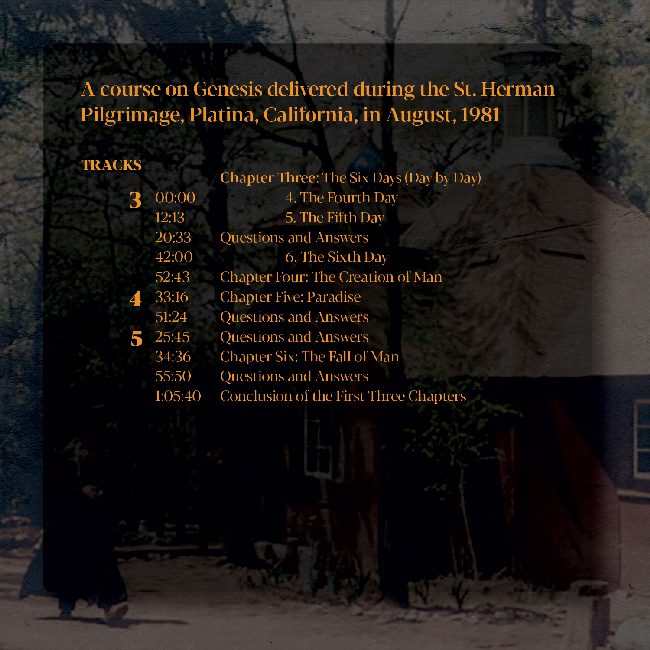

St. Seraphim of Platina – The Book of Genesis: Problems and Questions Involved in Approaching the Creation of Man


Pas de commentaire