
Chapter Two: The Six Days of Creation
(General Observations)
1. Introduction
Now let us study the Patristic model of the Six Days of Creation. We will not occupy ourselves with trying to guess “how long” these “days” were. Many fundamentalists think their literal interpretation of Genesis is lost if these “days” are not accepted as 24 hours long; and many others who want to reconcile Genesis with the modem theory of evolution think their hopes rest upon accepting these “days” as millions or billions of years long so they will accord with the supposed findings of geology. I think we can safely say that both of these views miss the mark.
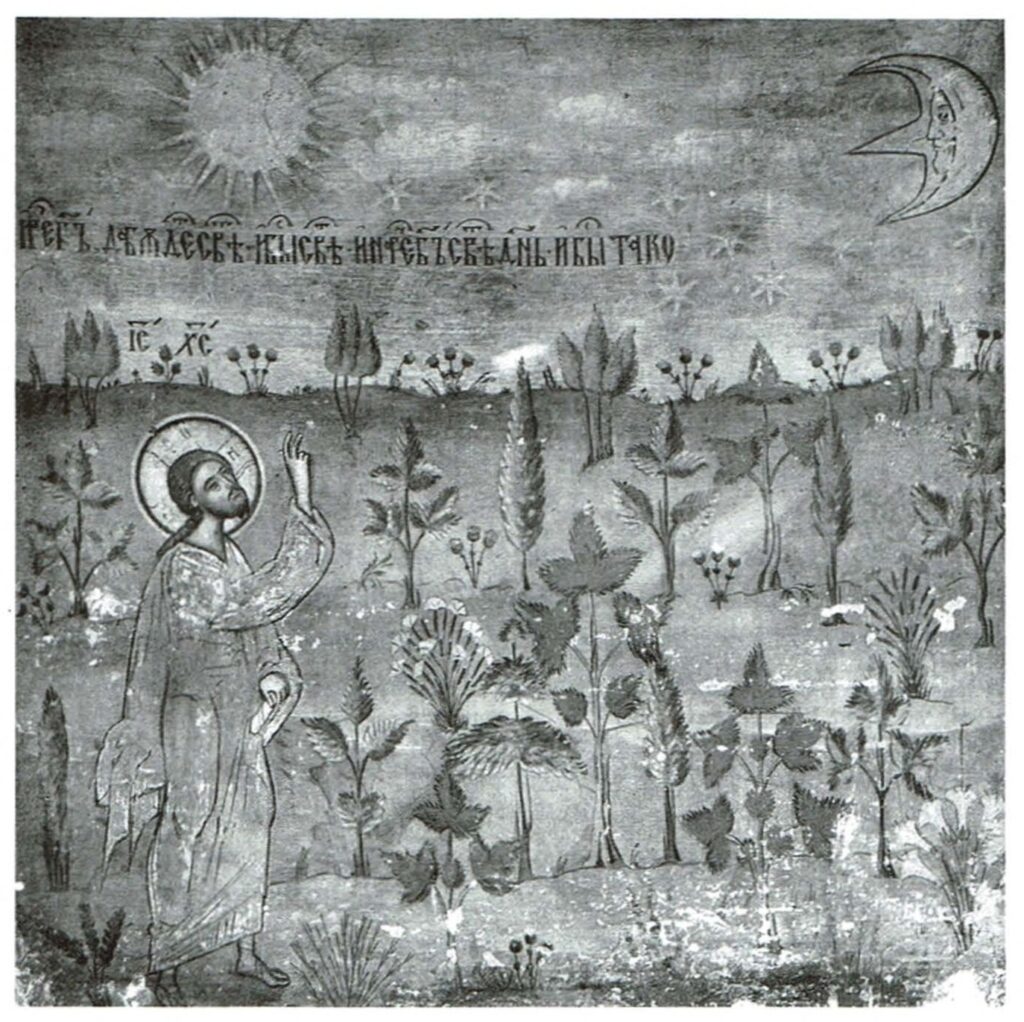
It is not that these days could not have been 24 hours long, if God so willed; one or two Fathers (St. Ephraim the Syrian, for example) even state precisely that they were 24 hours long. But most Fathers do not say anything at all on the subject: it was not a subject of debate in their times, and it seems not to have occurred to them to insist on projecting the time scale of our fallen world back to the stupendous and miraculous events of those Six Days. Blessed Augustine, I think, sums up well the Patristic attitude when he says: “What kind of days these were is very difficult for us to conceive, or even completely impossible; and all the more impossible is it for us to speak of this.” [1]
But if we do not need to define the Six Days of Creation as 24 hours long, it is quite impossible for us to regard them as millions or billions of years long—that is, to force them into an evolutionary time scale. The events of the Six Days simply do not fit into the evolutionary picture at all. In Genesis the first living things are grasses and trees upon the dry land, not micro-organisms in the sea, as the evolutionary theory would have it; these land plants exist for a whole day (billions of years?) before the sun was created, while in any evolutionary conception the sun precedes the earth itself. Any reasonably objective observer would have to conclude that the Six Days of Creation, if they are a true account and not a product of arbitrary fancy or speculation, simply do not fit into the evolutionary framework, and therefore there is no need to make them billions of years long. We will see below also how the description of these Days by the Holy Fathers makes this interpretation quite impossible. Evolutionary theory is obviously talking about something other than the Six Days of Creation.
And in actual fact, no scientific theory can tell us about those Six Days. Science tries to explain (sometimes with more and sometimes with less success) the changes of this world, based on projections of natural processes which can be observed today. But the Six Days of Creation are not a natural process; they are what came before all the world’s natural processes began to work. They are Gods work; by very definition they are miraculous and do not fit into the natural laws which govern the world we see now. If we can know what happened in those Six Days at all, it is not by scientific projections or speculations, but only by God’s revelation. In this respect, modern scientists are no better off than the ancient creators of cosmic speculations and myths. The writers of commentaries on Genesis emphasize this point. St. John Chrysostom writes:
What does it mean that first there is heaven, and then earth, first the roof and then the foundation? God is not subject to natural necessity; He is not subject to the laws of art. The will of God is the creator and artificer of nature and of art and of everything existing [2].
Today God goes over to the waters and shows us that from them, by His word and command, there proceeded animate creatures… What mind, tell me, can understand this miracle [3]?
Someone may, perhaps, ask this: Why does the Scripture reduce to a command of the Creator that tendency to flow downward which belongs naturally to water?… If water has this tendency by nature, the command ordering the waters to be gathered together into one place would be superfluous… To this inquiry we say this, that you recognized very well the movements of the water after the command of the Lord, both that it is unsteady and unstable and that it is borne naturally down slopes and into hollows; but how it had any power previous to that, before the motion was engendered in it from this command, you yourself neither know nor have you heard it from one who knew. Reflect that the voice of God makes nature, and the command given at that time to creation provided the future course of action for the creatures [4].
We are proposing to examine the structure of the world and to contemplate the whole universe, not from the wisdom of the world, but from what God taught His servant when He spoke to him in person and without riddles [5].
2. General Remarks about the Six Days
What, then, can we say of these Six Days?
First: One Orthodox person reflecting on the Six Days very nicely expressed our aim in studying them: we should measure them, not quantitatively, but theologically. The important thing about them is not how long they were, but what happened in them. They are the statement of six immense creative acts of God which produced the universe as we know it. In a moment we will look at these six acts in detail.
Second: As we have seen, by their very nature the events of these days are miraculous, are not subject to the laws of nature that now govern the world, and we cannot understand them by projections from our present experience.
Third: a point very much emphasized by the Holy Fathers who have written on Genesis: the creative acts of God in the Six Days are sudden, instantaneous.
St. Ephraim the Syrian, who understands the days of Creation to be 24 hours long, emphasizes that the creative acts of God in these days do not require 24 hours, but only an instant. Thus, concerning the first day he writes:
Although both the light and the clouds were created in the twinkling of an eye, still both the day and the night of the first day continued for twelve hours each [6].
At this saying all the dense woods appeared; all the trees shot up… Likewise, all the shrubs were immediately thick with leaf and bushy; and the so-called garland plants… all came into existence in a moment of time, although they were not previously upon the earth [7]. “Let the earth bring forth.” This brief command was immediately mighty nature and an elaborate system which brought to perfection more swiftly than our thought the countless properties of plants [8].
He (Moses) did not look forward to a late and leisurely creation of the world out of a concourse of atoms [9].
And fittingly (Moses) added: “He created,” lest it be thought there was a delay in creation. Furthermore, men would see also how incomparable the Creator was Who completed such a great work in the briefest moment of His creative act, so much so that the effect of His will anticipated the perception of time [10].
As to the separate stars or the great lights, not this appeared first, and that second, but in one day and by the same command, they were all called into being. And such was the original formation of the quadrupeds, and of birds, and fishes, and cattle, and plants… No one creature was made before another, but all things originate subsisted at once together upon one and the same command [11].
3. Why Six Days?
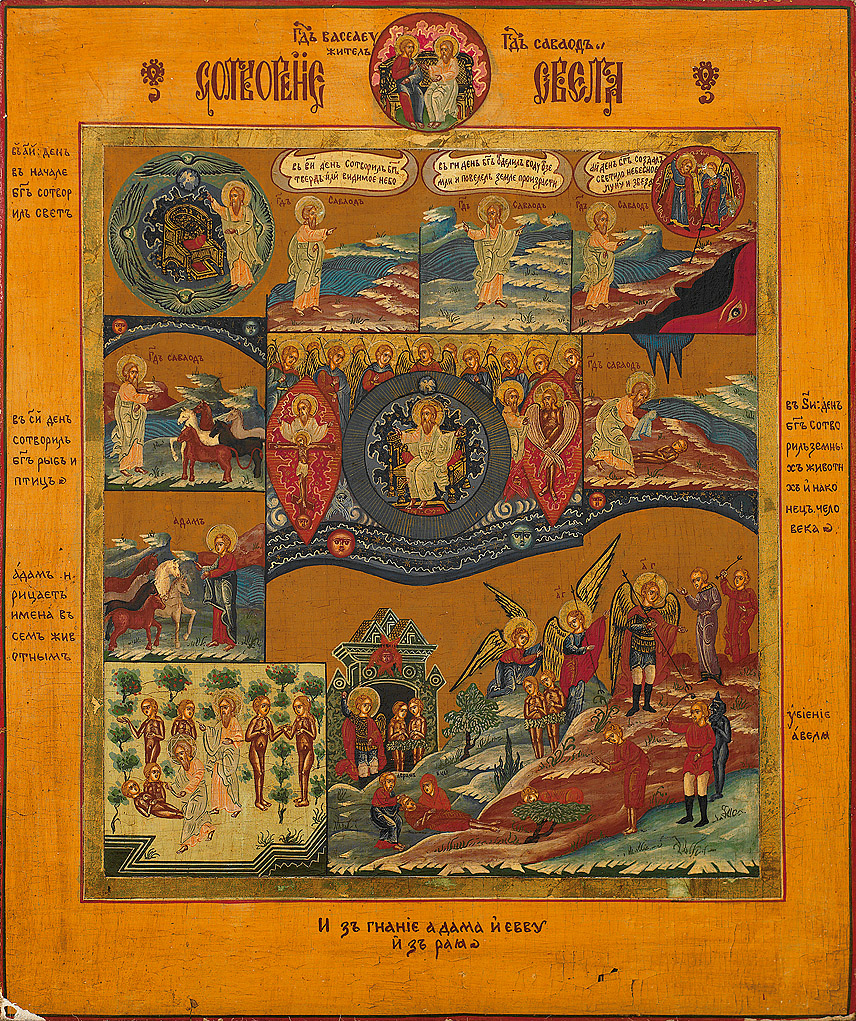
We have already quoted St. Ephraim the Syrian, who states that “it is likewise impermissible to say that what seems, according to the account (of Genesis), to have been created in the course of six days, was created in a single instant.” The Holy Fathers are quite insistent in their faithfulness to the text of Genesis: when the text says “day,” they find it impermissible to understand some indefinitely long epoch, since God’s creative acts are instantaneous; but they also find it impermissible to interpret these Six Days as merely some literary device to express a totally instantaneous creation. Although each creative act is instantaneous, the whole creation consists of an orderly sequence of these creative acts.
St. Gregory the Theologian writes:
To the days (of creation) is added a certain firstness, secondness, thirdness, and so on to the seventh day of rest from works, and by these days is divided all that is created, being brought into order by unutterable laws, but not produced in an instant, by the Almighty Word, for Whom to think or to speak means already to perform the deed. If man appeared in the world last, honored by the handiwork and image of God, this is not in the least surprising; since for him, as for a king, the royal dwelling had to be prepared and only then was the king to be led in, accompanied by all creatures [12].
The Almighty right hand of God and His limitless wisdom would have had no difficulty in creating everything in a single day. And what do I say, in a single day?—in an instant. But since He created everything that exists not for His own benefit, because He needs nothing, being All-sufficient unto Himself, on the contrary He created everything in His love of mankind and goodness, and so He creates in parts and offers us by the mouth of the blessed Prophet a clear teaching of what is created so that we, having found out about this in detail, would not fall under the influence of those who are drawn away by human reasonings… And why, you will say, was man created afterwards, if he surpassed all these creatures? For a good reason. When a king intends to enter a city, his armsbearers and others must go ahead, so that the king might enter chambers already prepared for him. Precisely thus did God now, intending to place as it were a king and master over everything earthly, at first arrange all this adornment, and only then did He create the master [man] [13].
Scripture informs us that the Deity proceeded by a sort of graduated and ordered advance to the creation of man. After the foundations of the universe were laid, as the history records, man did not appear on the earth at once; but the creation of the brutes preceded him, and the plants preceded them. Thereby Scripture shows that the vital forces blended with the world of matter according to a gradation; first, it infused itself into insensate nature; and in continuation of this advanced into the sentient world; and then ascended to intelligent and rational beings. . . The creation of man is related as coming last, as of one who took up into himself every single form of life, both that of plants and that which is seen in brutes. His nourishment and growth he derives from vegetable life; for even in vegetables such processes are to be seen when aliment is being drawn in by their roots and given off in fruit and leaves. His sentient organization he derives from the brute creation. But his faculty of thought and reason is incommunicable, and is a peculiar gift in our nature faculty to exist in the life of the body without existing by means of sensations, and since sensation is already found subsisting in the brute creation, necessarily, as it were, by reason of this one condition, our soul has touch with the other things which are knit up with it; and these are all those phenomena within us that we call “passions”. [14]
At the end of another description in a different book, St. Gregory concludes:
If, therefore. Scripture tells us that man was made last, after every animate thing, the lawgiver [Moses] is doing nothing else than declaring to us the doctrine of the soul, considering that what is perfect comes last, according to a certain necessary sequence in the order of things. . . Thus we may suppose that nature makes an ascent as it were by steps—I mean the various properties of life—from the lower to the perfect form [15].
every hillside and slope and hollow were crowned with young grass, and with the varied produce of the trees, just risen from the ground, yet shot up at once into their perfect beauty [16],
Further, St. Gregory states specifically that the one reason human nature has contact with the lower creation is because it shares the same sentient nature; it comes, indeed, from the same earth the lower creatures also sprang from. It is a totally arbitrary addition to the Saint’s meaning to insist that this means man “descended” from the brute creation; in this case, indeed, it would be required also that he (and the brutes) descended from the vegetable creation, since he has something of their nature also within himself. But evolutionary theory teaches, not that animals “evolved” from plants, but that the two kingdoms are separate and parallel branches from a common primitive ancestor.
St. Gregory’s “ascent by steps,” therefore, does not at all show the chronological descent of man from plants and animals, but only shows his kinship with the lower creation through sharing the nutritive and sentient nature which all earthborn creatures have, to the degree God has given it to them. He is describing, not the history of man, but his nature.
We will see more specifically below what St. Gregory actually thought about the “mixing of natures” which is implied in the evolutionary theory.
Chapter Three: The Six Days
(Day by Day)
(Genesis 1:1-25; 2:1-3)
Let us turn now to the text of Genesis and see briefly what God brought into being during the Six Days of Creation:
1. The First Day (Genesis 1:1-5)
1:1 In the beginning. . . This book is about the very first things in the world. But there can also be a mystical significance to the words, as St. Ambrose teaches:
A beginning in a mystical sense is denoted by the statement: I am the first and the last, the beginning and the end [18]. . . In truth, He Who is the beginning of all things by virtue of His Divinity is also the end. . . Therefore, in this beginning, that is, in Christ, God created heaven and earth, because all things were made through Him and without Him Was made nothing that was made [19] [20].
Let us inquire how God speaks. Is it in our manner?… Does He manifest His hidden thought by striking the air with the articulate movement of the voice? Surely, it is fantastic to say that God needs such a roundabout way for the manifestation of His thoughts. Or, is it not more in conformity with true religion to say that the Divine will joined with the first impulse of His intelligence is the Word of God? [i.e., Christ]. The Scripture delineates Him in detail in order that it may show that God wished the creation not only to be accomplished, but also to be brought to this birth through some co-worker. It could have related everything fully as it began, “In the beginning God created the heavens and the earth,” then “He created light,” next, “He created the firmament,” But now, introducing God as commanding and speaking, it indicates silently Him to Whom He gives the command and to Whom He speaks…. This way of speaking has been wisely and skillfully employed so as to rouse our mind to an inquiry of the Person to Whom the words are directed [21].
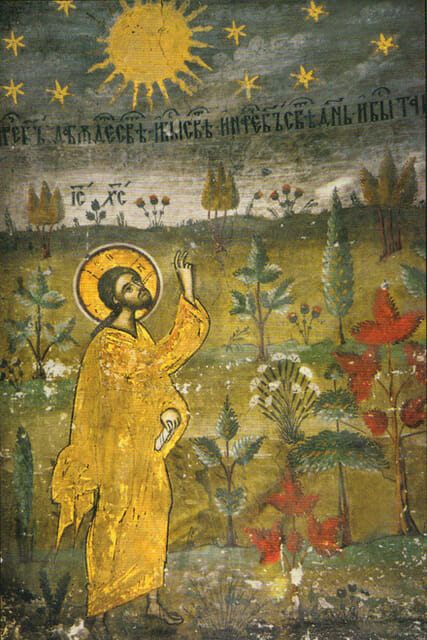
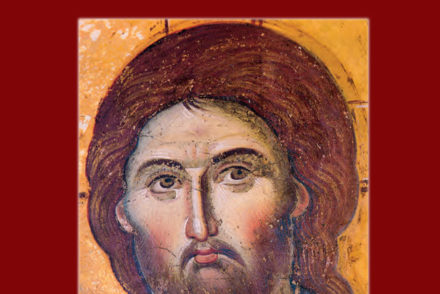
Thus, in traditional Orthodox iconography of the creation we see not Michelangelo’s old man (the Father) creating Adam (as in the fresco in the Sistine Chapel), but Christ (see illustration – Icon from Sucevița Monastery, Moldavia, Romania, sixteenth century). Of course, it is the Trinity as a whole that creates: the Father commands, the Son creates, and in a moment we will see the Spirit participating in this work, as he “moves” or “hovers” over the waters. Of this St. Ephraim the Syrian writes:
It was fitting for the Holy Spirit to hover as a proof that in creative power He is equal to the Father and the Son. For the Father uttered, the Son created, and it was fitting for the Spirit also to offer His work. And this He did by hovering, thereby clearly showing that all was brought into being and accomplished by the Trinity [25].
St. Basil asks:
How is it, if both the heavens and the earth were of equal honor, that the heavens were brought to perfection and the earth is still imperfect and unfinished? Or, in short, what was the lack of preparation of the earth? And for what reason was it invisible? Surely, the perfect condition of the earth consists in its state of abundance: the budding of all sorts of plants, the putting forth of the lofty trees both fruitful and barren, the freshness and fragrance of flowers, and whatever things appeared on earth a little later by the command of God to adorn their mother. Since as yet there was nothing of this, the Scripture reasonably spoke of it as incomplete. We might say the same also about the heavens; that they were not yet brought to perfection themselves, nor had they received their proper adornment, since they were not yet lighted around by the moon nor the sun, nor crowned by the choirs of the stars. For, these things had not yet been made. Therefore, you will not err from the truth if you say that the heavens also were incomplete [26].
The good architect lays the foundation first, and afterwards, when the foundation has been laid, plots the various parts of the building, one after the other, and then adds thereto the ornamentation… Why did not God… grant to the elements at the same time as they arose their appropriate adornments, as if He, at the moment of creation, were unable to cause the heavens immediately to gleam with studded stars and the earth to be clothed with flowers and fruit? That could very well have happened. Yet Scripture points out that things were first created and afterwards put in order, lest it be supposed that they were nor actually created and that they had no beginning, just as if the nature of things had been, as it were, generated from the beginning and did not appear to be something added afterwards [27].
He said this desiring to show that emptiness preceded the natures (of things). . . There was then only the earth, and there was nothing beside it [28].
The waters of the “deep” were created together with the earth and completely submerged the earth. This is the cause of its unfinished appearance. The Fathers assume there was a certain light created with the heavens, since the heavens are the region of light; but if so the clouds covering the earth prevented its reaching the earth. St. Ephraim writes:
If everything created (whether its creation is mentioned or not) was created in six days, then the clouds were created on the first day… For everything had to be created in six days [29].
St. Ambrose specifically rejects the opinion that the “darkness” here refers allegorically to powers of evil [30].
1:2 And the Spirit of God was moving over the face of the waters.
Here we see the activity of the Third Person of the Holy Trinity in the creation. St. Ambrose writes:
There was still to come the plenitude of the operation in the Spirit, as it is written: “By the Word of the Lord the heavens were established and all the power of them by the Spirit of His mouth [31]” …The Spirit fittingly moved over the earth, destined to bear fruit, because by the aid of the Spirit it held the seeds of new birth which were to germinate according to the words of the Prophet: “Send forth Thy Spirit and they shall be created and Thou shalt renew the face of the earth [32]”. [33]
St. Ephraim gives us a homely image of the activity of the Spirit on the First Day: The Holy Spirit
warmed the waters and made them fertile and capable of birth, like a bird when it sits with its outstretched wings on its eggs and by its warmth gives them warmth and produces fertility in them. This same Holy Spirit represented for us then an image of Holy Baptism, in which by His moving over the waters He gives birth to the children of God [34].
1:3 And God said, Let there be light; and there was light.
St. Ambrose writes:
God is the author of light, and the place and cause of darkness is the world. But the good Author uttered the word “light” so that He might reveal the world by infusing brightness therein and thus make its aspect beautiful. Suddenly, then, the air became bright and darkness shrank in terror from the brilliance of the novel brightness. The brilliance of the light which suddenly permeated the whole universe overwhelmed the darkness and, as it were, plunged it into the abyss [36].
St. Ephraim, in harmony with the other Fathers, tells us clearly that this light had nothing to do with the sun, which was created only on the Fourth Day:
The light which appeared on earth was like either a bright cloud, or a rising sun, or the pillar that illumined the Hebrew people in the desert. In any case, the light could not disperse the darkness that embraced everything if it had not extended everywhere either its substance or its rays, like the rising sun. The original light was shed everywhere and was not enclosed in a single definite place; it dispersed the darkness without having any movement; its whole movement consisted in its appearance and disappearance; after its sudden disappearance there came the dominion of night, and with its appearance this dominion ended. Thus the light produced also the three following days. . . It aided the conception and bringing forth of everything chat the earth was to produce on the third day; as for the sun, when it was established in the firmament, it was to bring to maturity what had already been produced with the aid of the original light [37].
God calls each stage of His work “good.” seeing its perfect and unspoiled nature and, as St. Ambrose teaches, looking forward to the perfection of the whole work:
God, as judge of the whole work, foreseeing what is going to happen as something completed, commends that part of His work which is still in its initial stages, being already cognizant of its termination… He praises each individual part as befitting what is to come[38].
1:4-5 And God separated the light from the darkness. God called the light Day, and the darkness He called Night.
St. Basil comments on this passage:
“God separated the light from the darkness.” That is, God made their natures incapable of mixing and in opposition, one to the other. For, He divided and separated them with a very great distinction between them. “And God called the light Day and the darkness Night.” Now, henceforth, after the creation of the sun, it is day when the air is illuminated by the sun shining on the hemisphere above the earth, and night is the darkness of the earth when the sun is hidden. Yet, it was not at that time according to solar motion, but it was when that first created light was diffused and again drawn in according to the measure ordained by God, that day came and night succeeded [39].
St. Basil continues:
Evening, then, is a common boundary line of day and night; and similarly, morning is the part of night bordering on day. In order, therefore, to give the prerogative of prior generation to the day, Moses mentioned first the limit of the day and then that of the night, as night followed the day. The condition in the world before the creation of light was not night, but darkness; that which was opposed to the day was named night; wherefore it received its name later than the day did… Why did he say “one” and not “first”? It is more consistent for him who intends to introduce a second and a third and a fourth day, to call the one which begins the series “first.” But he said “one” because he was defining the measure of day and night [40].
Thus we have come to the end of “Day One,” the first Day of creation. It has established the measure of time for all succeeding ages (because “before” it there was no time; time begins with it). And in another sense also it is a day unlike those that follow it, as St. Ephraim explains:
Thus, according to the testimony of Scripture, heaven, earth, fire, air, and the waters were created out of nothing; while the light which was created on the first day and everything else that was created after it were created out of what existed before. For when Moses speaks of what was created out of nothing he uses the word “created” (Hebrew: bara): God created the heavens and the earth. And although it is not written that fire, the waters and the air were created, it is likewise not said that they were produced from what existed earlier. And therefore they also are out of nothing, just as heaven and earth are out of nothing. But when God begins to create out of what already existed, the Scripture uses an expression like this: God said, let there be light, and the rest. And if it is said: God created the great sea monsters, before this the following is said: Let the waters bring forth swarms of living creatures. Therefore, only the above-named five kinds of creations were created out of nothing, while everything else was created out of what had already been created out of nothing [41].
The very idea of “creation out of nothing” or “from non-being” sharply distinguishes the Genesis account from that of all pagan myths and speculations about creation. In the latter it is some kind of “demiurge” or “fashioner-god” who forms the world out of already existing matter-which, as the Holy Fathers say, thus is a kind of “god” also. Genesis describes the absolute beginning of the whole world, not its development from something already existing; even the creations of the following five days, as we shall see, although they come out of the matter which has already been created, are something radically new which cannot be understood as a mere development of the first-created matter. The speculations of modern thinkers who try to trace the world back to some ultimately simple matter which develops by itself can be seen to be akin to the ancient pagan speculations; the radicalness of the Genesis explanation is beyond them both-precisely because it comes from God’s revelation and not the guesses and projections of men.
The Christian who understands the absoluteness of God’s creative work in the Six Days views the present creation with different eyes than does someone who views it as a gradual development or “evolution” from primordial matter (whether the latter is understood as created by God or as self-existing). In the latter view, the world is seen to be “naturally” what it is, and one can trace it back co ever simpler forms, each of which can be understood “naturally”; but in the former view, the view of Genesis, one is placed before the two radical poles of existence: that which now is, and the absolute nothingness from which it came, suddenly and by God’s will alone.
There is only one more question for us to ask concerning the First Day: where does the creation of the world of angels fit into it? Moses describes the creation only of the visible world; when was the invisible world of spiritual beings created? Some Fathers think they are included in the creation of “heaven”; others are not so specific, but know that they were also created “in the beginning.” St. Basil teaches:
In fact there did exist something, as it seems, even before this world, which our mind can attain by contemplation, but which has been left uninvestigated because it is not adapted to those who are beginners and as yet infants in understanding. This was a certain condition older than the birth of the world and proper to the supramundane powers, one beyond time, everlasting, without beginning or end. In it the Creator and Producer of all things perfected the works of His art, a spiritual light befitting the blessedness of chose who love the Lord, rational and invisible natures, and the whole orderly arrangement of spiritual creatures which surpass our understanding and of which it is impossible even to discover the names. These fill completely the essence of the invisible world [42].
The Angels, Dominations, and Powers, although they began to exist at some time, were already in existence when the world was created. For all things “were created, things visible and things invisible, whether Thrones or Dominations or Principalities or Powers. All things,” we are told, “have been created through and unto Him[43]”[44].
Indeed, God said to Job: When the stars were made, all My angels praised Me with a loud voice[45]. We will see on the Sixth Day how Adam was tempted by satan, and therefore we know that the battle of the proud angels in heaven, as described in the Apocalypse[46] has already been fought before then, and satan has already “fallen like lightning”.[47]
2. The Second Day (Genesis 1:6-8)
1:6-8 And God said, Let there be a firmament in the midst of the waters, and let it separate the waters from the waters. And God made the firmament and separated the waters which were under the firmament from the waters which were above the firmament. And it was so. And God called the firmament Heaven. And there was evening and there was morning, a second day.
Some have tried to find in this passage an “unscientific” view of the heavens, as though Moses believed in a kind of hard crystal dome in which the stars are embedded and above which there is a fictitious store of water. But there is nothing so fantastic to be found in this text.
The word “firmament” seems to have two shades of meaning in Genesis, one quite specific and “scientific,” the other general. In its general meaning the firmament is more or less synonymous with “heaven” or “sky”: the stars are called “lights in the firmament of the heavens” [48], and the birds fly “across the firmament of the heavens” [49]. We who have lost the specific meaning of “firmament” would omit it in such descriptions and say that stars and birds are both to be seen in the “heavens.” The idea that the stars are embedded in crystal spheres is a speculation of ancient pagan thought and does not have to be projected into the inspired text of Genesis.
What, then, is the specific “scientific” meaning of the “firmament” in this text? St. Basil teaches that, even though it is also called “heaven,” it is not synonymous with the “heaven” mentioned at the beginning of Genesis.
Since both a second name and a function peculiar to the second heaven was recorded, this is a different one from that recorded in the beginning, one of a more solid nature and furnishing a special service for the universe… We believe that this word has been assigned for a certain firm nature which is capable of supporting the fluid and unstable water. And, surely, we need not believe, because it seems to have had its origin, according to the general understanding, from water, that it is like either frozen water or some… translucent stone… almost like the air in transparency. Now, we compare the firmament to none of these things. Truly, it is peculiar to a childish and simple intellect to hold such notions about the heavens… We have been taught by the Scripture to permit our mind to invent no fantasy beyond the knowledge that has been granted it… Not a firm and solid nature, which has weight and resistance, it is not this that the word “firmament” means. In that case the earth would more legitimately be considered deserving of such a name. But, because the nature of the substances lying above is light and rare and imperceptible, He called this (a) firmament, in comparison with those very light substances which are incapable of perception by the senses. Now, imagine some place which tends to separate the moisture, and lets the rare and filtered part pass through into the higher regions, but lets the coarse and earthly part drop below, so that, by the gradual reduction of the liquids, from the beginning to the end the same mild temperature may be preserved [50].
St. Basil believes that the function of the “firmament” was to preserve a mild temperature over the whole earth. Now, it so happens that we know of a certain “greenhouse” effect on the earth in prehistoric times: tropical plants and animals have been found in the ice of the far north, indicating that the northern regions were indeed once temperate. Further, in the second chapter of Genesis we are told that before the creation of man, “the Lord had not caused it to rain upon the earth… but there went up a mist from the earth, and watered the whole face of the ground.” [51]
The early earth, then, seems to have been a place rather different from the one we know: a place universally temperate, plentiful in moisture which constantly watered an abundant vegetation, which, as we shall see, was all that God intended not only for the food of man, but even of the beasts [52].
When did this happy situation come to an end? We will soon look at the consequences of the fall of man; but there are indications that the earth even after the fall of man preserved some of the characteristics of the earliest earth. Let us look briefly at what the Scripture says in the light of our scientific-knowledge of the atmosphere. The Holy Fathers themselves often applied the scientific knowledge of their times in understanding the Scripture, and we are also permitted to do so—provided only that we do no violence to the text of Scripture and are humble and moderate in our own supposed understanding. The following explanation, therefore, is offered not as dogma but as speculation.
The very phenomenon of rain is not mentioned in the text of Genesis until the time of Noah; and then it is not an ordinary rain but a kind of cosmic catastrophe: “All the fountains of the great deep burst forth, and the windows of the heavens were opened. And rain fell on the earth forty days and forty nights.” [53] Immense—to us, nearly unimaginable—amounts of water were loosed on the earth, reducing it virtually to its state on the first day of creation, when the “deep” covered the earth. The rains we know today could not cause this to happen; but the text describes something even worse: an immense underground supply of water was loosed, and the “firmament”—the atmospheric condition that preserved a permanent reservoir of water in the air, evidently in the form of clouds such as the planet Venus has even now—was literally “broken” and emptied its contents upon the earth.
In this light we can also understand why God gave the rainbow as the sign of His covenant with Noah and all creatures that there would never again be such a flood upon earth. How could the rainbow have been a sign, when supposedly it had existed throughout the centuries before that? Evidently the rainbow then appeared for the first time. The rainbow is formed by the direct rays of the sun upon moisture in the air. If the permanent cloud cover of the earth was dissipated by the breaking of the “firmament,” then literally the direct rays of the sun struck the earth for the first time after the Flood. The rainbow had been unknown to man before that—which is why it can now be a sign to man that literally the supply of moisture in the air is limited and cannot cause a universal flood any more.
Some scientists recently have speculated—on different evidence—that the amount of cosmic radiation striking the earth for some reason manifested a striking increase about 5,000 years ago. This of course would be true if the waters above the firmament had served as a filter and kept out harmful radiation.
In view of all this, it would seem that the time after the Flood is a whole new epoch in human history. The comparatively “paradisal” conditions of the earth up to the time of Noah, when a universal temperateness prevailed over the earth and abundant vegetation supplied the needs of man without the need to eat meat (Noah is the first to receive God’s permission to eat flesh [54]), gives way to the harsher post-Flood earth we know, when there is “seedtime and harvest, cold and heat, summer and winter” [55], and men no longer live 900 years as did Adam and the early Patriarchs, but very quickly are reduced to the 70 or 80 years which is the general limit of our life even up to now [56].
3. The Third Day (Genesis 1:9-13)
1:9-10 And God said, Let the waters under the heavens he gathered together into one place, and let the dry land appear. And it was so. God called the dry land Earth, and the waters that were gathered together He called Seas. And God saw that it was good.
On each Day of creation a command is given that becomes the law of nature for all time thereafter. From the First Day, the succession of day and night begins; and from the Third Day, the waters begin their ceaseless movement. Thus, “the element of water was ordered to flow, and it never grows weary when urged on unceasingly by this command.” [57]
It is tempting for us, in the pride of our scientific knowledge, to speculate about the how of this event: Did the waters flow into underground reservoirs? Did the land rise up? The Scripture does not say, and for this reason the Holy Fathers say little on this subject. St. Ambrose writes:
What He actually has done, which I have not learned from the clear testimony of Scripture, I pass over as a mystery, lest, perchance, that stir up other questions starting even from this point. Nevertheless, I maintain in accordance with the Scriptures, that God can extend the low-lying regions and the open plains, as He has said: “I will go before thee and make level the mountains [58] ” [59]
As for the question, how any single thing came into existence, we must banish it altogether from our discussion. Even in the case of things which are quite within the grasp of our understanding and of which we have sensible perception, it would be impossible for the speculative reason to grasp the “how” of the production of the phenomenon; so much so, that even inspired and saintly men have deemed such questions insoluble. For instance, the Apostle says, “Through faith we understand that the worlds were framed by the word of God, so that things which are seen are not made of things which do appear” [60]… While the Apostle affirms that it is an object of his faith that it was by the will of God that the world itself and all which is therein was framed,… he has on the other hand left out of the investigation the “how” of this framing…. Let us, following the example of the Apostle, leave the question of the “how” in each created thing, without meddling with it at all, but merely observing incidentally that the movement of God’s will becomes at any moment that He pleases a fact, and the intention becomes at once realized in nature [61].
The dry land appeared at the command of God, and not by some natural process:
It was provided that the earth would, to all appearance, have been dry by the hand of God rather than by the sun, for the earth actually became dry before the sun was created. Wherefore, David, too, distinguished the sea from the land, referring to the Lord God: “For the sea is His and He made it, and His hands made the dry land [62].” [63]
1:11-13 And God said, Let the earth put forth vegetation, plants yielding seed, and fruit trees hearing fruit in which is their seed, each according to its kind, upon the earth. And it was so. The earth brought forth vegetation, plants yielding seed, according to their own kinds, and trees bearing fruit in which is their seed, each according to its kind. And God saw that it was good. And there was evening and there was morning, a third day.
The Holy Fathers are unanimous in emphasizing the miraculous nature of the creation of the Third Day. St. Basil teaches:
“Let the earth bring forth herbs.” And in the briefest moment of time the earth, beginning with germination in order that it might keep the laws of the Creator, passing through every form of increase, immediately brought the shoots to perfection. The meadows were deep with the abundant grass; the fertile plains, rippling with standing crops, presented the picture of a swelling sea with its moving heads of grain. And every herb and every kind of vegetable and whatever shrubs and legumes there were, rose from the earth at that time in all profusion… “And the fruit tree,” He said, “that bears fruit containing seed of its own kind and of its own likeness on the earth.” At this saying all the dense woods appeared; all the trees shot up, those which are wont to rise to the greatest height, the firs, cedars, cypresses, and pines; likewise, all the shrubs were immediately thick with leaf and bushy; and the so-called garland plants—the rose bushes, myrtles, and laurels—all came into existence in a moment of time, although they were not previously upon the earth, each one with its own peculiar nature [64].
The herbs, at the time of their creation, were the productions of a single instant, but in appearance they appeared the productions of months. Likewise the trees, at the time of their creation, were the productions of a single day, but in their perfection and fruits, which weighed down the branches, they appeared the productions of years [65].
We learn from Scripture in the account of the first creation, that first the earth brought forth “the green herb,” and that then from this plant seed was yielded, from which, when it was shed on the ground, the same form of the original plant again sprang up…. In the beginning, we see, it was not an ear rising from a grain, but a grain coming from an ear, and, after that, the ear grows round the grain [66].
(Moses) shows you that everything was accomplished before the creation of the sun, so that you might ascribe the ripening of the fruits not to it, but to the Creator of the universe [67].
The adornment of the earth is older than the sun, that those who have been misled may cease worshipping the sun as the origin of life [68].
Before the light of the sun shall appear, let the green herb be born, let its light be prior to that of the sun. Let the earth germinate before it receives the fostering care of the sun, lest there be an occasion for human error to grow. Let everyone be informed that the sun is not the author of vegetation…. How can the sun give the faculty of life to growing plants, when these have already been brought forth by the life-giving creative power of God before the sun entered into such a life as this? The sun is younger than the green shoot, younger than the green plant [69].
[1] City of God, XI, 6
[2] Eight Homilies on Genesis, I, 3, pp. 731–732
[3] Homilies on Genesis, VII, 3, p. 52
[4] Hexaemeron, IV, 2, pp. 56–57
[5] Hexaemeron, VI, 1, p. 83
[6] Commentary on Genesis, ch. 1
[7] Hexaemeron, V, 6
[8] Hexarmeron, V, 10, p. 82
[9] Hexaemeron, I, 2, pp. 5, 7
[10] Hexaemeron, I, 5, p. 8
[11] Four Discourses Against the Arians, II, 48, 60; pp. 374, 381
[12] Homily 44, On New Week, Spring, and the Commemoration of the Martyr Mamas
[13] Homilies on Genesis, III, 3, p. 18; VIII, 2, pp. 60–61
[14] On the Soul and the Resurrection, pp. 441–442
[15] On the Making of Man, ch. VIII, pp. 393–394
[16] On the Making of Man, ch. I. 5. p. 389
[17] ch. III, 1, p. 390
[18] Behold, he cometh with clouds; and every eye shall see him, and they also which pierced him: and all kindreds of the earth shall wail because of him. Even so, Amen. I am Alpha and Omega, the beginning and the ending, saith the Lord, which is, and which was, and which is to come, the Almighty. I John, who also am your brother, and companion in tribulation, and in the kingdom and patience of Jesus Christ, was in the isle that is called Patmos, for the word of God, and for the testimony of Jesus Christ. Revelation 1 7-9
[19] In the beginning was the Word, and the Word was with God, and the Word was God. The same was in the beginning with God. All things were made by him; and without him was not any thing made that was made. In him was life; and the life was the light of men. And the light shineth in darkness; and the darkness comprehended it not. John 1 1-5
[20] Six Days, I, 15, pp.14-15
[21] Hexaemeron, III, 2, pp. 38-9
[22] John 1:1, 3
[23] Unto me, who am less than the least of all saints, is this grace given, that I should preach among the Gentiles the unsearchable riches of Christ; And to make all men see what is the fellowship of the mystery, which from the beginning of the world hath been hid in God, who created all things by Jesus Christ: To the intent that now unto the principalities and powers in heavenly places might be known by the church the manifold wisdom of God, According to the eternal purpose which he purposed in Christ Jesus our Lord: In whom we have boldness and access with confidence by the faith of him. Ephesians 3 8-12
[24] For this cause we also, since the day we heard it, do not cease to pray for you, and to desire that ye might be filled with the knowledge of his will in all wisdom and spiritual understanding; That ye might walk worthy of the Lord unto all pleasing, being fruitful in every good work, and increasing in the knowledge of God; Strengthened with all might, according to his glorious power, unto all patience and longsuffering with joyfulness; Giving thanks unto the Father, which hath made us meet to be partakers of the inheritance of the saints in light: Who hath delivered us from the power of darkness, and hath translated us into the kingdom of his dear Son: In whom we have redemption through his blood, even the forgiveness of sins: Who is the image of the invisible God, the firstborn of every creature: For by him were all things created, that are in heaven, and that are in earth, visible and invisible, whether they be thrones, or dominions, or principalities, or powers: all things were created by him, and for him: And he is before all things, and by him all things consist. Colossians 1 9-17
[25] Commentary on Genesis, ch. 1, p. 286
[26] Hexaemeron, II, l, pp. 21-2
[27] Six Days, I, 7, pp. 26, 28-9
[28] Commentary on Genesis, ch. l, p. 283
[29] ch. l, p. 284
[30] Six Days, I, 8, p. 31
[31] Ps. 32 6
[32] Ps. 103 30
[33] Six Days, I, 8, pp. 32-3
[34] Commentary on Genesis, ch. 1, pp. 286-7
[35] Wherefore, Job, I pray thee, hear my speeches, and hearken to all my words. Behold, now I have opened my mouth, my tongue hath spoken in my mouth. My words shall be of the uprightness of my heart: and my lips shall utter knowledge clearly. The Spirit of God hath made me, and the breath of the Almighty hath given me life. If thou canst answer me, set thy words in order before me, stand up. Job 33 1-5
[36] Six Days, I, 9, p. 39
[37] Commentary on Genesis, ch. 1, pp. 287-8
[38] Six Days, II, 5, p. 65
[39] Hexaemeron, II, 8, p. 33
[40] Hexaemeron, II, 8, pp. 33-4
[41] Commentary on Genesis, ch. 1, p. 293
[42] Hexaemeron, I. 5, p. 9
[43] For this cause we also, since the day we heard it, do not cease to pray for you, and to desire that ye might be filled with the knowledge of his will in all wisdom and spiritual understanding; That ye might walk worthy of the Lord unto all pleasing, being fruitful in every good work, and increasing in the knowledge of God; Strengthened with all might, according to his glorious power, unto all patience and longsuffering with joyfulness; Giving thanks unto the Father, which hath made us meet to be partakers of the inheritance of the saints in light: Who hath delivered us from the power of darkness, and hath translated us into the kingdom of his dear Son: In whom we have redemption through his blood, even the forgiveness of sins: Who is the image of the invisible God, the firstborn of every creature: For by him were all things created, that are in heaven, and that are in earth, visible and invisible, whether they be thrones, or dominions, or principalities, or powers: all things were created by him, and for him: And he is before all things, and by him all things consist. Colossians 1 9-17
[44] Six Days, I, 5, p. 18
[45] Where wast thou when I founded the earth? tell me now, if thou hast knowledge, who set the measures of it, if thou knowest? or who stretched a line upon it? On what are its rings fastened? and who is he that laid the corner-stone upon it? When the stars were made, all my angels praised me with a loud voice. And I shut up the sea with gates, when it rushed out, coming forth out its mother’s womb. And I made a cloud its clothing, and swathed it in mist. And I set bounds to it, surrounding it with bars and gates. And I said to it, Hitherto shalt thou come, but thou shalt not go beyond, but thy waves shall be confined within thee. Job 38 4-11 [Septuagint]
[46] And there appeared a great wonder in heaven; a woman clothed with the sun, and the moon under her feet, and upon her head a crown of twelve stars: And she being with child cried, travailing in birth, and pained to be delivered. And there appeared another wonder in heaven; and behold a great red dragon, having seven heads and ten horns, and seven crowns upon his heads. And his tail drew the third part of the stars of heaven, and did cast them to the earth: and the dragon stood before the woman which was ready to be delivered, for to devour her child as soon as it was born. And she brought forth a man child, who was to rule all nations with a rod of iron: and her child was caught up unto God, and to his throne. And the woman fled into the wilderness, where she hath a place prepared of God, that they should feed her there a thousand two hundred and threescore days. And there was war in heaven: Michael and his angels fought against the dragon; and the dragon fought and his angels, And prevailed not; neither was their place found any more in heaven. And the great dragon was cast out, that old serpent, called the Devil, and Satan, which deceiveth the whole world: he was cast out into the earth, and his angels were cast out with him. Revelation 12 1-9
[47] And the seventy returned again with joy, saying, Lord, even the devils are subject unto us through thy name. And he said unto them, I beheld Satan as lightning fall from heaven. Behold, I give unto you power to tread on serpents and scorpions, and over all the power of the enemy: and nothing shall by any means hurt you. Notwithstanding in this rejoice not, that the spirits are subject unto you; but rather rejoice, because your names are written in heaven. Luke 10 17-20
[48] And God said, Let there be lights in the firmament of the heaven to divide the day from the night; and let them be for signs, and for seasons, and for days, and years: And let them be for lights in the firmament of the heaven to give light upon the earth: and it was so. Genesis 1 14-15
[49] And God said, Let the waters bring forth abundantly the moving creature that hath life, and fowl that may fly above the earth in the open firmament of heaven. And God created great whales, and every living creature that moveth, which the waters brought forth abundantly, after their kind, and every winged fowl after his kind: and God saw that it was good. And God blessed them, saying, Be fruitful, and multiply, and fill the waters in the seas, and let fowl multiply in the earth. And the evening and the morning were the fifth day. Genesis 1 20-23
[50] Hexaemeron, III, 3,4,7; pp. 41-3, 47-8
[51] Thus the heavens and the earth were finished, and all the host of them. And on the seventh day God ended his work which he had made; and he rested on the seventh day from all his work which he had made. And God blessed the seventh day, and sanctified it: because that in it he had rested from all his work which God created and made. These are the generations of the heavens and of the earth when they were created, in the day that the LORD God made the earth and the heavens, And every plant of the field before it was in the earth, and every herb of the field before it grew: for the LORD God had not caused it to rain upon the earth, and there was not a man to till the ground. But there went up a mist from the earth, and watered the whole face of the ground. And the LORD God formed man of the dust of the ground, and breathed into his nostrils the breath of life; and man became a living soul. Genesis 2 1-7
[52] So God created man in his own image, in the image of God created he him; male and female created he them. And God blessed them, and God said unto them, Be fruitful, and multiply, and replenish the earth, and subdue it: and have dominion over the fish of the sea, and over the fowl of the air, and over every living thing that moveth upon the earth. And God said, Behold, I have given you every herb bearing seed, which is upon the face of all the earth, and every tree, in the which is the fruit of a tree yielding seed; to you it shall be for meat. And to every beast of the earth, and to every fowl of the air, and to every thing that creepeth upon the earth, wherein there is life, I have given every green herb for meat: and it was so. And God saw every thing that he had made, and, behold, it was very good. And the evening and the morning were the sixth day. Genesis 1 27-31
[53] And Noah was six hundred years old when the flood of waters was upon the earth. And Noah went in, and his sons, and his wife, and his sons’ wives with him, into the ark, because of the waters of the flood. Of clean beasts, and of beasts that are not clean, and of fowls, and of every thing that creepeth upon the earth, There went in two and two unto Noah into the ark, the male and the female, as God had commanded Noah. And it came to pass after seven days, that the waters of the flood were upon the earth. In the six hundredth year of Noah’s life, in the second month, the seventeenth day of the month, the same day were all the fountains of the great deep broken up, and the windows of heaven were opened. And the rain was upon the earth forty days and forty nights. Genesis 7 6-12
[54] And God blessed Noah and his sons, and said unto them, Be fruitful, and multiply, and replenish the earth. And the fear of you and the dread of you shall be upon every beast of the earth, and upon every fowl of the air, upon all that moveth upon the earth, and upon all the fishes of the sea; into your hand are they delivered. Every moving thing that liveth shall be meat for you; even as the green herb have I given you all things. But flesh with the life thereof, which is the blood thereof, shall ye not eat. Genesis 9 1-4
[55] And the LORD smelled a sweet savour; and the LORD said in his heart, I will not again curse the ground any more for man’s sake; for the imagination of man’s heart is evil from his youth; neither will I again smite any more every thing living, as I have done. While the earth remaineth, seedtime and harvest, and cold and heat, and summer and winter, and day and night shall not cease. Genesis 8 21-22
[56] During his oral delivery of this section, Fr. Seraphim explained this last point more fully:
“We know that, to the race of mankind up until the time of Noah, a very extraordinary thing happened. All the Patriarchs of the Old Testament up to then are said to have lived tremendous numbers of years: Adam lived 930 years, Methuselah lived 969 years, others lived 900, 800 years.
Nowadays people might say: “That’s an exaggeration, that’s a mistake, that’s silly.” But almost every single Patriarch lived that long… Only after Noah (who lived 950 years, 600 of which were before the Flood), the age of man begins to decrease… Why? The world even before Noah was quite a different place; the world before Adam’s Fall, even more so. Before the time of Noah, man was not allowed to eat meat; man was living on vegetables, and in fact the animals of the earth were blessed to eat vegetables until the time of Noah. Of course, today it’s inconceivable that man could live 900 years, but under those totally different conditions, who knows what might have happened? God created the world in the beginning totally new and fresh, and according to a totally different way of life than what we know now.”
[57] St. Basil, Hexaemeron, IV, 3, p.57
[58] Thus saith the LORD to his anointed, to Cyrus, whose right hand I have holden, to subdue nations before him; and I will loose the loins of kings, to open before him the two leaved gates; and the gates shall not be shut; I will go before thee, and make the crooked places straight: I will break in pieces the gates of brass, and cut in sunder the bars of iron: And I will give thee the treasures of darkness, and hidden riches of secret places, that thou mayest know that I, the LORD, which call thee by thy name, am the God of Israel. Isaiah 45 1-3
[59] Six Days, III, 3, p. 78
[60] Now faith is the substance of things hoped for, the evidence of things not seen. For by it the elders obtained a good report. Through faith we understand that the worlds were framed by the word of God, so that things which are seen were not made of things which do appear. Hebrews 11 1-3
[61] On the Soul and the Resurrection, pp. 457-8
[62] O come, let us sing unto the LORD: let us make a joyful noise to the rock of our salvation. Let us come before his presence with thanksgiving, and make a joyful noise unto him with psalms. For the LORD is a great God, and a great King above all gods. In his hand are the deep places of the earth: the strength of the hills is his also. The sea is his, and he made it: and his hands formed the dry land. O come, let us worship and bow down: let us kneel before the LORD our maker. For he is our God; and we are the people of his pasture, and the sheep of his hand. To day if ye will hear his voice, Harden not your heart, as in the provocation, and as in the day of temptation in the wilderness: When your fathers tempted me, proved me, and saw my work. Forty years long was I grieved with this generation, and said, It is a people that do err in their heart, and they have not known my ways: Unto whom I sware in my wrath that they should not enter into my rest. Psalm 95
[63] St. Ambrose, Six Days, III, 4, p. 80
[64] Hexaemeron, V, 5-6, p. 74
[65] Commentary on Genesis, I, p. 298
[66] On the Soul and the Resurrection, p. 467
[67] Commentary on Genesis, VI, 4, p. 44
[68] Hexaemeron, V, 1, p. 67
[69] Six Days, III, 6, p. 87
Sources
The Orthodox Word,Vol. 27, No. 1 (156), January-February, 1991, pp. 38-45
The Orthodox Word, Vol. 27, No.3 (158), May-June, 1991, pp. 161- 170
The Orthodox Word, Vol. 27, No. 4 (159), July-August, 1991, pp. 221- 224
The Orthodox Word, Vol. 27, Nos. 5-6 (160-161), Sept.-Dec., 1991, pp. 317-20
Audio recording: Orthodox Australia
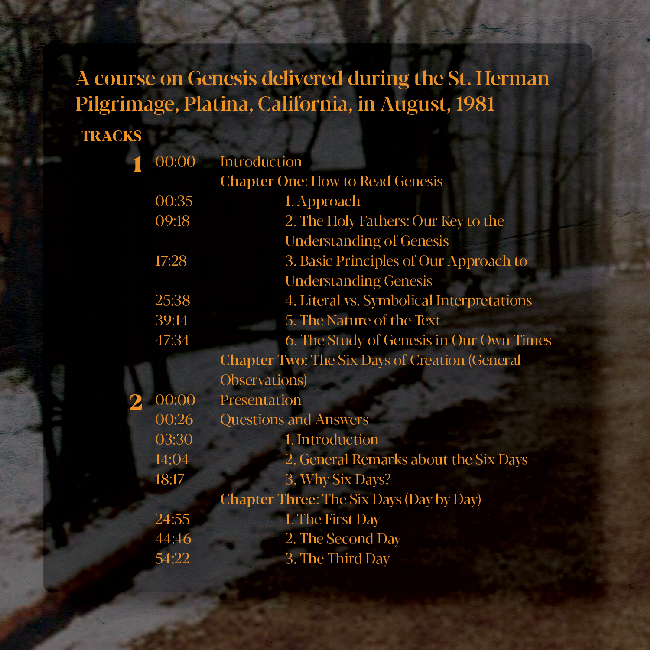
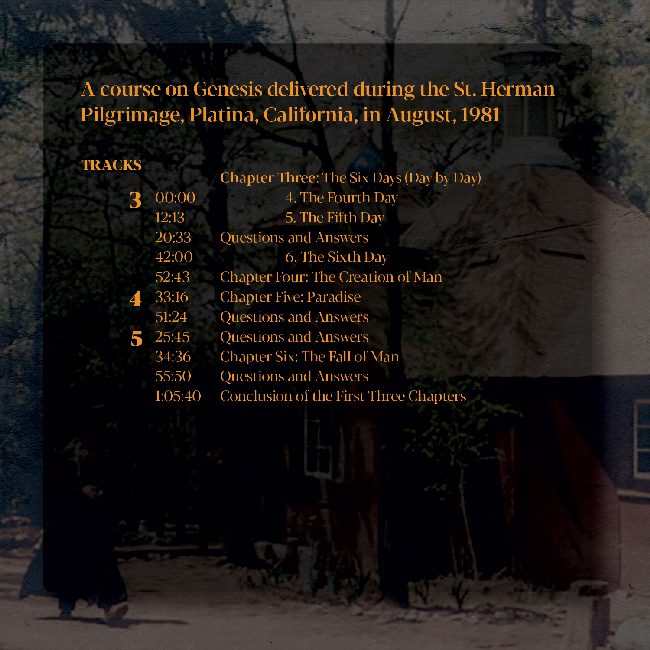

St. Seraphim of Platina – The Book of Genesis: Problems and Questions Involved in Approaching the Creation of Man

Pas de commentaire