
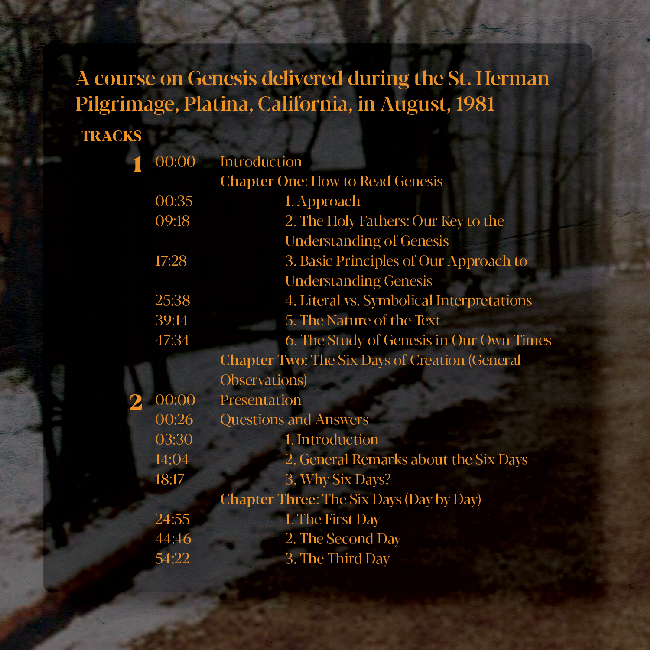
EDITOR’S NOTE: The following text was delivered orally as a course on Genesis during the St. Herman Pilgrimage, Platina, California, in August, 1981. As he read from the text, Fr. Seraphim would at times add illuminating impromptu remarks. Some of these remarks the editors have transcribed from cassette tapes and included in the main body of the text and in the footnotes.
Chapter One: How to Read Genesis
1. Approach
In a sense, none of us knows how to approach this book. Modern science and philosophy have filled our minds with so many theories and supposed facts about the beginnings of the universe and man that we inevitably come to this book with preconceived notions. Some want it to agree with their particular scientific theories; others look for it to disagree. Both of these look to it as having something scientific to say; but others look on it as sheer poetry, a product of religious imagination having nothing to do with science.
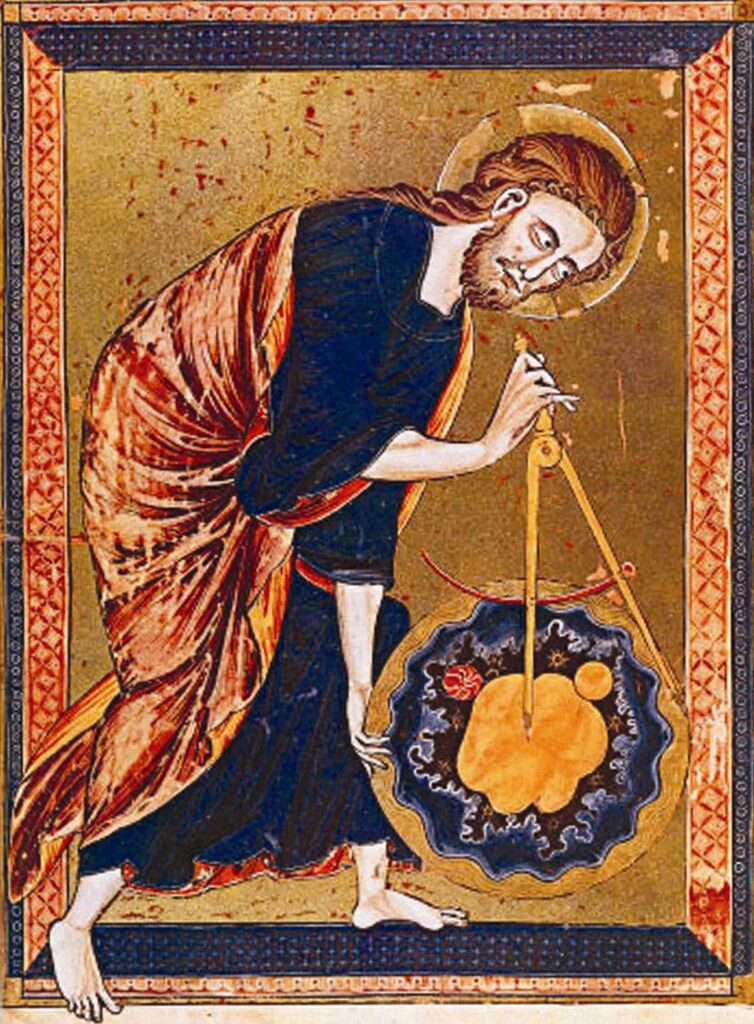
The central question that causes our difficulties in understanding this book is: how “literally” are we to read it?
Some Protestant Fundamentalists tell us it is all (or virtually all) “literal.” But such a view places us in some impossible difficulties: quite apart from our literal or non-literal interpretation of various passages, the very nature of the reality which is described in the first chapters of Genesis (the very creation of all things) makes it quite impossible for everything to be understood “literally”; we don’t even have words, for example, to describe “literally” how something can come out of nothing. How does God “speak”?—does He make a noise which resounds in an atmosphere that doesn’t yet exist? This explanation is obviously a little too simple—the reality is more complex.
Then there is the opposite extreme. Some people would like to interpret this book (at least the earliest chapters which give the most difficulty) as being an allegory, a poetic way of describing something that is really much closer to our experience. Roman Catholic thinkers in recent years, for example, have come up with some ingenious ways of “explaining away” Paradise and the fall of man; but in reading these interpretations one has the impression that they have so little respect for the text of Genesis that they treat it as a primitive commentary on some recent scientific theories. This is also an extreme. St. John Damascene, the 8th-century Father whose views generally sum up the Patristic opinion of the first Christian centuries, specifically states that the allegorical interpretation of Paradise is part of an early heresy and does not belong to the Church.
One encounters often today a common way out between these two views. The statement of a Roman Catholic nun (who is also a teacher) was recently publicized widely under the title: “God helped create evolution.” She says: “The biblical story of creation has a religious purpose. It contains, but does not teach, errors. The evolutionary theory of creation, in contrast, has a scientific purpose, and the search for truth is the province of astronomers, geologists, biologists and the like. Those two purposes are distinct, and both offer truth to the human mind and heart.” She states that Genesis comes from oral traditions which were limited by the scientific views of that time.
According to this view, Genesis belongs in one category, and scientific truth or reality in another; Genesis has little if anything to do with any kind of truth, whether literal or allegorical. Therefore, one doesn’t really need to think about the question: you read Genesis for spiritual uplift or poetry, and the scientists will tell you what you need to know about the facts of the world’s and man’s beginning.
In one form or another this is a very common view today—but what it actually amounts to is a failure to look at the question at all; it does not take Genesis seriously. But our very purpose in studying Genesis is to take it seriously, to see what it actually says. None of these approaches we have mentioned can do this. We must look elsewhere for the “key” to understanding Genesis.
In approaching Genesis we must try to avoid pitfalls such as we have mentioned above by a certain degree of self-awareness: what kind of prejudices or predispositions might we have in approaching the text?
We have already mentioned that some of us may be too anxious to have the meaning of Genesis agree (or disagree) with some particular scientific theory. Let us state a more general principle as to how we, with our 20th-century mentality, tend to do this. In reaction to the extreme literalness of our scientific outlook (a literalness which is required by the very nature of science), when we turn to non-scientific texts of literature or theology we are very much predisposed to find non-literal or “universal” meanings. And this is natural: we want to save these texts from appearing ridiculous in the eyes of scientifically trained men. But we must realize that with this predisposition we often leap to conclusions which we have not really thought over very seriously.
To take an obvious example: When we hear of the “six days” of creation, most of us automatically adjust these “days” to accord with what contemporary science teaches of the gradual growth and development of creatures. “These must be some indefinitely long periods of time,” our 20th— century mind tells us; “all those geological strata, all those fossils—they couldn’t have been formed in a literal ‘day.’ ” And if we hear that a Fundamentalist in Texas or southern California is once more loudly insisting that these days are positively 24 hours long and no longer, we can even become indignant and wonder how people can be so dense and anti-scientific.
In this course I don’t intend to tell you how long those days were. But I think we should be aware that our natural, almost subconscious tendency to regard them as indefinitely long periods, thereby thinking that we have solved the “problem” they present, is not really a thought-out answer to this problem, but more of a predisposition or prejudice which we have picked up out of the intellectual air in which we live. When we look at these “days” more closely, however, we will see that the whole question is not so simple and that our natural predisposition in this as in many other cases tends more to cloud than to clarify the real question.
We will look at this specific question later. For now I would urge us to be not too certain of our accustomed ways of looking at Genesis, and to open ourselves to the wisdom of the God-bearing men of the past who have devoted so much intellectual effort to understanding the text of Genesis as it was meant to be understood. These Holy Fathers are our key to understanding Genesis.
2. The Holy Fathers: Our Key to the Understanding of Genesis
In the Holy Fathers we find the “mind of the Church”—the living understanding of God’s revelation. They are our link between the ancient texts which contain God’s revelation and today’s reality. Without such a link it is every man for himself—and the result is a myriad of interpretations and sects.
There are many Patristic commentaries on Genesis. This already is an indication to us that this text is considered extremely important by the Fathers of the Church. Let us look now at which Fathers talked about this text and what books they wrote[1].
In this course I will make use primarily of four commentaries of the early Fathers:
- St. John Chrysostom wrote a larger and smaller commentary on the whole book of Genesis. The larger, called Homilies on Genesis, was actually a course of lectures delivered during Great Lent, since during Lent the book of Genesis is read in church. This book contains 60 homilies and is some 700 pages long. Another year, St. John delivered seven other homilies, comprising several hundred more pages. He also wrote a treatise called “On the Creation of the World,” over a hundred pages long. Thus, in St. John Chrysostom we have a thousand pages or more of interpretation of Genesis. He is one of the main interpreters of this book.
- St. Ephraim the Syrian, from about the same time as St. John Chrysostom, also has a commentary on the whole book. In his work, called simply Interpretation of the Books of the Bible, several hundred pages are devoted to Genesis.
- St. Basil the Great wrote an interpretation of the “six days” of Creation, called the Hexaemeron—meaning “Six Days.” There are other Hexaemera in the literature of the early Church, some going back to the second century. St. Basil’s, one might say, is the most authoritative. This book does not cover the whole of Genesis, but only the first chapter. Another book by him which we will quote is called On the Creation of Man, which is like a continuation of the Hexaemeron.
- In the West, St. Ambrose of Milan read St. Basil’s homilies and wrote homilies on the six days himself[2]. His Hexaemeron is quite a bit longer, about 300 pages[3]. St. Ambrose also wrote a whole book on Paradise, a continuation of the Hexaemeron, as well as a book on Cain and Abel.
In addition to these basic commentaries, we will look at a number of books which do not go into the whole book of Genesis or into the whole of the six days. For example, the brother of St. Basil, St. Gregory of Nyssa, has a book On the Creation of Man, which goes into detail about the end of the first chapter and the beginning of the second chapter of Genesis.
I have also made use of outlines of Orthodox dogma. The book of St. John Damascene, On the Orthodox Faith, contains many chapters on questions about the six days, the creation of man, the fall, Paradise, and so forth. The catechisms of the early Church—the Great Catechism of St. Gregory of Nyssa and the Catechetical Lectures of St. Cyril of Jerusalem—also have a few details on these questions.
On one specific question of the Patristic world view I have used the treatises on the Resurrection by Sts. Athanasius the Great, Gregory of Nyssa, and Ambrose of Milan.
St. Symeon the New Theologian has written homilies on Adam, the fall and the early world, which we have in English in the book The Sin of Adam.
Then there are various writings of St. Gregory the Theologian about the creation of man, about man’s nature and his soul. St. Macarius the Great, St. Abba Dorotheos, St. Isaac the Syrian and other writers of the ascetic life often talk about Adam and the fall. Since the basic aim of the ascetic life is to return to the state of Adam before the fall, they write about what the fall means, what Paradise was, and what it is we are trying to get back to.
Blessed Augustine touches on the subject of Genesis in The City of God; St. Gregory Palamas writes on various aspects in his apologetic works; and St. Gregory of Sinai writes on Paradise as well[4].
These Fathers don’t give us all the answers to questions we may have about Genesis; we read them rather to get our attitude toward Genesis. Sometimes Fathers may seem to contradict each other or to speak in a way we might not consider very useful for the questions we have today. There— fore we must have some basic principles which govern our understanding both of Genesis and the Holy Fathers.
3. Basic Principles of Our Approach to Understanding Genesis
- We are seeking truth. We must respect the text of Genesis enough to recognize that it contains truth, even though that truth may seem unusual or surprising to us. If it seems to conflict with what we think we know from science, let us remember that God is the author of all truth, and anything genuinely true in Scripture cannot contradict anything that is genuinely true in science.
- The Scripture is Divine in inspiration. We will look more closely below at what this means; but for a beginning, it means that we must look in it for truths of a high order, and if we find difficulty in understanding anything we should suspect first our own lack of knowledge rather than a deficiency in the inspired text.
- We should not hasten to offer our own explanations of “difficult” passages, but should first try to familiarize ourselves with what the Holy Fathers have said about these passages, recognizing that they have spiritual wisdom that we lack.
- We should also beware of the temptation to seize on isolated, out-of-context quotes from the Holy Fathers to “prove” a point one would like to make. For example, I have seen an Orthodox person wishing to prove that there was nothing “special” about the creation of Adam quote the following statement from St. Athanasius the Great: “The first-created man was made of dust like everyone, and the hand which created Adam then is creating also and always those who come after him.” This is a general statement about God’s continuous creative activity[5] which no one would think of contradicting. But the point this person wanted to make was that there was no real distinction between the creation of every living man and the creation of the first man—and specifically, that the body of Adam could have been formed by natural generation in the womb of some not-quite-human creature. Can such a statement legitimately be used as a “proof” on this question?
It so happens that we can find a passage in the works of St. Athanasius that specifically refutes this idea. In another place he says: “Though Adam only was formed out of earth, yet in him was involved the succession of the whole race” (Discourses Against the Arians, II, 48, p. 375). Here he quite specifically states that Adam was created in a way different from all other men, which indeed, as we shall see, is the teaching of the Holy Fathers in general. Therefore, it is illegitimate to take one quote of his and think that it proves or opens the way to some favorite idea of our own. St. Athanasius’ general statement about the nature of man says nothing whatever about the specific nature of Adam’s creation.
Such a misuse of quotations from the Holy Fathers is a very common pitfall in our days when polemics on such subjects are often very passionate. In this course we will try our best to avoid such pitfalls by not forcing any of our own interpretations on the Holy Fathers, but simply trying to see what they say themselves.
- We do not need to accept every word the Fathers wrote on Genesis; sometimes they made use of the science of their time for illustrative material, and this science was mistaken in some points. But we should carefully distinguish their science from their theological statements, and we should respect their whole approach and general conclusions and theological insights.
- If we ourselves think we can add something to the understanding of the text for our days (perhaps based on the findings of modern science), let it be done cautiously and with full respect for the integrity of the text of Genesis and the opinions of the Holy Fathers. And we should always be humble in this attempt—the science of our own days also has its failings and mistakes, and if we rely too much on it we may find ourselves with wrong understandings.
- Specifically in this course we will be trying first to understand the Fathers, and only then to offer our own answers to some questions, if we have them.
- Finally, if it is true that modern science is capable of throwing some light on the understanding of at least a few passages of Genesis—for we do not need to deny that in some areas the truths of these two spheres overlap—I think that it is no less true that the Patristic understanding of Genesis is also capable of throwing light on modern science and gives some hints on how to understand the facts of geology, paleontology, and other sciences concerned with the early history of the earth and of mankind. This study can therefore be a fruitful one in both directions.
- The aim of this course, however, is not to answer all questions about Genesis and creation, but rather, first of all, to inspire Orthodox Christians to think about this subject in a broader way than it is usually approached, without being satisfied with the simplistic answers that are so often heard.
4. Literal vs. Symbolical Interpretations
This question is a great stumbling block for us modern men, who have been brought up with a “scientific” education and world view which has left us impoverished in our understanding of symbolical meanings in literature. Too often, as a result of this, we jump to conclusions: if there is a symbolical meaning to some image in Scripture (for example, the tree of the knowledge of good and evil) we are very inclined to say “it’s only a symbol”; the slightest indication of a figurative or metaphorical meaning often leads us to dismiss the literal meaning. Sometimes this attitude can even lead to sweeping judgments of whole portions or books of Scripture: If there are symbolical or figurative elements, for example, in the Genesis narrative of the Garden of Eden, we easily jump to the conclusion that the whole narrative is a “symbol” or an “allegory.”
Our key to understanding Genesis is: how did the Holy Fathers understand this question, specifically with regard to separate passages, and generally with regard to the book as a whole?
Let us take some examples:
- St. Macarius the Great of Egypt, a Saint of the most exalted mystical life and whom one certainly cannot suspect of overly literal views of Scripture, writes on Genesis 3:24[6]: “That Paradise was closed and that a Cherubim was commanded to prevent man from entering it by a flaming sword: of this we believe that in visible fashion it was indeed just as it is written, and at the same time we find that this occurs mystically in every soul.” [7] This is a passage which many of us might have expected to have only a mystical meaning, but this great seer of Divine things assures us that it is also true “just as it is written”—for those capable of seeing it.
- St. Gregory the Theologian, noted for his profound mystical interpretations of Scripture, says of the tree of the knowledge of good and evil: “This tree was, according to my view, Contemplation, upon which it is only safe for those who have reached maturity of habit to enter.” [8] Does this mean that he regarded this tree as only a symbol, and not also a literal tree? In his own writings he apparently does not give an answer to this question, but another great Holy Father does (for when they are teaching Orthodox doctrine and not just giving private opinions, all the great Fathers agree with each other and even help to interpret each other). St. Gregory Palamas, the 14th-century hesychast Father, comments on this passage:
Gregory the Theologian has called the tree of the knowledge of good and evil “contemplation”… but it does not follow that what is involved is an illusion or a symbol without existence of its own. For the divine Maximus (the Confessor) also makes Moses the symbol of judgment, and Elijah the symbol of foresight! Arc they too then supposed not to have really existed, but to have been invented “symbolically”? [9]
- These are specific interpretations. As for general approaches to the “literal” or “symbolical” nature of the text of Genesis, let us look at the words of several other Holy Fathers who have written commentaries on Genesis. St. Basil the Great in his Hexaemeron writes:
Those who do not admit the common meaning of the Scriptures say that water is not water, but some other nature, and they explain a plant and a fish according to their opinion… (But) when I hear “grass,” I think of grass, and in the same manner I understand everything as it is said, a plant, a fish, a wild animal, and an ox. Indeed, “1 am not ashamed of the Gospel.”… (Some) have attempted by false arguments and allegorical interpretations to bestow on the Scripture a dignity of their own imagining. But theirs is the attitude of one who considers himself wiser than the revelations of the Spirit and introduces his own ideas in pretense of an explanation. Therefore, let it be understood as it has been written[10].
- St. Ephraim the Syrian tells us similarly in the Commentary on Genesis:
No one should think that the Creation of Six Days is an allegory; it is likewise impermissible to say that what seems, according to the account, to have been created in six days, was created in a single instant, and likewise that certain names presented in this account cither signify nothing, or signify something else. On the contrary, we must know that just as the heaven and the earth which were created in the beginning are actually the heaven and the earth and not some— thing else understood under the names of heaven and earth, so also everything else that is spoken of as being created and brought into order after the creation of heaven and earth is not empty names, but the very essence of the created natures corresponds to the force of these names.” [11]
- St. John Chrysostom, speaking specifically of the rivers of Paradise, writes:
Perhaps one who loves to speak from his own wisdom here also will not allow that the rivers are actually rivers, nor that the waters are precisely waters, but will instill, in those who allow themselves to listen to them, the idea that they (under the names of rivers and waters) represented something else. But I entreat you, let us not pay heed to these people, let us stop up our hearing against them, and let us believe the Divine Scripture, and following what is written in it, let us strive to preserve in our souls sound dogmas.” [12]
This should be enough to show us that the Holy Fathers who wrote on Genesis were in general quite “literal” in their interpretation of the text, even while, in many cases, allowing also a symbolic or mystical meaning. There are, of course, in Scripture, as in every kind of literature, obvious metaphors which no one in his right mind would think of taking “literally.” For example, in Psalm 104 it says “the sun knoweth his going down.” [13] With full respect for the text, we do not need to believe that the sun has a consciousness and literally “knows” when it is to set; this is simply a normal device of poetic language and should cause trouble to no one.
There is, further, one important kind of statement in Scripture—and there are many examples of it in Genesis—which the Holy Fathers tell us specifically not to understand in a literal way. These are anthropomorphic statements made of God as though He were a man who walks, talks, gets angry, etc. All such statements we are to understand in a “God-befitting” manner—that is, based on our knowledge from Orthodox teaching that God is purely spiritual, has no physical organs, and that His acts are described in Scripture as they seem to us. The Fathers are very careful over the text of Genesis in this regard. Thus, St. John Chrysostom states:
When you hear that “God planted Paradise in Eden in the East,” understand the word “planted” befittingly of God: that is, that He commanded; but concerning the words that follow, believe precisely that Paradise was created and in that very place where the Scripture has assigned it” [14]
As for the “scientific” information given in the book of Genesis—and since it talks about the formation of the world we know, there cannot but be some scientific information there—contrary to popular belief, there is nothing “out-of-date” about it. Its observations, it is true, are all made as seen from earth and as affecting mankind; but they do not put forth any particular teaching, for example, on the nature of the heavenly bodies or their relative motions, and so the book can be read by each generation and understood in the light of its own scientific knowledge. The discovery in recent centuries of the vastness of space and the immensity of many of its heavenly bodies does nothing but add grandeur in our minds to the simple account of Genesis.
When the Holy Fathers talk about Genesis, of course, they try to illustrate it with examples taken from the natural science of their time; we do the same thing today. All this illustrative material is open to scientific criticism, and some of it, in fact, has become out-of-date. But the text of Genesis itself is unaffected by such criticism, and we can only wonder at how fresh and timely it is to each new generation. And the theological commentary of the Holy Fathers on the text partakes of this same quality.
5. The Nature of the Text
A final important point to consider before approaching the text of Genesis itself: what kind of text is it?
We all know of the anti-religious arguments about the Scripture, and in particular about Genesis: that it is a creation of backward people who knew little of science or the world, that it is full of primitive mythology about “creator—gods” and supernatural beings, that it has all been taken from Babylonian mythology, etc. But no one can seriously compare Genesis with any of the creation myths of other peoples without being struck by the sobriety and simplicity of the Genesis account. Creation myths are indeed full of fabulous events and fairy-tale beings which are not even intended to be taken as the text is written. There is no competition between these texts and Genesis; they are not in the least comparable.
Nonetheless, there is a widespread popular view—without foundation either in Scripture or in church tradition—that Moses wrote Genesis after consulting other early accounts of the creation, or that he simply recorded the oral traditions that came down to him; that he compiled and simplified the tales that had come down to his time. This, of course, would make Genesis a work of human wisdom and speculation, and it would be pointless to study such a work as a statement of truth about the beginning of the world.
There are different kinds of knowledge, and the knowledge that comes directly from God is quite distinct from that which proceeds from man’s natural powers. St. Isaac the Syrian distinguishes these kinds of knowledge in the following way[15]:
Knowledge which is concerned with the visible, or which receives through the senses what comes from the visible, is called natural. Knowledge which is concerned with the power of the immaterial and the nature of incorporeal entities within a man is called spiritual, because perceptions are received by the spirit and not by the senses. Because of these two origins (perceptions of the visible and of the spiritual) each kind of knowledge alike comes to the soul from without. But the knowledge bestowed by Divine power is called supra- natural; it is more unfathomable and is higher than knowledge. Contemplation of this knowledge comes to the soul not from matter, which is outside it… It manifests and reveals itself in the innermost depths of the soul itself, immaterially, suddenly, spontaneously, and unexpectedly, since, according to the words of Christ, “the Kingdom of God is within you.” [16]
St. Isaac in another place describes how, in men of the highest spiritual life, the soul can rise to a vision of the beginning of things. Describing how such a soul is enraptured at the thought of the future age of incorruption, St. Isaac writes:
And from this one is already exalted in his mind to that which preceded the composition (making) of the world, when there was no creature, nor heaven, nor earth, nor angels, nothing of that which was brought into being, and to how God, solely by His good will, suddenly brought everything from non-being into being, and everything stood before Him in perfection[17].
Thus, one can believe that Moses and later chroniclers made use of written records and oral tradition when it came to recording the acts and chronology of historical patriarchs and kings; but an account of the beginning of the world’s existence, when there were no witnesses to God’s mighty acts, can come only from God’s revelation; it is a supra-natural knowledge revealed in direct contact with God. And this is exactly what the Fathers and church tradition tell us the book of Genesis is.
St. Ambrose writes:
Moses “spoke to God the Most High, not in a vision nor in dreams, but mouth to mouth” [18]. Plainly and clearly, not by figures nor by riddles, there was bestowed on him the gift of the Divine presence. And so Moses opened his mouth and uttered what the Lord spoke within him, according to the promise He made to him when He directed him to go to King Pharaoh: “Go therefore and I will open thy mouth and instruct thee what thou shouldest speak.” [19] For, if he had already accepted from God what he should say concerning the liberation of the people, how much more should you accept what He should say concerning heaven? Therefore, “not in the persuasive words of wisdom,” not in philosophical fallacies, “but in the demonstration of the Spirit and power,” [20] he has ventured to say as if he were a witness of the Divine work: “In the beginning God created heaven and earth.” [21]
In a similar vein, St. Basil writes at the very beginning of his Hexaemeron:
This man, who is made equal to the angels, being considered worthy of the sight of God face to face, reports to us those things which he heard from God[22].
St. John Chrysostom in his Homilies on Genesis comes back again and again to the statement that every word of the Scripture is Divinely inspired and has a profound meaning that it is not Moses’ words, but God’s:
Let us see now what we are taught by the blessed Moses, who speaks not of himself but by the inspiration of the grace of the Spirit[23].
He calls Moses a prophet, not of future events but of past:
All the other prophets spoke cither of what was to occur after a long time or of what was about to happen then; but he, the blessed (Moses), who lived many generations after (the creation of the work!), was vouchsafed by the guidance of the right hand of the Most High to utter what had been done by the Lord before his own birth. It is for this reason that he begins to speak thus: “In the beginning God created the heaven and the earth,” as if calling out to us all with a loud voice: it is not by the instruction of men that I say this; He Who called them (heaven and earth) out of non-being into being—it is lie Who has roused my tongue to relate of them. And therefore I entreat you, let us pay heed to these words as if we heard not Moses but the very Lord of the universe Who speaks through the tongue of Moses, and let us take leave for good of our own opinions[24].
Thus, we should approach the early chapters of Genesis as we would a book of prophecy, knowing that it is actual events being described, but knowing also that because of their remoteness to us and because of their very nature as the very first events in the history of the world we will be able to understand them only imperfectly, even as we have a very imperfect understanding of the events at the very end of the world as set forth in the Apocalypse and other New Testament Scriptures. St. John Chrysostom himself warns us not to think we understand too much about the creation:
With great gratitude let us accept what is related (by Moses), not stepping out of our own limitations, and not testing what is above us as the enemies of the truth did when, wishing to comprehend everything with their minds, they did not realize that human nature cannot comprehend the creation of God[25].
Let us then try to enter the world of the Holy Fathers and their understanding of the Divinely-inspired text of Genesis. Let us love and respect their writings, which in our confused times are a beacon of clarity which shines most clearly on the inspired text itself. Let us not be quick to think we “know better” than they, and if we think we have some understanding they did not see, let us be humble and hesitant about offering it, knowing the poverty and fallibility of our own minds. Let them open our minds to understand God’s revelation.
6. The Study of Genesis in Our Own Times
We should add here a final note about the study of Genesis in our own times. The Holy Fathers of the early Christians who wrote about the Six Days of Creation found it necessary at various points to take note of the non-Christian scientific or philosophical speculations of their days—such views, for example, as that the world is eternal, that it produced itself, that it was created out of pre-existing matter by a limited fashioner-god (demiurge), and the like.
In our own times, too, there are non-Christian speculations about the beginnings of the universe, of life on earth, and the like, and we cannot help but touch on them at various points of our commentary. The most widespread such ideas today are those bound up with the so-called theory of “evolution.” We will have to discuss some of these ideas briefly, but in order to avoid misunderstandings let us state what we mean by this word.
The concept of “evolution” has many levels of application in both scientific and popular language: sometimes it is no more than a synonym for “development”; at other times it is used to describe the “variations” that occur within a species; and again, it describes real or hypothesized changes in nature of a somewhat larger kind. In this course we will not have to be concerned with these kinds of “evolution,” which belong pretty much to the realm of scientific fact and its interpretation.
The only kind of “evolution” we will have to deal with is evolution as a “cosmogony”—that is, a theory about the origin of the world. This kind of theory of evolution occupies the same place for contemporary students of the book of Genesis as the ancient speculations on the origins of the world did for the early Church Fathers. There are those, of course, who will insist that even this kind of evolution is perfectly scientific; in fact, some of them are quite “dogmatic” about it. But any reasonably objective view will have to admit that the evolutionary cosmogony, unless it claims to be Divinely revealed, is just as speculative as any other theory of origins and can be discussed on the same level with them. Although it may claim to have its foundation in scientific facts, it itself belongs to the realm of philosophy and even touches on theology, inasmuch as it cannot avoid the question of God as Creator of the world, whether it accepts or denies Him.
In this course, therefore, we will touch on “evolution” only as a universal theory that attempts to explain the origin of the world and of life.
[1] Most of the following description of the Holy Fathers and their works has been transcribed from a cassette tape of Fr. Seraphim’s oral delivery of the Genesis course, since his lecture text offers only a brief outline of this section (ed.).
[2] “Homilies” usually means they were delivered in church, where the people stood and listened.
[3] Here we can see how, when one Father speaks specifically on one passage, another Father will perhaps say something in detail about a different passage. If you keep it all together, you get a very good overview of how the mind of the Church, how the Fathers in general look at these passages. You might find a disagreement over some little interpretation, some small point, but concerning the big points you will see they all say the same thing in different ways, that they are quite in harmony over how to interpret the book of Genesis.
[4] There are also some later commentaries which I have not seen, unfortunately. One is by St. John of Kronstadt on the Hexaemeron, and another is by Metropolitan Philaret of Moscow on Genesis. [St. Nectarios of Pentapolis, although he did not write a commentary on Genesis, has writings on the nature of man in which he refutes modern evolutionary philosophy (ed.).]
[5] Without God’s continuous creative effort, nothing would exist or come into being. We think it is “natural” that plants grow from a seed, that everything, in fact, comes from a small seed and grows into a full individual. But without God, this process cannot continue. So of course God is still creating today, “from the dust.”
[6] And Adam called his wife’s name Eve; because she was the mother of all living. Unto Adam also and to his wife did the LORD God make coats of skins, and clothed them. And the LORD God said, Behold, the man is become as one of us, to know good and evil: and now, lest he put forth his hand, and take also of the tree of life, and eat, and live for ever: Therefore the LORD God sent him forth from the garden of Eden, to till the ground from whence he was taken. So he drove out the man; and he placed at the east of the garden of Eden Cherubims, and a flaming sword which turned every way, to keep the way of the tree of life. Genesis 3 20-24
[7] Seven Homilies, IV:5
[8] Homily on Theophany, XII
[9] Defense of the Holy Hesychasts
[10] Hexaemeron, IX, 1, pp. 135–136
[11] Commentary on Genesis, Ch. 1
[12] Homilies on Genesis, XIII, 4, p. 107
[13] The trees of the LORD are full of sap; the cedars of Lebanon, which he hath planted; Where the birds make their nests: as for the stork, the fir trees are her house. The high hills are a refuge for the wild goats; and the rocks for the conies. He appointed the moon for seasons: the sun knoweth his going down. Thou makest darkness, and it is night: wherein all the beasts of the forest do creep forth. Psalm 104 16-20
[14] Homilies on Genesis, XIII, 3, p. 106
[15] Philokalia, 49; English translation, Early Fathers from the Philokalia, p. 196
[16] And when he saw them, he said unto them, Go shew yourselves unto the priests. And it came to pass, that, as they went, they were cleansed. And one of them, when he saw that he was healed, turned back, and with a loud voice glorified God, And fell down on his face at his feet, giving him thanks: and he was a Samaritan. And Jesus answering said, Were there not ten cleansed? but where are the nine? There are not found that returned to give glory to God, save this stranger. And he said unto him, Arise, go thy way: thy faith hath made thee whole. And when he was demanded of the Pharisees, when the kingdom of God should come, he answered them and said, The kingdom of God cometh not with observation: Neither shall they say, Lo here! or, lo there! for, behold, the kingdom of God is within you. Luke 17 14-21
[17] Homily 21, Russian ed.; Homily 85, Greek ed. [After Fr. Seraphim’s repose, there appeared a new English edition of St. Isaac’s Homilies, in which the above passage is found in Homily 37 (ed.).]
[18] And Miriam and Aaron spake against Moses because of the Ethiopian woman whom he had married: for he had married an Ethiopian woman. And they said, Hath the LORD indeed spoken only by Moses? hath he not spoken also by us? And the LORD heard it. (Now the man Moses was very meek, above all the men which were upon the face of the earth.) And the LORD spake suddenly unto Moses, and unto Aaron, and unto Miriam, Come out ye three unto the tabernacle of the congregation. And they three came out. And the LORD came down in the pillar of the cloud, and stood in the door of the tabernacle, and called Aaron and Miriam: and they both came forth. And he said, Hear now my words: If there be a prophet among you, I the LORD will make myself known unto him in a vision, and will speak unto him in a dream. My servant Moses is not so, who is faithful in all mine house. With him will I speak mouth to mouth, even apparently, and not in dark speeches; and the similitude of the LORD shall he behold: wherefore then were ye not afraid to speak against my servant Moses? And the anger of the LORD was kindled against them; and he departed. Numbers 12 1-9
[19] And Moses said unto the LORD, O my Lord, I am not eloquent, neither heretofore, nor since thou hast spoken unto thy servant: but I am slow of speech, and of a slow tongue. And the LORD said unto him, Who hath made man’s mouth? or who maketh the dumb, or deaf, or the seeing, or the blind? have not I the LORD? Now therefore go, and I will be with thy mouth, and teach thee what thou shalt say. Exodus 4 10-12
[20] And I, brethren, when I came to you, came not with excellency of speech or of wisdom, declaring unto you the testimony of God. For I determined not to know any thing among you, save Jesus Christ, and him crucified. And I was with you in weakness, and in fear, and in much trembling. And my speech and my preaching was not with enticing words of man’s wisdom, but in demonstration of the Spirit and of power: That your faith should not stand in the wisdom of men, but in the power of God. 1 Corinthians 2 1-5
[21] Hexaemeron, 1:2, pp. 6–7
[22] Hexaemeron I, 1; p. 4
[23] XIV, 2, p. 110
[24] II, 2 p. 9
[25] Homilies on Genesis, II, 2, p. 9
Sources
The Orthodox Word, Vol. 26, Nos. 5 (154), September-October, 1990, pp. 281-301
Audio recording: Orthodox Australia

St. Seraphim of Platina – The Book of Genesis: Problems and Questions Involved in Approaching the Creation of Man

Pas de commentaire