
The concept of prelest, a key one in Orthodox ascetical teaching, is completely absent in the Protestant-Catholic world which produced the “charismatic” movement; and this fact explains why such an obvious deception can gain such a hold over nominally “Christian” circles, and also why a “prophet” like Nicholas Berdyaev who comes from an Orthodox background should regard it as absolutely essential that in the “new age of the Holy Spirit” “there will be no more of the ascetic world view.”

The reason is obvious: the Orthodox ascetic world view gives the only means by which men, having received the Holy Spirit at their baptism and chrismation, may truly continue to acquire the Holy Spirit in their lives; and it teaches how to distinguish and guard oneself against spiritual deception. The “new spirituality” of which Berdyaev dreamed and which the “charismatic revival” actually practices, has an entirely different foundation and is seen to be a fraud in the light of the Orthodox ascetical teaching. Therefore, there is not room for both conceptions in the same spiritual universe: to accept the “new spirituality” of the “charismatic revival,” one must reject Orthodox Christianity; and conversely, to remain an Orthodox Christian, one must reject the “charismatic revival,” which is a counterfeit of Orthodoxy.
To make this quite clear, in what follows we shall give the teaching of the Orthodox Church on spiritual deception chiefly as found in the 19th-century summation of this teaching made by Bishop Ignatius Brianchaninov, himself an Orthodox Father of modern times, in volume one of his collected works.
There are two basic forms of prelest or spiritual deception. The first and more spectacular form occurs when a person strives for a high spiritual state or spiritual visions without having been purified of passions and relying on his own judgment. To such a one the devil grants great “visions.” There are many such examples in the Lives of Saints, one of the primary textbooks of Orthodox ascetical teaching. Thus St. Nicetas, Bishop of Novgorod (Jan. 31), entered on the solitary life unprepared and against the counsel of his abbot, and soon he heard a voice praying with him. Then “the Lord” spoke to him and sent an “angel” to pray in his place and to instruct him to read books instead of praying, and to teach those who came to him. This he did, always seeing the “angel” near him praying, and the people were astonished at his spiritual wisdom and the “gifts of the Holy Spirit” which he seemed to possess, including “prophecies” which were always fulfilled. The deceit was uncovered only when the fathers of the monastery found out about his aversion for the New Testament (although the Old Testament, which he had never read, he could quote by heart), and by their prayers he was brought to repentance, his “miracles” ceased, and later he attained to genuine sanctity. Again, St. Isaac of the Kiev Caves (Feb. 14) saw a great light and “Christ” appeared to him with “angels”; when Isaac, without making the sign of the Cross, bowed down before “Christ,” the demons gained power over him and, after dancing wildly with him, left him all but dead. He also later attained genuine sanctity. There are many similar cases when “Christ” and “angels” appeared to ascetics and granted astonishing powers and “gifts of the Holy Spirit,” which often lead the deluded ascetic finally to insanity or suicide.
But there is another more common, less spectacular form of spiritual deception, which offers to its victims not great visions but just exalted “religious feelings.” This occurs, as Bishop Ignatius has written, “when the heart desires and strives for the enjoyment of holy and divine feelings while it is still completely unfit for them. Everyone who does not have a contrite spirit!, who recognizes any kind of merit or worth in himself, who does not hold unwaveringly the teaching of the Orthodox Church but on some tradition or other has thought out his own arbitrary judgment or has followed a non-Orthodox teaching—is in this state of deception.” The Roman Catholic church has whole spiritual manuals written by people in this state; such is Thomas a Kempis’ Imitation of Christ. Bishop Ignatius says of it: “There reigns in this book and breaths from its pages the unction of the evil spirit, flattering the reader, intoxicating him… The book conducts the reader directly to communion with God, without previous purification by repentance… From it carnal people enter into rapture from a delight and intoxication attained without difficulty, without self-renunciation, without repentance, without crucifixion of the flesh with its passions and desires[1], with flattery of their fallen state.” [2] And the result, as I. M. Kontzevitch, the great transmitter of patristic teaching, has written[3], is that “the ascetic, striving to kindle in his heart love for God while neglecting repentance, exerts himself to attain a feeling of delight, of ecstasy, and as a result he attains precisely the opposite: ’he enters into communion with satan and becomes infected with hatred for the Holy Spirit’ (Bishop Ignatius).”
And this is the actual state in which the followers of the “charismatic revival,” even without suspecting it, find themselves. This may be seen most clearly by examining their experiences and views, point by point, against the teaching of the Orthodox Fathers as set forth by Bishop Ignatius.
A. Attitude toward “Spiritual” Experiences
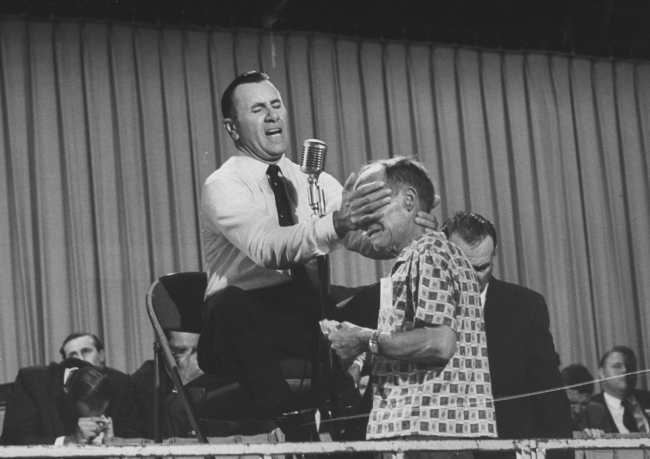
Being outside the Church and having no experience of Divine grace——or, in the case of the Orthodox participants, having little or no foundation in the genuine sources of Orthodoxy—the followers of the “charismatic” movement have no means of distinguishing the grace of God from its counterfeit. All “charismatic” writers show, to a lesser or greater degree, a lack of caution and discrimination toward the experiences they have. Some Catholic Pentecostals, to be sure, “exorcise satan” before asking for “Baptism in the Spirit”; but the efficacy of this act, as will soon be evident from their own testimony, is similar to that of the Jews in the Acts[4], to whose “exorcism” the evil spirit replied: Jesus I know, and Paul I know; but who are you? The widespread practice of “exorcism” in “charismatic” circles says nothing whatever of the spiritual orientation of these circles, for this practice is also very common (and seemingly successful) among primitive shamans, (14) who also recognize that there are different kinds of spirits—which are all, however, equally devils, whether they flee when exorcised or come when invoked to give shamanistic powers.
Protestants at best offer as defense the Scriptures. One of them says: “The word must be hid in our hearts and become an anointed word of faith on our lips. Against that word the devil has no authority” [5]. On the contrary, the Orthodox Christian knows that the devil is an “expert” in Scripture. St. John of the Ladder instructs us, indeed, that “at the beginning of the monastic life some of the unclean demons instruct [novices] in the interpretation of the Divine Scriptures … gradually deceiving them that they may lead them into heresy and blasphemy” [6]. In the face of such an enemy the use of Scripture by many “charismatic” pastors is an open invitation to deceit. One pastor, for example, counsels meditation on Scripture passages and then writing down any thought “triggered” by the reading: “This is the Holy Spirit’s personal message to you” [7].
Many followers of the “charismatic revival,” to be sure, imagine that among the other “gifts of the Spirit” they possess also the gift of “discernment of spirits”; but on observation this gift, like the others, turns out to be a crude imitation of the true Christian gift. Thus, to one “charismatic” counsellor a student came who told him: “There is a presence surrounding me. Any time I ask a question, I receive an immediate answer from this presence.” The teacher rightly persuaded the student, who had acquired his “spirit” by being exposed to fortune-tellers as a child, that this “spirit” was not the Holy Spirit. But then the teacher himself discovered that “as I talked the presence of the Holy Spirit became apparent in the room” [8]. The occult spirit had left, and just as easily a “charismatic” spirit had taken his place; the cruder spirit is distinguished and rejected, but the subtler spirit is allowed free entrance! By the end of this essay we shall try to answer the crucial question: what is this cunning, “Christian” spirit? No one will deny that the “charismatic revival” is firmly oriented against contemporary occultism and satanism. But no one who believes that our Lord Jesus Christ established a Church on earth—not an “idea” of a Church that can be shared by different sects, but an actual Church, which can only be the Orthodox Church—can recognize the Holy Spirit Who guides that Church to be the “spirit” of the “charismatic revival.”
Sadly, the attitude of the Orthodox followers of the “charismatic revival” seems no more discerning than that of Catholics and Protestants. They obviously do not know well the Orthodox Fathers or Lives of Saints, and when they do quote a rare Father, it is often out of context (see later concerning St. Seraphim). The “charismatic” appeal is chiefly one to experience. One Orthodox priest writes: “Some have dared to label this experience ‘prelest’—spiritual pride. No one who has encountered the Lord in this way could fall into this delusion” [9]. But it is a very rare Orthodox Christian who is capable of distinguishing very subtle forms of spiritual deception (where “pride,” for example, may take the form of “humility”) solely on the basis of his feeling about them without reference to the patristic tradition; only one who has already fully assimilated the patristic tradition into his own thought and practice and has attained great sanctity can presume to do this.
How is the Orthodox Christian prepared to withstand deception? He has the whole body of God-inspired patristic writings which, together with Holy Scripture, present the judgment of Christ’s Church for 1900 years with regard to virtually every conceivable spiritual and pseudo-spiritual experience. Later we shall see that this tradition has a very definite judgment precisely on the chief question the “charismatic” movement raises: concerning the possibility of a new and widespread “outpouring of the Holy Spirit” in the last days. But even before consulting the Fathers on specific questions, the Orthodox Christian is protected against deception by the very knowledge that such deception not only exists, but is everywhere including within himself. Bishop Ignatius writes: “We are all in deception. The knowledge of this is the greatest preventative against deception. It is the greatest deception to acknowledge oneself to be free of deception.” He quotes St. Gregory the Sinaite, who warns us: “It is not a little labor to attain the truth precisely and to make oneself pure of everything that opposes grace; because it is usual for the devil to show his deception, especially to beginners, in the form of truth, giving a spiritual appearance to what is evil.” And “God is not angry at him who, fearing deception, watches over himself with extreme caution, even if he should not accept something which is sent from God… On the contrary, God praises such a one for his good sense.”
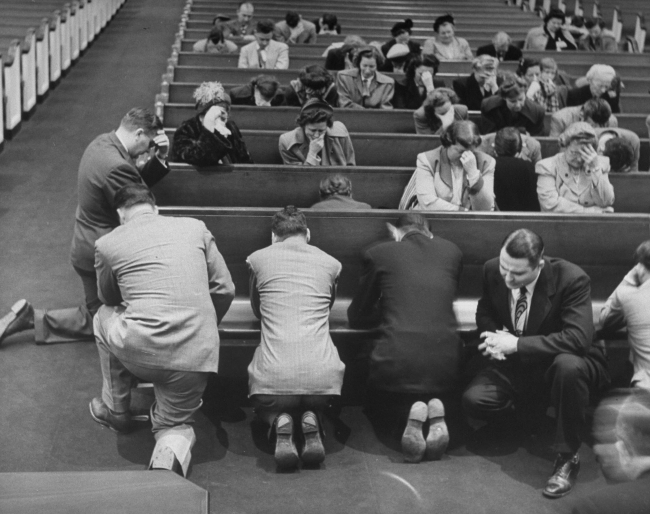
Thus, totally unprepared for spiritual warfare, unaware that there is such a thing as spiritual deception of the most subtle sort (as opposed to obvious forms of occultism), the Catholic or Protestant or uninformed. Orthodox Christian goes to a prayer-meeting to be “baptized (or filled) with the Holy Spirit.” The atmosphere of the meeting is extremely loose, being intentionally left “open” to the activity of some “spirit.” Thus do Catholics (who profess to be more cautious than Protestants) describe some of their Pentecostal gatherings: “There seemed to be no barriers, no inhibitions… They sat cross legged on the floor. Ladies in slacks. White robed monk. Cigarette smokers. Coffee drinkers. Praying in free-form… It occurred to me that these people were having a good time praying! Is that what they meant by the Holy Spirit dwelling amongst them?” And at another Catholic Pentecostal meeting, “except for the fact that no one was drinking, it seemed like a cocktail party” [10]. At interdenominational “charismatic” meetings the atmosphere is likewise sufficiently informal that no one is surprised when the “spirit” inspires an elderly woman, in the midst of a fit of general weeping, to stand up and “dance a little jig” [11]. To the sober Orthodox Christian, the first thing noticeable about such an atmosphere is its total lack of what he knows in his own Divine services as genuine piety and awe, proceeding from the fear of God. And this first impression is only strikingly confirmed by observation of the truly strange effects which the Pentecostal “spirit” produces when it descends into this loose atmosphere. We shall now examine some of these effects, placing them before the judgment of the Holy Fathers of the Church of Christ.
B. Physical Accompaniments of “Charismatic” Deception
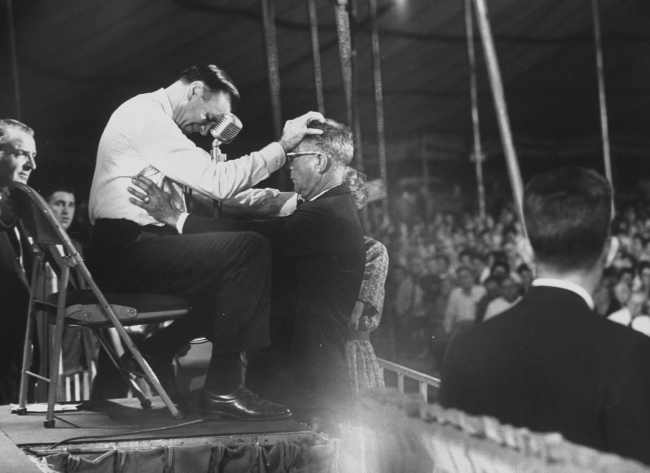
One of the commonest responses to the experience of the “Baptism of the Holy Spirit” is laughter. One Catholic testifies: “I was so joyful that all I could do was laugh as I lay on the floor” [12]. Another Catholic: “The sense of the presence and love of God was so strong that I can remember sitting in the chapel for a half hour just laughing out of joy over the love of God” [13]. A Protestant testifies that at his “Baptism” “I started laughing… I just wanted to laugh and laugh the way you do when you feel so good you just can’t talk about it. I held my sides and laughed until I doubled over” [14]. Another Protestant: “The new’ tongue I was given was intermingled with waves of mirth in which every fear I had just seemed to roll away. It was a tongue of laughter” [15]. An Orthodox priest, Fr. Eusebius Stephanou, writes: “I could not conceal the broad smile on my face that any minute could have broken out into laughter—a laughter of the Holy Spirit stirring in me a refreshing release” [16]
Many, many examples could be collected of this truly strange reaction to a “spiritual” experience, and some “charismatic” apologists have a whole philosophy of “spiritual joy” and “God’s foolishness” to explain it. But this philosophy is not in the least Christian; such a concept as the “laughter of the Holy Spirit” is unheard of in the whole history of Christian thought and experience. Here perhaps more clearly than anywhere else the “charismatic revival” reveals itself as not at all Christian in religious orientation; this experience is purely worldly and pagan, and where it cannot be explained in terms of emotional hysteria (for Fr. Eusebius, indeed, laughter provided “relief” and “release” from “an intense feeling of self-consciousness and embarrassment” and “emotional devastation”), it can only be due to some degree of “possession” by one or more of the pagan gods, which the Orthodox Church calls demons. Here, for example, is a comparable “initiation” experience of a pagan Eskimo shaman: Not finding initiation, “I would sometimes fall to weeping and feel unhappy without knowing why. Then for no reason all would suddenly be changed, and I felt a great, inexplicable joy, a joy so powerful that I could not restrain it, but had to break into song, a mighty song, with room for only one word: joy, joy! And I had to use the full strength of my voice. And then in the midst of such a fit of mysterious and overwhelming delight I became a shaman… I could see and hear in a totally different way. I had gained my enlightenment … and it was not only I who could see through the darkness of life, but the same bright light also shone out from me … and all spirits of earth and sky and sea now came to me and became my helping spirits.” [17]
It is not surprising that unsuspecting “Christians,” having deliberately laid themselves open to a similar pagan experience, would still interpret it as a “Christian” experience; psychologically they are still Christians, although spiritually they have entered the realm of distinctly non-Christian attitudes and practices. What is the judgment of the Orthodox ascetic tradition concerning such a thing as a “laughter of the Holy Spirit”? Sts. Barsanuphius and John, the 6th-century ascetics, give the unequivocal Orthodox answer in reply to an Orthodox monk who was plagued by this problem (Answer 451): “In the fear of God there is no laughter. The Scripture says of the foolish, that they raise their voice in laughter[18]; and the word of the foolish is always disturbed and deprived of grace.” St. Ephraim the Syrian just as clearly teaches: “Laughter and familiarity are the beginning of a soul’s corruption. If you see these in yourself, know that you have come to the depths of evils. Do not cease to pray God that He will deliver you from this death… Laughter removes from us that blessing which is promised to those who mourn[19] and destroys what has been built up. Laughter offends the Holy Spirit, gives no benefit to the soul, dishonors the body. Laughter drives out virtues, has no remembrance of death or thought of tortures” [20]. Is it not evident how far astray ignorance of basic Orthodoxy can lead one?
At least as common as laughter as a response to charismatic “Baptism” is its psychologically close relative, tears. These occur to individuals and, quite often, to whole groups at once (in this case quite apart from the experience of “Baptism”), spreading infectiously for no apparent reason at all[21]. “Charismatic” writers do not find the reason for this in the “conviction of sin” that produces such results at Protestant revivals; they give no reason at all, and there seems to be none, except that this experience simply comes upon one who is exposed to the “charismatic” atmosphere. The Orthodox Fathers, as Bishop Ignatius notes, teach that tears often accompany the second form of spiritual deception. St. John of the Ladder, telling of the many different causes of tears, some good and some bad, warns: “Do not trust your fountains of tears before your soul has been perfectly purified” (Step 7:35); and of one kind of tears he states definitely: “Tears without thought are proper only to an irrational nature and not to a rational one” (7:17).
Besides laughter and tears, and often together with them, there are a number of other physical reactions to the “Baptism of the Holy Spirit,” including warmth, many kinds of trembling and contortions, and falling to the floor. All the examples given here, it should be emphasized, are those of ordinary Protestants and Catholics, and not at all those of any Pentecostal extremists, whose experiences are much more spectacular and unrestrained.
“When hands were laid on me, immediately it felt as if my whole chest were trying to rise into my head. My lips started trembling, and my brain started turning flips. Then I started grinning” [22]. Another was “without emotion following the event, but with great warmth of body and a great ease” [23]. Another gives this testimony: “As soon as I knelt down I began to tremble… All of a sudden I became filled with the Holy Spirit and realized that ’God is real.’ I started laughing and crying at the same time. The next thing I knew I was prostrate before the altar and filled with the peace of Christ” [24]. Another says: “As I knelt quietly thanking the Lord, D. lay prostrate and suddenly began to heave by the power of someone unseen. By an insight that must have been divinely inspired… I knew D. was being moved quite visibly by the Holy Spirit” [25]. Another: “My hands (usually cold because of poor circulation) grew moist and warm. Warmth enveloped me” [26]. Another: “I knew God was working within me. I could feel a distinct tingling in my hands, and immediately I became bathed in a hard sweat” [27]. A member of the “Jesus Movement” says: “I feel something welling up inside me and all of a sudden I’m speaking in tongues” [28]. One “charismatic” apologist emphasizes that such experiences are typical in the “Baptism of the Holy Spirit,” which “has often been marked by a subjective experience which has brought the recipient into a wonderful new sense of nearness to the Lord. This sometimes demands such an expression of worship and adoration as cannot be contained within the usual restrictions imposed by the etiquette of our western society! At such times, some have been known to shake violently, to lift up their hands to the Lord, to raise the voice above the normal pitch, or even to fall to the floor” [29]l
One does not know at what to marvel the more: at the total incongruence of such hysterical feelings and experiences with anything at all spiritual, or at the incredible lightmindedness that leads such deceived people to ascribe their contortions to the “Holy Spirit,” to “divine inspiration,” to the “peace of Christ.” These are clearly people who, in the spiritual and religious realm, are not only totally inexperienced and without guidance, but are absolutely illiterate. The whole history of Orthodox Christianity does not know of any such “ecstatic” experiences produced by the Holy Spirit. It is only foolishness when some “charismatic” apologists presume to compare these childish and hysterical experiences, which are open to absolutely everyone, with the Divine revelations accorded to the greatest saints, such as to St. Paul on the road to Damascus or to St. John the Evangelist on Patmos. Those saints fell down before the true God (without contortions, and certainly without laughter), whereas these pseudo-Christians are merely reacting to the presence of an invading spirit, and are worshiping only themselves. The Elder Macarius of Optina wrote to a person in a similar state: “Thinking to find the love of God in consoling feelings, you are seeking not God but yourself, that is, your own consolation, while you avoid the path of sorrows, considering yourself supposedly lost without spiritual consolations.” [30] If these “charismatic” experiences are religious experiences at all, then they are pagan religious experiences; and in fact they seem to correspond exactly to the mediumistic initiation experience of spirit-possession, which is caused by “an inner force welling up inside attempting to take control” [31]. Of course, not all “Baptisms of the Holy Spirit” are as ecstatic as some of these experiences (although some are even more ecstatic); but this too is in accord with spiritistic practice: “When spirits find a medium friendly or well-disposed in submissiveness or passivity of mind, they enter quietly as into their own home; while, on the contrary, when the psychic is less well-disposed from some resistance, or want of passivity of mind, the spirit enters with more or less force, and this is often reflected in the contortions of the face and tremor of the medium’s members”.[32]
This experience of “spirit-possession,” however, should not be confused with actual demonic possession, which is the condition when an unclean spirit takes up permanent habitation in someone and produces physical and psychic disorders which do not seem to be indicated in “charismatic” sources. Mediumistic “possession” is temporary and partial, the medium consenting to be used for a time or for a particular function by the invading spirit. But the “charismatic” texts themselves make it quite clear that what is involved in these experiences—when they are genuine and not merely the product of suggestion—is not merely the development of some mediumistic ability, but actual possession by a spirit. These people would seem to be correct in calling themselves “spirit-filled”—but it is certainly not the Holy Spirit with which they are filled!
Bishop Ignatius gives several examples of such physical accompaniments of spiritual deception: one, a monk who trembled and made strange sounds, and identified these signs as the “fruits of prayer”; another, a monk whom the bishop met who as a result of his ecstatic method of prayer felt such heat in his body that he needed no warm clothing in winter, and this heat could even be felt by others. As a general principle, Bishop Ignatius writes, the second kind of spiritual deception is accompanied by “a material, passionate warmth of the blood”; “the behavior of the ascetics of Latinism, embraced by deception, has always been ecstatic, by reason of this extraordinary material, passionate warmth”—the state of such Latin “saints” as Francis of Assissi and Ignatius Loyola. This material warmth of the blood, a mark of the spiritually deceived, is to be distinguished from the spiritual warmth felt by those such as St. Seraphim of Sarov who genuinely acquired the Holy Spirit. But the Holy Spirit is not acquired from ecstatic “charismatic” experiences, but by the long and arduous path of asceticism, the “path of sorrows” of which the Elder Macarius spoke, within the Church of Christ.
C. “Spiritual Gifts” Accompanying ”Charismatic” Deception

The chief claim of the followers of the “charismatic revival” is that they have acquired “spiritual” gifts. One of the first such “gifts” that becomes noticeable in those “baptized with the Holy Spirit” is a new “spiritual” power and boldness. What gives the boldness is the definite experience which no one can doubt that they have had, although one can certainly doubt their interpretation of it. Some typical examples: “I do not have to believe in Pentecost, because I have seen it” [33]. “I began to feel that I knew exactly what to say to others and what they needed to hear… I found that the Holy Spirit gave me a real boldness to say it and it had a marked effect” [34]. “I was so confident that the Spirit would be true to his word that I prayed without any if’s. I prayed in will’s and shall’s and in every other kind of declarative statement” [35]. An Orthodox example: “We pray for wisdom and suddenly we are wise in the Lord. We pray for love and true love is felt for all men. We pray for healings, and health has been restored. We pray for miracles and, believing, we have seen miracles happen. We pray for signs, and receive them. We pray in tongues known and tongues unknown” [36]
Here again, a genuine Orthodox characteristic, acquired and tested by long years of ascetic labor and maturing in faith, is supposedly obtained instantly by means of “charismatic” experience. It is true, of course, that the Apostles and Martyrs were given a magnificent boldness by the special grace of God; but it is only ridiculous when every “charismatic Christian,” without any notion of what Divine grace is, wishes to compare himself to these great saints. Being based on an experience of deception, “charismatic” boldness is no more than a feverish, “revivalistic” imitation of true Christian boldness, and it only serves as another identifying mark of “charismatic” deception. Bishop Ignatius writes that a certain “self-confidence and boldness are usually noticeable in people who are in self-deception, supposing that they are holy or are spiritually progressing.” “An extraordinary pomposity appears in those afflicted with this deception: they are as it were intoxicated with themselves, by their state of self-deception, seeing in it a state of grace. They are steeped in, overflowing with high-mindedness and pride, while appearing humble to many who judge by appearances without being able to judge by fruits.”
Beyond speaking in tongues itself, the most common “supernatural” gift of those “baptized in the Spirit” is the direct reception of “messages from God” in the form of “prophecies” and “interpretations.” One Catholic girl says of her “charismatic” friends: “In some of them I witnessed the speaking in tongues, some of which I have been able to interpret. The messages have always been those of great solace and joy from the Lord” [37]. One “interpretation” is summarized thus: “He was speaking words from God, a message of consolation” [38]. The messages are nothing if not bold; at one meeting “still another young woman announced a ’message from God,’ speaking in the first person” [39]. A “charismatic” Protestant writes that in such messages “God’s Word is directly spoken! … The Word may suddenly be spoken by anyone present, and so, variously, a ’Thus says the Lord’ breaks forth in the fellowship. It is usually in the first person (though not always), such as I am with you to bless you’ ”.[40]
A few specific texts of “prophecy” and “interpretation” are given in the apologetical books of the “charismatic” movement:
- “Be like a tree swaying with his will, rooted in his strength, reaching up to his love and light”.[41]
- “As the Holy Spirit came down upon Mary and Jesus was formed within her, so the Holy Spirit comes upon you and Jesus is in your midst”—given in tongues by a Roman Catholic and “interpreted” by a Protestant[42].
- “The feet of him who walked the streets of Jerusalem are behind you. His gaze is healing to those who draw near but death to those who flee”—this had special meaning for one member of the prayer group[43].
- “I reach out my hand to you. You need only take it and I will lead you”—this same message was given a few minutes earlier to a Roman Catholic priest in another room; he wrote it down and entered the prayer room just in time to hear it uttered in exactly the words he had written down.[44]
- “Do not worry. I am pleased with the stand you have taken. This is difficult for you but will bring much blessing to another”—this brought final reassurance to one person present concerning a recent difficult decision[45].
- “My wife walked in and began to play the organ. Suddenly, the Spirit of God came upon her and she began to speak in tongues and prophesy, ’My son, I am with you. Because you have been faithful in little things I am going to use you in a greater way. I am leading you by the hand. I am guiding you, be not afraid. You are in the center of My will. Do not look to the right or to the left, but continue therein”—this “prophecy” was accompanied by a “vision” and was directly responsible for the founding of a large and influential Pentecostal organization, the “Full Gospel Business Men’s Fellowship International”.[46]
We may well believe, according to the testimony of witnesses who find that such messages apply directly to them, that there is something preternatural about a number of them, that they are not just “made up.” But does the Holy Spirit use such artificial methods to communicate with men? (The “spirits” at seances certainly do!) Why is the language so monotonous and stereotyped, sometimes worthy of the penny fortune-telling machines in American cafes? Why are the messages so vague and dreamlike, sounding indeed like trance-utterances? Why is their content always one of “consolation,” “solace and joy,” reassurance, precisely without prophetic or dogmatic character—as if the “spirit,” even like the “spirits” at seances, were especially pleased with his non-denominational audience? Who, after all, is the strangely characterless “I” that speaks? Are we wrong in applying the words of a true Prophet of God to all this? —Let not your prophets that are in the midst of you, and your diviners, deceive you… For they prophesy falsely unto you in My name—. I have not sent them, saith the Lord[47].
Just as one “baptized in the Spirit” usually carries the ability to speak in tongues over into his private devotions, and in general is aware that “the Lord” is constantly with him, so too, even outside the atmosphere of the prayer meeting he often has private “revelations,” including audible voices and tangible “presences.” Thus does the “prophet” of the “charismatic revival” describe one of his experiences: “I was awakened from a deep restful sleep by a voice that seemed loud and clear … distinctly saying: ’God has no grandsons’… Then it seemed as if there was someone in my room and the presence made me feel good. Suddenly it dawned on me. It must be the Holy Spirit who spoke to me”.[48]
How can one account for such experiences? Bishop Ignatius writes: “One possessed by this kind of spiritual deception fancies of himself [the second form of prelest is called ‘fancy,’ mnenie in Russian] that he abounds in the gifts of the Holy Spirit. This fancy is composed of false concepts and false feelings, and in this character which it has it belongs fully to the realm of the father and representative of falsehood, the devil. One who, in praying, strives to unveil in the heart the feeling of the new man, yet does not have any possibility to do this, substitutes for this feelings of his own invention, counterfeits, to which the action of fallen spirits does not tarry to join itself. Acknowledging his incorrect feelings, both his own and those from the demons, to be true and grace-given, he receives conceptions which correspond to the feelings.”
Precisely such a process has been observed by writers on spiritism. For someone seriously involved in spiritism (and not only mediums themselves), a moment comes when the whole false spirituality that cultivates passivity of mind and openness to the activity of “spirits,” manifested even in such seemingly innocent pastimes as the use of a ouija-board, passes over into the actual possession of this person by an invading spirit, after which undeniably “super-natural” phenomena begin to appear[49]. In the “charismatic revival” this moment of transition is identified as the experience of the “Baptism of the Holy Spirit,” which, when it is genuine, is precisely the moment when self-deception becomes satanic deception, and the “charismatic” victim is virtually assured that from then on his deceived “religious feelings” can expect a response from the “Spirit” and he will enter a “life of miracles.”
D. The New “Outpouring of the Holy Spirit”
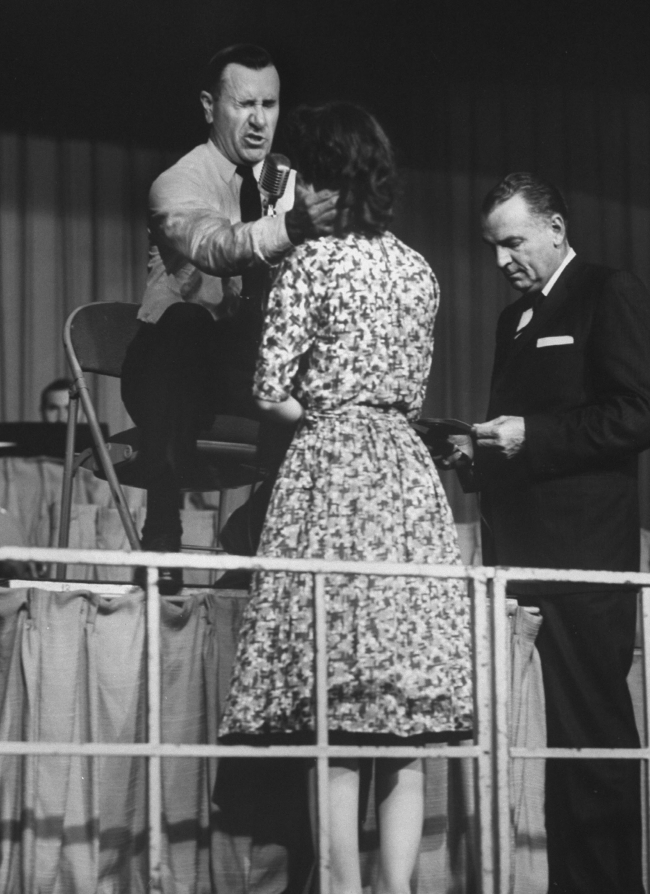
In general, followers of the “charismatic revival” have the feeling of being (as they constantly repeat) “Spirit-filled.” “I felt free, clean and a new person and completely filled with the Holy Spirit” [50]. “Because of what was begun in the baptism of the Spirit, I have now begun to see more and more a vision of what life in the Spirit is like. It is truly a life of miracles … of being filled over and over with the life-giving love of the Spirit of God” [51]. They invariably characterize their “spiritual” state in similar words; a Catholic priest writes, “whatever other particular effects may have occurred, peace and joy seem to have been received by all, almost without exception, of those who have been touched by the Spirit” [52]. One inter-denominational “charismatic” group states that the aim of its members is “to show and spread Jesus Christ’s Love, Joy and Peace wherever they are” (Inter-Church Renewal). In this “spiritual” state (in which, characteristically, both repentance and salvation are seldom mentioned), some rise to great heights. In one Catholic the gift of the “Spirit” “has risen within me to long periods (several hours) of near ecstasy in which I’d swear I was experiencing a foretaste of the Kingdom of Heaven” [53]. Spectacular stories are told of deliverance from drug addiction and the like. The Greek priest Fr. Eusebius Stephanou summarizes this “spirituality” by quoting a Roman Catholic priest who states that the “charismatic” movement involves “a new sense of the presence of God, a new awareness of Christ, a greater desire to pray, an ability to praise God, a new desire to read the Scriptures, the Scriptures coming alive as the Word of God, a new eagerness to have others know about Christ, a new compassion for others and a sensitiveness to their needs, a new sense of peace and joy…” And Fr. Eusebius presents the ultimate argument of the whole movement: “The tree is known by its fruits… Do these fruits demonstrate the presence of the Devil or of the sanctifying Spirit of Christ? No Orthodox in his right mind who has seen the fruits of the Spirit with his own eyes can give a mistaken answer to this question” [54].
There is no reason to doubt any of this testimony. True, there is also testimony—we have given a few examples—that contradicts this and definitely that the “spirit” of the “charismatic revival” is something dark and ominous; but still it cannot be doubted that many followers of the “charismatic revival” actually feel that it is something “Christian” and “spiritual.” As long as these people remain outside the Orthodox Church, we might well leave their opinions without comment. But when an Orthodox priest tells us that sectarian phenomena are produced by the Holy Spirit, and. he even exhorts us: “Don’t be left out. Open your heart to the promptings of the Holy Spirit and be part of the growing charismatic renewal” (loc. cit.)—then we have the right and the duty to examine their opinions quite closely, judging them not by the standard of the vague humanist “Christianity” which prevails in the West and is prepared to call anything “Christian” that merely “feels” so, but by the quite different standard of Orthodox Christianity. And by this standard there is not one item in the above list of “spiritual fruits” but that can be, and has been in the sectarian and heretical movements of the past, produced by the devil appearing as an “angel of light,” precisely with the aim of leading people away from the Church of Christ into some other kind of “Christianity.” If the “spirit” of the “charismatic revival” is not the Holy Spirit, then these “spiritual fruits” likewise are not from God.
According to Bishop Ignatius, the deception known as fancy “is satisfied with the invention of counterfeit feelings and states of grace, from which there is born a false, wrong conception of the whole spiritual undertaking… It constantly invents pseudo-spiritual states, an intimate companionship with Jesus, an inward conversation with him, mystical revelations, voices, enjoyments… From this activity the blood receives a sinful, deceiving movement, which presents itself as a grace-given delight… It clothes itself in the mask of humility, piety, wisdom.” Unlike the more spectacular form of spiritual deception, fancy, while “bringing the mind into the most frightful error, does not however lead it to delirium,” so that the state may continue for many years or a whole lifetime and not be easily detected. One who falls into this warm, comfortable, fevered state of deception virtually commits spiritual suicide, blinding himself to his own true spiritual state. Writes Bishop Ignatius: “Fancying of himself … that he is filled with grace, he will never receive grace… He who ascribes to himself gifts of grace fences off from himself by this ’fancy’ the entrance into himself of Divine grace, and opens wide the door to the infection of sin and to demons.” Thou sayest, I am rich, and increased with goods, and have need of nothing; and knowest not that thou art wretched, and miserable, and poor, and blind, and naked[55].
Those infected with the “charismatic” deception are not only themselves “spirit-filled”; they also see around them the beginning of a “new age” of the “outpouring of the Holy Spirit,” believing, as docs Fr. Eusebius Stephanou, that “the world is on the threshold of a great spiritual awakening” [56]; and the words of the Prophet Joel arc constantly on their lips: I will pour out My Spirit upon all flesh[57]. The Orthodox Christian knows that this prophecy refers in general to the last age that began with the coming of our Lord, and more specifically to Pentecost[58], and to every Orthodox saint who truly possesses in abundance the gifts of the Holy Spirit—such as St. John of Kronstadt and St. Nectarios of Pentapolis, who have worked thousands of miracles even in this corrupt 20th century.
But to today’s “charismatics,” miraculous gifts are for everyone; almost everyone who wants to can and does speak in tongues, and there are manuals telling you how to do it. But what do the Holy Fathers of the Orthodox Church teach us? According to Bishop Ignatius, the gifts of the Holy Spirit “exist only in Orthodox Christians who have attained Christian perfection, purified and prepared beforehand by repentance.” They “are given to saints of God solely at God’s good will and by God’s action, and not by the will of men and not by one’s own power. They are given unexpectedly, extremely rarely, in cases of extreme need, by God’s wondrous providence, and not just at random (St. Isaac the Syrian).” “It should be noted that at the present time spiritual gifts are granted in great moderation, corresponding to the enfeeblement that has enveloped Christianity in general. These gifts serve entirely the needs of salvation. On the contrary, ‘fancy’ lavishes its gifts in boundless abundance and with the greatest speed.”
In a word, the “spirit” that suddenly lavishes its “gifts” upon this adulterous generation which, corrupted and deceived by centuries of false belief and pseudo-piety, seeks only a “sign”—is not the Holy Spirit of God. These people have never known the Holy Spirit and never worshiped him. True spirituality is so far beyond them that, to the sober observer, they only mock it by their psychic and emotional—and sometimes satanic—phenomena and blasphemous utterances. Of true spiritual feelings, writes Bishop Ignatius, “the fleshly man cannot form any conception: because a conception of feeling is always based on those feelings already known to the heart, while spiritual feelings are entirely foreign to the heart that knows only fleshly and emotional feelings. Such a heart does not so much as know of the existence of spiritual feelings.”
[1] Now the works of the flesh are manifest, which are these; Adultery, fornication, uncleanness, lasciviousness, Idolatry, witchcraft, hatred, variance, emulations, wrath, strife, seditions, heresies, Envyings, murders, drunkenness, revellings, and such like: of the which I tell you before, as I have also told you in time past, that they which do such things shall not inherit the kingdom of God. But the fruit of the Spirit is love, joy, peace, longsuffering, gentleness, goodness, faith, Meekness, temperance: against such there is no law. And they that are Christ’s have crucified the flesh with the affections and lusts. If we live in the Spirit, let us also walk in the Spirit. Let us not be desirous of vain glory, provoking one another, envying one another. Galatians 5 19-26
[2] ⸹Self-Delusion
Holy truth comes to our heart through silence, tranquility, clarity, and peace. An inclination toward repentance encourages us toward a deeper awareness of self and toward less dependence on ourselves, fostering within us a consoling hope in God. Deceit, even when clothed in a mask of goodness, is recognized by its effects . . . embarrassment, gloom, uncertainty, changeability, amusement, dreaminess; or else [deceit] only seduces the heart—flattering it with contentment, feeling satisfied with oneself, a kind of moot, unclear sensation of pleasure. This pleasure of a self-deluded heart is like a sham tranquility, whose surface cloaks a deep and dark pool—the dwelling place of monsters. Among the already mentioned deceitful, pestilential gales, there is also cast upon the heart this terrible tranquility, this disastrous baneful pleasure, evoked by the reading of the famous book called the Imitation of Christ by Thomas à Kempis [c. 1380–1471], the Western monk who was in the grip of demonic deceit. Seductive pleasure feeds on conceit, which is born of a refined and active vanity, that blinds the mind and heart; it loves to express itself; it allows itself to depart from the correct obedience to the Holy Church, considering itself smarter than it. As with all self-delusions, it is the product of machinations of the devil and his offspring sin; this pleasure does not tolerate the sweet scent of repentance and its fruit—humility . . . both of which would bring an end to the pleasure. The Saviour of the world said: “Blessed are the poor in spirit . . ., blessed are those who hunger and thirst for righteousness” (Matt 5:3,6).
The human mind is unable to differentiate between good and evil; evil is easily masked and almost always deceives the mind. All this is very natural: the mind of man is young and the evil conceptions waging battle with the mind have more than 7,000 years of practice . . . in battle, in craftiness, in preying upon souls of men. The task of differentiating good and evil belongs to the heart; it’s the business of the heart. But for this one needs time, the accumulation of practice with the New Testament commandments, so the heart could acquire a refined taste for wine that is excellent as well as wine that is counterfeit. The fact that the heart has the task of knowing the difference between good and evil and does not suddenly acquire this ability are both facts witnessed to by the apostle: “But solid food belongs to those who are of full age, that is those who by reason of use have their senses exercised to discern both good and evil” (Heb 5:14).
That is why, before one’s heart acquires the skill to distinguish good from evil, one benefits from the practiced advice of a neighbor, a student of the Eastern Church. Only this Church is sacred and true. Find one who sought and found in obedience to it a blessed freedom. “From obedience, said St. John the Ladder, issues true humility; from humility is born spiritual discourse, or the mind.” Outside the steadfast obedience to the Church, there is no true humility, no true spiritual discourse; there one finds a wide territory, a dark kingdom of deception that creates its own self-delusion. Good can be distinguished from evil by the following features that can be recognized by means of one’s spiritual advances. In the beginning of my letter I identified these features, which are close to your spiritual state. And they are very sufficient attributes! Little by little learn to distinguish good from camouflaged evil. Christ is with you! [Letter 186, Letters to Laity [no date].]
⸹Eternity
Exactly, life on earth is full of sorrows; when a person completes a significant part of his life and looks back, then it seems all that was pleasant was actually vain that for which he was yearning with such hunger in his youth! Let us then not lose at least the rest of our life by sacrificing it in hectic pursuit of all that is vain. Let us get acquainted with eternity not by reading little foreign books, which lead the reader invariably to self-deception. Instead be guided by the holy writers of our Church, where there is nothing romantic, dreamy, or flattering in garnering knowledge about our relationship to God, our Creator and Redeemer, where we are taught to approach Him with repentance, where we are not flattered with imaginary sweet emotions about spiritual love, to which are attracted the extravagant likes of Thomas a Kempis, Francois de Sales, and other false teachers. Spiritual love is the reward of those who reach perfection; and the reward of the righteous and those who fear God, those who see their own sins and shortcomings; the product of one and the other is a contrite and humble heart, which expresses repentance. This is the true moral teaching of the Orthodox Church, to which any kind of deception and self-delusion is foreign. I invoke God’s blessing upon you and feelings of heartfelt devotion, with wishes for all good things for you, especially for true soulful Christian edification, which is the highest blessing on earth and a token of our blessings in heaven. [Letter 395, “To Elizabeth Alexandrovna [St Ignatius’ Sister] and Her Husband Dimitri Parensov,” Letters to Family and Friends, April 13, 1847.]
[3] See The Orthodox Word, 1965, no. 4, pp. 155–158.
[4] And God wrought special miracles by the hands of Paul: So that from his body were brought unto the sick handkerchiefs or aprons, and the diseases departed from them, and the evil spirits went out of them. Then certain of the vagabond Jews, exorcists, took upon them to call over them which had evil spirits the name of the Lord Jesus, saying, We adjure you by Jesus whom Paul preacheth. And there were seven sons of one Sceva, a Jew, and chief of the priests, which did so. And the evil spirit answered and said, Jesus I know, and Paul I know; but who are ye? And the man in whom the evil spirit was leaped on them, and overcame them, and prevailed against them, so that they fled out of that house naked and wounded. And this was known to all the Jews and Greeks also dwelling at Ephesus; and fear fell on them all, and the name of the Lord Jesus was magnified. Acts 19 11-17
[5] Lillie, p. 44
[6] Step 26:152
[7] Christenson, p. 139
[8] Logos Journal, Sept.-Oct., 1971, p. 22
[9] Logos, April, 1972, p. 10
[10] Ranaghan, pp. 209, 157
[11] Sherrill, p. 118
[12] Ranaghan, p. 28
[13] Ranaghan, p. 64
[14] Sherrill, p. 113
[15] Sherrill, p. 115
[16] Logos, April, 1972, p. 4
[17] Lewis, Ecstatic Religion, p. 37
[18] Sirach 21:23
[19] And seeing the multitudes, he went up into a mountain: and when he was set, his disciples came unto him: And he opened his mouth, and taught them, saying, Blessed are the poor in spirit: for theirs is the kingdom of heaven. Blessed are they that mourn: for they shall be comforted. Blessed are the meek: for they shall inherit the earth. Blessed are they which do hunger and thirst after righteousness: for they shall be filled. Blessed are the merciful: for they shall obtain mercy. Blessed are the pure in heart: for they shall see God. Blessed are the peacemakers: for they shall be called the children of God. Blessed are they which are persecuted for righteousness’ sake: for theirs is the kingdom of heaven. Blessed are ye, when men shall revile you, and persecute you, and shall say all manner of evil against you falsely, for my sake. Matthew 5 1-11
[20] Philocalia. Russian ed., Moscow, 1913: vol. 2, p. 448
[21] See Sherrill, pp. 109, 117
[22] Ranaghan, p. 67
[23] Ranaghan, p. 91
[24] Ranaghan, p. 34
[25] Ranaghan, p. 29
[26] Ranaghan, p. 30
[27] Ranaghan, p. 102
[28] Ortega, p. 49
[29] Lillie, p. 17
[30] Starets Macarius of Optina, Harbin, 1940, p. 100 (in Russian).
[31] Koch, Occult Bondage, p. 44
[32] Blackmore, Spiritism, p. 97
[33] Ranaghan, p. 40
[34] Ranaghan, p. 64
[35] Ranaghan, p. 67
[36] Logos, April, 1972, p. 13
[37] Ranaghan, p. 32
[38] Ranaghan, p. 181
[39] Ranaghan, p. 2
[40] Williams, p. 27
[41] Ford, p. 35
[42] Ford, p. 35
[43] Ford, p. 35
[44] Ranaghan, p. 54
[45] Sherrill, p. 88
[46] Logos Journal, Sept.-Oct., 1971, p. 14
[47] Build ye houses, and dwell in them; and plant gardens, and eat the fruit of them; Take ye wives, and beget sons and daughters; and take wives for your sons, and give your daughters to husbands, that they may bear sons and daughters; that ye may be increased there, and not diminished. And seek the peace of the city whither I have caused you to be carried away captives, and pray unto the LORD for it: for in the peace thereof shall ye have peace. For thus saith the LORD of hosts, the God of Israel; Let not your prophets and your diviners, that be in the midst of you, deceive you, neither hearken to your dreams which ye cause to be dreamed. For they prophesy falsely unto you in my name: I have not sent them, saith the LORD. For thus saith the LORD, That after seventy years be accomplished at Babylon I will visit you, and perform my good word toward you, in causing you to return to this place. For I know the thoughts that I think toward you, saith the LORD, thoughts of peace, and not of evil, to give you an expected end. Then shall ye call upon me, and ye shall go and pray unto me, and I will hearken unto you. Jeremiah 29 5-12
[48] Du Plessis, p. 61
[49] See Blackmore, Spiritism, pp. 144–175, where an example is given of a Catholic priest who was physically pursued by a ouija-board (propelled, of course, by a demon) when he tried to give up using it!
[50] Ranaghan, p. 98
[51] Ranaghan, p. 65
[52] Ranaghan, p. 185
[53] Ranaghan, p. 103
[54] Logos, Jan., 1972, p. 13
[55] And unto the angel of the church of the Laodiceans write; These things saith the Amen, the faithful and true witness, the beginning of the creation of God; I know thy works, that thou art neither cold nor hot: I would thou wert cold or hot. So then because thou art lukewarm, and neither cold nor hot, I will spue thee out of my mouth. Because thou sayest, I am rich, and increased with goods, and have need of nothing; and knowest not that thou art wretched, and miserable, and poor, and blind, and naked: I counsel thee to buy of me gold tried in the fire, that thou mayest be rich; and white raiment, that thou mayest be clothed, and that the shame of thy nakedness do not appear; and anoint thine eyes with eyesalve, that thou mayest see. As many as I love, I rebuke and chasten: be zealous therefore, and repent. Revelation 3 14-19
[56] Logos, Feb., 1972, p. 18
[57] And ye shall know that I am in the midst of Israel, and that I am the LORD your God, and none else: and my people shall never be ashamed. And it shall come to pass afterward, that I will pour out my spirit upon all flesh; and your sons and your daughters shall prophesy, your old men shall dream dreams, your young men shall see visions: And also upon the servants and upon the handmaids in those days will I pour out my spirit. And I will shew wonders in the heavens and in the earth, blood, and fire, and pillars of smoke. Joel 2 27-30
[58] Acts 2

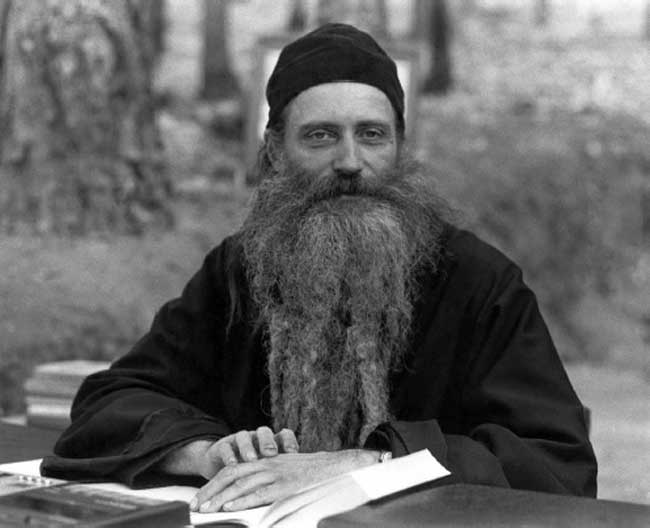
by Saint Seraphim of Platina [†1982]
The Orthodox Word, 1972, Vol. 8, No. 2 (43) March-April, pp. 52-66, 71-95



Pas de commentaire