
A talk delivered at the summer New Valaam Theological Academy, Platina, 1980, as an introduction to Fr. Seraphim’s course on the Book of the Apocalypse.[1]
1. The Wrong Approach
Our times—the twentieth century and especially the last part of the twentieth century—are, more than ever before, what one can call apocalyptic times, that is, times in which there are such great events that it looks as though the end of the world is at hand. Because of the nature of the inventions of our times, even people who are very realistic and down to earth talk about the possibility of the annihilation of whole countries and even of the whole of humanity, whether by weapons such as thermonuclear bombs or through the production of modern monsters, through pollution, chemical and biological experiments, and so forth.
This being the character of our times, it is not surprising that the Book of the Apocalypse is more popular than ever before. So, as we begin this course, I’d like to give an indication of how we are going to approach this Book. Today, most of the interest and most of the books about this Book are very superficial. One of the most popular books on the subject is The Late Great Planet Earth by Hal Lindsey, a Protestant Evangelist. On the cover it says, “A penetrating look at incredible prophecies involving this generation.” He talks about Israel, about Russia, Gog and Magog, the end of the world, and nuclear warfare. You get dizzy reading all these things. It’s written in a flippant tone: “Russia is a Gog,” “What’s Your Game, Gog?” and things like that. It’s very easy on a superficial level to get absorbed in this book. When you finish it, you’re all excited about what’s happening. Phrases occur like, “Look at Iran,” “Watch what Russia does next.” It says that, when the ten nations come together in Europe—that is, when the tenth country joins the Common Market—that’s the sign to watch, because that’s the ten horns of the Beast. The king of the north is obviously Russia; Egypt’s the king of the south; China’s the king of the east, etc.—you get dizzy after a while.
The tone of excitement which is aroused by such a book is not the right tone for a person who is studying Scripture. It is more on the level of movies or television. The very language the author uses is jazzed up. The whole approach he gives does not help you actually to understand what this book is about; instead, it helps you to get excited. Some of the things he talks about may be true. Who knows? Russia may be the king of the north, but that’s a secondary point. He makes these things the big points, and they are not. The big point is something else entirely.
This is not the reason we should be reading the Book of the Apocalypse. I know people who have read it and were very excited the whole time: in one night they read the whole Book, but when they finished it, they didn’t have any spiritual food for themselves. They’re all excited, and are ready to go out and read the newspapers to see what Russia does next, who is about to blow up whom. Spiritually speaking, they have not obtained anything because all they’re doing is indulging in guesses and speculations, and that’s not what the Book is about.
2. Revelation of Mysteries
Therefore, we must approach this Book, as the whole of biblical prophecy, in a totally different way. We must ask the question: Why do we read such a book as this, the Book of the Apocalypse? We must first understand the purpose for which this Book was written. It is a book of Mysteries, one can say. Mysteries are certain deep things which are bound up with the beginning and the end of all things, with the ultimate purpose of the world and of mankind, and the opening up of the eternal Kingdom of God. In the Scripture, this word appears a number of times. In our Church services, we sing about the “Mystery which was from before the ages and unknown to angels,” that is, the Mystery of the Incarnation of God. Ordinary things in this world we do not call “mysteries.” Such things as the Loch Ness Monster or the Bermuda Triangle—these are not Mysteries. They are riddles or strange, mysterious things, but they’re not Mysteries in the sense that Scripture speaks of Mysteries. The “Mystery hidden from the ages,” on the other hand, is the Mystery about our salvation, the redemption by Jesus Christ Who came into this world. It is something in this world that already bring us into a different world, the unending Kingdom of God.
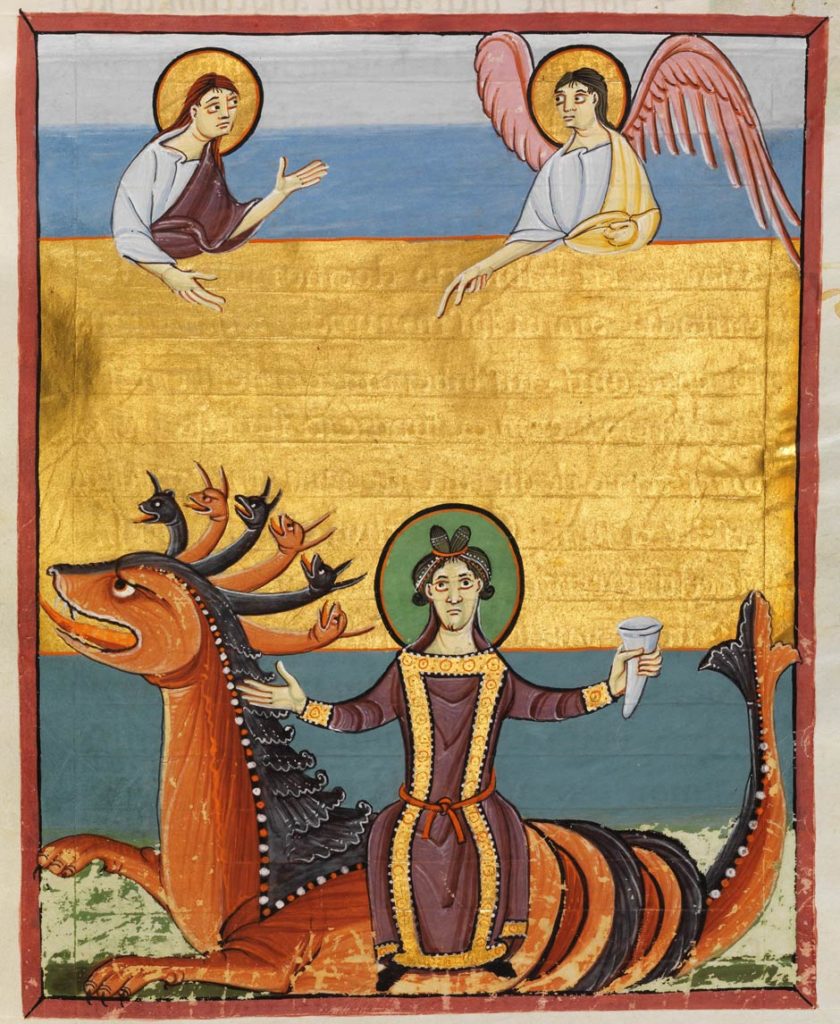
We also read in the Scriptures, including in the Apocalypse[2], about the Mystery[3] of Iniquity[4] This is also a very deep thing because, in a way, it is the opposite of the Mystery hidden from the ages—it is the mystery of the working of the devil in the world. The devil also has an unending kingdom; he wants to bring everybody into the abyss of hell. Therefore, the working out of his plan on the earth is like a mystery because it starts in this world and leads into something else, into the bottomless pit.
So we are to read this Book as one which is concerned with the Mysteries of the whole future of mankind and the end of the world. If you examine history, you don’t see quite where it begins or quite where it ends. You study about the rise of nations, the fall of kingdoms, and nowhere in history do you read about when everything suddenly comes to an end. This Book, however, is about what happens when the whole of history comes to an end, when there’s no more history. That is this element of Mystery which brings us into the other world, the new age.
3. Consolation to the Suffering Church

The purpose for which this Book was written is given in the very first verse. It is to “show unto His servants (the servants of Christ) things which must shortly come to pass.” That is, the subject of the Apocalypse is a mystical depiction of the future fate of the Church of Christ and of the whole world. It describes the battle of the Church against its enemies, particularly the devil, and its triumph over all enemies.
This is a great consolation, especially in times of persecutions and discouragement for Christians such as our own times. Through this Book, the historical events which we see about us are placed in the context of the whole battle of the Church against the powers of evil, and the final victory of the Church and the opening up of the eternal Kingdom of Heaven.
Anyone who has read stories about the life of the Catacomb Church in Russia will know that many of the people there in the underground Church speak about their Church in terms of the Woman fleeing into the wilderness of the last times[5]. They look at themselves as in apocalyptic times. Since the whole of society is governed by atheism, and there’s no consolation anywhere for a Christian, and they themselves are persecuted and hidden underground, the images of this Book of the Apocalypse are very consoling. They show that, despite the fact that the enemy has conquered the whole of society, in the end the Church is going to triumph. Thereby people who read this Book at such times, under great difficulties and persecutions, gain strength for their very difficult struggle.
When the powers of evil take such a powerful form as that of the atheist governments today, it is very easy for people to give up the battle if they do not have a picture of the meaning of their struggle, the meaning of the fact that evil seems to triumph in this world, and the knowledge that the Church of Christ will triumph in the end. Thus this Book has been especially read and understood by Christians in times of great trials and persecutions; but it has been read by sectarians in a very wrong way because they also in times of persecutions look to it and, not having a deeper, mystical insight into it, become carried away with the images, make up all kinds of new doctrines which do not fit in with the whole teaching of the Church, and in the end go off the deep end. They find that, for example, the number 666 refers to this person or that person, or the Pope of Rome or someone else, and therefore everything makes sense in terms of that; and when history proves it isn’t true, they collapse. Of course, that’s not the way to read this Book.
4. The Danger of Trusting One’s Own Opinions
So we must not be carried away by the particular images in this Book, which are extremely striking, dramatic images—of beasts and dragons and women in the sky, and so on. We must not draw any fantastic conclusions of our own. It’s very important that we do not simply pick it up and read it, and interpret it according to whatever comes into our head. We must read it in the context of the whole of sacred Scripture and the Church’s interpretation of it. It must be read first of all together with regular spiritual nourishment, by Orthodox people who are attending church, praying every day, receiving sacraments, reading the Holy Scripture (and not just this Book of Scripture), and reading other spiritual books. If a whole regime of Christian life is present, and if our Orthodox Christianity is a conscious struggle that is conducted daily on our own level—that is, at least saying some prayers and reading some Scripture every day, and being aware that we are Christians and there is a struggle going on—then we will not be overwhelmed by some new catastrophe that comes into our life, or by misinterpreting some image of this Book, and going off the deep end.
Most of all, we must read a book like this with the fear of God and distrust in our own wisdom. Every person reading books like this—including the Book of Daniel, which has very similar images—should in the very beginning decide that he is not going to trust any idea that comes into his head. If we think we understand by our own experience or study what a particular passage refers to, we should be hesitant to accept this. We should not jump to conclusions until we have checked with Holy Fathers, with our own priests, and until this fits in with our own Christian life. We should by no means think that we have understood something just because we’ve figured it out. For example, many people have figured out all kinds of things about the number 666. You can prove that it’s Napoleon; you can prove it’s Hitler; you can prove it’s the Pope of Rome, and various caesars and anybody else you want. But that is not necessarily true; it’s just private interpretation.
The understanding of Holy Scripture is a lifelong matter, and therefore we should be very slow to think we understand very much. The more hesitant we are to trust our own understanding, the deeper we will begin to understand, especially if we’re also reading other books on the subject, Orthodox books and commentaries.
For this course the main Orthodox commentary we will follow is that of Archbishop Averky of Jordanville: the last chapter of his commentary on the New Testament Epistles. He takes most of his interpretations from a 5th-century Father, St. Andrew of Caesarea. There are not too many Fathers who have written commentaries on the whole Book of Apocalypse, and his is the main one.
5. The Right Approach
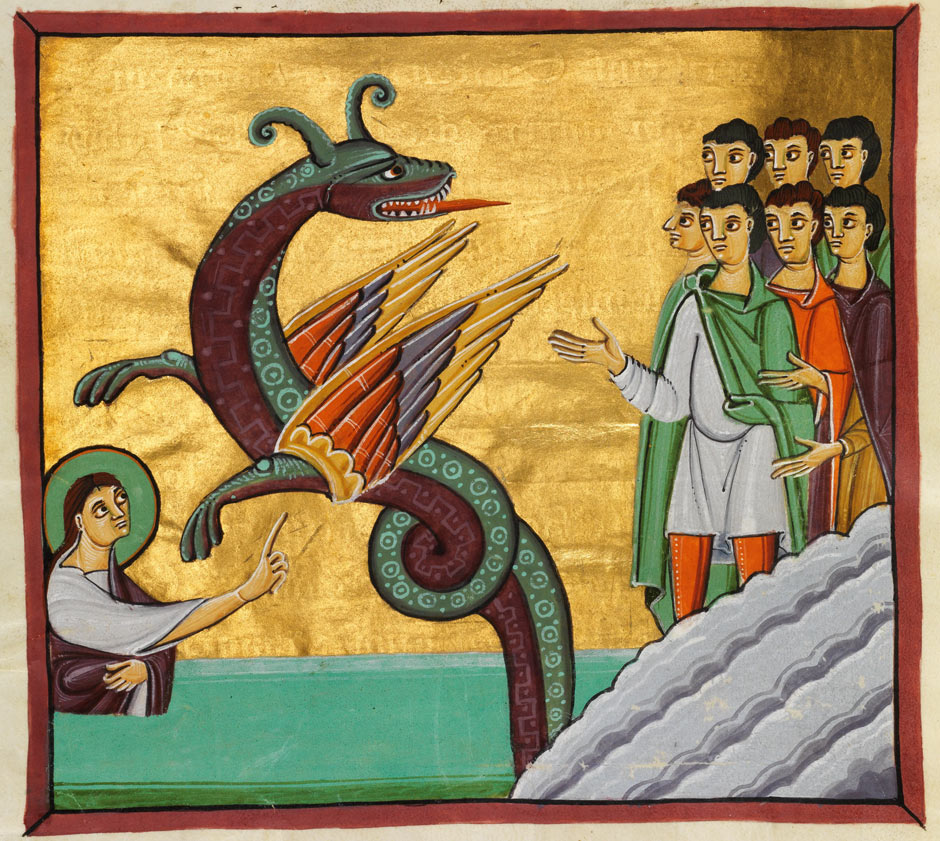
In interpreting this Book, our first purpose will not be to identify the images of the Apocalypse with contemporary events. At some points perhaps we will talk a little about this, but this is not a prime purpose at all. These identifications will be clear only when the events themselves are actually happening. Until then, we should withhold judgment and be very careful. Perhaps the king of the north will be Russia if these events are to occur in our lifetime, but until we see the actual events described in the Apocalypse, we should not be too excited about such things.
Our first concern in interpreting this book is a deeper one. We are to see it as a mystical description of the nature and the destiny of the Church of Christ and its enemies, which are the devil, the world, and the Antichrist. Awareness of this will keep us from many of the elementary errors which the Protestants make regarding the Millennium, the so-called thousand-year reign of Christ in this world, which is a heresy; the Rapture, which was actually not even invented until the 19th century; the actual nature and reign of Antichrist, and so forth.
As in interpreting all Holy Scripture, we must read it together with the other books of Scripture which give many clues for understanding it, especially the Book of Daniel which has some of the exact same images. And again, we must read it in accordance with the interpretation of God-bearing Fathers down the ages, and not just our own ideas.
The deeper our own spiritual life, the deeper will be our understanding of such books. We should not read this Book until we have begun a regular spiritual life with regular times for prayer, spiritual reading, a spiritual father. Then it will not throw us off the track.
6. The Error of Interpreting the Book Chronologically
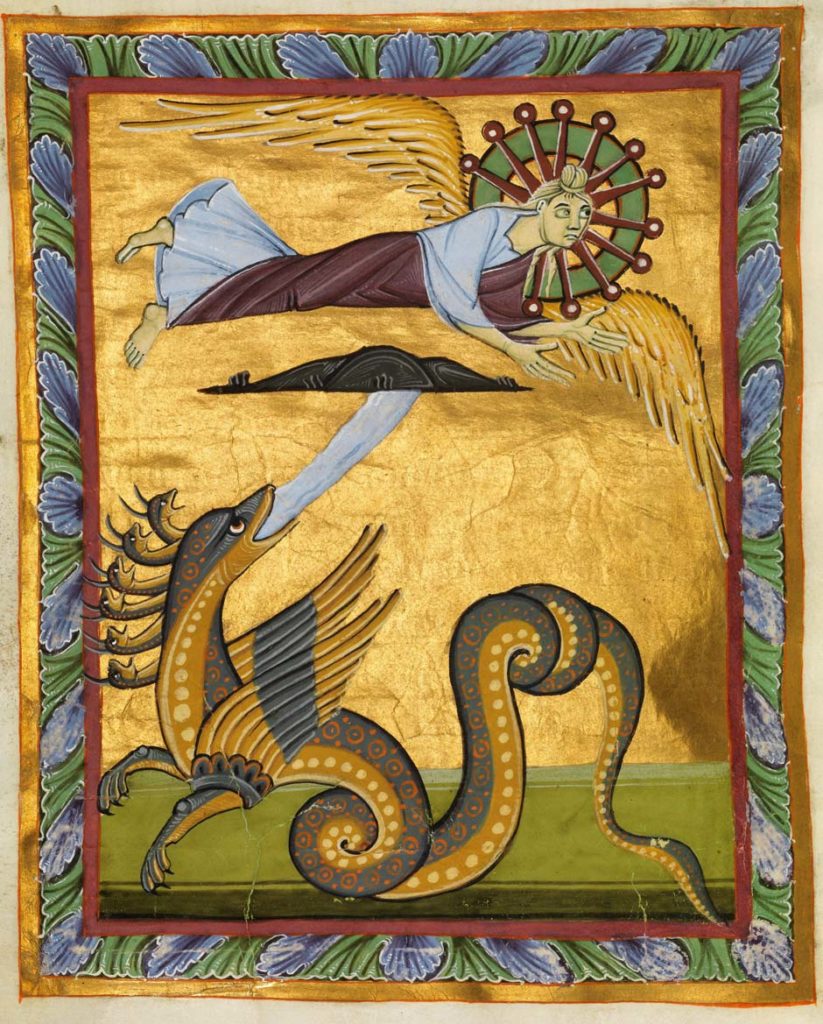
The book is composed of a series of visions of a very complicated sort, so that if you start to read it without any interpretation, you will become totally mixed up. Some of these are visions of the past, some are visions of the present, and some are visions of the future. St. John Chrysostom, in his commentaries on the Books of Daniel and Genesis, says that the first part of the Book of Genesis is a prophecy of the past, because no one was there to see the events that occurred, and they were revealed in the same way that the events of the future were revealed to Daniel and John.
The general content of the Book of Apocalypse concerns the events that must occur at the end of the world. Sometimes the end of the world is viewed as a whole period, beginning with the first coming of Christ, in which case it has already been a period of almost two thousand years. At other times the end of the world means the very last events of this period, just before the actual end. In order to give the whole context of the end of the world, some of the visions—for example, the battle of the angels in heaven—concern things which happened even before the beginning of the world. Therefore, no simple explanation is possible. For example, you cannot say that all the events occur in chronological order. That’s where the Protestants err with their interpretation of the Millennium, because they think everything is just chronological according to the way it’s put down there. This is impossible, because the text jumps back and forth: future, past, present, and then comes a new vision of the same thing which has just been prophesied. You cannot follow it chronologically at all.
The Book of Apocalypse is not simply a chronology of future events, but a mystical view of the whole history of the Church of Christ; and only incidentally does it have visions of future events.
Also, there are many different levels of interpretation of the visions in this Book. Thus, with very few exceptions, it’s not possible to say that one image equals one reality because—as in all of Holy Scripture and in our divine services which are the same kind of literature—one image can stand for many different things. We’ll go into this as we look at the images of this Book and find that one Father says it means one thing, another Father says it means something else, and another might say it means something else; and all these three pictures could very well be true because it’s not simply a one-to-one correspondence of image with reality.
Of course, before reading a book like this you should have read others like the Epistles of James and Peter and John, which deal with much simpler things: like how to lead a moral life, how to be a Christian, how to fight the unseen warfare, etc. By its very contents, the Book of Apocalypse assumes that you have already read things like these, because it assumes you know what is the battle going on between the Church and the devil, what is the Christian life, and what kind of struggle we have to go through. If you haven’t got any idea of that, then you won’t understand the Book at all.
7. The Imminence of Christ’s Coming
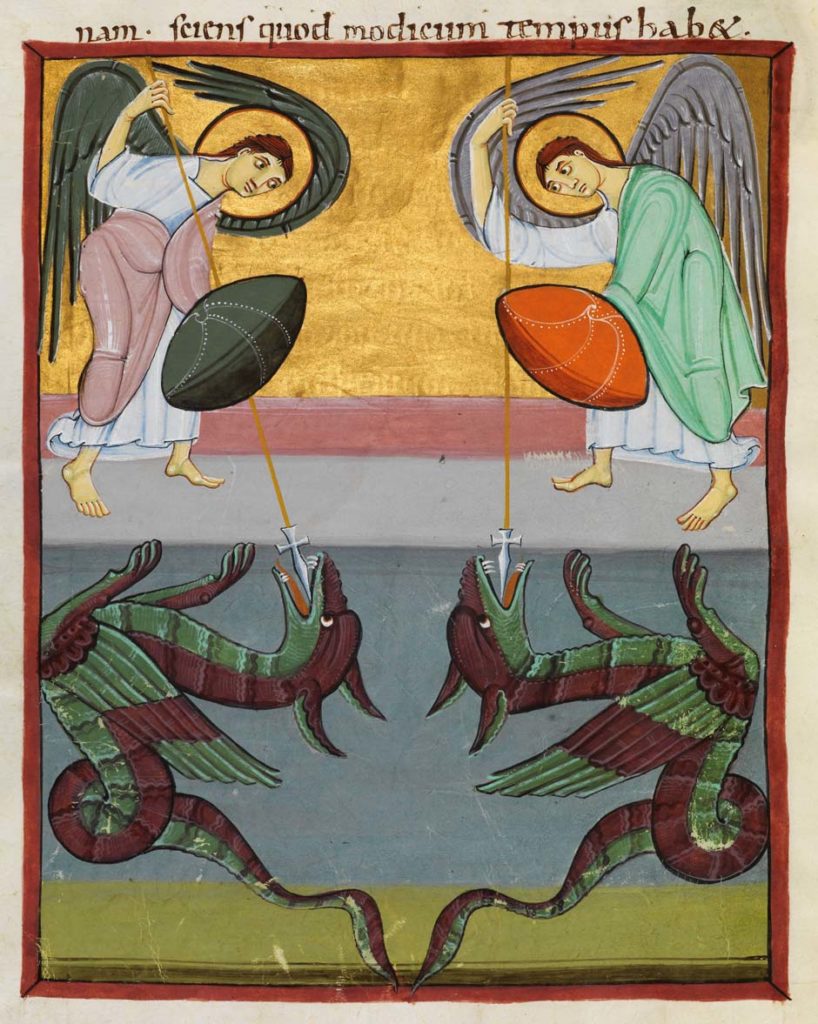
The Book begins: “The revelation of Jesus Christ which God gave Him to show to His bondservants, the things which must shortly come to pass. And He sent and communicated it by His angel to His bondservant John.”
What does it mean by saying, “The things which must shortly come to pass”? We must remember that it says in II Peter 3:3-8:
“Know this first of all, that in the last days, mockers will come with their mocking following after their own lusts, and saying, ‘Where is the promise of His coming? For ever since the fathers fell asleep, all continues just as it was from the beginning of the creation.’ For when they maintain this, it escapes their notice that by the Word of God the heavens existed long ago, and the earth was formed out of water and by water, through which the world at that time was destroyed, being flooded with water. But the present heavens and earth by His Word are being reserved for fire kept for the day of judgment and destruction of ungodly men. But do not let this one fact escape your notice, beloved, that with the Lord one day is as a thousand years, and a thousand years is as one day. The Lord is not slow about His promise as some count slowness, but is patient towards you, not wishing for any to perish, but for all to come to repentance. But the day of the Lord will come like a thief in the night, in which the heavens will pass away with a roar, and the elements will be destroyed with intense heat, and the earth and its works will be burned up.” [6]
All this shows that even in the days of St. Peter—that is, right after the coming of Christ—people were already saying to the Christians, “You talk about the end of the world, but the world is as it’s always been; nothing is different.” Now two thousand years have passed after that, and people again say the same thing: “You talk about the end of the world; Christians have always thought the end of the world is at hand, and it’s been two thousand years. It’s going to go on for thousands and thousands of years more.”
Of course, when St. John says, “The things which must shortly come to pass,” we must remember that “shortly” could mean these two thousand years. If one thousand years is a day in the sight of the Lord, then two thousand years is a fairly short time. This period is needed for the coming into the Church of all who are to be saved, and for the Mystery of Iniquity to work itself out.
All throughout the ages, many Fathers say that the end of things is at hand, that Christ is corning soon; but He doesn’t come soon. Now were living in what we call the latter days, when again we say it looks like the end is at hand. Why is this? Are Christians constantly being mistaken or getting excited in the wrong way, thinking the end is soon, and it doesn’t turn out to be soon?
First of all, Christ comes to each person; each person must live in this world once and die. Therefore, for each one of us the coming of Christ is very soon. That’s very true.
Secondly, anyone who lives by faith and looks at things mystically—that is, tries to look behind the external events of history—sees that indeed those things are already happening which are to come to pass. In fact, St. John himself says, in one of his Epistles, “You have heard that the Antichrist is to come; even now there are many Antichrists.” Even in his days, the end of the first century, already many Antichrists had come; that is, many people who were in the spirit of Antichrist had come, and there would be many more. The Antichrist is both outside and inside the Church. Certainly the communists are a kind of Antichrist; and people who try to corrupt the Church from within also perform the role of Antichrist. We can look throughout history and see many who were very much in the spirit of Antichrist, but they weren’t yet the Antichrist who is to come at the very end. That spirit of Antichrist was present at the very beginning of the history of the Church, because the devil instantly began his warfare against it.
Therefore, since the Book of Apocalypse is about the whole warfare of the Church of Christ against the devil, all these things which are going to happen at the end, begin to happen right at the beginning of the history of the Church.
In conclusion, we must view “shortly” as referring first of all to our own death, because eschatology—the study of the last things—refers to not only the end of the world, but also the end of our life, for when each one of us dies he goes into that other world and there awaits the end of this world. And secondly, it refers to the fact that it indeed is a short time as history is measured, and in the sight of God. We can go back five, six, seven thousand years in history. Two thousand years is a small part of that.
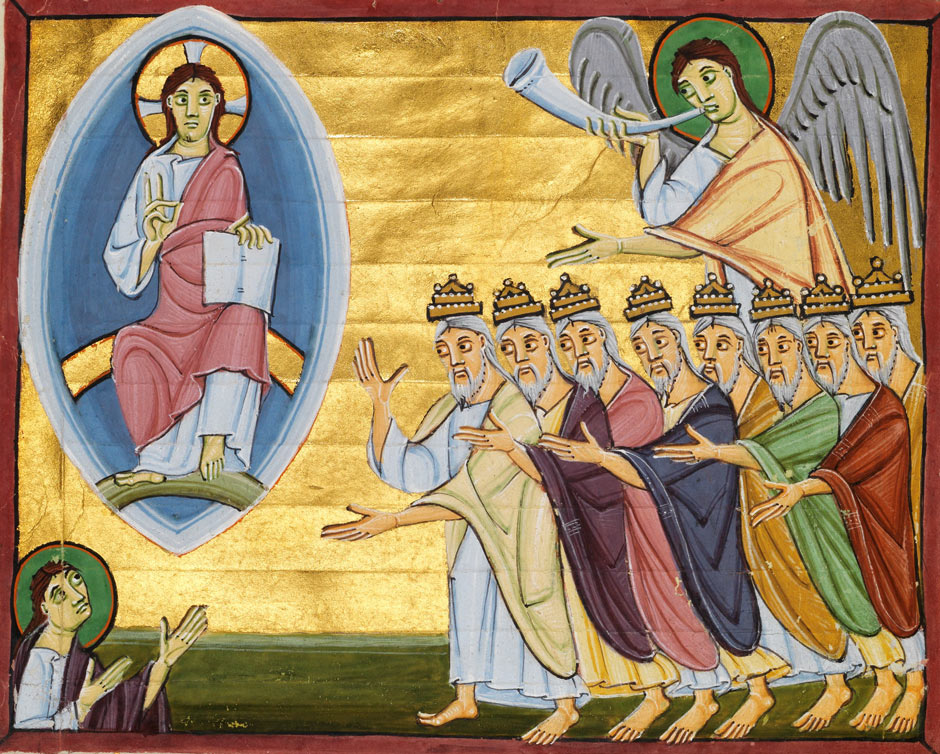
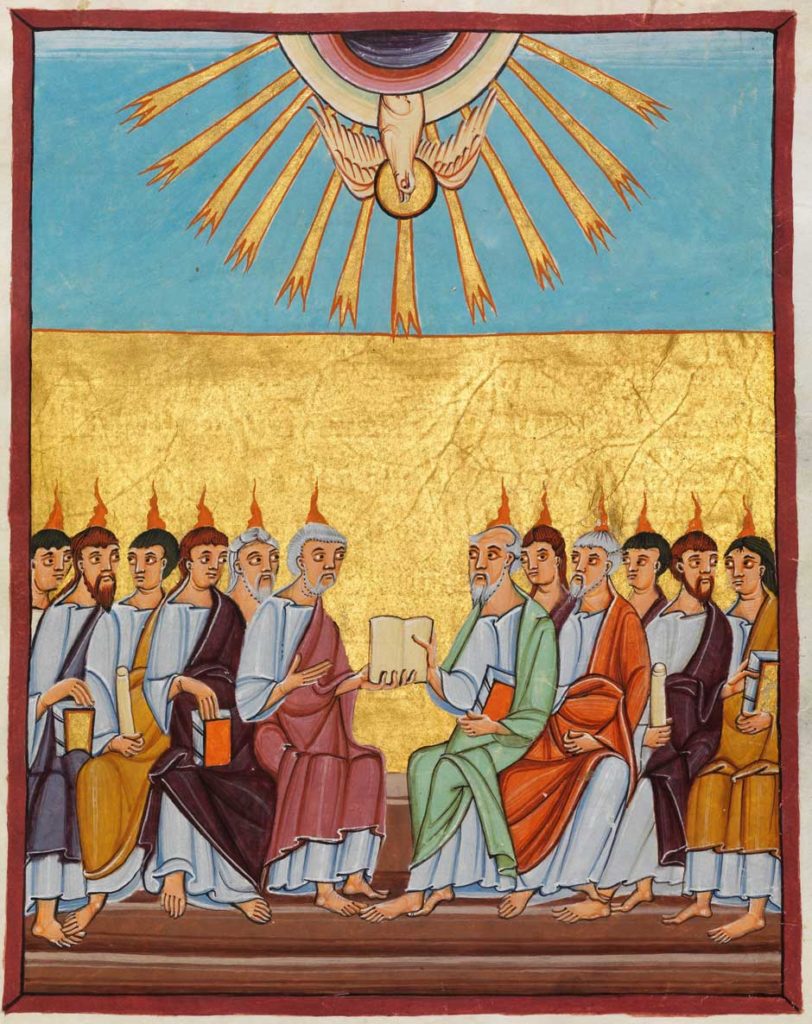
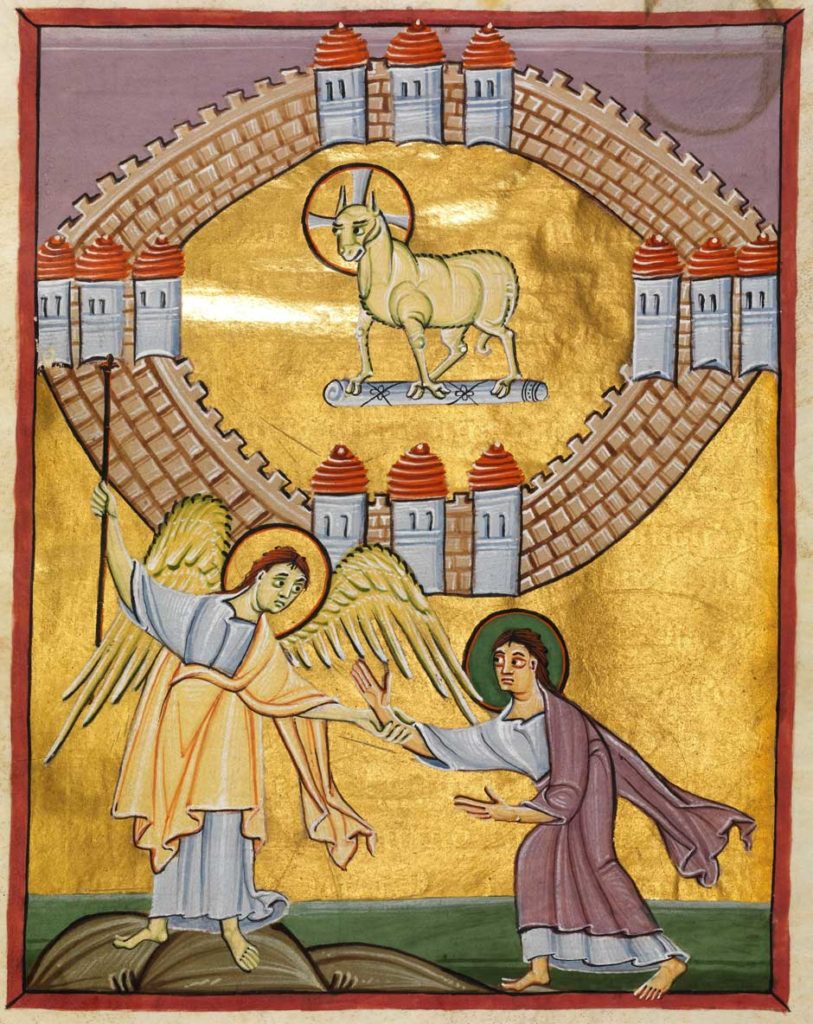
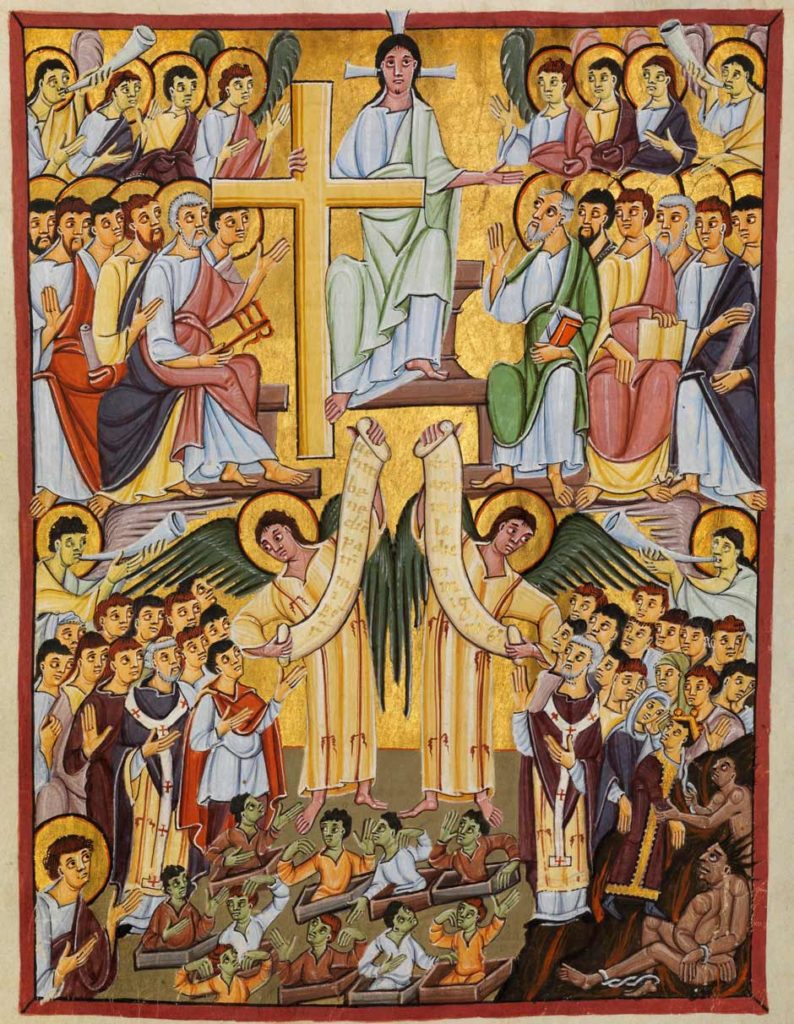
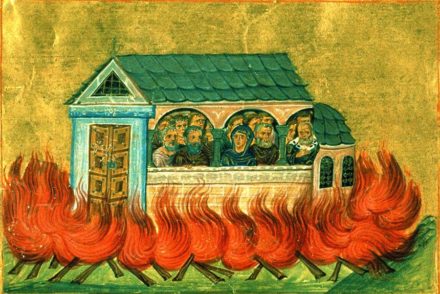
Bamberger Apokalypse – Staatsbibliothek Bamberg Msc.Bibl.140 / Reichenau, circa 1010
[1] We have only included the introduction to the course here, since for the course itself Fr. Seraphim followed Archbishop Averky’s Commentary on the Apocalypse, which has since been published in English in Fr. Seraphim’s translation, both in The Orthodox Word (beginning in 1982) and in book form (see The Apocalypse in the Teachings of Ancient Christianity [St. Herman Brotherhood, first edition 1985, second edition 1995]). This introduction is now appearing for the first time in print, and offers many insights that are not included in the book.—Ed.
[2] So he carried me away in the spirit into the wilderness: and I saw a woman sit upon a scarlet coloured beast, full of names of blasphemy, having seven heads and ten horns. And the woman was arrayed in purple and scarlet colour, and decked with gold and precious stones and pearls, having a golden cup in her hand full of abominations and filthiness of her fornication: And upon her forehead was a name written, MYSTERY, BABYLON THE GREAT, THE MOTHER OF HARLOTS AND ABOMINATIONS OF THE EARTH. And I saw the woman drunken with the blood of the saints, and with the blood of the martyrs of Jesus: and when I saw her, I wondered with great admiration. Revelation 17 3-6
[3] Let no man deceive you by any means: for that day shall not come, except there come a falling away first, and that man of sin be revealed, the son of perdition; Who opposeth and exalteth himself above all that is called God, or that is worshipped; so that he as God sitteth in the temple of God, shewing himself that he is God. Remember ye not, that, when I was yet with you, I told you these things? And now ye know what withholdeth that he might be revealed in his time. For the mystery of iniquity doth already work: only he who now letteth will let, until he be taken out of the way. And then shall that Wicked be revealed, whom the Lord shall consume with the spirit of his mouth, and shall destroy with the brightness of his coming: Even him, whose coming is after the working of Satan with all power and signs and lying wonders, And with all deceivableness of unrighteousness in them that perish; because they received not the love of the truth, that they might be saved. 2 Thessalonians 2 3-10
[4] See 2 Thessalonians 2:7 and Apocalypse 17:5.—Ed.
[5] And there appeared a great wonder in heaven; a woman clothed with the sun, and the moon under her feet, and upon her head a crown of twelve stars: And she being with child cried, travailing in birth, and pained to be delivered. And there appeared another wonder in heaven; and behold a great red dragon, having seven heads and ten horns, and seven crowns upon his heads. And his tail drew the third part of the stars of heaven, and did cast them to the earth: and the dragon stood before the woman which was ready to be delivered, for to devour her child as soon as it was born. And she brought forth a man child, who was to rule all nations with a rod of iron: and her child was caught up unto God, and to his throne. And the woman fled into the wilderness, where she hath a place prepared of God, that they should feed her there a thousand two hundred and threescore days. And there was war in heaven: Michael and his angels fought against the dragon; and the dragon fought and his angels, And prevailed not; neither was their place found any more in heaven. And the great dragon was cast out, that old serpent, called the Devil, and Satan, which deceiveth the whole world: he was cast out into the earth, and his angels were cast out with him. And I heard a loud voice saying in heaven, Now is come salvation, and strength, and the kingdom of our God, and the power of his Christ: for the accuser of our brethren is cast down, which accused them before our God day and night. And they overcame him by the blood of the Lamb, and by the word of their testimony; and they loved not their lives unto the death. Therefore rejoice, ye heavens, and ye that dwell in them. Woe to the inhabiters of the earth and of the sea! for the devil is come down unto you, having great wrath, because he knoweth that he hath but a short time. And when the dragon saw that he was cast unto the earth, he persecuted the woman which brought forth the man child. And to the woman were given two wings of a great eagle, that she might fly into the wilderness, into her place, where she is nourished for a time, and times, and half a time, from the face of the serpent. Revelation 12 1-14
[6] This second epistle, beloved, I now write unto you; in both which I stir up your pure minds by way of remembrance: That ye may be mindful of the words which were spoken before by the holy prophets, and of the commandment of us the apostles of the Lord and Saviour: Knowing this first, that there shall come in the last days scoffers, walking after their own lusts, And saying, Where is the promise of his coming? for since the fathers fell asleep, all things continue as they were from the beginning of the creation. For this they willingly are ignorant of, that by the word of God the heavens were of old, and the earth standing out of the water and in the water: Whereby the world that then was, being overflowed with water, perished: But the heavens and the earth, which are now, by the same word are kept in store, reserved unto fire against the day of judgment and perdition of ungodly men. But, beloved, be not ignorant of this one thing, that one day is with the Lord as a thousand years, and a thousand years as one day. The Lord is not slack concerning his promise, as some men count slackness; but is longsuffering to us-ward, not willing that any should perish, but that all should come to repentance. But the day of the Lord will come as a thief in the night; in the which the heavens shall pass away with a great noise, and the elements shall melt with fervent heat, the earth also and the works that are therein shall be burned up. Seeing then that all these things shall be dissolved, what manner of persons ought ye to be in all holy conversation and godliness, Looking for and hasting unto the coming of the day of God, wherein the heavens being on fire shall be dissolved, and the elements shall melt with fervent heat? Nevertheless we, according to his promise, look for new heavens and a new earth, wherein dwelleth righteousness. 2 Peter 3 1-13

by Saint Seraphim of Platina [†1982]
The Orthodox Word, Vol. 34, Nos 3-4 (200-201), May-August, 1998, pp. 157-1650
Pas de commentaire