Each year more and more Orthodox Christians, and those wishing to become Orthodox, strive to acquire and strengthen their faith by attending church services, by reading and studying Scripture and the writing of the Church Fathers and ascetics, by the reading of various good Orthodox materials on the history and traditions of the Church, and by making pilgrimages to monasteries and convents where they are exposed to the monastic services and way of life.
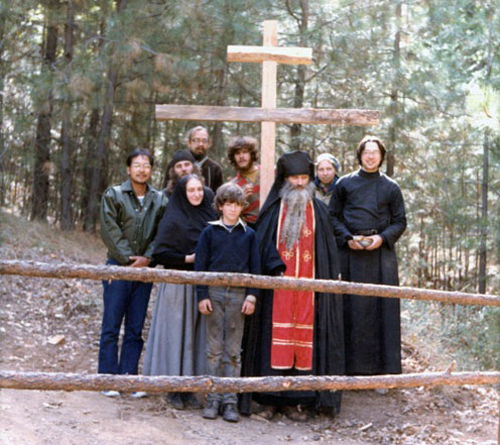
This past summer, not a few Orthodox and non-Orthodox pilgrims made a pilgrimage to the mountainous regions of Northern California, exactly for that reason … to take part in the church services, lectures, and classes at the annual Summer Pilgrimage in the St. Herman of Alaska Monastery.
Although the actual feast day of St. Herman’s canonization look place on Monday of the week of August 7th (n.s.), many pilgrims arrived as early as Friday the week before.
Early Saturday morning one of the two baptisms which occurred during the pilgrimage was performed by Hieromonk Seraphim in the nearby Beegum Gorge Creek. The newly-illumined Martinian Prince received Holy Communion that morning at Liturgy and then spent the entire week in his baptismal robe as a beginning foundation to his new life in Christ.
Saturday evening vigil was well attended by all the early arrivals. Sunday’s Liturgy was followed by a common meal and lectures given by Fr. Alexey Young on the New Martyrs of the Turkish Yoke, and Fr. Seraphim Rose on Living the Orthodox World-View. Both lectures evoked lively discussions and question and answer sessions which carried over to the time for the beginning of Small Vespers in preparation for the Vigil of the feast of St. Herman. Many new pilgrims arrived that day just in time for the All Night Vigil, causing the church to be filled to capacity for all services.
The Vigil lasted until the late hours of the night and many of the pilgrims camped out under the clear but unseasonably cool and breeze-filled summer skies.
Monday morning was filled with anticipation and excitement. Archbishop Anthony arrived and, after being greeted with the traditional bread and salt by the monastic brotherhood, proceeded to the church where he served the Divine Liturgy assisted by the monastery’s clergy. Before the Liturgy began, during the Hours, Serge Jerdes was ordained Reader for the mission parish of Medford. As a newly-tonsured Reader, he read the Epistle at the Liturgy.
After the Liturgy, a procession with banners and cross, relics, and icons, proceeded around the church as a moleben was sung for the success of the pilgrimage and the courses of the New Valaam Theological Academy. Following these Divine services, a common meal was served at the monastery’s trapeza, after which Archbishop Anthony opened the lectures with a short address in which he likened the Platina activities to those of the late great Abba Vitaly in Pochaev where “he would crucify himself by charging the atmosphere with high inspiration of noble Christian causes, purity of Orthodoxy, urging huge crowds of people to live according to the patristic ideal.”
After an introductory lecture by Fr. Abbot Herman, Fr. Seraphim proceeded to begin his series of lectures on The Orthodox Interpretation of Genesis. Time passed quickly and soon the services were begun already for the following day. After Compline that evening, a slide presentation on the New Martyrs of Russia was shown by Fr. Herman who had earlier shown a similar presentation on the Valaam Monastery.
On Tuesday the monastery and pilgrims were blessed with a visit by the Kursk Icon of the Mother of God. Bishop Nektary together with Fr. Boris (the guardian of the icon) arrived and were warmly greeted by all.
For many of the pilgrims this was the first time they had ever seen the Kursk Root Icon of the Mother of God, such a miraculous and much revered icon. A moleben was served after which everyone sang hymns, made prostrations, venerated the icon, and brought to the Mother of God, with humble and fervent faith, all their sorrows, joys, hopes, fears, and wants, as Vladika Nektary had asked them all to do. Everyone was touched to the heart. Many wept with contrition of heart, others with that special visitation of God’s grace—from “tender feeling.” Fr. Abbot Herman took the icon around the monastery in procession, and blessed the people, the cells, and the grounds of monastery with it. The icon was brought back to the church and while pilgrims took turns keeping watch, a trapeza was held. Soon the icon had to leave. While it was taken in solemn procession out of the church, held by Fr. Herman and Fr. Seraphim, everyone made prostrations and venerated it, passing underneath the uplifted arms of the Mother of God (as she is portrayed in the icon), begging Her protection, help, and motherly prayers. Fr. Seraphim then accompanied the icon and Bishop Nektary to the St. Xenia Skete.
The classes during the rest of the week seemed to go ever so quickly and finally, on Saturday, the “graduation exercises” were held. Early on Saturday morning, the second of two baptisms which occurred during the pilgrimage was performed, also by Fr. Seraphim. The newly-illumined Nicholas Kronauer, who had just completed the entire week of classes, received Holy Communion for the first time at Liturgy which followed his Baptism, and later that day departed from the monastery still clad in his white baptismal robe.
The graduation exercises began in church with a moleben of Thanksgiving, after which a procession with banners flying high, marched to the outdoor lecture hall where the ten graduates were presented with certificates and a book on Elder Paisius Velichkovsky, who had recently been proclaimed a Saint on Mt Athos. A talk for the students was given by the newly-illumined Nicholas on “Operation Keelhaul”, dealing also with the phenomenon of Russia’s New Martyrs who still await their public presentation.
At the conclusion of the pilgrimage, when a feeling of relief as of a job well done had settled over all, there came a moment of restful hesitation before the leave-taking of the pilgrims. The day was still young, the weather cool, windy, with a touch of autumn already in the air. The bright sunbeams moved Rhythmically through the forest idyll of roaming herds of deer, grey squirrels, and peacocks, who paraded in their natural surroundings before the resting pilgrims, involuntary bringing them into a state of tranquil contemplation. Here Fr. Herman expressed in a few solemn words what was in the hearts of all: What is the purpose of theology and Christian life itself upon this beautifully adorned earth of ours? Is it not the sweetness of death that crowns our earthly endeavors?
At this moment there resounded the lilting strains of J.S. Bach’s Cantata #82 (Ich habe genug, BWV 82), describing the state of the Righteous Simeon the God-receiver as he holds in his arms Incarnate Life Itself, foretasting the happiness of a righteous man who is dying:
I’ve had enough. I have received the Saviour…
I have seen Him; I already see the joy of that other life…
Slumber now weary eyes; World, I renounce thee.
That my spirit may thrive… I rejoice in my death…
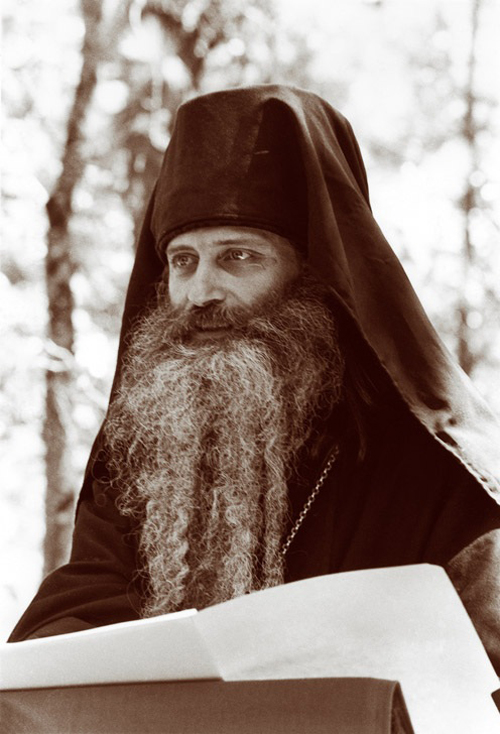
When the sounds echoed through the forest and died away in the deep gorge below, Father Seraphim concluded by saying what joy the human soul experiences in growing in the Orthodox Christ, and how Christian culture, so debased by the subhumanity of our times, can form and elevate the soul, bringing it to the threshold of paradise. He did not tell, however, that in his formative years, it was precisely this Cantata that used to enchant and mystify him so intensely and hence lead him to the idea of dying to the world. This was the last time on this earth that he heard this music, for within three weeks he met his long desired death. Little did the pilgrims know, also, that within another four months the monastery church which he built and in which he gave monastic vows of dying to the world, would be enveloped in fire and lifted up to heaven as another burnt offering to God.
This pilgrimage will be forever in the hearts of those who attended it and have a special place in the memories of those who loved and respected Fr. Seraphim, as it was his last St. Herman’s Pilgrimage here on earth.
by Father Nazarius
The Orthodox Word, 1982, Vol. 18, No. 4 (105), July-August, pp. 156–159
Pas de commentaire