
1. “Christian” and Non-Christian Ecumenism
As an answer to the question of the possibility of a “dialogue” of Orthodox Christianity with the various non-Christian religions, the reader has been presented the testimony of three Orthodox Christians who confirm, on the basis of Orthodox doctrine and their own experience, what the Orthodox Church has always taught: that Orthodox Christians do not at all have the “same God” as the so-called “monotheists” who deny the Holy Trinity; that the gods of the pagans are in fact demons; and that the experiences and powers which the pagan “gods” can and do provide are Satanic in nature.
All this in no way contradicts the words of St. Peter, that God is no respecter of persons: hut in every nation he that feareth Him and worketh righteousness is acceptable to Him[1]; or the words of St. Paul, that God in times past suffered all nations to walk in their own ways. Nevertheless He left not Himself without witness, in that He did good, and gave us rain from heaven, and fruitful season filling our hearts with food and gladness[2]. Those who live in the bondage of satan, the prince of this world[3], in darkness which is unenlightened by the Christian Gospel—are judged in the light of that natural testimony of God which every man may have, despite this bondage.
For the Christian, however, who has been given God’s Revelation, no “dialogue” is possible with those outside the Faith. Be ye not unequally yoked together with unbelievers: for what fellowship hath righteousness with un-righteousness? and what communion hath light with darkness? and what concord hath Christ with Belial? or what part hath he that believeth with an infidel? … Wherefore come out from among them, and be ye separate, saith the Lord[4]. The Christian calling is rather to bring the light of Orthodox Christianity to them, even as St. Peter did to the God-fearing household of Cornelius the Centurian[5], in order to enlighten their darkness and join them to the chosen flock of Christ’s Church.
How then are we to look upon the “dialogue with non-Christian religions” which is presently gaining momentum and drawing into its sphere not merely “liberal” Protestants and Roman Catholics, but more and more “Orthodox” theologians as well? Even since the beginning of this series of articles in mid-1971, this “dialogue” has been considerably accelerated, as the following examples will demonstrate.
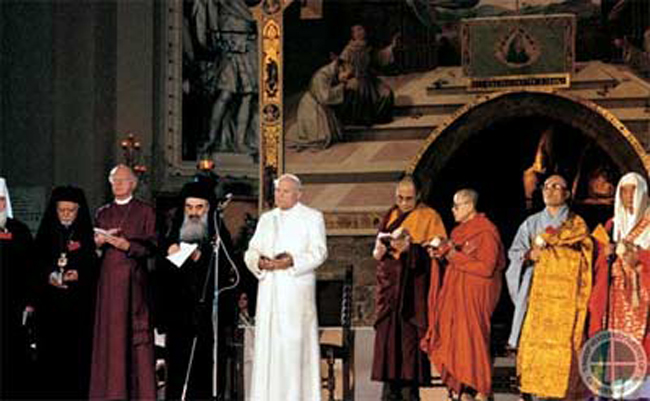
1. Promotional material sent out by the “Temple of Understanding” reveals that Orthodox delegates were indeed present at the second “summit conference” of this organization in Geneva in 1970 and again at the third “summit conference” in the United States in the autumn of 1971, and that Metropolitan Emilianos of the Patriarchate of Constantinople is a member of the Temple’s “International Committee.” The “summit conferences” offer Orthodox delegates the opportunity to enter discussions aiming to “create a world community of religions,” to “hasten the realization of mankind’s dream of peace and understanding” according to the philosophy of “Vivekananda, Ramakrishna, Gandhi, Schweitzer,” and the founders of various religions; and the delegates likewise participate in “unprecedented” supra-confessional prayer services where “everyone prays according to the customs of the religion which he represents.”[6] Those who have read installment II of this series, “Hinduism’s Assault upon Christianity,” know what Vivekananda’s “dream” actually was—to “Hinduize” and destroy Christianity. One can only wonder what must be in the soul of an Orthodox Christian who not only collaborates in this task, but even prays together with those who invoke the demons of their religions in order to accomplish it.
2. The Central Committee of the World Council of Churches at its last meeting in Addis Ababa in January, 1971, gave its approval and encouragement to the holding of meetings as regularly as possible between representatives of other religions, specifying that “at the present stage priority may be given to bilateral dialogues of a specific nature.” In accordance with this directive a major Christian-Moslem “dialogue” was set for mid-1972 involving some forty representatives of both sides, including a number of Orthodox delegates (Al Montada, January-February, p. 18).
3. In February 1972, another “unprecedented” ecumenical event occurred in New York when, according to Archbishop Iakovos of New York, for the first time in history, the Greek Orthodox Church (Greek Archdiocese of North and South America) held an official theological “dialogue” with the Jews. In two days of discussions definite results were achieved, which may be taken as symptomatic of the future results of the “dialogue with non-Christian religions:” the Greek “theologians” agreed “to review their liturgical texts in terms of improving references to Jews and Judaism where they are found to be negative or hostile” (Religious News Service). Does not the intention of the “dialogue” become ever more obvious?—to “reform” Orthodox Christianity in order to make it conformable to the religions of this world.
But let us now look at the “theology” and the goal of this accelerating “dialogue” and see how it differs from the “Christian” ecumenism that has prevailed up to now.
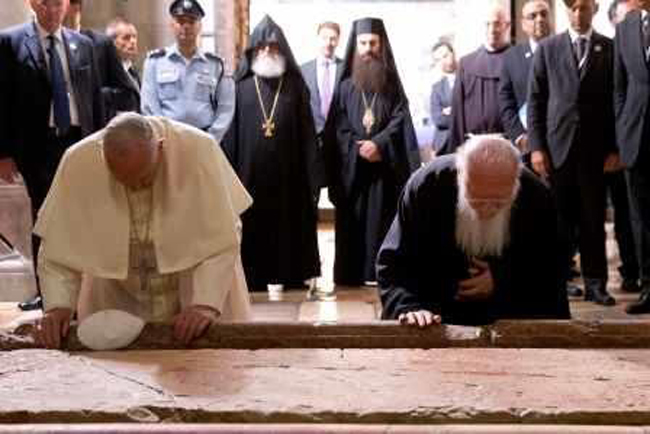
“Christian” ecumenism at its best may be seen to represent a sincere and understandable error on the part of Protestants and Roman Catholics—the error of failing to recognize that the visible Church of Christ already exists, and that they are outside it. The “dialogue with non-Christian religions,” however, is something quite different, representing rather a conscious departure from even that part of genuine Christian belief and awareness which some Catholics and Protestants retain. It is the product, not of simple human “good intentions,” but rather of a diabolical “suggestion” that can capture only those who have already departed so far from Christianity as to be virtual pagans: worshippers of the god of this world, satan[7], and followers of whatever intellectual fashion this powerful god is capable of inspiring.
“Christian” ecumenism relies for its support upon a vague but nonetheless real feeling of “common Christianity” which is shared by many who do not think or feel too deeply about the Church, and it aims somehow to “build” a church comprising all such indifferent “Christians.” But what common support can the “dialogue with non-Christians” rely on? On what possible ground can there be any kind of unity, however loose, between Christians and those who not merely do not know Christ, but—as is the case with all the present-day representatives of non-Christian religions who are in contact with Christianity—decisively reject Christ? Those who, like Metropolitan Georges Khodre of Lebanon, lead the avant-garde of Orthodox apostates (a name that is fully justified when applied to those who radically “fall away” from the whole Orthodox Christian tradition), speak of the “spiritual riches” and “authentic spiritual life” of the non-Christian religions; but it is only by doing great violence to the meaning of words and by reading his own fantasies into other people’s experience that he can bring himself to say that it is “Christ” and “grace” that pagans find in their scriptures, or that “every martyr for the truth, every man persecuted for what he believes to be right, dies in communion with Christ.”[8] Certainly, these people themselves (whether it be a Buddhist who sets fire to himself, a Communist who dies for the “cause” in which he sincerely believes, or whoever) would never say that it is “Christ” they receive or die for, and the idea of an unconscious confession or reception of Christ is against the very nature of Christianity. If a rare non-Christian does claim to have experience of “Christ,” it can only be in the way which Swami Vivekananda describes: “We Hindus do not merely tolerate, we unite ourselves with every religion, praying in the mosque of the Mohammedan, worshipping before the fire of the Zoroastrian, and kneeling to the cross of the Christian”[9]—that is, as merely one of a number of equally valid “spiritual experiences.”
No: “Christ,” no matter how redefined or reinterpreted, cannot be the common denominator of the “dialogue with, non-Christian religions,” but at best can only be added as an afterthought to a unity which is discovered somewhere else. The only possible common denominator among all religions is the totally vague concept of the “spiritual,” which indeed offers religious “liberals” almost unbounded opportunity for nebulous theologizing.
The address of Metropolitan Georges Khodre to the Central Committee meeting of the WCC at Addis Ababa in January, 1971, may be taken as an early, experimental attempt to set forth such a “spiritual” theology of the “dialogue with non-Christian religions.”[10] In raising the question as to “whether Christianity is so inherently exclusive of other religions as has generally been proclaimed up to now,” the Metropolitan, apart from his few rather absurd “projections” of Christ into non-Christian religions, has one main point: it is the “Holy Spirit,” conceived as totally independent of Christ and His Church, that is really the common denominator of all the world’s religions. Referring to the prophecy that I will pour out My Spirit upon all flesh[11], the Metropolitan states, “This must be taken to mean a Pentecost which is universal from the very first… The advent of the Spirit in the world is not subordinated to the Son… The Spirit operates and applies His energies in accordance with His own economy and we could, from this angle, regard the non-Christian religions as points where His inspiration is at work” (p. 172). We must, he believes, “develop an ecclesiology and a missiology in which the Holy Spirit occupies a supreme place” (p. 166).
All of this, of course, constitutes a heresy which denies the very nature of the Holy Trinity and has no aim but to undermine and destroy the whole idea and reality of the Church of Christ. Why, indeed, should Christ have established a Church if the Holy Spirit acts quite independently, not only of the Church, but of Christ Himself? Nonetheless, this heresy is here still presented rather tentatively and cautiously, no doubt with the aim of testing the response of other Orthodox “theologians” before proceeding more categorically. But it will not be necessary to wait for Metropolitan Khodre’s next exercise in “theology”, for the “ecclesiology of the Holy Spirit” has already been written—and by an “Orthodox” at that, by one of the acknowledged “prophets” of the “spiritual” movement of our day. Let us therefore examine his ideas in order to see the picture he gives of the nature and goal of the larger “spiritual” movement in which the “dialogue with non-Christian religions” has its place.
2. “The new age of the Holy Spirit”
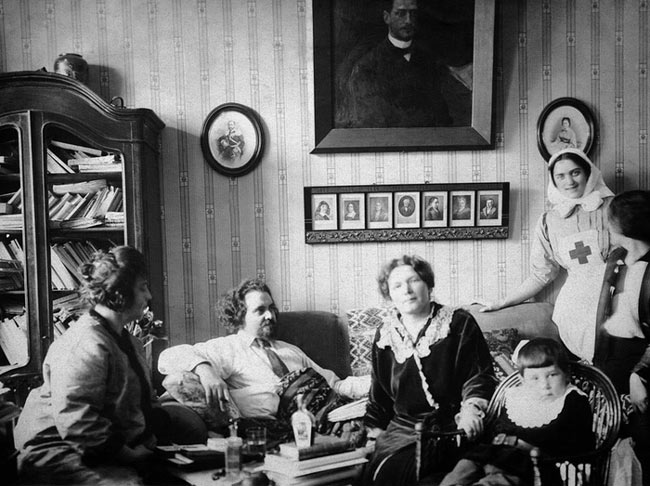
Nicholas Berdyaev (1874–1949) in any normal time would never have been regarded as an Orthodox Christian. He might best be described as a gnostic-humanist philosopher who drew his inspiration rather from Western sectarians and “mystics” than from any Orthodox sources. That he is called in some Orthodox circles even to this day an “Orthodox philosopher” or even “theologian,” is a sad reflection of the religious ignorance of our times. Here we shall quote from his writings[12].
Looking with disdain upon the Orthodox Fathers, upon the “monastic ascetic spirit of historical Orthodoxy,” indeed upon that whole “conservative Christianity which … directs the spiritual forces of man only towards contrition and salvation,” Berdyaev sought rather the “inward Church,” the “Church of the Holy Spirit,” the “spiritual view of life which, in the 18th century, found shelter in the Masonic lodges.” “The Church,” he believed, “is still in a merely potential state,” is “incomplete;” and he looked to the coming of an “ecumenical faith,” a “fullness of faith” that would unite, not merely different Christian bodies (for “Christianity should be capable of existing in a variety of forms in the Universal Church”), but also “the partial truths of all the heresies” and “all the humanistic creative activity of modern man … as a religious experience consecrated in the Spirit.” A “New Christianity” is approaching, a “new mysticism, which will be deeper than religions and ought to unite them.” For “there is a great spiritual brotherhood … to which not only the Churches of East and West belong, but also all those whose wills are directed towards God and the Divine, all in fact who aspire to some form of spiritual elevation”—that is to say, people of every religion, sect, and religious ideology. He predicted the advent of “a new and final Revelation.” “the Hew Age of the Holy Spirit,” resurrecting the prediction of Joachim of Floris, the 12th century Latin monk who saw the two ages of the Father (Old Testament) and the Son (New Testament) giving way to a final “Third Age of the Holy Spirit.” Berdyaev writes: “The world is moving towards a new spirituality and a new mysticism; in it there will be no more of the ascetic world view.” “The success of the movement towards Christian unity presupposes a new era in Christianity itself, a new and deep spirituality, which means a new outpouring of the Holy Spirit.”
The sober Orthodox Christian might at first be inclined to dismiss all this as the ravings of yet another of the would-be “prophets” of our disordered times, another “religious philosopher” gone astray by mistaking his own muddled feelings for a “new revelation”. There is clearly nothing whatever in common between these super-ecumenist fantasies and Orthodox Christianity, which Berdyaev in fact despised. Yet anyone aware of the religious climate of our times will see that these fantasies in fact correspond to one of the leading currents of contemporary religious thought. Berdyaev does indeed seem to be a “prophet,” or rather, to have been sensitive to a current of religious thought and feeling which was not so evident in his day, but has become almost dominant today. Everywhere one hears of a new “movement of the Spirit,” and now a Greek Orthodox priest, Father Eusebius Stephanou, invites Orthodox Christians to join this movement when he writes an editorial in his Logos (Jan. 1972) entitled (in the very words of Berdyaev, as if it answers to the latter’s “prophecy”): “The Mighty Outpouring of the Holy Spirit in Our Day.” And lest it be thought that Fr. Eusebius only accidentally talks in the language of Berdyaev, one need only look elsewhere in the same publication (March, 1972, p. 8) to find the Associate Editor Ashanin invoking not merely the name, but also the very program, of Berdyaev: “We recommend the writings of Nicholas Berdyaev, the great spiritual prophet of our age. This spiritual genius … [is] the greatest theologian of spiritual creativeness… Now the cocoon of Orthodoxy has been broken… God’s Divine Logos is leading His people to a new understanding of their history and their mission in Him. The Logos, herald of this new age… of the new posture of Orthodoxy.”
But Fr. Eusebius speaks somewhat more coherently of the new spiritual butterfly that is now supposedly hatching from the “cocoon of Orthodoxy.” In his article Fr. Eusebius refers to the “charismatic revival” which, arising from the Pentecostal sect which was founded at the beginning of this century, in the past ten years has made sensational advances within all the leading denominations, including Roman Catholicism, and now has spread to several Orthodox churches in the United States. Fr. Eusebius believes that “this outpouring of the Spirit is transcending denominational lines… A large-scale outpouring of the Holy Spirit is occurring among Protestants and Roman Catholics many of whom have been receiving the gifts of tongues, prophecy, and healing… The Spirit of God is moving in wonderful and exciting ways, dear reader, both inside and outside the Orthodox Catholic and Apostolic Church. Don’t be left out. Open your heart to the promptings of the Holy Spirit and be part of the growing charismatic renewal.”
These words, coming from someone who claims to be leading a movement of “Orthodox awakening,” are a challenge to the sincere Orthodox Christian. Here it is of crucial importance to follow the command of the Apostle and Evangelist John, to believe not every spirit, but try the spirits, whether they are of God[13]. No Orthodox Christian can “open his heart” to any spirit if he is not absolutely certain that it is of God; and if it is not of God, then the appeal to join this movement can only be seen as an attempt to corrupt and destroy the souls of Orthodox Christians. The issue is literally a matter of spiritual life or death.
Let us then examine, from the viewpoint of Orthodox Christianity, the one true Church of Christ where we know the Holy Spirit is, the chief characteristics of the present-day “charismatic revival,” expanding our conclusion to this series of articles into a final installment. Here it would seem that the “theology” of Metropolitan Georges Khodre and the “prophecy” of Nicholas Berdyaev receive their fulfillment in actual practice in a movement which its followers claim reproduces the fervor and the very miracles of the Apostolic age. The literature of this movement is already vast, and this enables us to Study it in detail, comparing it point for point with the teaching of the Holy Fathers of the Orthodox Church, who wore well acquainted with “charismatic” phenomena, both true and false. We shall find that this study, rather startlingly, brings us right hack to the subject of this series of articles: non-Christian religion; only now, instead of mere “dialogue,” it uncovers for us a more advanced stage of contemporary “spirituality,” and indeed would seem to offer a key to the understanding of this rather nebulous realm. And beyond this, already visible on the spiritual horizon, lies the even more spectacular goal and end of the whole “ecumenical” quest of modern man.
Next issue: IV. The “Charismatic Revival” as a Sign of the Times
[1] Now therefore are we all here present before God, to hear all things that are commanded thee of God. Then Peter opened his mouth, and said, Of a truth I perceive that God is no respecter of persons: But in every nation he that feareth him, and worketh righteousness, is accepted with him. Acts 10 33–35
[2] Then the priest of Jupiter, which was before their city, brought oxen and garlands unto the gates, and would have done sacrifice with the people. Which when the apostles, Barnabas and Paul, heard of, they rent their clothes, and ran in among the people, crying out, And saying, Sirs, why do ye these things? We also are men of like passions with you, and preach unto you that ye should turn from these vanities unto the living God, which made heaven, and earth, and the sea, and all things that are therein: Who in times past suffered all nations to walk in their own ways. Nevertheless he left not himself without witness, in that he did good, and gave us rain from heaven, and fruitful seasons, filling our hearts with food and gladness. And with these sayings scarce restrained they the people, that they had not done sacrifice unto them. Acts 14 13–18
[3] Jesus answered and said, This voice came not because of me, but for your sakes. Now is the judgment of this world: now shall the prince of this world be cast out. And I, if I be lifted up from the earth, will draw all men unto me. John 12 30–32
[4] O ye Corinthians, our mouth is open unto you, our heart is enlarged. Ye are not straitened in us, but ye are straitened in your own bowels. Now for a recompence in the same, (I speak as unto my children,) be ye also enlarged. Be ye not unequally yoked together with unbelievers: for what fellowship hath righteousness with unrighteousness? and what communion hath light with darkness? And what concord hath Christ with Belial? or what part hath he that believeth with an infidel? And what agreement hath the temple of God with idols? for ye are the temple of the living God; as God hath said, I will dwell in them, and walk in them; and I will be their God, and they shall be my people. Wherefore come out from among them, and be ye separate, saith the Lord, and touch not the unclean thing; and I will receive you, And will be a Father unto you, and ye shall be my sons and daughters, saith the Lord Almighty. 2 Corinthians 6 11–18
[5] Then Peter opened his mouth, and said, Of a truth I perceive that God is no respecter of persons: But in every nation he that feareth him, and worketh righteousness, is accepted with him. The word which God sent unto the children of Israel, preaching peace by Jesus Christ: (he is Lord of all:) That word, I say, ye know, which was published throughout all Judaea, and began from Galilee, after the baptism which John preached; How God anointed Jesus of Nazareth with the Holy Ghost and with power: who went about doing good, and healing all that were oppressed of the devil; for God was with him. And we are witnesses of all things which he did both in the land of the Jews, and in Jerusalem; whom they slew and hanged on a tree: Him God raised up the third day, and shewed him openly; Not to all the people, but unto witnesses chosen before of God, even to us, who did eat and drink with him after he rose from the dead. And he commanded us to preach unto the people, and to testify that it is he which was ordained of God to be the Judge of quick and dead. To him give all the prophets witness, that through his name whosoever believeth in him shall receive remission of sins. While Peter yet spake these words, the Holy Ghost fell on all them which heard the word. And they of the circumcision which believed were astonished, as many as came with Peter, because that on the Gentiles also was poured out the gift of the Holy Ghost. For they heard them speak with tongues, and magnify God. Then answered Peter, Can any man forbid water, that these should not be baptized, which have received the Holy Ghost as well as we? And he commanded them to be baptized in the name of the Lord. Then prayed they him to tarry certain days. Acts 10 34–48
[6] See The Orthodox Word, 1971, no. 3, p. 139.
[7] Therefore seeing we have this ministry, as we have received mercy, we faint not; But have renounced the hidden things of dishonesty, not walking in craftiness, nor handling the word of God deceitfully; but by manifestation of the truth commending ourselves to every man’s conscience in the sight of God. But if our gospel be hid, it is hid to them that are lost: In whom the god of this world hath blinded the minds of them which believe not, lest the light of the glorious gospel of Christ, who is the image of God, should shine unto them. For we preach not ourselves, but Christ Jesus the Lord; and ourselves your servants for Jesus’ sake. 2 Corinthians 4 1–5
[8] Sobornost, Summer, 1971, p. 171
[9] See The Orthodox Word, 1971, no.4, p. 166
[10] Full text in ibid., pp. 166–174
[11] And ye shall know that I am in the midst of Israel, and that I am the LORD your God, and none else: and my people shall never be ashamed. And it shall come to pass afterward, that I will pour out my spirit upon all flesh; and your sons and your daughters shall prophesy, your old men shall dream dreams, your young men shall see visions: And also upon the servants and upon the handmaids in those days will I pour out my spirit. And I will shew wonders in the heavens and in the earth, blood, and fire, and pillars of smoke. The sun shall be turned into darkness, and the moon into blood, before the great and the terrible day of the LORD come. And it shall come to pass, that whosoever shall call on the name of the LORD shall be delivered: for in mount Zion and in Jerusalem shall be deliverance, as the LORD hath said, and in the remnant whom the LORD shall call. Joel 2 27–32
[12] As cited by J. Gregerson in “Nicholas Berdyaev, Prophet of a New Age,” Orthodox Life, Jordanville, N.Y. 1962, no.6, where full references are given.
[13] Beloved, believe not every spirit, but try the spirits whether they are of God: because many false prophets are gone out into the world. Hereby know ye the Spirit of God: Every spirit that confesseth that Jesus Christ is come in the flesh is of God: And every spirit that confesseth not that Jesus Christ is come in the flesh is not of God: and this is that spirit of antichrist, whereof ye have heard that it should come; and even now already is it in the world. 1 John 4 1–3

by Saint Seraphim of Platina [†1982]
The Orthodox Word, 1972, Vol. 8, No. 1 (42) January-February, pp. 34-40

Pas de commentaire