
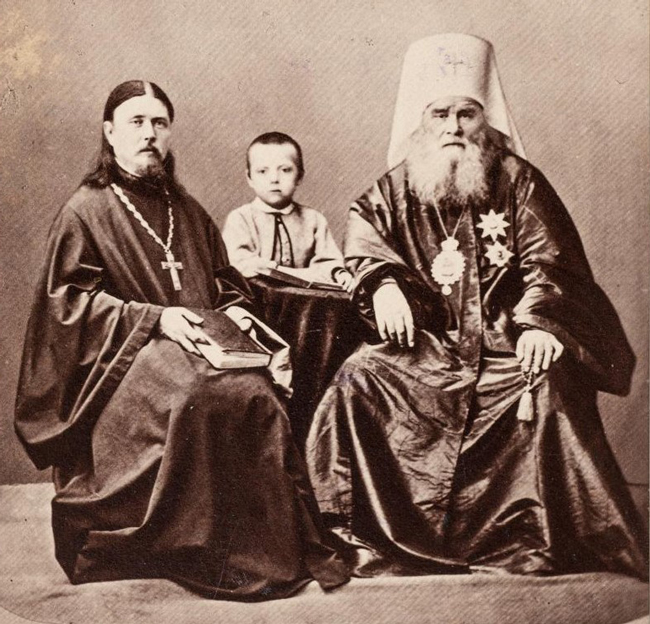
Instruction Of the Most Rev. Metropolitan Innocentius, formerly Archbishop of Kamtchatka, of the Kuril and Aleutian Islands, to the Missionary at Nushagak, Theophanus, Hieromonk.
Published by the order of Right Rev. Tikhon, Bishop of Alaska and the Aleutian Islands, for the guidance of the Orthodox Missionaries in Alaska.

Part Second – Special Directions concerning instruction, public worship, the Treatment of Natives, etc.
III.
- The dogmas of the faith and the substance of actual doctrine should be kept to so strictly as not to allow anything contrary to them in word or deed, though in the face of death itself. But some allowance should be made for new converts, as regards certain imperfections in the rites, partly in consideration of local conditions, partly in expectation of their growing firmer in the faith and the new mode of life.
- The nature of those countries makes it almost impossible for the inhabitants to observe the fasts after the usual manner, i.e. by changing animal flesh diet to a wholly vegetable diet, and their fasting can more conveniently modify not so much the quality as the. quantity of the food and the time of taking it. Therefore they should not be compelled to observe the fasts by change of diet; but, in the first place, the object of the institution of fasts should be explained to them, and the good of it; then, as their conviction and zeal increase, they should be, led to observe the fasts on certain days in this manner: that they should, according to circumstances, diminish the quantity of the food they take, and not take that in the early hours of the day. As regards the Holy Week, and especially the last days before Easter Sunday, all converts should be urged to spend them in the utmost self-mortification, bodily and spiritual, in memory of the passion suffered by Jesus Christ for our salvation.
- Attendance at ordinary services, with the exception of the Liturgy, should not be made an absolute duty. Hence, in the course of thy travels in the remoter localities, when those whom thou dost visit are bound to confess and receive the Sacrament, thou must not make it absolutely incumbent on them to go to church during a whole week, as is customary with us, but only so much as circumstances will permit, and thou must be content with reminding and advising them that they should, during this time, pray to God as frequently as possible in their hearts for forgiveness of their sins, and also observe as strict a fast as they can. For such converts, instruction in the Word of God is always a better preparation for partaking of the Sacrament than reciting the usual Psalms and prayers, because none of them will, for a very long time yet, understand what is read and recited in church.
- With regard to the celebration of marriages, departures from the strictness of existing rules can be permitted only for the most cogent reasons and in cases of extreme necessity; and in what these departures may consist, that shall be specified in special instructions which shall be given thee. In view of the scantiness of local populations, recalling the patriarchal times, it will not be advisable to extend overmuch the forbidden degrees of relationship. Still, the prohibitions recorded in this matter in Leviticus (ch. XVIII) [1], should be unswervingly kept in view.
- Ancient customs, so long as they are not contrary to Christianity, need not be too abruptly broken up; but it should be explained to converts that they are merely tolerated.
- Natives who have not received holy baptism, if only there is no reason to fear that they may in any way commit sacrilege or violate decorum, should not only not be forbidden from being present at our services,—such as vespers, matins, or Te Deums,—if they so wish, but should be invited to attend. As regards the Liturgy, it is against church rules to allow their presence at the Liturgy of the Faithful. Still, as the envoys of St. Vladimir in Constantinople were permitted, though they were heathens, to remain during the entire Liturgy, to the unspeakable benefit of all Russia,—thou also mayest grant the same favor, in the hope that the sacred act may have a salutary effect on hearts as yet un enlightened.
- No matrimonial unions or contracts entered into before baptism must be considered as hindrances to the administration of the Sacrament; and no marriages contracted before baptism, (with the exception of such incestuous ones as can scarcely occur at all), must be annulled, nor must such marriages be inquired into.
- Neophytes must be given no presents, either before, or at, or soon after baptism, nor must the sponsors be allowed to give them any, in order that the expectation of gifts may not serve as an inducement or suggest various cunnning devices; therefore nothing must be given at baptism, neither shirts nor anything else, except the small crosses they are to wear.
- Upon the holy Antimins given to thee thou art empowered to celebrate the Liturgy in any place whatever—in a clean dwelling or under the open sky. But for many reasons, it is preferable to have for the purpose a special tent, which should be pitched in places as clean as possible; and on such places the natives should be persuaded to erect, crosses, which may later on serve as landmarks, to show where the Bloodless Sacrifice has been offered, and also be a consecration to the place, so the people may assemble there tor common prayer in thy absence.
- Thou art to take up thy residence more or less permanently where thou shalt judge thy presence to be most needed and useful. Happy indeed is the preacher, whose presence among them the natives regard as a privilege!
- While shaping thy course of instruction after the order indicated above, be careful not to proceed to a new subject before the hearers—all or at least the majority—have well grasped the preceding ones, even though this may delay the baptism of many. The more firmly the foundation is laid, the more durable will be the building and the easier to erect it.
- Thou shalt not bring in support of instruction in the faith and the Christian law any proofs not confirmed by Holy Writ, nor, still less, false miracles and invented revelations, under penalty of the severest censure. But, should the Lord in any place manifest His power, either by some miraculous cure or by some extraordinary revelation, thou shalt not conceal such divine manifestations, but, after instituting a proper and most impartial investigation, with all possible proofs, report the matter to us.
- Thou shalt on no account attempt to increase the number of those who are to receive holy baptism by any measures or means inconsistent with the evangelical spirit and unbecoming a preacher,—such as compulsion, threats, bribes or promises (of exemption from taxes and the like), nor by any vain allurements; but thou shalt always act with apostolic sincerity.
- Thou shalt not proceed to administer holy baptism to natives before they have been thoroughly instructed by thee in the above-named matters, nor then, unless they shall have expressed the wish to receive it.
- On arriving in some settlement of savages. thou shalt on no account say that thou art sent by any government, or give thyself out for some kind of official functionary, but appear in the guise of a poor wanderer, a sincere well-wisher to his fellow-men, who has come for the single purpose of showing them the means to attain prosperity and, as far as possible, guiding them in their quest.
- From the moment when thou first enterest on thy duties, do thou strive, by conduct and by virtues becoming thy dignity, to win the good opinion and respect not alone of the natives, but of the civilized residents as well. Good opinion breeds respect, and one who is not respected will not be listened to.
- On no account show open contempt for their manner of living, customs, etc., however these may appear deserving of it, for nothing insults and irritates savages so much as showing them open contempt and making fun of them and anything belonging to them.
- From thy first interview with natives, do thy best to win their confidence and friendly regard, not by gifts or flattery, but by wise kindliness, by constant readiness to help in every way, by good and sensible advice and sincerity. For who will open his heart to thee, unless he trust thee?
- In giving instruction and talking with natives generally, be gentle, pleasant, simple, and in no way assume an overbearing, didactic manner, for by so doing thou canst seriously jeopardize the success of thy labors.
- When a native speaks to thee, hear him out attentively, courteously, and patiently, and answer questions convincingly, carefully and kindly; for any question asked by a native on spiritual subjects is a matter of great importance to the preacher, since it may be an indication both of the state of the questioner’s soul and of his capacity, as well as of his desire, to learn. But by not answering him even only once, or answering in a way at which he can take offence, he may be silenced forever.
- Those who show no wish to receive holy baptism, even after repeated persuasion, should not in any way be vexed. nor, especially, coerced: And although justice demands that converts and such as are ready to become converts should be treated with greater kindness and consideration, still thou, as preacher of the Gospel, should not be insulting in thy treatment of such as show no disposition to listen to instruction, but should be friendly in thy intercourse with them. This will be to them the best proof that thou dost really and truly wish them well.
- Among some savage tribes in those parts polygamy is to be met with, but only among the rich and powerful. Therefore, while striving to incline them to monogamy, do thou proceed with caution and tact, never in a masterful spirit, but so as not to anger and embitter them.
- From new converts or neophytes thou shalt not on any account whatsoever demand contributions or donations for the church or for any good work; yet shalt thou not refuse, but kindly accept gifts from such persons as may voluntarily offer anything,—taking care however, to explain on each separate occasion the object of the gift and the use it will be put to, in order that tey may not get the idea that God, like their own spirits, demands offerings, or that such gifts are expiatory or propitiatory sacrifices, and the like.
- Henceforth, unless a special instruction be given thee, thou shalt take laborers or guides in thy travels from among the new converts or the natives of the places thou visitest. In this matter thou shouldst act in such a manner as not to lead them to fancy that, in becoming Christians, they at the same time become in some sort the slaves or bound laborers of their teachers. Hence, whenever such an occasion arises, thou shouldst request the natives’ assistance in a friendly manner, and thou shouldst pay guides and all other help for their services.
- On no account shalt thou require of new converts or any natives presents or contributions; nor art thou to enter into any commercial transactions with them, either personally or through third parties, under penalty of severest censure. Even what is needed for food thou shalt receive only in case of absolute necessity and against payment, or else what is offered spontaneously at the hospitable board.
- Journeys are to be undertaken at seasonable times, i. e. when the inhabitants are comparatively at leisure from hunting and fishing, so that, by undertaking a journey at an unseasonable time, thou mayest not interfere with the earnings of either the natives or the Company. But, should thou find it impossible to visit some locality to the greatest possible advantage at any other time than the working season, thou shalt report the matter in good time to us, explaining all the reasons for and possible consequences of the one or the other course.
- In order to be of the greatest possible service to thy parishioners, thou shouldst quickly learn at least so much of their language as will enable thee to understand them. But the acolyte who is with thee as thy assistant must regard it as his bounden duty to study the language thoroughly, and thou art to see that he does.
- Make it thy business to find out all about the religion, rites, customs, tastes, disposition, and all that makes up the life of thy parishioners, more especially in order to be able the more surely and easily to influence them.
Note. It imports not a little for thy success that thou shouldst do justice to any good customs they may have.
- During thy visits and residence in that or the other locality, give the natives, as far as time will permit, advice and directions for the improvement of their manner of living, avoiding, however, anything like coercion, and taking care not to give offence in any way, all in a friendly, open-hearted spirit; and the advice and directions should be adapted to the local conditions and the simplicity of their manners.
- Do not meddle with any temporal affairs, and do not, either openly or by secret insinuation, discredit in their eyes any of the authorities placed over them either by the government or by their own choice; for Jesus Christ Himself, while He dwelt on earth, insulted no existing powers and touched nobody’s rights of property. But should the actions of an official and his treatment of the natives be too cruel and unbearable, exhort him at first in all gentleness and friendliness; then, should this prove inefficient, report the matter confidentially to us, with every detail and in all fairness or, in case of our absence, to the dean of the district, who will bring it before the higher authority.
- In all matters exceeding thy powers, thou shalt apply to us, and of any scruples or misunderstandings that may arise, thou shalt write to us, officially or confidentially, according to circumstances.
- Judging from the gentle temper of many of the natives of the American coastland, it would seem that, if thy conduct be peaceable and such as beseems a preacher of the Gospel, no attacks or attempts against life are to be expected. Yet, should thy life, against all expectation, be in any way endangered, thou shouldst have recourse to the last and decisive measures for thy defence only in a case of absolute extremity. But a hundred times blessed shalt thou be if thou be found worthy to suffer for the name of Jesus Christ.
- That thy labors, acts, and progress in the work entrusted to thee may be the better seen and thy services the more correctly appreciated, thou shalt keep a diary, in which thou shalt set down all thy acts, all the principal thoughts and words that shall have occurred in thy talks with the savages, and everything noteworthy generally. This diary thou shalt submit to us each year, together with thy other reports.
- Concerning the order in which the church matters are to be held’ such as the keeping of the books, of various registers, and the forms to be observed in both, special instructions shall be given thee.
- Wherever possible or convenient, try to start a primary school for the instruction of children in the Catechism, reading, etc., after the model of those which are ordered by imperial decree to be organized in monasteries and in connection with churches. Should it not be possible to organize schools on these principles, then at least assemble in thy own dwelling or in the chapel, once or twice a week, the children of both sexes, first those of resident Russians and halfbreeds, then those of new converts; instruct them in their duties to God, their parents, the authorities, to each other and to their neighbors. Thou mayest employ thy acolytes to assist thee in teaching the children to read and write.
- It goes without saying that thou art, in addition to all the above rules, to fulfil strictly and faithfully the general and particular rules concerning churches and the persons attached, to them conformably to local conditions and institutions, and all such directions as shall be given thee from time to time, and also all the regulations and ordinances of any kind whatever, issued by the local authorities for the general community,—and, by thus fulfilling them, thou shalt give a good example.
Bear in mind that thou art in a position where it is possible for thee’ to receive greater rewards, and more promptly, than do many others,—rewards both heavenly, in the future, and temporal, in the present The heavenly rewards are in the hands of the Great Distributor of meeds, Who will constantly behold thee and thy actions thy intentions, and the spirit in which thou wilt act. As regards temporal rewards, of this earth notice shall be taken of the number of converts thou shalt have made; but still more of the zeal and ardor thou shalt bring to thy labors,—of any translation thou mayest make of portions from books of the Scriptures into the language of thy parishioners,— of thy efforts to teach them to read the portions thus translated; and if thou succeedest with at least fifty pupils, this shall co considered us sufficient proof of thy zeal, and as a merit deserving of the highest rewards open to the clergy.
Do thou strive to stand before God, a laborer unashamed, righteously administering the Word of Truth. Devote thyself to thy teaching and abide therein,—and by thus doing, shalt thou eave both thyself and them that listen to thee.
The grace of our Lord Jesus Christ be with thy spirit.
Signed on the original:
Innocentius, Archbishop of Kamtchatka, of the Kuril and Aleutian Islands.
[1] And the LORD spake unto Moses, saying, Speak unto the children of Israel, and say unto them, I am the LORD your God. After the doings of the land of Egypt, wherein ye dwelt, shall ye not do: and after the doings of the land of Canaan, whither I bring you, shall ye not do: neither shall ye walk in their ordinances. Ye shall do my judgments, and keep mine ordinances, to walk therein: I am the LORD your God. Ye shall therefore keep my statutes, and my judgments: which if a man do, he shall live in them: I am the LORD. None of you shall approach to any that is near of kin to him, to uncover their nakedness: I am the LORD. The nakedness of thy father, or the nakedness of thy mother, shalt thou not uncover: she is thy mother; thou shalt not uncover her nakedness. The nakedness of thy father’s wife shalt thou not uncover: it is thy father’s nakedness. The nakedness of thy sister, the daughter of thy father, or daughter of thy mother, whether she be born at home, or born abroad, even their nakedness thou shalt not uncover. The nakedness of thy son’s daughter, or of thy daughter’s daughter, even their nakedness thou shalt not uncover: for theirs is thine own nakedness. The nakedness of thy father’s wife’s daughter, begotten of thy father, she is thy sister, thou shalt not uncover her nakedness. Thou shalt not uncover the nakedness of thy father’s sister: she is thy father’s near kinswoman. Thou shalt not uncover the nakedness of thy mother’s sister: for she is thy mother’s near kinswoman. Thou shalt not uncover the nakedness of thy father’s brother, thou shalt not approach to his wife: she is thine aunt. Thou shalt not uncover the nakedness of thy daughter in law: she is thy son’s wife; thou shalt not uncover her nakedness. Thou shalt not uncover the nakedness of thy brother’s wife: it is thy brother’s nakedness. Thou shalt not uncover the nakedness of a woman and her daughter, neither shalt thou take her son’s daughter, or her daughter’s daughter, to uncover her nakedness; for they are her near kinswomen: it is wickedness. Neither shalt thou take a wife to her sister, to vex her, to uncover her nakedness, beside the other in her life time. Also thou shalt not approach unto a woman to uncover her nakedness, as long as she is put apart for her uncleanness. Moreover thou shalt not lie carnally with thy neighbour’s wife, to defile thyself with her. And thou shalt not let any of thy seed pass through the fire to Molech, neither shalt thou profane the name of thy God: I am the LORD. Thou shalt not lie with mankind, as with womankind: it is abomination. Neither shalt thou lie with any beast to defile thyself therewith: neither shall any woman stand before a beast to lie down thereto: it is confusion. Defile not ye yourselves in any of these things: for in all these the nations are defiled which I cast out before you: And the land is defiled: therefore I do visit the iniquity thereof upon it, and the land itself vomiteth out her inhabitants. Ye shall therefore keep my statutes and my judgments, and shall not commit any of these abominations; neither any of your own nation, nor any stranger that sojourneth among you: (For all these abominations have the men of the land done, which were before you, and the land is defiled;) That the land spue not you out also, when ye defile it, as it spued out the nations that were before you. For whosoever shall commit any of these abominations, even the souls that commit them shall be cut off from among their people. Therefore shall ye keep mine ordinance, that ye commit not any one of these abominable customs, which were committed before you, and that ye defile not yourselves therein: I am the LORD your God. Leviticus 18
Russian Orthodox American Messenger, Vol. III, No. 21, 1-13 November 1899, pp. 534–74


Pas de commentaire