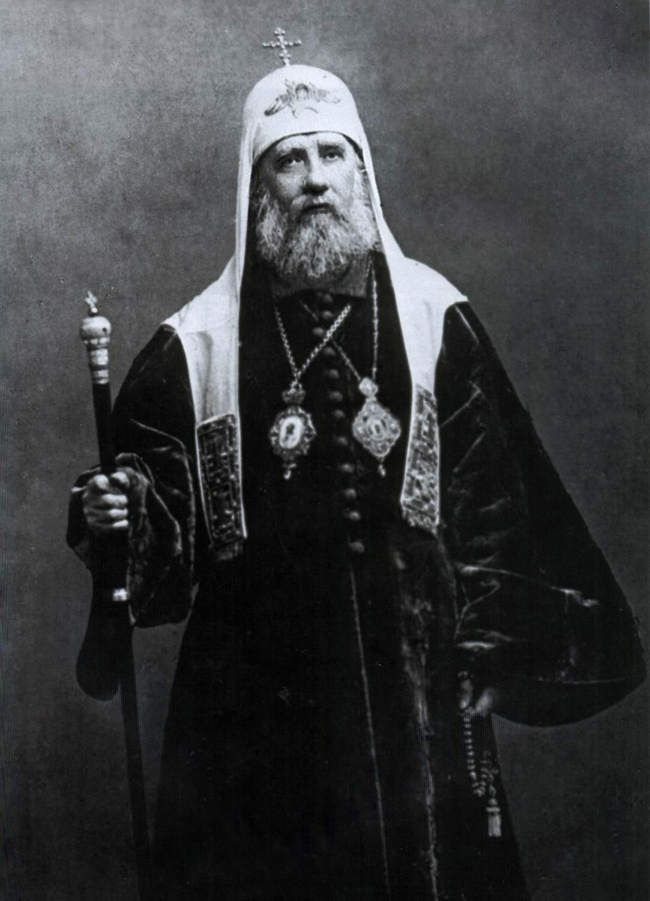
In 1865, the town of Toropets in the province of Pskov was almost untouched by any of the advantages or disadvantages of the modern era. The nearest railroad was 200 versts[1] away, and the old traditional Russian ways were still fully maintained. Life was patriarchal in character and slow in tempo. Industry was unknown and the economy of the town was dependent on the agrarian cycle of the surrounding area.

Twenty-six years before, Modest Mussorgsky had been born near Toropets, but his fame had not yet trickled back, nor was he ever to bring such glory to the town as the man Vasily Ivanovich Bellavin, who was born January 19, 1865, old style.[2]
The family of Bellavin had long been connected with the Church. Vasily’s father was a priest who had spent his entire life at Toropets and, as was the custom, his sons also would be expected to enter the priesthood.[3] Toropets[4] was a town bathed in religious atmosphere. Churches set the keynote. It could be compared to Moscow, for both were ancient, both were primarily religious strongholds and towns only as an afterthought, and both contained famous relics to which pilgrims continually flocked.
Except for the bare outlines of schooling,[5] little is known about the youth of Vasily. He was one of three sons, all of whom lived till manhood. It was just after Vasily became bishop of Alaska, at the age of 35, that his youngest brother died, and the new bishop accompanied the body back to Toropets for burial. This incident had been predicted many years before by Vasily’s father in one of those curiously prophetic dreams that seem to come to people close to the soil. One night the old Bellavin had dreamed that he spoke with his dead mother. The mother warned him of his imminent death and then went on to say that of his three sons, one would be protector,[6] one would die a youth, and one would be brought back to Toropets, and Vasily would become great.
In 1878, Vasily entered the Pskov Seminary. Seminaries in Russia provided free religious training for future priests. Seminary education was usually the end of a priest’s formal schooling and was finished when the student was twenty. A few of the most brilliant students were elected to continue their studies at one of the four academies[7] in Russia. These men were trained as learned theologians and professors, and often, after taking vows, they became Bishops.
Vasily was one of the few selected to enter the Academy of Divinity at St Petersburg, where he went in 1884 at the age of 19. Since the normal age at entrance was 20, this attests to his superior scholastic abilities. From almost the beginning of his studies, his comrades him “Patriarch”[8], and the nickname was an affectionate one. The little that has been written about him by his friends speaks of his constant popularity with his colleagues for his gentle ways, complete simplicity, and ever-ready wit. The young Vasily, as well as the later Patriarch Tikhon, had a joke and kind word for everyone.[9]
During his studies at the St Petersburg Academy, a very popular librarian of the Academy was dismissed because of his political leanings. The library belonged completely to the students, being owned, supported, and operated by them.[10] Up to this time, they had themselves elected the librarian, and consequently were incensed over this action of the rector. So violent were the protests that the students refused to elect a new librarian. The rector appointed Vasily as the new librarian, and given his great popularity, the students ceased protesting and accepted the rector’s decision.
In 1888, Vasily finished the St Petersburg Academy still as a layman[11] and returned to the Pskov Seminary as a Master in Dogmatic and Moral theology. He settled in the town of Pskov, and here his utter lack of material interest soon showed itself by the manner in which he lived. His home was a tiny annex to a simple wooden house near the church of St Nicholas, but such simplicity of life only further endeared him to his friends. Between 1888 and 1891, he continued teaching at the Pskov Seminary, and it was only in 1891 that he took vows to enter monastic life. The ceremony took place on the second floor of a church, and so great was the rush of people that special supports for the ceiling had to be added quickly, to bear the weight of the people. Thus at the age of 26, Vasily Ivanovich Bellavin became the Russian Orthodox monk Tikhon.[12]
From the Pskov Seminary, Tikhon, in March 1892, was transferred to a seminary in Kholm, in the province of Lublin in Poland, where he was made superintendent. From the Kholm Seminary, Tikhon was for a short time transferred to the Kazan Theological School as rector with the rank of archimandrite,[13] but he soon returned to the Kholm Seminary having been made rector.
A detailed account of Tikhon’s work during his five year rectorship at the Kholm Seminary is given by Metropolitan Eulogy who was a teacher at the seminary at that time. Tikhon introduced literary and musical meetings, which took place once a week on a week day evening and every Sunday after the morning services. Lectures, discussions, and concerts were presented, and the public was invited. After each meeting, the rector invited all for tea. Almost immediately after he was appointed, he had a new second chapel erected at the Seminary in memory of the finding of the relics of Theodosius of Chernigov. There was a daily service at the new chapel, and each day one of the six forms did the singing. The local elementary form children were invited to perform on holidays. Such methods ensured his immediate popularity, and soon he was invited to serve at all the local churches. This serving at other churches became part of Tikhon’s work throughout his life and the enormous demands made on him, no matter where he went, attest to his popularity.
Kholm, by history and tradition, was one of the sorest spots for the Church authorities. The town was composed chiefly of Roman Catholics constantly at odds with the Orthodox Catholics and a large proportion of Uniates,[14] who were considered as potential Orthodox converts.[15] Throughout the ages, there had been constant friction among the three groups. Tikhon, with his gentle unprovocative ways, was an excellent person to be placed in such a position, and he quickly became popular with all groups. So successful was he in allaying suspicion and hostility that Archbishop Flavian chose him for his personal assistant. Under his tactful administration, many Uniates returned to the Orthodox confession.
Reports of his successful work reached the Synod, and a movement began to make him a bishop. However, by canon law, no monk can become bishop until he is 33, but in this case, the Synod made an exception and consecrated him Bishop of Lublin on October 19, 1897.[16] After the consecration, he returned to Kholm for a year as Vicarial Bishop[17] of the Kholm Diocese.
On September 14, 1898, Tikhon was made Bishop of the Aleutian Islands and Alaska,[18] whose diocesan see was located in San Francisco. From 1899 to 1907, he remained in the United States with only one quick trip to Russia in those eight years.
When the news reached people in Kholm that their bishop was being transferred to an independent see of his own, riots broke out. He was forced to hold farewell services in each individual church, and street fighting occurred in an attempt to stop him from going. On the day of his actual departure, people threw themselves on the tracks to keep the train from leaving and had to be removed forcibly.
It was while Bishop Tikhon was en route to his new see, his young brother, who was accompanying him, died and Tikhon took the body back to Toropets for burial, thus fulfilling his father’s dream.[19]
Tikhon’s years in the America were not only extremely productive, as far as successful administration of his diocese was concerned, but for Tikhon personally, they were years of useful experience that served him well later on. Later in life, he mentioned the fact that his American sojourn widened not only his ecclesiastical horizon but also his political outlook.[20]
In all the recorded sermons and speeches, there is seldom any personal reference. Early in life, in his manner of living, and in his dealings with people, he completely effaced all thought of self. It is only in his first sermon in America, and perhaps because of his recent sad visit to Toropets with the body of his brother,[21] that we find a reference to “my old mother in Russia.” Only through this comment has it been possible to establish the fact that his mother survived the father and lived to see the four boys grown to manhood.[22]
In 1905, because of the great increase of Orthodox parishes in America, chiefly under Tikhon’s guidance, the American Mission was made into an Archdiocese, and Tikhon was promoted to the rank of archbishop at the age of forty. The diocese was divided into two Sub-Vicariates, one located in Alaska and one in Brooklyn, New York. A cathedral was built and completed in New York City on 97th Street, and the official see was removed there. Along with the St Nicholas Cathedral in New York, Tikhon established an Theological Seminary[23] in Minneapolis, Minnesota, and the St Tikhon’s Monastery in South Canaan, Pennsylvania. The number of parishes increased from 15 to 70 in the U.S.A. and all the parishes became self-supporting. Again, as in Kholm, Tikhon continued his missionary activities[24] among the Uniates, and a large number returned to the Orthodox confession.[25]
While Pobedonosteff was still high procurator, Tikhon was called back from America only once to be a member of the Synod.[26] As soon as the session was over, he returned to America and stayed until he was transferred to Yaroslav on January 25, 1907.
Tikhon’s actions in Yaroslav at first created only amazement. He never refused to serve in the churches, monasteries, or even the smallest village parish churches. He constantly made trips to churches without any pomp or ceremony, examined minutely all the affairs of the church, and even climbed up to the church belfries[27] to see the bells. Amazement soon turned to love, for with high and low, he maintained the same friendly manner, usually speaking kindly and always ready with a joke. Parish priests soon came to expect the archbishop at any time, arriving on foot without fanfare, examining books, discussing local problems, and remaining quick to notice all the details of the provincial church life.
In 1913, Tikhon[28] was appointed Archbishop of Vilnius and had to leave Yaroslav. The entire province was saddened, and at a grand farewell ceremony, he was made an honorary citizen of the city, the first time any bishop was ever so honored.
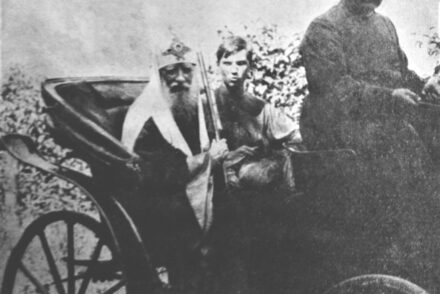
It was in Vilnius that Tikhon’s former work with Roman Catholics and Uniates both in Kholm and in the U.S.A. stood him in good stead. The Vilnius Diocese was composed largely of Roman Catholics and Uniates. A further complication was the strong historical animosity existing between the Russian Orthodox and the Polish population. Here, the church was forced to display more pomp and ceremony to appeal to the Polish temperament, and such a role was difficult for a man of Tikhon’s character. The local Polish population were chiefly members of the intelligentsia, quick to criticize and quick to be offended. The majority of them were Catholics and deeply distrusted Russian Orthodoxy. Tikhon was unable to maintain the necessary formality while conducting services, but he then would shock many by being driven to the magnificent summer home for the Archbishop in a simple carriage with only a small cap on his head. Around Trynopol, where the Archbishop’s home was located, was a section known as Calvary, which consisted of a series of Roman Catholic chapels marking the stations of the cross. Here it was Tikhon’s wont to walk dressed only in the plain monk’s frock and cap. Soon, the familiar figure was greeted on all sides by the Catholic priests and peasants, Jews, and Uniates, and a growing respect and liking grew up for the cheerful archbishop. However, this slow and constructive work of allaying distrust and building up united foundations, free of national and religious dissension, was soon interrupted by the outbreak of the first World War. Vilnius soon became a center of war activities, and within a few months the frontline passed over it.
At first, all the secular and religious institutions were removed to Moscow, and here Tikhon was transferred, bringing with him the most valuable of the church vessels and Holy Relics, but this proved too far from his diocese, so Tikhon moved to Disna, which was on the edge of the Vilna diocese.
From here Tikhon carried on extensive war work. His activities were at first with the refugees, but gradually they came to be centered with the soldiers at the front. He visited the front personally, conducted services, was caught under bombardment, and did such splendid work maintaining the morale of the soldiers that he was awarded a military order with swords for distinguished conduct.
During these war years, he frequently was called on to attend meetings of the Synod, and was at one sent to Tobolsk to investigate the complex affair of Bishop Varnava’s glorification of relics. In the early winter of 1917, Lvov, after the Revolution, became high procurator. In the first meeting in March, 1917, at his suggestion, a Synod appeal was issued which spoke of the revolution as the “will of God” [29] and begged that all dissentions should be set aside, all quarrels ended, and the war successfully persecuted under the Provisional Government, which would work for the good of Russia. Prayers were changed, and mention of the Czar was replaced by the “true-believing Provisional Government.” Friction became so strong that Lvov—asserting his power as chief procurator—dismissed the Synod in April 1917 and called a new one, which retained only two old members, Archbishop Sergy of Vladimir and Archbishop, Exarch of Georgia.
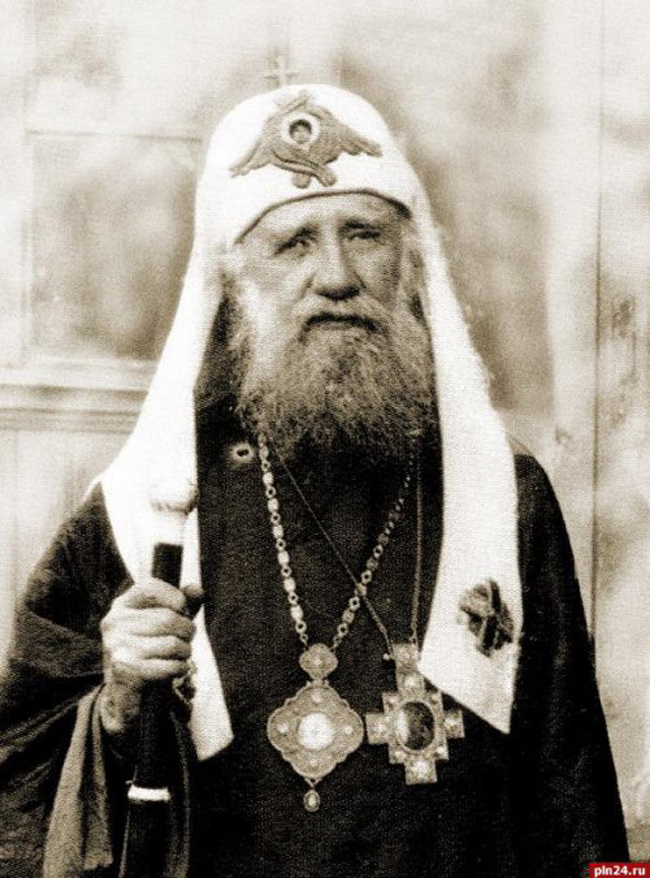
With the abdication of the tsar, a period of ecclesiastical revolutionary activity swept some of the lower clergy who were eager to settle scores with unpopular bishops. Things became so chaotic that the Synod adopted a rule declaring that the bishop should be elected by the clergy and laymen of the diocese. In actual fact, most bishops were reelected, but although Moscow had been sent Bishop Hermogen by Synod [30] appointment to replace the disgraced Makary, the people of Moscow decided to elect their own Metropolitan. A delegation of clergy and laymen were sent to Petrograd to investigate the records of possible candidates and departed with a long list. Tikhon was almost an unknown personality to the Moscow people, so it was a complete surprise to all when he received the highest number of ballots at the official election,[31] which was held before the miraculous Vladimir icon of the Virgin in the Cathedral of the Assumption in Moscow.
Almost immediately, it became known that the new Metropolitan would officiate in any church, so he was besieged on all sides with invitations. To the great amazement of all, when the service was over, Tikhon gladly visited the parishioners in their homes, no matter how small or humble they might be. Soon, his black-clad figure became a familiar sight to the Moscow citizens, and official reverence was replaced with warm personal love.
[1] 200 versts is approximately 130 miles
[2] Russia, unlike Western Europe, continued to reckon by the Julian calendar. This meant a time lag of twelve days before 1900 in comparison with the Gregorian calendar, and after 1900, a time lag of thirteen days. Unless indicated, the author will date by the Gregorian calendar.
[3] Vasily’s father, Father Ioann Timofeevich Bellavin, was born in 1822 in the village of Sopki, where his father served as the priest. Ioann was ordained a priest in 1847 and in 1849 assigned to the Resurrection Church in the village of Klin (Toropets district, Pskov province), where he served over twenty years before his transfer to Toropets. Vasily was born in Klin and was four years old when the family moved to Toropets in 1869. —S. M. K.
[4] The history of Toropets dates back to pagan times. A large fortress is still there, rising about 42 yards high and 500 yards in circumference, whose beginnings are buried in legend. Originally the town was devoted to warlike enterprises, having battles with the Lithuanians, and as late as the seventeenth century, fighting against the Zaporozhye Cossacks in the Ukraine. Early wealth based on the silk trade had dwindled completely, until by 1870 the census revealed a population of only 5,161, all of Great Russian origin. The famous Nebin Trinity-Sergius Monastery, built in 1592, was only two miles from the town and influenced the atmosphere of the surrounding area. The town was surrounded half by forests and half by tilled land. Snow covered the land from November to April, and the lake was covered with ice all winter long. The weather was cloudy all year.
[5] The priest Alexander Rozhdestvensky in his memoirs of the Patriarch entitled, His Holiness Tikhon, Patriarch of Moscow and All Russia (London, 1923), spoke of Tikhon’s readiness to write his friends’ essays for them and explain any problems of theology that they could not understand. Apparently his friends were all too ready to take advantage of Vasily’s good nature.
[6] The word pechal’nik is almost impossible to translate into English. It means a protector or caretaker, as a term for a person who looks after others with great anxiety and concern, and usually is applied to parents. This might possibly indicate that this brother would be the eldest one of the family and, after the early death of the father, may have been instrumental in the bringing up of his two younger brothers. No evidence, however, shows the respective ages of the three Bellavin brothers. Vasily Bellavin was one of four sons (not three); the others were Pavel (1857–1881), Ioann (1859–1891), and Mikhail (1873–1902); the date of his father’s death has not yet been established, but it was evidently in or around 1894. Although Swan does not cite her source for the father’s prophetic dream, most versions state not that one brother will be a pechal’nik (someone who grieves over others), but rather an unhappy or pitiable person. Since all three of St Tikhon’s brothers died relatively young, it is not clear to which brothers the dream refers. —S. M. K.
[7] The four academies were in St Petersburg, Moscow, Kiev, and Kazan.
[8] Perhaps nothing so reveals the character of a person as the nicknames he picks up in life. While Vasily was still at the seminary at Pskov, he was called “Bishop.” This was when he was just sixteen years old, and when he later entered the Academy in St Petersburg, he was at once christened “Patriarch” by his classmates. The spiritual force within him must have been immediately clear to others from a very early age. In later years, old friends reminded Tikhon of this jocular prophetic title.
[9] Even Julius Hecker, in his completely biased and highly critical book Religion Under the Soviets (New York: Vanguard Press, 1927), was forced to fall back on Patriarch Tikhon’s happy temperament.
[10] This student library was quite separate from the religious library, which belonged to the academy, and had been started by the students themselves who sold personal belongings to buy the books and periodicals.
[11] Most of the students took monastic vows in their third and fourth years at the academy, and it was rare that any of them graduated while still laymen. Although in earlier times academy students frequently took monastic vows as their first step on the path to becoming bishops, this was no longer the case in the St Petersburg Academy after the 1860s. —S. M. K.
[12] Rozhdestvensky, His Holiness Tikhon, p. 4, tells how Tikhon’s voice remained firm and clear as he spoke his vows, “Yes with God’s help,” and many in the church were moved with tears by the pathos of the moment.
[13] The ranks of the clergy are as follows—Black or monastic: hierodeacon, hieromonk, igumen, archimandrite, bishop, archbishop, metropolitan, patriarch. White or secular: deacon, protodeacon, priest, archpriest, protopresbyter.
[14] In 1595–1596, the Orthodox bishops in the Polish-Lithuanian Commonwealth (modern Ukraine and Belarus) decided to break communion with the Orthodox patriarch of Constantinople and to enter into union with the Roman Catholic Church. These bishops and those of their flock who followed them were obliged to accept the doctrines of the Church of Rome and the authority of the pope, but were allowed to retain Eastern liturgical rites. The adherents of this union are commonly called “Greek Catholics” or “Uniates.”—Ed.
[15] The Kholm region had been predominantly Greek Catholic (once more commonly referred to as “Uniates,” though this term today is seen as condescending). Russian authorities suppressed the Greek Catholic Church in the Russian Empire over the course of the nineteenth century, and the Kholm Greek Catholic Church was the last to be dissolved in 1875. —S. M. K.
[16] The following quotation is taken from Bishop Tikhon’s first sermon after he was consecrated bishop of Lublin and is a good indication of his feeling about the duties and position of bishops: “In my youth, the office of a bishop seemed to me to be dignity, power, might, and honor. When I was a child I had childish conceptions. Now I know that it means work, striving, and sacrifice. It is not easy to be weak with those who are weak, nor is it easy to be an example to the faithful in word, in one’s bearing, in love, faith, and chastity, and it certainly is not easy to admonish, to threaten and to punish in all patience. The life of a true bishop is daily dying in cares and concerns for others, therefore the success of the bishop’s official activities depend not so much on human qualities and faculties, but much more on the power of God which is given to those who are conscious of their weakness” (Karl Rose, Drei Patriarchen, Berlin, c. 1950). In fact, neither the canons, nor the pre-revolutionary church legislation established any minimal age for the consecration of a bishop, except the canonical minimum of thirty years for a presbyteral ordination. The Council of 1917–1918 was the first to set the minimal age for episcopal consecration at thirty-five years.—Ed.
[17] A vicar or auxiliary bishop is a bishop who assists the ruling bishop of a larger diocese or administers part of his diocese.
[18] The Diocese of Alaska and the Aleutian Islands was created in 1870, with the bishop’s residence at San Francisco.
[19] His brother Mikhail, who accompanied him to North America and served as his secretary and the diocesan librarian, died on November 21, 1902, in San Francisco. St Tikhon accompanied his brother’s body back to Russia for burial in Toropets in 1903. —S. M. K.
[20] It must be remembered that Tikhon was thrown into a completely new environment, including freedom of religion; no censorship; the hurrying, business-like American bustle; and above all a clash of Galician, Syrian, Bulgarian, Serbian, Greek, and Russian nationalities, which often must have drowned out the quiet voice of this man of God.
[21] This sermon was given in December 1898, thus three years before his brother Mikhail’s death. —S. M. K.
[22] Rozhdestvensky, His Holiness Tikhon, says that Tikhon’s mother died soon after he came to America but gives no date. Patriarch Tikhon’s mother, Anna Gavrilovna Bellavina, passed away on April 29, 1904. In fact, she outlived three of her four sons. —Ed., S. M. K.
[23] The newly established seminary had formerly been a mission school that Tikhon enlarged and changed to supply American priests for American churches and to make sure that the American churches would not depend on Russia for a constant supply of clergy. One of Tikhon’s wishes was that all priests in America have American citizenship.
[24] In February 1907, the first Orthodox Church Synod in America was held in Mayfield, New York. This had been organized by Tikhon, but just a month before it met, he was transferred to Yaroslavl’.
[25] In 1891, the Slovak Greek Catholic priest Alexis Toth (Tovt), with his parish community in Minneapolis, was received into the Orthodox Church, becoming part of the Diocese of Alaska and Aleutian Islands. Under his influence, from 1891 to 1909 a number of Greek Catholic parish communities and thousands of former Uniates returned to the Orthodoxy. For his missionary labours, which were supported by the future patriarch Tikhon during his tenure in North America, Fr Alexis was glorified as a saint by the Orthodox Church in America in 1994. His relics reside at St Tikhon’s Monastery in South Canaan, Pa. –Ed.
[26] After Mikhail’s death, St Tikhon submitted a request for a three-month leave in order to return to Russia (in part to bury Mikhail in Toropets). The leave was granted in March 1903 and he departed New York on May 15/28, 1903, arriving in Toropets at the end of May. Coming to St Petersburg in mid-June, St Tikhon was called to attend the sessions of the Holy Synod, which he did until the end of the year. After celebrating Christmas in Toropets, he departed for America, arriving in New York on January 3/16, 1904. —S. M. K.
[27] Russian churches traditionally have the bell tower quite separate from the main part of the church, and this tower is often the proudest piece of architecture in the town, much like the Giotto tower in Florence.
[28] There is a difference between Emhardt, Religion in Soviet Russia (London, 1929), and Ivan Andreyev, Краткiй обзоръ исторiи Русской Церкви отъ революцiи до нашихъ дней [A Short History of the Russian Church from the Revolution to Our Times] (Jordanville: Holy Trinity Monastery, 1952); because several of Emhardt’s dates have proved wrong, I have used Andreyev’s dates here. Archbishop Tikhon was transferred to Vilnius on December 22, 1913 and arrived in Vilnius on January 24, 1914. –Ed., S. M. K.
[29] Vladimir L’vov’s reference to the “will of God” when speaking of the revolution is most interesting in light of Tikhon’s later speeches; Tikhon also saw the chaotic state of revolution and civil strife as the will of God brought on by the materialistic attitude and indifference of the Russian people to things of the spirit, as the real cause of the upheaval, rather than the work of political groups.
[30] Bishop Joasaph had been appointed by the Synod to Moscow before the new ruling on elections had been made. Joasaph was appointed bishop of Dmitrovsk, one of the vicar bishops of the Moscow diocese, and temporary administrator of the diocese until a new metropolitan was elected. —S. M. K.
[31] In a preliminary straw vote, Alexander D. Samarin, the former chief procurator of the Holy Synod in 1915, received most of the votes, and Tikhon was not even in the first rank of candidates. In fact, Samarin and Archbishop Tikhon received an equal share of votes in the first round of election for Metropolitan of Moscow. —Ed.
By Jane Swan
Orthodox Life, No. 1, January-February 1964, pp. 3-12

Pas de commentaire