
The Holy Twenty Thousand Martyrs—December 28
Glory be to God! Every year on the twenty-fifth of December, my beloved, we celebrate Christmas and after Christmas the holy days continue until we end with the Feast of Saint John the Baptist. This is the so called dodecahemeron.
The question is raised, “How should we celebrate Christmas? How should we celebrate the twelve days of the holy season? Do we celebrate, as Christ wants?”
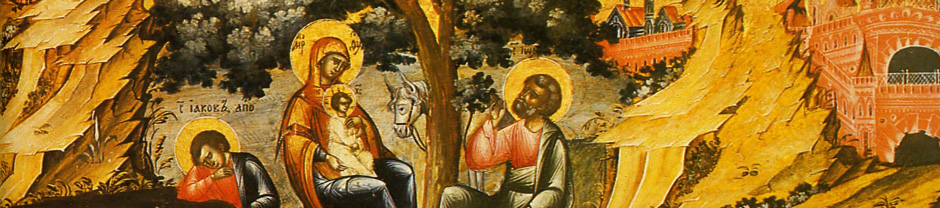
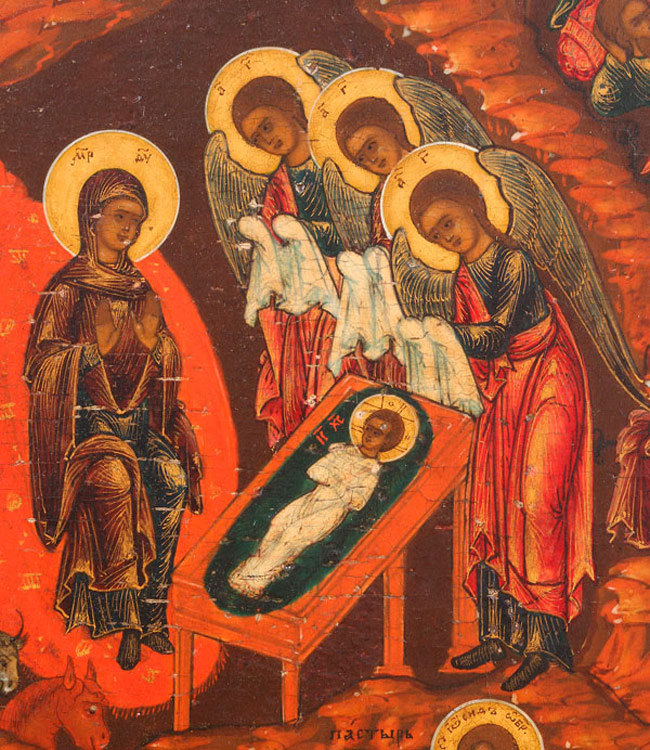
Unfortunately, in the time in which we live—a time of disbelief and corruption—only the names of the great Holy Days remain; the essence of the feasts is far from us. If you go, for example, on the day of Christmas to the homes of the Orthodox Christians, you will not hear a word about the most important event in the history of the world—that God became man for the salvation of man. In not a single home does a father and mother open the Gospel to read a section from the Evangelists, which describe the divine birth. If the name of Christ is heard, it will be as a blasphemy. Yes, even on the holy day of Christmas, itself, there are people who open their filthy mouths and blaspheme Christ and the All Holy Mother. Who can count the sins which take place in the dodecahemeron by young and old; the drunkenness, the card games, the prostitution of the fornicators, and other sins? During these days, Satan has many customers. It is not an exaggeration to say that the Christians, save for a few exceptions, celebrate Christmas without Christ.
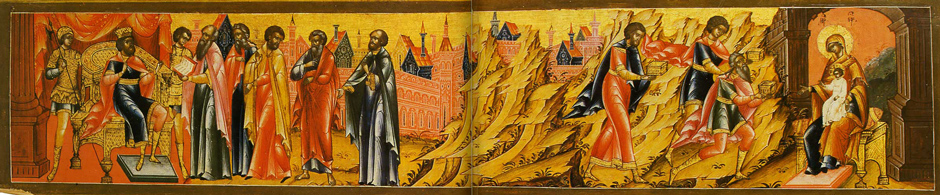
Do you want to see how the Christians of the first centuries celebrated? In this homily we will speak about how the Christians of Nicomedia used to celebrate Christmas. Nicomedia was an ancient city of Asia Minor not far from Constantinople. In this city, Christianity had made deep inroads. Great progress had been made preaching the Gospel. Not only illiterate people, but also educated men with high positions and offices in the Roman State, had believed in Christ. Among them was a chosen girl named Donna. She was at first a priestess, namely a woman who serve like a priest in the temples of the idols. When she read the Epistles of the Apostle Paul, however, she was amazed with everything that the Apostle wrote. She could discern where light, truth, and life were. Donna changed her mind, left the idols, was baptized, and became a Christian. Another person, who had a confidential position in the palace, also became a Christian; his name was Indis.
When the idolaters found out that these two people became Christians, they were enraged. They went to the homes where they were living and took whatever they had. Donna and Indis succeeded in keeping two things, which were more valuable than all the treasures of the world, from the hands of the idolaters—the Gospel and the artophorion. The artophorion is a small box where the Christians of the first centuries kept the divine pearl from which they would partake often. Donna took the Gospel and Indis took the artophorion. Today, these two items are found in the Holy Sanctuary. The Gospel and Holy Communion are indispensable. Without these two items there can be no Christian life.
Donna and Indis were thrown into prison. Not a long time passed when these two persons found the martyr’s death. Persecution, however, was not reserved to only to these two persons. The orders of Emperor Maximian were strict. The military administrator of Nicomedia, a savage wolf, thirsted to drink the blood of Christians. He looked for a suitable opportunity in which he could exterminate, not only two people, but as many as possible and, if it was possible, all the Christians of Nicomedia. Since he was cunning, however, he hid his plans. He wanted to strike quickly and decisively.
The opportunity came; a certain spy informed him that the Christians of Nicomedia would be gathered in a place to celebrate the great Feast of Christmas. At that time they would celebrate Christmas at night. Everyone was congregated in the Church along with their Bishop and the rest of the clergy. While the Divine Liturgy was being conducted, the military governor besieged their gathering with soldiers. He ordered that wood be collected along with other flammable materials and placed around the Church. He had decided to put it to fire and burn all of them. Before he set the fire, however, he informed them that only those who would deny Christ and venerate the idols, would be saved. The military officer expected that they would be scared into denying Christ, however, the time passed and no one appeared to deny Christ. What an admirable thing! Twenty thousand people were congregated there and were celebrating Christmas and not one became a traitor! All had decided to die for Christ. Many, in particular, who were not baptized yet and were being catechized asked if they could be baptized that night. The Archdeacon Agapios preached to the people with burning words and asked them to remain faithful to the end. They kneeling in prayer. Chanting was heard when the end came. The idolaters set the fire. Enormous flames rose and encircled them from all sides. What a terrible furnace! Everyone—the elderly with white hair, small children, infants, men and women, clergy and laity—all were burned as incense in Christ’s censer of love. Twenty thousand martyrs! It is one of the greatest single sacrifices which the history of our Church mentions.
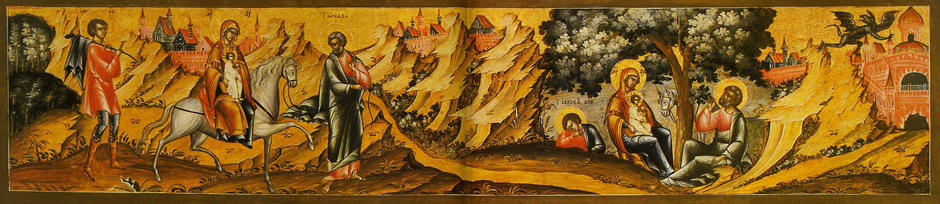
Did you see, my beloved Christians, how the Christians of Nicomedia celebrated the Feast of Christmas? Let us pay attention. Let us place in front of us this picture of sacrifice and ask ourselves, “If we were that night in Nicomedia, what stand would we take?” Would we stay until the end in the Divine Liturgy or would we leave when we heard the order of the unbelieving army officer in order to save our skins? It is not necessary to answer; the facts speak for themselves. Today the doors of the Church are open and free—no one threatens us—and in spite of this, how many go to church? The Church is chanting: “Glory to God in the highest”, “Today Christ is born”, and other hymns. Contemporary Christians in Athens, Thessaloniki, and many other cities do not go to Church but, rather, gather at night in hotels and taverns to celebrate Christmas with banquets. Then there are the others who leave before the end of the Divine Liturgy.
Christians do these things on this holy day. What if a persecution occurred today? How many people would go to Church and receive the precious gifts? No matter how many there are, even if there are only five who remain in a city—then only these will be the true Christians. These will be worthy to escort the 14,000 infants in the heavens which Herod killed and the 20,000 Martyrs of Nicomedia, whom another Herod, Maximian, burned.
My Christians! Herods will always exist. However, Christians who are willing to sacrifice their lives will never disappear. The “Glory to God in the Highest” will never cease to be heard on earth from the mouths of martyrs. No power of the Antichrist will ever be able to extinguish the name of Christ. To Him belongs honor, glory, and worship forever.
Augoustinos N. Kantiotes, Bishop of Florina, Greece, Fragrant Flowers—Orthodox Homilies on the Lives of the Saints, Translation and Foreword by Asterios Gerostergios, Institute for Byzantine and Modern Greek Studies, Belmon MA, 2006, pp. 205–208

Pas de commentaire