From this day, from this hour,
from this minute, let us strive
to love God above all, and
fulfill His holy will.
St. Herman
Since the glorification of St. Herman of Alaska in 1970, a number of pious people within the Russian Church Outside of Russia have hoped that this patron saint of the American land might become a source of inspiration and a kind of rallying point for renewed spiritual life, especially among Orthodox young people in America, rather in the spirit of the St. Vladimir’s circles for Russian youth in the 1950’s.
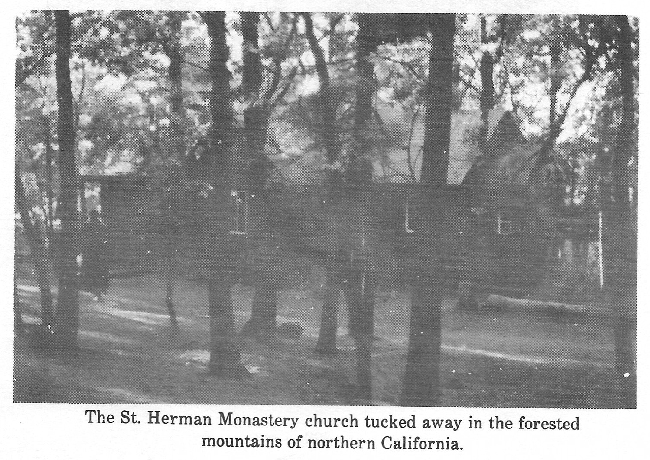
Although the service of glorification itself, celebrated by hierarchs of the Russian Church Outside of Russia in San Francisco, was a time of great spiritual uplift and fervor and produced in many a new resolve for labors pleasing to God—still, little was done in the first years after this to keep alive this initial fervor. There were sporadic attempts in some parishes to make St. Herman’s feast (December 12/25) something special, and there was a major pilgrimage on this day in 1973 at Holy Trinity Monastery at Jordanville, New York. But it was not until the late 1970’s that more regular activities began in the name of St. Herman.
In the summer of 1977 the first Saint Herman Summer Pilgrimage was held at the St. Herman of Alaska Monastery, Platina, California. The aim of the pilgrimage was to provide an opportunity for basic Orthodox education and inspiration in the context of a pilgrimage to an Orthodox monastery; away from the distracting and worldly influences of modern city life, the pilgrims were able to go deeper into their own Orthodox faith and became more aware of the riches it contains for their own and others’ salvation. Two days of lectures after the Divine Liturgy on the feast of St. Herman’s glorification (July 27/August 9) and the next day were followed by a week of courses in basic Orthodox knowledge. The aim was not a “conference’’ of academic lectures (which, of course, can also have its place in Orthodox life), but a learning experience on a simpler level, stemming not only from the formal talks, but also from the daily cycle of church services and the labors in which many pilgrims shared. The pilgrimage was entirely free of charge so as to be accessible to everyone, and the pilgrims the first year came mainly from northern California and Oregon. There were a number of free discussions on Orthodox questions of the day, the chief question being always: How to put Orthodoxy into life today.
The Saint Herman Summer Pilgrimages in succeeding years have followed the format of the first pilgrimage, attracting an ever-increasing number of pilgrims, many from the East Coast of the United States (and, in the last pilgrimage, some even from Australia and Japan). Russians and American converts alike come, as well as young people of other Orthodox jurisdictions who are beginning to thirst for the genuine Orthodoxy that is so hard to find in “official” Orthodox life today. Beginning with the second pilgrimage in 1978, a regular part of the week’s activity has been the baptism of adult converts (as many as seven at the 1980 pilgrimage), for whom the summer courses serve as the culminating point of their preparation for receiving Holy Orthodoxy. Pilgrims also include new inquirers into the faith, some of whom become catechumens.
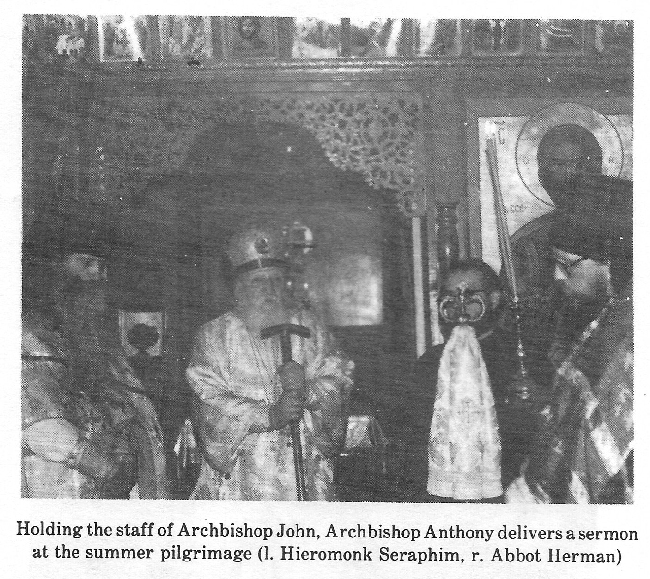
The 1980 pilgrimage was attended by both bishops of the diocese: Archbishop Anthony of San Francisco, ruling bishop of Western America, and Bishop Nektary of Seattle. During his own talk to the pilgrims, Archbishop Anthony identified the pilgrimage as being in the spirit of the missionary labors of the late Archbishop Vitaly at Pochaev Monastery in Western Russia before the First World War. There this fervent missionary would give inspired talks outdoors to the great crowds who came to the monastery to venerate the relics of St. Job and the wonder-working Pochaev Icon of the most Holy Theotokos, arousing them to fervent piety and firm defense of the Orthodox Faith. These talks would alternate with church services, the singing of akathists, and the showing of slides of Orthodox places against the wall of the church late at night. The fervor inspired by these Pochaev pilgrimages changed lives and gave new life to the Orthodox Christians of Western Russia. The Saint Herman Summer Pilgrimage, on a much humbler scale, does indeed try to follow the example of Archbishop Vitaly.
Every year at the summer pilgrimage there are slides or films illustrating some aspect of Orthodox piety or concern; in 1979 it was films of the suffering Christians in Russia, in 1980 a film of the Holy Land by a pilgrim who had been there, in 1981 slides of old Valaam Monastery and of a recent pilgrimage to Mount Athos. The highlight of the talks at the 1980 pilgrimage was that of Father Roman Lukianov, priest of the Epiphany parish in Boston, on the New Martyrs of Russia, culminating in a lively discussion and the signing of a petition to the Synod of Bishops calling for their speedy glorification (which indeed occurred in 1981).
The 1981 pilgrimage overlapped the Russian Youth Conference in San Francisco, and Bishop Alypy of Cleveland replaced the local bishops at the opening of the pilgrimage, taking also an active part in the discussions following the lectures. Later in the week Archbishop Laurus of Jordanville also visited the pilgrimage. Apart from the formal lectures, there were also informal talks, for example at the communal meals after the reading of the Lives of Saints. All of the talks had as their aim the deepening of Orthodox awareness and piety and the putting into life of the Orthodox spirit of otherworldliness, and the pilgrims showed a great thirst for all they were given. The week of courses every year is devoted to a general view of Orthodox history and literature, church singing, and the like; in the past three years there have also been solid courses in the Patristic interpretation of books of Scripture (Daniel, the Apocalypse, the first three chapters of Genesis). Oral examinations are given to all pilgrims who wish to “graduate” from the courses, and it is noticeable how much the general level of awareness of Orthodoxy increases by the end of the week. The daily cycle of church services, celebrated mostly in English, helps to set a pious and sober tone to the whole week.
The 1982 pilgrimage will be held August 7–9, with the week’s courses following until August 15.
In 1979 the St. Herman Winter Pilgrimage was revived at Holy Trinity Monastery at Jordanville, and in the two years since then has attracted increasing interest among the young Orthodox people of the East Coast. In addition to the main lecture by a visiting priest-speaker, the pilgrimage includes panel discussions by young seminarians, lively discussion periods, slides or movies—and of course the splendid monastery church services.
In 1981 the first St. Herman Winter Pilgrimage was held in Redding, California (the nearest parish to the St. Herman Monastery, which is often snow-bound at this time of year) on the beloved feast of St. Herman, the Meeting of the Lord, to which his chapel on Spruce Island was dedicated (Feb. 2/15). In 1981 the two-day pilgrimage drew Orthodox people from California and Oregon for two days of talks, discussions, and church services which centered around the Orthodox awareness of and preparation for Great Lent. The 1982 pilgrimage has a similar practical theme.
Recent years have seen the beginning of a revival of Orthodox life in America—perhaps as a preparation for disasters and sufferings that lie ahead of us. Only a living and conscious Orthodox spiritual life can face such trials. The time is more than ripe for every Orthodox Christian to begin making his own that true and only Christianity which is his by virtue of baptism. All are invited to participate in the St. Herman Pilgrimages and to begin now to renew the life of Christ within us.
The Orthodox Word, 1981, vol. 17, nos. 5–6(100–101), September-December, pp.198-203

Pas de commentaire