St. Innocent of Alaska
1879–1979
The year 1979 marked the hundredth anniversary of the death of one of the greatest missionaries the Orthodox Church has produced. The holy hierarch Innocent of Alaska was a true apostle in the full meaning of this word, and what a shame it is to today’s Christians that such a man of genuine Christian zeal and greatness is almost unnoticed. Thus, the spiritual atmosphere in which Christians live ·today, being already heavily charged with the spirit of militant lawlessness and rising paganism, is deprived of a beam of Christ’s light which can warm the living hearts of the remnant of faithful Christians-hearts that are too often growing cold in these cruel days.
This same year also marked a decade since the passing away of one of St. Herman Monastery’s inspirers and founders, the humble desert-dweller of modern America, Archimandrite Gerasim of Spruce Island, Alaska (1888–1969).
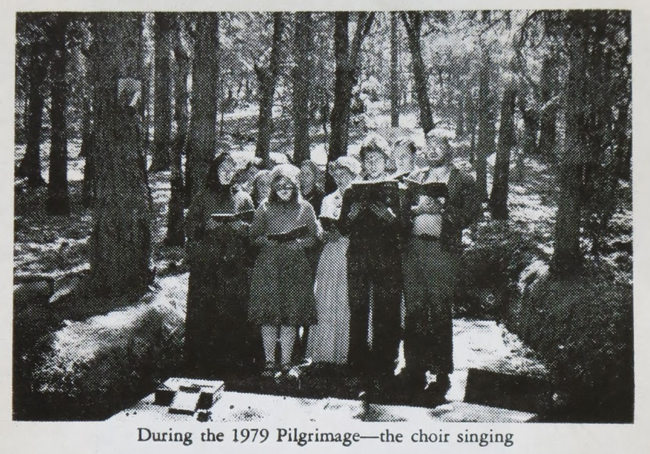
With God’s help the St. Herman Pilgrimage this year was quite concentrated and fruit-bearing. The first weekend was followed by a weeklong course in basic Orthodox theology, culminating in the baptisms of two new converts on rhe “graduation day,” which was the eve of our Lord’s Transfiguration.
Preceding the feast day of St. Herman’s canonization (July 27/August 9) there were celebrated the customary services: Ninth Hour, Small Vespers and Compline, followed by supper in the monastery trapeza, and then the All-night Vigil service, according to Russian usage but served and sung entirely in English. In the morning, to the ringing of the church bells, His Grace Bishop Nektary of Seattle arrived, and the pontifical Liturgy proceeded with the usual inspiring solemnity. Besides the monastery clergy, the newly-ordained priest, Father Alexey Young, concelebrated; he had been ordained in this very church earlier this year and had served his first Liturgy here the following day, on the Sunday of the Myrrh-bearing Women and Sts. Joseph of Arimathea and Nikodemos—very appropriately for Father Alexey, who publishes the well-known Orthodox periodical Nikodemos. The service ended with a procession of banners, icons, and the large coffin-like reliquary of St. Herman, which contains also the holy relics of many other great saints, including St. Panteleimon, whose feast is also celebrated on this day.
During the meal after the Liturgy, the Life of St. Herman was read by a Jordanville seminarian, Br. Thomas Anderson, after which Bishop Nektary recounted a brief and touching incident in the life of a new martyr, Father Nikon of Optina, whom he knew well from his childhood days in Optina Monastery.
Orthodox Christians Facing the 1980’s
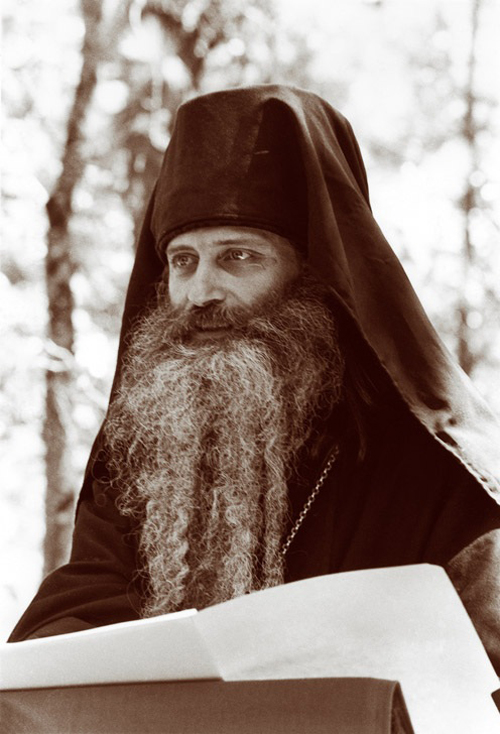
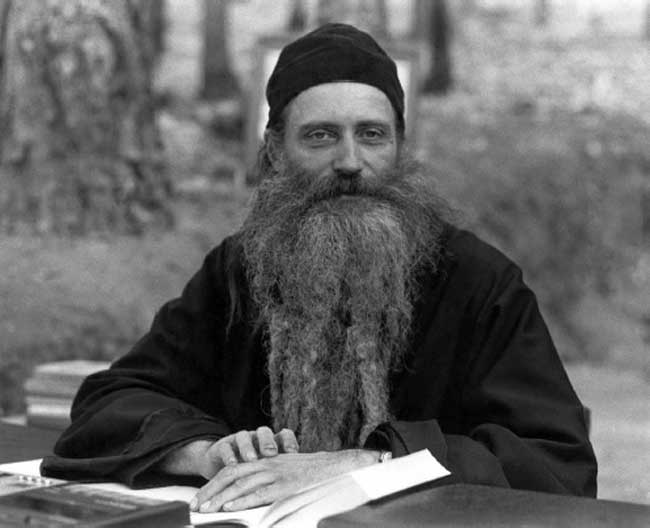
The main purpose of Hieromonk Seraphim’s talk was to make Orthodox Christians aware of the times in which they live and prepare them to make a true Christian response to the problems of these times.
After an introduction in which he set forth the warnings of two 19th-century Orthodox prophets of our present critical situation—Bishop Theophan the Recluse and St. John of Kronstadt—Fr. Seraphim gave a brief diagnosis of the present state of mankind: in the secular world, the running down of modern technological and economic “progress” in the numerous “crises” of our days in energy, strikes and violence in the free world, terror and slavery in the communist world, and the literal “monsters” being produced by scientific experiments; in religion, the enormous proportions already taken by the charismatic and occult revivals which have established contact with a “spiritual” world that is remote from real Christianity.
On the basis of this diagnosis, he then made a prognosis for the decade ahead: Communism, if nothing stops it, will spread to the rest of the world, it being the most obvious sign of the spiritual emptiness of contemporary mankind. However, Communism by itself, because it has no believable ideology, cannot unify the world but can only unleash a terrible time of wars and disorders such as the world has never seen (the recent Chinese-Vietnamese-Cambodian conflict and literal genocide being already a preview of this). To prepare spiritually to face the challenge of Communism we must learn to value and make use of the precious freedom which has been given us as our special talent; we must recognize the reality of Communism, not primarily as a political system but as a spiritual plague of our times, and in the face of its closeness deepen our own spiritual awareness and life; we must become informed of the foundations of our Orthodox faith, which is the answer to Communism, and make maximum use of the books (Scripture, lives of Saints, Holy Fathers) which may be taken away from us soon, learning the living wisdom which they contain and which will enable us to be witnesses of Christ even under Communism; we should become informed of how Christians are living now under Communism, especially in Russia, both in order to be able to help them and in order to learn from them how to survive in such conditions. A number of periodicals and bulletins were displayed as a sample of how easy it actually is today to be informed about life under Communist rule (The Orthodox Monitor, Religion in Communist Dominated Countries, Keston News Service, Aid to the Russian Church, the publications of Pastor Wurmbrand, etc.).
The second reality facing us in the years ahead, the speaker continued, is the rapid spread of the non-Christian religious experiences, which have produced the increasingly spectacular “paranormal” or “miraculous” phenomena of our days. This is another sign of the spiritual emptiness of our times, and it is trying to give a “spiritual” foundation for the “one world” of tomorrow (something that Communism cannot offer). Many of these “paranormal” phenomena are bound up with the activity of demons, which has become more open now that at any time in modern history, and this increasingly bold demonic activity will undoubtedly be one of the major characteristics of the 1980’s. The frightful massacre at Jonestown, where the cult leader claimed to receive instructions from “discarnate entities” in outer space, is probably only the beginning of the spectacular “religious” events of the 1980’s.
But even this increasing activity of demons has its positive side, Fr. Seraphim emphasized: the very boldness of this activity can awaken men to the reality of the demonic world and therefore arouse Christians to spiritual vigilance and struggle and bring unbelievers to Christ.
Next, the speaker discussed the specific situation of the Orthodox Church now and in the years just ahead. The first and most obvious characteristic of the Orthodox world today is the spirit of worldliness which has led to the gradual diluting and “modernizing” of Orthodox attitudes and practice and the loss of the sense of difference between Orthodoxy and heterodoxy. The offspring of this spirit, the ecumenical movement, may well reach its goal in the 1980’s: the union with Rome and other Western confessions-a union not in the truth, but on the basis of compromises in faith and on a “common Christianity” born of human reason and not of Christ. Our practical response to the ecumenical movement has been laid down for us by the bishops of our Russian Church Outside of Russia: we do not participate in this movement, and our Metropolitan has warned the bishops of the other Orthodox Churches of the disastrous results of their ecumenical course if they continue it; our position to some extent isolates us from the other Orthodox Churches, but at the same time our bishops have refused to cut off all contact and communion with them. But thus our Russian Church Abroad has suffered attacks both from the “left” side and the “right”: on the “left,” Orthodox ecumenists accuse us of being “uncharitable” and “behind the times” for not relaxing our Orthodox standards to keep up with the liberal current of the times; and on the “right” side, some extreme groups think we are as bad as the ecumenists because we refuse to declare all other Orthodox Churches to be already fallen and without the grace of God. The question of “strictness” in Orthodoxy has already produced schism after schism among the old calendarist Churches of the Greek-speaking world, and one old-calendar bishop[1] (who belongs to the most moderate group) speaks openly of the “correctness disease” which has caused incalculable harm to Orthodoxy in Greece: when people quote canons, Fathers, the Typicon, without love and tolerance and awareness of their own shortcomings, but solely in order to prove they are “correct” and everyone else is wrong. This can be a temptation to American and European converts to Orthodoxy also: with our calculating, rationalistic minds, we can easily think we are being zealous and strict, when actually we are only indulging our passion for self-righteousness; and uncharitable criticism.
A more positive characteristic of Orthodoxy today is the movement of conversion to Orthodoxy which will undoubtedly become greater in the decade ahead as Western people find out about the Orthodox Church and come to her, fleeing from the modernism of the Western confessions, from the demonic world of occultism, or simply from unbelief. The Orthodox missionary movement in the West will probably remain comparatively small, but Orthodoxy in black Africa has become a major movement, attracting many thousands of converts in Uganda, Kenya, Tanzania, Zaire, and ocher African countries. Orthodoxy in Africa has a simplicity often lacking in our “complicated” American and European converts; the speaker read a letter recently received from Uganda which revealed something of the heartfelt fervor of these new Christians[2].
Another positive aspect of Orthodoxy today, and one that will probably occupy the center of Orthodox attention in the 1980’s, is the religious revival in Russia. No one can now doubt the reality of this revival—thousands of adult converts are being baptized in the Orthodox Church, and there is even a strong movement of sympathy for the Orthodox· monarchy, part of the return of the Russian people to its own roots. Of course, there is much that is not Orthodox in this revival also: many Protestant groups are growing, and among some of the Orthodox there is a movement of renovationism close in spirit to the “Living Church” of the 1920’s, and the books of the emigre modernists (Berdyaev, Bulgakov, etc.) are widely read. Therefore, one cannot say for certain that we are seeing the beginning of the true restoration of Orthodoxy in Russia which some 19th-century prophets have foreseen as occurring just before the end of the world.
Nevertheless, in the truly Orthodox voices of Russia we can find something most instructive and inspiring for us in the free world. Nobody speaks so directly to the believing Orthodox heart today as Fr. Dimitry Dudko, and his message is addressed as much to Orthodox Christians abroad as to his fellow Russians. He has no general “answers” to the terrible spiritual problems facing Russia and the world-in particular, the damage done to the human soul by atheism and unbelief, and the betrayal of the Christian conscience by the “official” church leadership in Russia-but when he says that we must stand at Golgotha with the crucified Christ, his words have a power and convincingness lacking in most Orthodox teachers today. Leaving the West its “spirituality with comfort,” he calls on the Orthodox people to bring spiritual fruits from their terrible sufferings and from the blood of their martyrs.
His words are a trumpet call, not only to his fellow Russians, but to all of us Orthodox Christians in the free world, who are indeed far too satisfied and “comfortable” with our feeble Christianity. Are we content to have beautiful churches and chanting; do we perhaps boast that we keep the fasts and the church calendar, have “good icons” and “congregational singing,” that we give to the poor and perhaps tithe to the Church? Do we delight in exalted patristic teachings and theological discussions without having in our hearts the simplicity of Christ and true compassion for the suffering?—then ours is a “spirituality with comfort,” and we will not have the spiritual fruits that will be exhibited by those without all these “comforts” who deeply suffer and struggle for Christ. The recovery of faith in Russia by men like Fr. Dimitry is probably the most alive thing in the Orthodox world today, and it can inspire us to treasure our own faith all the more and increase the talent which God has given us to speak the truth of Orthodoxy in freedom.
In conclusion, the speaker described the approaching 1980’s as a “pre-apocalyptic” period, in that the tendencies he sees there are those we should expect to see completed with the corning of Antichrist and the end of this world. He set as the most important task before Orthodox Christians today the Christian enlightenment of ourselves and others by drinking deeply of the Orthodox sources, becoming aware of the struggles and sufferings of our fellow Orthodox today, and learning to see how God acts in our lives. Many, even in this time of false religions, are thirsting for the truth of Orthodoxy, and if we ourselves have a living and deep Orthodoxy and a conscious Orthodox philosophy of life based on it, we can help to communicate it to them. And only thus can we know the true Christ in our time of deception, and recognize the false Christ (Antichrist) when he appears. We must be Orthodox nor merely intellectually and outwardly, but with our whole heart, which must be warm, loving, and simple; those who are merely “correct” and “orthodox” in externals, but not deeply Christian in heart, will also follow Antichrist. We are all called to be witnesses of the true Christianity which, even in these evil times, exists for the salvation of all mankind.
[1] The Orthodox Word, 1980, Vol. 16, no. 93, July-August, pp. 164-169, 184
[2] Printed in “Letters,” The Orthodox Word, no. 87
Saint Herman Summer Pilgrimage, 1979, The Orthodox Word,1980, vol. 16, no. 2 (91), March-April, p. 52–64.
Pas de commentaire