
Costa Deir took the mike and told us how his heart was burdened for the Greek Orthodox Church. He asked Episcopalian Father Driscoll to pray that the Holy Spirit would sweep that Church as He was sweeping the Catholic Church. While Father Driscoll prayed, Costa Deir wept into the mike. Following the prayer was a long message in tongues and an equally long interpretation saying that the prayers had been heard and the Holy Spirit would blow through and awaken the Greek Orthodox Church… By this time there was so much weeping and calling out that I backed away from it all emotionally… Yet I heard myself saying a surprising thing. ’Some day when we read how the Spirit is moving in the Greek Orthodox Church, let us remember that we were here the moment that it began.’ [1]

Six months after the event here described occurred at an interdenominational “charismatic” meeting in Seattle, Orthodox Christians did indeed begin to hear that the “charismatic spirit” was moving in the Greek Orthodox Church. Beginning in January, 1972, Fr. Eusebius Stephanou’s Logos began to report on this movement, which had begun earlier in several Greek and Syrian parishes in America and now has spread to a number of others, being actively promoted by Fr. Eusebius. After the reader has read the description of this “spirit” from the words of its leading representatives in the pages that follow, he should not find it difficult to believe that in very fact it was evoked and instilled into the Orthodox world by just such urgent entreaties of “interdenominational Christians.” For if one conclusion emerges from this description, it must certainly be that the spectacular present-day “charismatic revival” is not merely a phenomenon of hyper-emotionalism and Protestant revivalism—although these elements are also strongly present—but is actually the work of a “spirit” who can be invoked and who works “miracles.” The question we shall attempt to answer in these pages is: what or who is this spirit? As Orthodox Christians we know that it is not only God Who works miracles; the devil has his own he can and does imitate virtually every genuine miracle therefore attempt in these pages to be careful to try the spirits, whether they are of God[2].
We shall begin with a brief historical background, since no one can deny that the “charismatic revival” has come to the Orthodox world from the Protestant and Catholic denominations, which in turn received it from the Pentecostal sects.
1. The 20th-century Pentecostal Movement
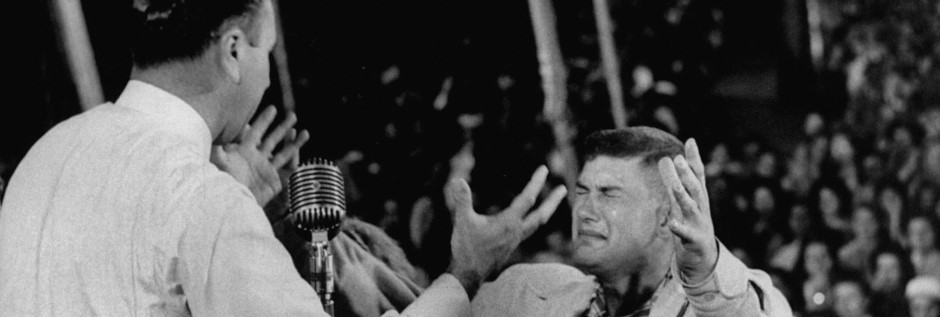
The Modern Pentecostal Movement, although it did have 19th-century antecedents, dates its origin precisely to 7 p.m. on New Year’s Eve of the year 1900. For some time before that moment a Methodist minister in Topeka, Kansas, Charles Parham, as an answer to the confessed feebleness of his Christian ministry, had been concentratedly studying the New Testament with a group of his students with the aim of discovering the secret of the power of Apostolic Christianity. The students finally deduced that this secret lay in the “speaking in tongues” which, they thought, always accompanied the reception of the Holy Spirit in the Acts of the Apostles. With increasing excitement and tension, Parham and his students resolved to pray until they themselves received the “Baptism of the Holy Spirit” together with speaking in tongues. On December 31, 1900, they prayed from morning to night with no success, until one young girl suggested that one ingredient was missing in this experiment: “laying on of hands.” Parham put his hands on the girl’s head, and immediately she began to speak in an “unknown tongue.” Within three days there were many such “Baptisms,” including that of Parham himself and twelve other ministers of various denominations, and all of them were accompanied by speaking in tongues. Soon the revival spread to Texas, and then it had spectacular success at a small Negro church in Los Angeles. Since then it has spread throughout the world and claims ten million members.
For half a century the Pentecostal Movement remained sectarian and everywhere it was received with hostility by the established denominations. Then, however, speaking in tongues began gradually to appear in the denominations themselves, although at first it was kept rather quiet, until in 1960 an Episcopalian priest near Los Angeles gave wide publicity to this fact by publicly declaring that he had received the “Baptism of the Holy Spirit” and spoke in tongues. After some initial hostility, the “charismatic revival” gained the official or unofficial approval of all the major denominations and has spread rapidly both in America and abroad. Even the once rigid and exclusivist Roman Catholic Church now numbers 20,000 American members in its “Catholic Charismatic Renewal” which began in 1967, and in 1969 the American Catholic bishops gave their approval to it.
What can be the reason for such a spectacular success of a “Christian” revival in a seemingly “post- Christian” world? Doubtless the answer lies in two factors: first, the receptive ground which consists of those millions of Christians” who feel that their religion is dry, over-rational, merely external, without fervency or power; and second, the evidently powerful “spirit” that lies behind the phenomena, which is capable, under the proper conditions, of producing a multitude and variety of “charismatic” phenomena, including healing, speaking in tongues, interpretation, prophecy—and, underlying all of these, an overwhelming experience which is called the “Baptism of (or in, or with) the Holy Spirit.”
But what precisely is this “spirit”? Significantly, this question is seldom if ever even raised by followers of the “charismatic revival”; their own “baptismal” experience is so powerful and has been preceded by such an effective psychological preparation in the form of concentrated prayer and expectation, that there is never any doubt in their minds but that they have received the Holy Spirit and that the phenomena they have experienced and seen are exactly those described in the Acts of the Apostles. Too, the psychological atmosphere of the movement is often so one-sided and tense that it is regarded as the very blasphemy against the Holy Spirit to entertain any doubts in this regard. Of the hundreds of books that have already appeared on the movement, only a very few express any even slight doubts as to its spiritual validity.
In order to obtain a better idea of the distinctive characteristics of the “charismatic revival,” let us examine some of the testimonies and practices of its participants, always checking them against the standard of Holy Orthodoxy. These testimonies will be taken, with a few exceptions as noted, from the apologetical books and magazines of the movement, written by people who are favorable to it and who obviously publish only that material which seems to support their position. Further, we shall make only minimal use of narrowly Pentecostal sources, confining ourselves chiefly to Protestant, Catholic, and Orthodox participants in the contemporary “charismatic revival.”
2. The “Ecumenical” Spirit of the “Charismatic Revival”
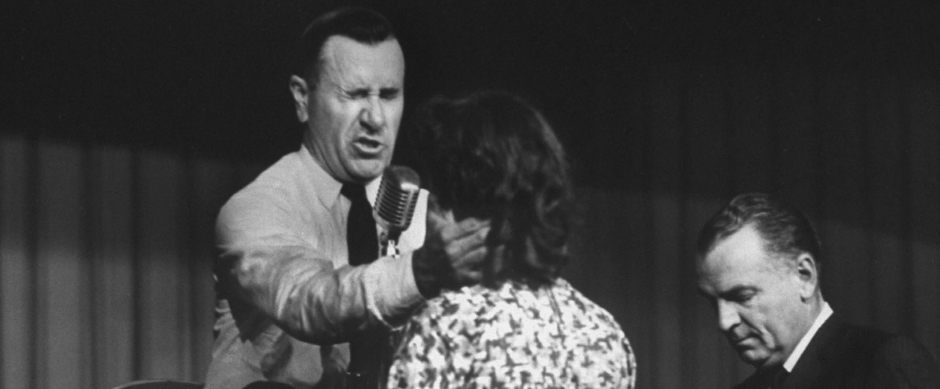
Before quoting the “charismatic” testimonies, we should take note of a chief characteristic of the original Pentecostal movement which is seldom mentioned by “charismatic” writers, and that is, that the number and variety of Pentecostal sects is astonishing, each with its own doctrinal emphasis, and many of them having no fellowship with the others. There are “Assemblies of God,” “Churches of God,” “Pentecostal” and “Holiness” bodies, “Full Gospel” groups, etc., many of them divided into smaller sects. The first thing that one would have to say about the “spirit” that inspires such anarchy is that it certainly is not a spirit of unity, in sharp contrast to the Apostolic Church of the first century to which the movement professes to be returning. Nevertheless, there is much talk, especially in the “charismatic revival” within the denominations in the past decade, of the “unity” which it inspires. But what kind of unity is this?—the true unity of the Church which Orthodox Christians of the first and twentieth centuries alike know, or the pseudo-unity of the Ecumenical Movement, which denies that the Church of Christ exists?
The answer to this question is stated quite clearly by perhaps the leading “prophet” of 20th-century Pentecostalism, David Du Plessis, who for the last twenty years has been actively spreading news of the “Baptism of the Holy Spirit” among the denominations of the World Council of Churches, in answer to a “voice” which commanded him to do so in 1951. “The Pentecostal revival within the churches is gathering force and speed. The most remarkable thing is that this revival is found in the so-called liberal societies and much less in the evangelical and not at all in the fundamentalist segments of Protestantism. The last-mentioned are now the most vehement opponents of this glorious revival because it is in the Pentecostal Movement and in the modernist World Council Movements that we find the most powerful manifestations of the Spirit”[3]. In the Roman Catholic church likewise, the “charismatic renewal” is occurring precisely in “liberal” circles, and one of its results is to inspire even more their ecumenism and liturgical experimentation (“guitar masses” and the like); whereas traditionalist Catholics are as opposed to the movement as are fundamentalist Protestants. Without any doubt the orientation of the “charismatic revival” is strongly ecumenist. A “charismatic” Lutheran pastor, Clarence Finsaas, writes: “Many are surprised that the Holy Spirit can move also in the various traditions of the historic Church … whether the church doctrine has a background of Calvinism or Arminianism, this matters little, proving God is bigger than our creeds and that no denomination has a monopoly on Him” [4]. An Episcopalian pastor, speaking of the “charismatic revival,” reports that “ecumenically it is leading to a remarkable joining together of Christians of different traditions, mainly at the local church level” [5]. The California “charismatic” periodical Inter-Church Renewal is full of “unity” demonstrations such as this one: “The darkness of the ages was dispelled and a Roman Catholic nun and a Protestant could love each other with a strange new kind of love,” which proves that “old denominational barriers are crumbling. Superficial doctrinal differences are being put aside for all believers to come into the unity of the Holy Spirit.” The Orthodox priest Fr. Eusebius Stephanou believes that “this outpouring of the Holy Spirit is transcending denominational lines… The Spirit of God is moving … both inside and outside the Orthodox Church” [6].
Here the Orthodox Christian who is alert to “try the spirits” finds himself on familiar ground, sown with the usual ecumenist cliches. And above all let us note that this new’ “outpouring of the Holy Spirit,” exactly like the Ecumenical Movement itself, arises outside the Orthodox Church; those few Orthodox parishes that are now taking it up are obviously following a fashion of the times that matured completely outside the bounds of the Church of Christ.
And yet we know, as Orthodox Christians, that in the Protestant and Catholic denominations there is no grace of the Holy Spirit, which is given only to those within the Church of Christ. God’s mercy, to be sure, is shown to those outside the Church, as when in the Near East a Moslem receives healing at the relics of an Orthodox saint; and there are many cases of God’s mercy being given abundantly to Catholics, Protestants, and pagans alike, quite apart from their relation to Orthodoxy—the very rains from heaven are one of these mercies. But the gifts and fruits of the Holy Spirit are not revealed in those outside the Church. The great Orthodox Father of the 19th century, Bishop Theophan the Recluse, writes that the gift of the Holy Spirit is given “precisely through the Sacrament of Chrismation, which was introduced by the Apostles in place of the laying on of hands” (which is the form the Sacrament takes in the Acts of the Apostles). “We all—who have been baptized and chrismated—have the gift of the Holy Spirit … even though it is not active in everyone.” The Orthodox Church provides the means for making this gift active, and “there is no other path… Without the Sacrament of Chrismation, just as earlier without the laying on of hands of the Apostles, the Holy Spirit has never descended and never will descend.” [7]
To be sure, the Orthodox “Pentecostals” emphasize that their own experience of what is elsewhere called the “Baptism of the Holy Spirit” is not a sacrament, but rather an “infilling” or “greater measure of the Holy Spirit,” and they “seek nothing more than a return to our faith as a living, personal experience,” and they believe that they “are discovering what Orthodox faith and spirituality are all about” {Logos, April, 1972, p. 10). And yet they cannot deny that their experience is the same as the Protestant and Catholic “charismatic” experience, and they admit that they “are forced to behold spiritual victories among the heterodox in the life of prayer, devotion to the ’sacraments,’ ” etc. {Logos, April, 1972, p. 9). Another Orthodox “Pentecostal” writes: “We realized that so many of our Christian brothers of other denominations were deeply moved by the development of the Charismatic movement because they were now making the Holy Spirit a real force in their lives. Their faith was renewed with the heavenly Grace of that Spirit, just as ours would be” {Logos, March, 1972, p. 16).
And indeed, as one “charismatic” Protestant notes, “Catholics and Protestants alike find themselves inspired with fresh zeal for the sacraments, the worship, the practice of their own denominations” (Williams, p. 15). Here, under the guise of a better Catholicism, a better Protestantism, and even a better Orthodoxy, a certain “unity” emerges among all “Christians”; but what a strange “unity” for an Orthodox Christian to find himself in a unity that involves an almost complete relativism of doctrine and practice. As a consequence, “charismatic” ecumenism is even more unrestrained than professional denominational ecumenism. One “charismatic” Presbyterian minister declares that he has “concelebrated” at a Catholic Mass, an Episcopalian Eucharist, and a Pentecostal communion service, the latter together with a Catholic priest (Williams, p. 45); and one Catholic Pentecostal states openly: “The Lord is baptizing us all in His Holy Spirit and he is not stopping first to ask if we’re Catholics, Protestants, or unchurched… He doesn’t want us wasting our energies in attempting to convert one another to our denominational traditions” (Fr. Joseph Orsini, in Logos Journal, Jan.-Feb., 1972, p. 18).
In a word, the orientation of the “charismatic revival” may be described as one of a new and deeper or “spiritual” ecumenism: each Christian “renewed” in his own tradition, but at the same time strangely united (for it is the same experience’) with others equally “renewed” in their own traditions, all of which contain various degrees of heresy and impiety! This relativism leads also to openness to completely new religious practices, as when an Orthodox priest allows laymen to “lay hands” on him in front of the Royal Gates of an Orthodox church (Logos, April, 1972, p. 4). The end of all this is the super-ecumenist vision of the leading Pentecostal “prophet,” who says that many Pentecostals “began to visualize the possibility of the Movement becoming the Church of Christ in the closing days of time. However, this situation has completely changed during the past ten years. Many of my brethren are now convinced that the Lord Jesus Christ, the head of the Church, will pour out His Spirit upon all flesh and that the historic churches will be revived or renewed and then in this renewal be united by the Holy Spirit” (Du Plessis, p. 33). Clearly, there is no room in the “charismatic revival” for those who believe that the Orthodox Church is the Church of Christ. It is no wonder that even some Orthodox Pentecostals admit that in the beginning they were “suspicious of the Orthodoxy” of this movement (Logos, April, 1972, p. 9).
But now let us begin to look beyond the ecumenistic theories and practices of Pentecostal ism to that which really inspires and gives strength to the “charismatic revival”: the actual experience of the power of the “spirit.”
3. “Speaking in Tongues”
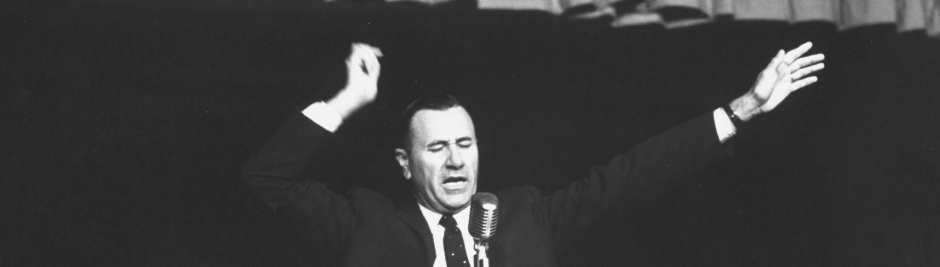
If we look carefully at the writings of the “charismatic revival,” we shall find that this movement closely resembles many sectarian movements of the past in basing itself primarily or even entirely on one rather bizarre doctrinal emphasis or religious practice. The only difference is that the emphasis now is placed on a specific point which no sectarians in the past regarded as so central: speaking in tongues.
According to the constitution of various Pentecostal sects, “the Baptism of believers in the Holy Ghost is witnessed by the initial physical sign of speaking with other tongues” [8]. And not only is this the first sign of conversion to a Pentecostal sect or orientation; according to the best Pentecostal authorities, this practice must be continued or the “spirit” maybe lost. Writes David Du Plessis: “The practice of praying in tongues should continue and increase in the lives of those who are baptized in the Spirit, otherwise they may find that the other manifestations of the Spirit come seldom or stop altogether” [9]. Many testify, as does one Protestant, that tongues “have now become an essential accompaniment of my devotional life” [10]. And a Roman Catholic book on the subject, more cautiously, says that of the “gifts of the Holy Spirit” tongues “is often but not always the first received. For many it is thus a threshold through which one passes into the realm of the gifts and fruits of the Holy Spirit” [11].
Here already one may note an overemphasis that is certainly not present in the New Testament, where speaking in tongues has a decidedly minor significance, serving as a sign of the descent of the Holy Spirit on the Day of Pentecost[12] and on two other occasions (Acts 10[13] and 19[14]). After the first or perhaps the second century there is no record of it in any Orthodox source, and it is not recorded as occurring even among the great Fathers of the Egyptian desert, who were so filled with the Spirit of God that they performed numerous astonishing miracles, including raising the dead. The Orthodox attitude to genuine speaking in tongues, then, may be summed up in the words of Blessed Augustine[15]: “In the earliest times the Holy Spirit jell upon them that believed, and they spake with tongues which they had not learned, as the Spirit gave them utterance. These were signs adapted to the time. For it was fitting that there be this sign of the Holy Spirit in all tongues to show that the Gospel of God was to run through all tongues over the whole earth. That was done for a sign, and it passed away.” And as if to answer contemporary Pentecostals with their strange emphasis on this point, Augustine continues: “Is it now expected that they upon whom hands are laid, should speak with tongues? Or when we imposed our hand upon these children, did each of you wait to see whether they would speak with tongues? And when he saw that they did not speak with tongues, was any of you so perverse of heart as to say ’These have not received the Holy Spirit’?”
Modern Pentecostals, to justify their use of tongues, refer most of all to St. Paul’s First Epistle to the Corinthians (chs. 12–14). But St. Paul wrote this passage precisely because “tongues” had become a source of disorder in the Church of Corinth; and even while he does not forbid them, he decidedly minimizes their significance. This passage, therefore, far from encouraging any modern revival of “tongues,” should on the contrary discourage it—especially when one discovers (as Pentecostals themselves admit) that there are other sources of speaking in tongues besides the Holy Spirit! As Orthodox Christians we already know that speaking in tongues as a true gift of the Holy Spirit cannot appear among those outside the Church of Christ; but let us look more closely at this modern phenomenon and see if it possesses characteristics that might reveal from what source it does come.
If we are already made suspicious by the exaggerated importance accorded to “tongues” by modern Pentecostals, we should be completely awakened about them when we examine the circumstances in which they occur.
Far from being given freely and spontaneously, without man’s interference—as are the true gifts of the Holy Spirit—speaking in tongues can be caused to occur quite predictably by a regular technique of concentrated group “prayer” for it accompanied by psychologically suggestive Protestant hymns (“He comes! He comes!”), culminating in a “laying on of hands,” and sometimes involving such purely physical efforts as repeating a given phrase over and over again[16], or just making sounds with the mouth. One person admits that, like many others, after speaking in tongues “I often did mouth nonsense syllables in an effort to start the flow of prayer-in-tongues” [17]; and such efforts, far from being discouraged, are actually advocated by Pentecostals. “Making sounds with the mouth is not ’speaking-in-tongues,’ but it may signify an honest act of faith, which the Holy Spirit will honor by giving that person the power to speak in another language” [18]. Another Protestant pastor says: “The initial hurdle to speaking in tongues, it seems, is simply the realization that you must ’speak forth’… The first syllables and words may sound strange to your ear. They may be halting and inarticulate. You may have the thought that you are just making it up. But as you continue to speak in faith… the Spirit will shape for you a language of prayer and praise” [19]. A Jesuit “theologian” tells how he put such advice into practice: “After breakfast I felt almost physically drawn to the chapel where I sat down to pray. Following Jim’s description of his own reception of the gift of tongues, I began to say quietly to myself ’La, la, la, la. » To my immense consternation there ensued a rapid movement of tongue and lips accompanied by a tremendous feeling of inner devotion” [20].
Can any sober Orthodox Christian possibly confuse these dangerous psychic games with the gifts of the Holy Spirit?! There is clearly nothing whatever Christian, nothing spiritual here in the least. This is the realm, rather, of psychic mechanisms which can be set in operation by means of definite psychological or physical techniques, and “speaking in tongues” would seem to occupy a key role as a kind of “trigger” in this realm. In any case, it certainly bears no resemblance whatever to the spiritual gift described in the New Testament, and if anything is much closer to shamanistic “speaking in tongues” as practiced in primitive religions, where the shaman or witch doctor has a regular technique for going into a trance and then giving a message to or from a “god” in a tongue he has not learned.[21] In the pages that follow we shall encounter “charismatic” experiences so weird that the comparison with shamanism will not seem terribly far-fetched, especially if we understand that primitive shamanism is but a particular expression of a “religious” phenomenon which, far from being foreign to the modern West, actually plays a significant role in the lives of some contemporary “Christians”: mediumism.
4. “Christian” Mediumism
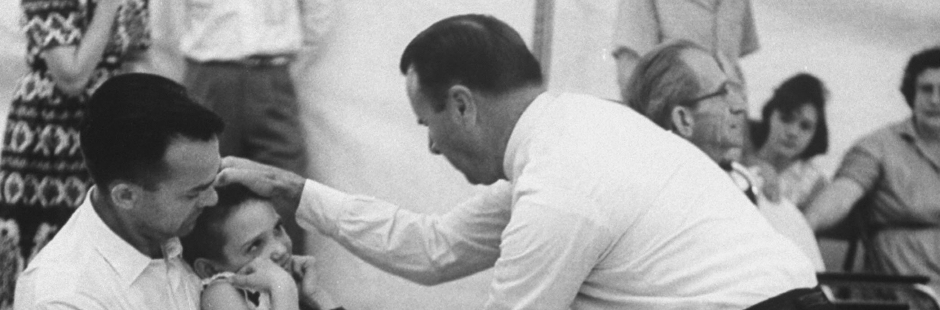
One careful and objective study of “speaking in tongues” has been made by the German Lutheran pastor, Dr. Kurt Koch[22]. After examining hundreds of examples of this “gift” as manifested in the past few years, he came to the conclusion, on scriptural grounds, that only four of these cases might be the same as the gift described in the Acts of the Apostles; but he was not sure of any of them. The Orthodox Christian, having the full patristic tradition of the Church of Christ behind him, would be more strict in his judgment than Dr. Koch. As against these few possibly positive cases, however, Dr. Koch found a number of cases of undoubted demonic possession—for “speaking in tongues” is in fact a common “gift” of the possessed. But it is in Dr. Koch’s final conclusion that we find what is perhaps the clue to the whole movement. He concludes that the “tongues” movement is not at all a “revival, for there is in it little repentance or conviction of sin, but chiefly the search for power and experience; the phenomenon of tongues is not the gift described in the Acts, nor is it (in most cases) actual demonic possession; rather, “it becomes more and more clear that perhaps over 95% of the whole tongues movement is mediumistic in character”.[23]
What is a ‘medium’? A medium is a person with a certain psychic sensitivity which enables him to be the vehicle or means for the manifestation of unseen forces or beings (where actual beings are involved, as Starets Ambrose of Optina has clearly stated[24], these are always the fallen spirits whose realm this is, and not the ‘spirits of the dead’ imagined by spiritists). Almost all non-Christian religions make large use of mediumistic gifts, such as clairvoyance, hypnosis, ‘miraculous’ healing, the appearance and disappearance of objects as well as their movement from place to place, etc.
It should be noted that several similar gifts have also been possessed by Orthodox saints—but there is an immense difference between the true Christian gift and its mediumistic imitation. The true Christian gift of healing, for example, is given by God directly in answer to fervent prayer, and especially at the prayer of a man who is particularly pleasing to God, a righteous man or saint[25], and also through contact in faith with objects that have been sanctified by God (holy water, relics of saints, etc.; see Acts 19 12[26], 2 Kings 13 21[27]). But mediumistic healing, like any other mediumistic gift, is accomplished by means of certain definite techniques and psychic states which can be cultivated and brought into use by practice, and which have no relation whatever either to sanctity or to the action of God. The mediumistic ability may be acquired either by inheritance or by transference through contact with someone who has the gift, or even through the reading of occult books.[28]
Many mediums claim that their powers are not at all supernatural, but come from a part of nature about which very little is known. To some ex- tent this is doubtless true; but it is also true that the realm from which these gifts come is the special realm of the fallen spirits, who do not hesitate to use the opportunity afforded by the people who enter this realm to draw them into their own nets, adding their own demonic powers and manifestations in order to lead souls to destruction. And whatever the explanation of various mediumistic phenomena may be, God in His Revelation to mankind has strictly forbidden any contact with this occult realm:
There shall not he found among thee any one that useth divination, one that practiseth augury, or an enchanter, or a sorcerer, or a charmer, or a consulter with a familiar spirit, or a necromancer. For whosoever doeth these things is an abomination unto the Lord[29].
In practice it is impossible to combine mediumism with genuine Christianity, the desire for mediumistic phenomena or powers being incompatible with the basic Christian orientation toward the salvation of the soul. This is not to say that there are not ‘Christians’ who are involved in mediumism, often unconsciously (as we shall see); it is only to say that they are not genuine Christians, that their Christianity is only a ‘new Christianity’ such as the one Nicholas Berdyaev preached, which will be discussed again below. Dr. Koch, even from his Protestant background, makes a valid observation when he notes:
“A person’s religious life is not harmed by occultism or spiritism. Indeed spiritism is to a large extent a ’religious’ movement. The devil does not take away our ’religiousness’… [But] there is a great difference between being religious and being born again by the Spirit of God. It is sad to say that our Christian denominations have more ’religious’ people in them than true Christians[30].”
The best-known form of mediumism in the modern West is the spiritistic seance, where contact is made with certain forces that produce observable effects such as knockings, voices, various kinds of communications such as automatic writing and speaking in unknown tongues, the moving of objects, and the apparition of hands and ‘human’ figures that can sometimes be photographed. These effects are produced with the aid of definite attitudes and techniques on the part of those present, concerning which we shall here quote one of the standard textbooks on the subject[31].
- Passivity: “A spirit’s activity is measured by the degree of passivity or submissiveness which he finds in the sensitive, or medium.” “Mediumship … may by diligent cultivation be attained by anyone who deliberately yields up his body, with his free will, and sensitive and intellectual faculties, to an invading or controlling spirit.”
- Solidarity in faith: All present must have a “sympathetic attitude of mind in support of the medium”; the spiristic phenomena are “facilitated by a certain sympathy arising from a harmony of ideas, views and sentiment existing between the experimenters and the medium. When this sympathy and harmony, as well as the personal surrender of the will, are wanting in the members of the “circle,” the seance proves a failure.” Also, “the number of experimenters is of great importance. If larger, they impede the harmony so necessary for success.”
- All present ‘join hands to form the so-called magnetic circle. By this closed circuit, each member contributes the energy of a certain force which is collectively communicated to the medium.’ However, the ‘magnetic circle’ is required only in less well-developed mediums. Mme. Blavatsky, the founder of modern ‘theosophy,’ herself a medium, later laughed at the crude techniques of spiritism when she encountered much more powerful mediums in the East, to which category also belongs the fakir described in Part III of this series of articles.
- “The necessary spiritistic atmosphere is commonly induced by artificial means, such as the singing of hymns, the playing of soft music, and even the offering of prayer.”
The spiritistic seance, to be sure, is a rather crude form of mediumism—although for that very reason its techniques are all the more evident—and only rarely docs it produce spectacular results. There are other more subtle forms, some of them going under the name of “Christian.” To realize this one need only look at the techniques of a “faith-healer” such as Oral Roberts (who until joining the Methodist church a few years ago was a minister of the Pentecostal Holiness sect), who causes “miraculous” healings by forming an actual “magnetic circle” composed of people with the proper sympathy, passivity, and harmony of “faith” who put their hands on the television set while he is on the air; the healings can even be brought about by drinking a glass of water that has been placed on the television set and has thus absorbed the flow of mediumistic forces that have been brought into action. But such healings, like those produced by spiritism and witchcraft, can take a heavy toll in later psychic, not to mention spiritual, disorders[32].
In this realm one must be very careful, because the devil is constantly aping the works of God, and many people with mediumistic gifts continue to think they are Christians and that their gifts come from the Holy Spirit. But is it possible to say that this is true of the “charismatic revival”—that it is in fact, as some say, primarily a form of mediumism?
In applying the most obvious tests for mediumism to the “charismatic revival,” one is struck first of all by the fact that the chief prerequisites for the spiritistic seance described above are all present at “charismatic” prayer meetings, whereas not one of these characteristics is present in the same form or degree in the true Christian worship of the Orthodox Church.
- The “passivity” of the spiritistic seance corresponds to what “charismatic” writers call “a kind of letting go… This involves more than the dedication of one’s conscious existence through an act of will; it also refers to a large, even hidden area of one’s unconscious life… All that can be done is to offer the self—body, mind, and even the tongue—so that the Spirit of God may have full possession… Such persons are ready—the barriers are down and God moves mightily upon and through their whole being”.[33] Such a “spiritual” attitude is not that of Christianity; it is rather the attitude of Zen Buddhism, Eastern “mysticism,” hypnosis, and spiritism. Such an exaggerated passivity is entirely foreign to Orthodox spirituality, and is only an open invitation to the activity of deceiving spirits. One sympathetic observer notes that at Pentecostal meetings people speaking in tongues or interpreting “seem almost to go into a trance” [34]. This passivity is so pronounced in some “charismatic” communities that they completely abolish the church organization and any set order of services and do absolutely everything as the “spirit” directs.
- There is a definite “solidarity in faith”—and not merely solidarity in Christian faith and hope for salvation, but a specific unanimity in the desire for and expectation of “charismatic” phenomena. This is true of all “charismatic” prayer meetings; but an even more pronounced solidarity is required for the experience of the “Baptism of the Holy Spirit,” which is usually performed in a small separate room in the presence of only a few who have already had the experience.
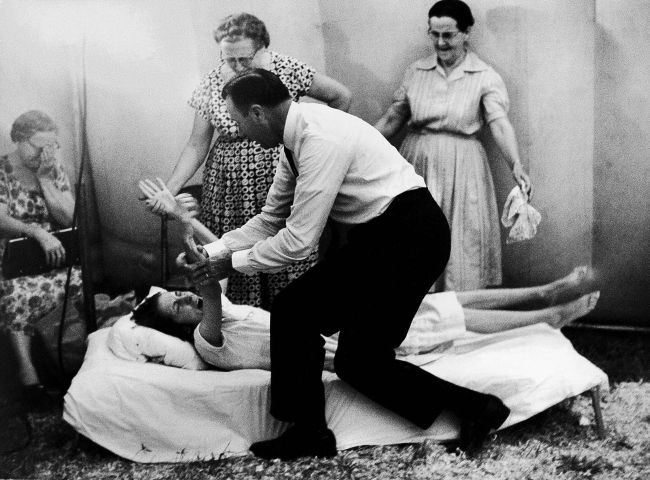
- The spiritistic “magnetic circle” corresponds to the Pentecostal “laying on of hands,” which is always done by those who themselves have already experienced the “Baptism” with speaking in tongues, and who serve, in the words of Pentecostals themselves, as “channels of the Holy Spirit” [35]—a word used by spiritists to refer to mediums.
- The “charismatic,” like the spiritistic, “atmosphere” is induced by means of suggestive hymns and prayers, and often also by hand-clapping, all of which give “an effect of mounting excitement, and almost intoxicating quality” [36].
It may still be objected that all these similarities between mediumism and Pentecostalism are only coincidental; and indeed, in order to show whether or not the “charismatic revival” is actually mediumistic, we shall have to determine what kind of “spirit” it is that is communicated through the Pentecostal “channels.” A number of testimonies by those who have experienced it—and who believe that it is the Holy Spirit—point clearly to its nature. “The group moved closer around me. It was as if they were forming with their bodies a funnel through which was concentrated the flow of the Spirit that was pulsing through the room. It flowed into me as I sat there” [37]. At a Catholic Pentecostal prayer meeting, “upon entering a room one was practically struck dead by the strong visible presence of God” [38].[39] Another man describes his “Baptismal” experience: “I became aware that the Lord was in the room and that He was approaching me. I couldn’t see Him, but I felt myself being pushed over on my back. I seemed to float to the floor…” (Logos Journal, Nov.-Dec., 1971, p. 47). Other similar examples will be given below in the discussion of the physical accompaniments of “charismatic” experience. This “pulsing,” “visible,” “pushing” spirit that “approaches” and “flows” would seem to confirm the mediumistic character of the “charismatic” movement. Certainly the Holy Spirit could never be described in these ways!
And let us recall a strange characteristic of “charismatic” speaking in tongues that we have already mentioned: that it is given not only at the initial experience of the “Baptism of the Holy Spirit,” but is supposed to be continued (both in private and public) and become an “essential accompaniment” of religious life, or else the “gifts of the Spirit” may cease. One Presbyterian “charismatic” writer speaks of the specific function of this practice in “preparing” for “charismatic” meetings: “Often it is the case that … a small group will spend time ahead praying in the Spirit [i.e., in tongues]. In so doing there is greatly multiplied the sense of God’s presence and power that carries over into the gathering.” And again: “We find that quiet praying in the Spirit during the meeting helps to maintain an openness to God’s presence…” for “after one has become accustomed to praying in tongues aloud … it soon becomes a possibility for one’s breath, moving across vocal chords and tongue, to manifest the Spirit’s breathing, and thereby for prayer to go on quietly, yet profoundly, within” [40]. Let us remember also that speaking in tongues can be triggered by such artificial devices as “making sounds with the mouth”—and we come to the inevitable conclusion that “charismatic” speaking in tongues is not a “gift” at all but a technique, itself acquired by other techniques and in turn triggering still other “gifts of the Spirit,” if one continues to practice and cultivate it. Do we not have here a clue to the chief actual accomplishment of the modern Pentecostal Movement—that it has discovered a new mediumistic technique for entering into and preserving a psychic state wherein miraculous “gifts” become commonplace? If this is true, then the “charismatic” definition of the “laying on of hands”— “the simple ministry by one or more persons who themselves are channels of the Holy Spirit to others not yet, so blessed,” in which “the important thing [is] that those who minister have themselves experienced the movement of the Holy Spirit” [41]—describes precisely the tranference of the mediumistic gift by those who have already acquired it and have themselves become mediums. The “Baptism of the Holy Spirit” thus becomes mediumistic initiation.
Indeed, if the “charismatic revival” is actually a mediumistic movement, much that is unclear about it if it is viewed as a Christian movement, becomes clear. The movement arises in America, which fifty years before had given birth to spiritism in a similar psychological climate: a dead, rationalized Protestant faith is suddenly overwhelmed by actual experience of an invisible “power” that cannot be rationally or scientifically explained. The movement is most successful in those countries which have a substantial history of spiritism or mediumism: America and England first of all, then Brazil, Japan, the Philippines, black Africa. There is scarcely to be found an example of “speaking in tongues” in any even nominally Christian context for over 1600 years after the time of St. Paul, and even then it is an isolated and short-lived hysterical phenomenon precisely until the 20th-century Pentecostal Movement, as the scholarly historian of religious “enthusiasm” has pointed out[42]; and yet this “gift” is possessed by numerous shamans and witch doctors of primitive religions, as well as by modern spiritistic mediums and the demonically possessed. The “prophecies” and “interpretations” at “charismatic” services, as we shall see, are strangely vague and stereotyped in expression, without specifically Christian or prophetic content. Doctrine is subordinated to practice: the motto of both movements might be, as “charismatic” enthusiasts say over and over again, “it works”—the very trap into which, as we have seen[43], Hinduism leads its victims. There can scarcely be any doubt that the “charismatic revival,” as far as its phenomena are concerned, bears a much closer re- semblance to spiritism and in general to non-Christian religion, than it does to Orthodox Christianity. But we shall have yet to give many examples to demonstrate just how true this is.
Up to this point we have been quoting, apart from Dr. Koch’s statements, only from those favorable to the “charismatic revival,” who only give r their testimonies of what they imagine to be the workings of the Holy Spirit. Now let us quote the testimony of several people who have left the “charismatic” movement, or refused to enter it, because they found that the “spirit” that animates it is not the Holy Spirit.
- “In Leicester (England) a young man reported the following. He and his friend had been believers for some years when one day they were invited to the meeting of a tongues speaking group. The atmosphere of the meeting got a hold on them and afterwards they prayed for the second blessing and the baptism of the Holy Spirit. After intensive prayer it was as if something hot came over them. They felt very excited inside. For a few weeks they reveled in this new experience, but slowly these waves of feeling abated. The man who told me this noticed that he had lost all desire to read the Bible and to pray. He examined his experience in the light of the Scriptures and realized that it was not of God. He repented and denounced it… His friend on the other hand continued in these ’tongues’ and it destroyed him. Today he will not even consider the idea of going on further as a Christian”.[44]
- Two Protestant ministers went to a “charismatic” prayer meeting at a Presbyterian church in Hollywood. “Both of us agreed beforehand that when the first person started to speak in tongues, we would pray roughly the following, ’Lord, if this gift is from you, bless this brother, but if it is not of you, then stop it and let there be no other praying in tongues in our presence.’… A young man began the meeting with a short devotion after which it was open for prayer. A woman started to pray fluently in a foreign language without any stammering or hesitation. An interpretation was not given. The Rev. B. and I started to pray quietly as we had agreed earlier. What happened? No one else spoke in tongues although usually in these meetings all of them, except for an architect, pray in unknown tongues” [45]. Note here that in the absence of the mediumistic solidarity of faith, the phenomena do not appear.
- “In San Diego, California, a woman came for counselling. She told me of a bad experience that she had had during a mission held by a member of the tongues movement. She had gone to his meetings in which he had spoken about the necessity of the gift of tongues, and in an after-meeting she had allowed hands to be laid on herself in order to receive the baptism of the Holy Spirit and the gift of speaking in tongues. At that moment she fell down unconscious. On coming round again she found herself lying on the floor with her mouth still opening and shutting itself automatically without a word being uttered. She was terribly frightened. Standing around her were some of the people who were followers of this evangelist and they exclaimed, ‘O sister, you have really spoken wonderfully in tongues. Now you have the Holy Spirit.’ But the victim of this so-called baptism of the Holy Spirit was cured. She never again returned to this group of tongues speakers. When she came to me for advice she was still suffering from the bad after-effects of this ’spiritual baptism’ ”.[46]
- An Orthodox Christian in California relates a private encounter with a “spirit-filled” minister who has shared the same platform with the leading Catholic, Protestant, and Pentecostal representatives of the “charismatic revival”: “For five hours he spoke in tongues and used every artifice (psychological, hypnotic, and ’laying on of hands’) to induce those present to receive the ’baptism of the Holy Spirit.’ The scene was really terrible. When he laid hands on our friend she made gutteral sounds, moaned, wept, and screamed. He was well pleased by this. He said she was suffering for others—interceding for them. When he ’laid hands’ on my head there was a presentiment of real evil. His ’tongues’ were interspersed with English: ’You have the gift of prophecy, I can feel it.’ ’Just open your mouth and it will flow out.’ ’You are blocking the Holy Spirit.’ By the grace of God I kept my mouth shut, but I am quite certain that if I had spoken, someone else would have ’interpreted.’ ” (Private communication.)
- Readers of The Orthodox Word will recall the account of the “prayer-vigil” held by the Syrian Antiochian Archdiocese of New York at its “testify” how the “spirit” was moving them. But several people who were present related later that the atmosphere was “dark and ominous,” “stifling,” “dark and evil,” and by a miraculous intercession of St. Herman of Alaska, whose icon was present in the room, the whole meeting was broken up and the evil atmosphere dispelled[47].
There are numerous other cases in which people have lost interest in prayer, reading the Scriptures, and Christianity in general, and have even come to believe, as one student did, that “he would not need to read the Bible any more. God the Father would himself appear and speak to him”.[48]
We shall yet have occasion to quote the testimony of many people who do not find anything negative or evil in their “charismatic” experience, and we shall examine the meaning of their testimony. However, without yet reaching a conclusion as to the precise nature of the “spirit” that causes “charismatic” phenomena, on the basis of the evidence here gathered we can already agree this far with Dr. Koch: “The tongues movement is the expression of a delirious condition through which a breaking in of demonic powers manifests itself” [49]. That is, the movement, which is certainly “delirious” in giving itself over to the activity of a “spirit” that is not the Holy Spirit, is not Satanic in intention or in itself (as contemporary occultism and satanism certainly are), but by its nature it lays itself particularly open to the manifestation of obvious satanic forces, which do in fact sometimes appear.
As to the precise nature of the “tongues” that are being spoken today, probably no simple answer can be given. We know quite certainly that in Pentecostalism, just as in spiritism, the elements of both fraud and suggestion play no small role, under the sometimes intense pressures applied in “charismatic” circles to force the phenomena to appear. Thus, one member of the largely Pentecostal “Jesus Movement” testifies that when he spoke in tongues “it was just an emotional build-up thing where I mumbled a bunch of words,” and another frankly admits, “When I first became a Christian the people that I was with told me that you had to do it. So I prayed that I could do it, and I went as far as copying off them so they would think that I had the gift” [50]. Some of the supposed “tongues” are thus doubtless not genuine, or at best the product of suggestion under conditions of emotional near-hysteria. However, there are actually documented cases of Pentecostal speaking in an unlearned language (Sherrill, pp. 90–95); there is also the testimony of many concerning the ease and assurance and calmness (without any hysterical conditions at all) with which they can enter into the state of “speaking in tongues”; and there is a distinctly preternatural character in the related phenomenon of “singing in tongues,” where the “spirit” also inspires the melody and many join in to produce an effect that is variously described as “eerie but extraordinarily beautiful” [51] and “unimaginable, humanly impossible” [52]. It would therefore seem evident that no merely psychological or emotional explanation can account for much of the phenomena of contemporary “tongues.” If it is not due to the working of the Holy Spirit—and by now it is abundantly evident that it could not be so—then today’s “speaking in tongues” as an authentic “supernatural” phenomenon can only be the manifestation of a gift of some other spirit.
But to identify this “spirit” more precisely, and to understand the “charismatic” movement more fully, not only in its phenomena but also in its “spirituality,” we shall have to draw more deeply from the sources of Orthodox tradition. And first of all we shall have to return to a teaching of the Orthodox ascetic tradition that has already been discussed in this series of articles, in explanation of the power which Hinduism holds over its devotees: prelest, or spiritual deception.
[1] Pat King, in Logos Journal, Sept.-Oct., 1971, p. 50. This “international charismatic journal” should not be confused with Fr. E. Stephanou’s Logos.
[2] Beloved, believe not every spirit, but try the spirits whether they are of God: because many false prophets are gone out into the world. Hereby know ye the Spirit of God: Every spirit that confesseth that Jesus Christ is come in the flesh is of God: And every spirit that confesseth not that Jesus Christ is come in the flesh is not of God: and this is that spirit of antichrist, whereof ye have heard that it should come; and even now already is it in the world. 1 John 4 1-3
[3] Du Plessis, p. 28 – Most books will be cited in this article only by author and page number; full bibliographical information is supplied at the end of the article.
[4] Christenson, p. 99
[5] Harper, p. 17
[6] Logos, Jan., 1972, p. 12
[7] Bishop Theophan the Recluse, What Is the Spiritual Life, Jordanville, N.Y., 1962, pp. 247-8 (in Russian). Fr. Eusebius Stephanou (Logos, Jan., 1972, p. 13) attempts to justify the present-day ’reception of the Holy Spirit’ outside the Church by citing the account of the household of Cornelius the Centurion (Acts 10), which received the Holy Spirit before baptism. But the difference in the two cases is crucial: the reception of the Holy Spirit by Cornelius and his household was the sign that they should be joined to the Church by Baptism, whereas contemporary Pentecostals by their experience are only confirmed in their delusion that there is no one saving Church of Christ.
[8] Sherrill, p. 79
[9] Du Plessis, p. 89
[10] Lillie, p. 50
[11] Ranaghan, p. 19
[12] And when the day of Pentecost was fully come, they were all with one accord in one place. And suddenly there came a sound from heaven as of a rushing mighty wind, and it filled all the house where they were sitting. And there appeared unto them cloven tongues like as of fire, and it sat upon each of them. And they were all filled with the Holy Ghost, and began to speak with other tongues, as the Spirit gave them utterance. And there were dwelling at Jerusalem Jews, devout men, out of every nation under heaven. Now when this was noised abroad, the multitude came together, and were confounded, because that every man heard them speak in his own language. And they were all amazed and marvelled, saying one to another, Behold, are not all these which speak Galilaeans? And how hear we every man in our own tongue, wherein we were born? Parthians, and Medes, and Elamites, and the dwellers in Mesopotamia, and in Judaea, and Cappadocia, in Pontus, and Asia, Phrygia, and Pamphylia, in Egypt, and in the parts of Libya about Cyrene, and strangers of Rome, Jews and proselytes, Cretes and Arabians, we do hear them speak in our tongues the wonderful works of God. And they were all amazed, and were in doubt, saying one to another, What meaneth this? Others mocking said, These men are full of new wine. But Peter, standing up with the eleven, lifted up his voice, and said unto them, Ye men of Judaea, and all ye that dwell at Jerusalem, be this known unto you, and hearken to my words: For these are not drunken, as ye suppose, seeing it is but the third hour of the day. But this is that which was spoken by the prophet Joel; And it shall come to pass in the last days, saith God, I will pour out of my Spirit upon all flesh: and your sons and your daughters shall prophesy, and your young men shall see visions, and your old men shall dream dreams: And on my servants and on my handmaidens I will pour out in those days of my Spirit; and they shall prophesy: And I will shew wonders in heaven above, and signs in the earth beneath; blood, and fire, and vapour of smoke: The sun shall be turned into darkness, and the moon into blood, before that great and notable day of the Lord come: And it shall come to pass, that whosoever shall call on the name of the Lord shall be saved. Acts 2 1-21
[13] The word which God sent unto the children of Israel, preaching peace by Jesus Christ: (he is Lord of all:) That word, I say, ye know, which was published throughout all Judaea, and began from Galilee, after the baptism which John preached; How God anointed Jesus of Nazareth with the Holy Ghost and with power: who went about doing good, and healing all that were oppressed of the devil; for God was with him. And we are witnesses of all things which he did both in the land of the Jews, and in Jerusalem; whom they slew and hanged on a tree: Him God raised up the third day, and shewed him openly; Not to all the people, but unto witnesses chosen before of God, even to us, who did eat and drink with him after he rose from the dead. And he commanded us to preach unto the people, and to testify that it is he which was ordained of God to be the Judge of quick and dead. To him give all the prophets witness, that through his name whosoever believeth in him shall receive remission of sins. While Peter yet spake these words, the Holy Ghost fell on all them which heard the word. And they of the circumcision which believed were astonished, as many as came with Peter, because that on the Gentiles also was poured out the gift of the Holy Ghost. For they heard them speak with tongues, and magnify God. Then answered Peter, Can any man forbid water, that these should not be baptized, which have received the Holy Ghost as well as we? And he commanded them to be baptized in the name of the Lord. Then prayed they him to tarry certain days. Acts 10 36-48
[14] And it came to pass, that, while Apollos was at Corinth, Paul having passed through the upper coasts came to Ephesus: and finding certain disciples, He said unto them, Have ye received the Holy Ghost since ye believed? And they said unto him, We have not so much as heard whether there be any Holy Ghost. And he said unto them, Unto what then were ye baptized? And they said, Unto John’s baptism. Then said Paul, John verily baptized with the baptism of repentance, saying unto the people, that they should believe on him which should come after him, that is, on Christ Jesus. When they heard this, they were baptized in the name of the Lord Jesus. And when Paul had laid his hands upon them, the Holy Ghost came on them; and they spake with tongues, and prophesied. And all the men were about twelve. Acts 19 1-7
[16] Koch, p. 24
[17] Sherrill, p. 127
[18] Harper, p. 11
[19] Christenson, p. 130
[20] Gelpi, p. 1
[21] See Burdick, pp. 66–67.
[22] The Strife of Tongues
[23] Koch, p. 35
[24] V. P. Bykov, Tikhie Priyuty, Moscow, 1913, pp. 168–170
[25] Is any among you afflicted? let him pray. Is any merry? let him sing psalms. Is any sick among you? let him call for the elders of the church; and let them pray over him, anointing him with oil in the name of the Lord: And the prayer of faith shall save the sick, and the Lord shall raise him up; and if he have committed sins, they shall be forgiven him. Confess your faults one to another, and pray one for another, that ye may be healed. The effectual fervent prayer of a righteous man availeth much. Elias was a man subject to like passions as we are, and he prayed earnestly that it might not rain: and it rained not on the earth by the space of three years and six months. And he prayed again, and the heaven gave rain, and the earth brought forth her fruit. Brethren, if any of you do err from the truth, and one convert him; Let him know, that he which converteth the sinner from the error of his way shall save a soul from death, and shall hide a multitude of sins. James 5 13-20
[26] And God wrought special miracles by the hands of Paul: So that from his body were brought unto the sick handkerchiefs or aprons, and the diseases departed from them, and the evil spirits went out of them. Then certain of the vagabond Jews, exorcists, took upon them to call over them which had evil spirits the name of the Lord Jesus, saying, We adjure you by Jesus whom Paul preacheth. Acts 19 11-13
[27] And Elisha died, and they buried him. And the bands of the Moabites invaded the land at the coming in of the year. And it came to pass, as they were burying a man, that, behold, they spied a band of men; and they cast the man into the sepulchre of Elisha: and when the man was let down, and touched the bones of Elisha, he revived, and stood up on his feet. 2 Kings 13 20-21
[28] See Kurt Koch, Occult Bondage and Deliverance, Kregel Publications, Grand Rapids, Mich., 1970, pp. 38–57, for examples of mediumism.
[29] Deut. 18 10-12; see also Lev. 20 6
[30] Kurt Koch, Between Christ and Satan, Kregel Publications, 1962, p. 124. This book and Dr. Koch’s Occult Bondage offer a remarkable confirmation, based on 20th-century experience, of virtually every manifestation of mediumism, magic, sorcery, etc., that is found in the Holy Scriptures and the Orthodox Lives of Saints—the source of all of which, of course, is the devil. On only a few points will the Orthodox reader have to correct his interpretations.
[31] Simon A. Blackmore, S.J., Spiritism Facts and Frauds, Benziger Bros., New York, 1924: chapter TV, ‘Mediums,’ pp. 89–105 passim.
[32] On Oral Roberts see Kurt Koch, Occult Bondage, pp. 52–55.
[33] Williams, pp. 62–63; italics in the original
[34] Sherrill, p. 87
[35] Williams, p. 64
[36] Sherrill, p. 23
[37] Sherrill, p. 122
[38] Ranaghan, p. 79
[39] Compare the ‘vibrant’ atmosphere at some pagan and Hindu rites — The Orthodox Word, 1971, no. 4, pp. 161–162.
[40] Williams, p. 31
[41] Williams, p. 64
[42] Ronald A. Knox, Enthusiasm, A Chapter in the History of Religion, Oxford (Galaxy Book), 1961, pp. 550–551.
[43] The Orthodox Word, 1971, no. 4, p. 156.
[44] Koch, p. 28
[45] Koch, p. 15
[46] Koch, p. 26
[47] The Orthodox Word, 1970, no. 4–5, pp. 196–199
[48] Koch, p. 29
[49] Koch, p. 47
[50] Ortega, p. 49
[51] Sherrill, p. 118
[52] Williams, p. 33

by Saint Seraphim of Platina [†1982]
The Orthodox Word, 1972, Vol. 8, No. 2 (43) March-April, pp. 52-66, 71-95
Pas de commentaire