Baptism
The Baptismal Rite
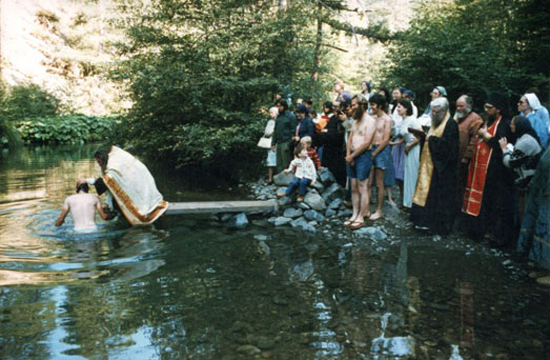
The rite of Baptism consists of a great many ceremonies, which may be divided into five groups or sets:
1.) those which are performed before Baptism, and independently from it
2.) those which may be designated as the preliminaries to Baptism, but are performed at the same time with it
3.) those which constitute Baptism proper
4.) those which belong partly to Baptism, partly to Confirmation
5.) those which follow after Confirmation.
1. Ceremonies performed before Baptism and independently from it.
These are:
a) the prayers for a woman when she has given birth to a child, and
b) the prayer at naming the child.
The Greek and Slavic rituals direct that the prayer for the mother be recited on the first day after the child’s birth, and that at naming the child on the eighth; but it is now customary to recite both at the same time.
a.) The prayers for the mother are three. Their essential features are: petitions for the forgiveness of her sins, for the restoration of her health and the preservation of her life and that of the child to which she has given birth. These prayers are un-accompanied by any ceremonies.
b.) The essential feature of the prayer at the naming of a child consists in the petition offered by the priest after naming it, that the Christian name conferred upon the babe may abide by it, inalienably, and that it may, by living as becometh a Christian, in the observance of God’s commandments, become worthy of inheriting the Kingdom of God. Only two ceremonies accompany this prayer: ono precedes it, the other follows it. Before beginning the prayer, the priest blesses the brow, the lips, and the breast of the infant. After he has recited the prayer, he takes up the babe and raising it in his hands, moves it in front of the holy ikons so as to simulate the sign of the cross, reciting at the same time the Troparion of the Feast of the Presentation of our Lord in the Temple (Candlemas):— “Hail, Virgin Mother of God, full of grace!, for from thee shone forth the Sun of righteousness, Christ our God.” All these ceremonies, viz: the blessing of the babe by the priest in the name of the Father, and of the Son, and of the Holy Ghost,—the giving to it of a Christian name, the motion in the shape of the cross imparted to the child’s body by the priest’s hands before the holy ikons,—all these signify one common thought, namely that the child lately born in a Christian family, although not as yet a Christian, because not yet baptized, is already separated, taken out, from the midst of, let us say, heathens, Jews, and Mohammedans, who do not recognize the One God in Three Persons, nor pay reverence to holy ikons, do not bear Christian names, nor receive the protection of priestly blessing.
A newborn child in a Christian Orthodox family is usually given the name of some Saint, who, from that moment, becomes his special guardian and protector and intercedes for him in his prayers before God. Therefore a name should never be mutilated or distorted, nor should unusual names be given, or such as lend themselves to mispronunciation. And names in general use should not be altered at will, or, especially, pronounced in some diminutive form, expressive of anger or contempt towards the bearer of the name. I will not even mention how indecent and wrong it is to give Christian names to animals, as some foolish persons sometimes do. But there is of course no objection to the use of diminutives as pet names and expressions of endearment.
What names should be given to new-born babes is not specified by any canonical rule. In the Slavic rituals and the Greek Euchologies it is only said that the name of a Saint is given, whose memory is celebrated by the Church on the eighth day after the infant’s birth. In South-Western Russia they are fond of naming the child for the Saint whose feast falls on the day of its birth, because birth is so important an act in a child’s life that we should thank God for the favor of awarding to it the name of the Saint under whose auspices it was born. In Great Russia they prefer the names of those saints whose memory is celebrated on the day of baptism, for the reason that every man knows the day of his birth, but the day of baptism can be recalled only by associating it with the saint on whose day it took place. In Bulgaria there is a predilection for the names of grandparents. It seems best to leave the choice of a name to the babe’s parents, especially to the mother, who should be asked to what saint she prayed more particularly through all the months preceding the child’s birth, or on the very day of its birth.
2. Ceremonies preliminary to Baptism, but performed at the same time with it.
The preliminaries to Baptism, according to the rulings of the Orthodox Church, are the following:
a) the Rite of Reception among the Catechumens
b) the Renunciation of the Devil
c) the Joining to Christ.
a) The custom of receiving a neophyte among the Catechumens is based, beyond all doubt, on the words of Christ: “Go ye, and teach all nations”, and “he that believeth and is baptized shall be saved”. It follows that it behoveth first to teach a person the dogmas of the faith and only then to baptize him. Accordingly we see in the practice of the Apostolic Church, among other instances, that the holy Apostle Philip first preached Christ’s teaching in Samaria, and only then “they were baptized, both men and women”[1], and therefore reception among the Catechumens, in some form or other, appears to have existed in all Christian communities. In the early Church Catechumens remained in this stage not less than 40 days, which term was shortened only for sick persons. In Russia it lasted from 8 to 40 days. According to the ritual of the Orthodox Church, this rite is composed of the following ceremonies: the priest breathes thrice in the neophyte’s face and on his breast, blesses him thrice, recites the preliminary prayer, laying his hands on the infant, and the three Exorcisms, after which he again breathes thrice on the infant, uttering the words: “Drive from him every evil and unclean spirit hiding and lurking in his heart”. All these ceremonies are very ancient: it was by breathing, blessing and reciting of prayers that, in the earliest times, the Jews and the heathens who had declared their desire to become Christians, were prepared for the hearing and study of the dogmas of the Orthodox doctrine. Thus the ceremony of breathing is referred to in the 7th ruling of the 1st (Ecumenic Council; those of breathing, blessing and imposition of hands are mentioned by the Blessed Augustine, by St Gregory Theologus [in his book on the Sacraments], and in the Apostolic Ordinances. The ceremony of breathing is motivated as follows: As God, when He had formed the body of the first man of the dust of the ground, “breathed into his nostrils the breath of life, and man became a tiring soul”[2], so when man is regenerated through the Sacrament of Baptism, he, in order to receive the now spiritual life, is first of all breathed upon thrice. Soon after our first parents had been created, the Devil, as we know, tempted them and instigated them to violate the command of God. It is possibly in reference to this that the three Exorcisms are recited—or more correctly, the three prohibitory prayers, in which the priest, in the name of God, forbids the Evil One to touch the Catechumen.
b) The Renunciation of the Devil consists, in our ritual, of four ceremonies: turning the Catechumen and sponsors with their faces to the West.—uttering the formula of renunciation,—blowing,—and spitting. We saw above that the priest, in the name of God, forbids the Evil One to touch the Catechumen. Now he interrogates the Catechumen himself, asking whether he, of his own free will, consents to have no communion whatsoever with him. The renunciation in mentioned, among others, by St. Cyprian, Bishop of Carthage. The Catechumen and his godfather take their stand with their faces to the West, because the Devil, whom the Catechumen directly addresses when he renounces him, is a power of darkness, and his is the Kingdom of darkness: “What communion hath light with darkness? And what concord hath Christ with Belial?”[3]. The formula of renunciation is as follows: the priest asks the Catechumen thrice “Dost thou renounce Satan and all his works, and all his angels, and all his service, and all his pomp?” and the Catechumen each time answers “I do.” Then the priest asks again three times “Hast thou renounced Satan?” and he answers each time “I have”. Lastly, at the priest’s command, “Then blow and spit on him” (i.e. on Satan); he blows and spits down on the ground, as though on Satan. According to the Greek Euchology and our own Ritual, the Catechumen (or his godfather for him), while renouncing Satan, holds his hands slightly uplifted, although this is no longer observed in our church: this attitude indicates bold defiance of him who is renounced, just as, in our own familiar speech, when our manner is excited and defiant towards our inferiors, our hands almost involuntarily raise themselves us though to strike. In old times and in certain localities, the sponsors, in the act of renunciation, repeated five times, with hands uplifted: “I have none of thine evil; nothing is hidden on my person; I nowhere keep or conceal anything”. (The Ritual of the Josephan edition prescribes the renunciation with hands hanging down). The acts of blowing and spitting are, of course, symbolical of contempt for him whom the Catechumen renounces.
c) Joining Christ. We say of a husband and wife that they are “joined in love”. Who, then, in this case, is joined to whom? Who is the bridegroom and who the bride? The Bridegroom is Christ Himself, Whom the Church so designates: “Lo, the Bridegroom cometh in the night” “the bride is, in general, the Church of Christ, and in particular, each Christian soul holding the Orthodox faith, since of such the Church is composed. As the priest, before performing the marriage ceremony, asks the bride whether she is marrying the groom of her own free will, so before performing the ceremony of baptism, he asks the bride of Christ—the Catechumen’s soul “Dost thou join thyself to Christ?” i.e. “is it thy wish to enter into such close union with Christ as that into which the bride enters with the bridegroom?” This question is repeated three times, and each time the answer is “I do”. Then the priest asks: “Hast thou joined thyself to Christ?” and the Catechumen or the sponsor answers “I have“—, and to the priest’s question: “And dost thou believe in Him?” he answers “I believe in Him as King and God.” These questions and answers are also repeated three times, and after each answer the Creed of the Councils (of Nicea and Constantinople) is recited; it should therefore be recited three times, but it is generally done only once. Lastly the priest asks three more times “Hast thou joined thyself to Christ?”, and three times hears the answer “I have” after the third answer he says “Bow thyself also unto Him”, to which the Catechumen—or his sponsor—replies “I Bow myself to the Father, and to the Son, and to the Holy Ghost, to the Trinity con substantial and undivided” All this ends with the priest praying that the Lord may count the Catechumen worthy to receive holy Baptism, and lighted candles are given to the sponsors. Thus the ceremony of joining Christ resembles in form, though not in substance, that of renouncing the Devil. For the later the sponsors stand with their faces to the West, for the former they turn towards the East, because they now are dealing with Christ. Who is Himself called “the Orient” (Orient is His name) and the Light which illumes every human being that comes into the world. In both ceremonies the substance lies in the questions and answers. The church rules that, when renouncing the Devil, the answers shall be given with hands uplifted, and, when joining Christ, with lowered hands, in token of respect to Christ. Who is the person addressed (although the Josephan Ritual here also prescribes hands uplifted). The renunciation ends with the acts of blowing and spitting, symbolical of contempt, while the other ceremony ends with a salutation, symbolical of reverence and submission.
The ceremony of joining Christ is also very ancient: it is mentioned in ruling 78 of the VIth Ecumenical Council and 46 of the Council of Laodicea. In this ceremony the Creed is inserted into the series of questions and answers. According to the original statute of the Church, it should he recited three times by the Catechumen himself if he is an adult, or by his god-father if he is an infant. But with us it is usually recited only once, and that by the reader. The Creed is inserted here because of the words of the Savior, “he that believeth and is baptized shall be saved”, which imply that a study of the dogmas of the faith should precede the baptism, in order that the neophyte may know in what and in whom he is to believe. Hence the Catechumen’s reciting of the Creed is to serve as test whether he has sufficiently studied the dogmas of the faith—a sort of examination for admission into the Church of Christ, that holy school of grace which prepares us hero on earth for our transmigration into Heaven.
At the end of two above-described ceremonies, the sponsors are given lighted candles; others are placed around three sides of the font, on its margin. Neither in the Slavic Ritual nor in the Greek Euchology is any mention made of the candles: but there is no doubt that wax candles have always boon burned during baptism, because such were burned during all services. Thus the Apostle Paul tells in one passage how, in the upper chamber where the Christians were celebrating the Liturgy and breaking bread, there were many lights[4]. In the rulings of the Apostles and of the Councils mention is made of the wax, which it is allowed to bring into the churches together with other articles required for worship. We see from history among other things that under Constantine the Great the church at Constantinople was illumined, on the Vigils of the Nativity and the Epiphany, with lamps and wax candles. It is customary with us to give the sponsors the candles after the ceremony of joining Christ, doubtless because at this moment the prayer is recited calling the Catechumen to be illumined by holiness and asking that he be counted worthy of receiving the great grace of holy Baptism. In the Uniate ritual of Athanasuis Sheptitsky it is said that the priest places the lighted candle in the infant’s hands or his sponsors’ [after reading Psalm 31 7-8], with the words: “Receive this lighted candle and strive through all thy life to be illumined by the light of faith and good deeds, in order that when the Lord doth come, thou mayest go forth with thy light to meet Him with all the Saints, and enter unhindered into the habitation of His heavenly glory, and reign with Him through endless ages. Amen.”
[1] But there was a certain man, called Simon, which beforetime in the same city used sorcery, and bewitched the people of Samaria, giving out that himself was some great one: To whom they all gave heed, from the least to the greatest, saying, This man is the great power of God. And to him they had regard, because that of long time he had bewitched them with sorceries. But when they believed Philip preaching the things concerning the kingdom of God, and the name of Jesus Christ, they were baptized, both men and women. Then Simon himself believed also: and when he was baptized, he continued with Philip, and wondered, beholding the miracles and signs which were done. Acts 8 9-13
[2] And the LORD God formed man of the dust of the ground, and breathed into his nostrils the breath of life; and man became a living soul. Genesis 2 7
[3] O ye Corinthians, our mouth is open unto you, our heart is enlarged. Ye are not straitened in us, but ye are straitened in your own bowels. Now for a recompence in the same, (I speak as unto my children,) be ye also enlarged. Be ye not unequally yoked together with unbelievers: for what fellowship hath righteousness with unrighteousness? and what communion hath light with darkness? And what concord hath Christ with Belial? or what part hath he that believeth with an infidel? And what agreement hath the temple of God with idols? for ye are the temple of the living God; as God hath said, I will dwell in them, and walk in them; and I will be their God, and they shall be my people. Wherefore come out from among them, and be ye separate, saith the Lord, and touch not the unclean thing; and I will receive you, And will be a Father unto you, and ye shall be my sons and daughters, saith the Lord Almighty. 2 Corinthians 6 11-18
[4] And upon the first day of the week, when the disciples came together to break bread, Paul preached unto them, ready to depart on the morrow; and continued his speech until midnight. And there were many lights in the upper chamber, where they were gathered together. And there sat in a window a certain young man named Eutychus, being fallen into a deep sleep: and as Paul was long preaching, he sunk down with sleep, and fell down from the third loft, and was taken up dead. And Paul went down, and fell on him, and embracing him said, Trouble not yourselves; for his life is in him. When he therefore was come up again, and had broken bread, and eaten, and talked a long while, even till break of day, so he departed. And they brought the young man alive, and were not a little comforted. Acts 20 7-12
From Lectures delivered by Hemogen Bishop of Pskof and Porkhof
Translated from the Russian by Zenaide A. Ragozin
Russian Orthodox American Messenger, Vol. IV, No. 11, June 1-14, 1900, pp. 218-22
Pas de commentaire