According to tradition the Korsun icon is from the hand of the first iconographer, St. Luke the Evangelist, who also painted other great wonderworking icons of the Mother of God: for example, those of Vladimir, Don, Tikhvin, the Passion. The history of the original Korsun icon is not clear. It was brought to Russia, according to one account, by St. Vladimir in 988, the very year of the baptism of Russia; but according to another account, in the 12th century, being received by the great St. Ephrosinia for her convent in Polotsk.
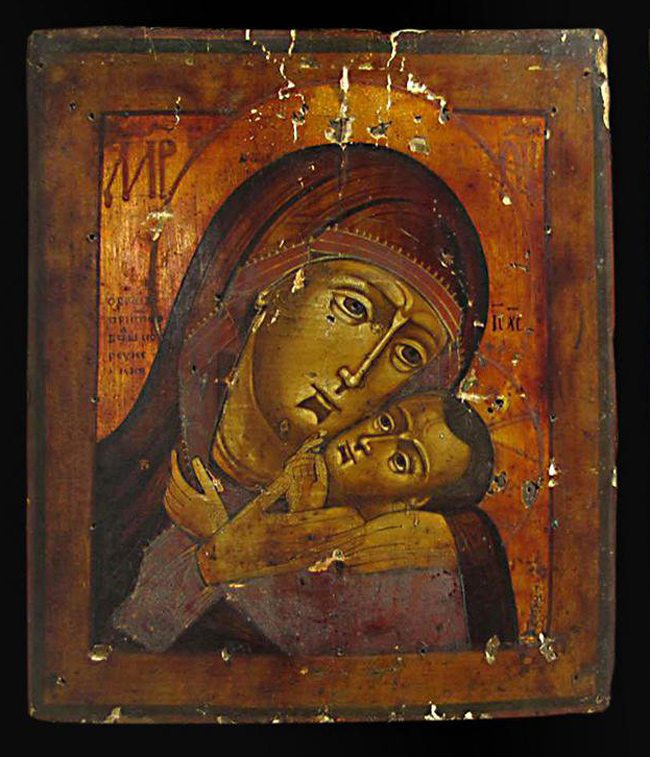
The very composition of the icon is extremely moving, the gently— leaning Infant and the position of the Theotokos evoking a harmony of encircling lines, wherein the eyes of the Mother of God form a centre and look at the viewer with sad and stern penetration… The composition is also known as Umilenie, “tender compassion.”
In Russia before the Revolution there were a large number of very venerated miraculous icons of this type. A more recent icon in St. Isaak’s Cathedral in St Petersburg, and before that for a long time in private hands, was also venerated as miraculous; it is recorded that St. John of Kronstadt, once having visited the apartment where the icon was housed, was so moved by the beauty of it that he spent a half hour kneeling and praying before the sacred image.
Yet the most remarkable of all the Korsun icons was one known as that of Isborsk. Since it was glorified by miraculous tears, the information on it, taken from an old manuscript, is presented here as an addition to the list of The Weeping Icons begun in volume 1, number 6, of The Orthodox Word:
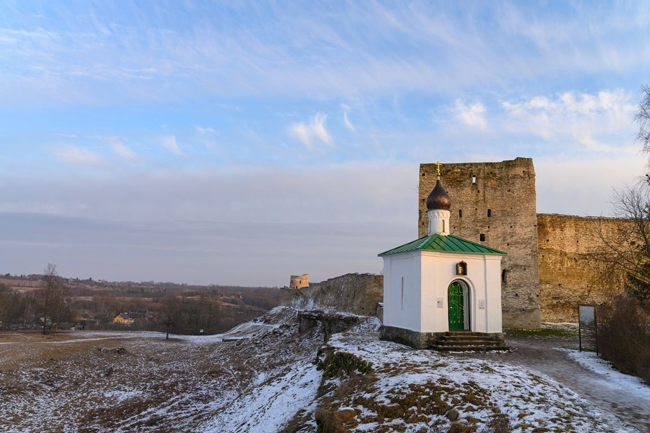
10. The Korsun Icon of Isborsk near Pskov. A great and glorious miracle of the Mother of God took place in the year of our Lord 1657. On Tuesday of the sixth week of the Great and Holy Lent, on March 17, the German troops came at night to the outskirts of the Pskov-Caves Monastery and burned down a whole village, shedding much blood. The Christians living outside the nearby town of Isborsk fled in fear within the walls of this town. Among them was a widow, Eudokia, who had at home an icon of the Most Holy Mother of God with the Infant Jesus Christ, which she took with her to Isborsk and kept in her room. On March 22, Palm Sunday, just at the time when a religious procession was proceeding to the St. Nicholas Monastery outside the city, the widow lit a candle before the icon and began to pray with her daughter Photinia. And then she saw a terrible sign—on the icon of the Most Holy Mother of God there appeared tears flowing from both eyes. The widow informed a certain churchman Simeon of this, and he took the sacred icon and brought it to the main church of the Wonderworker St. Nicholas. On March 24 the chief of the army together with others saw traces of the tears from both eyes, and from the left eye a stream of tears flowing down and stopping on the Blessed Infant. They sent an act of witness of this miracle to Archbishop Makary of Pskov, and he ordered a moleben to be sung for forty days before the icon. Thanks to the prayers of the Most Holy Mother of God, the town of Isborsk was saved from the enemy. Later the icon was brought to Pskov for a time, and then returned to the church of St. Nicholas, where it worked many miracles.

by Saint Seraphim of Platina [†1982]
The Orthodox Word, Volume 2, No. 2, 1966, pp. 70-71

Pas de commentaire