From Lectures delivered by Hemogen Bishop of Pskof and Porkhof
Translated from the Russian by Zenaide A. Ragozin
Baptism.
(general Notions on Baptism)
Baptism ranks first among the seven Sacraments, not because it is higher than the others—the Eucharist stands higher—but because it is the first and only way which gives access to the other sacraments, since it alone entitles a person to take the; name of Christian, and it is Christians only for whose benefit the Sacraments exist. Baptism is, so to speak, the entrance gate to Christ’s Church.
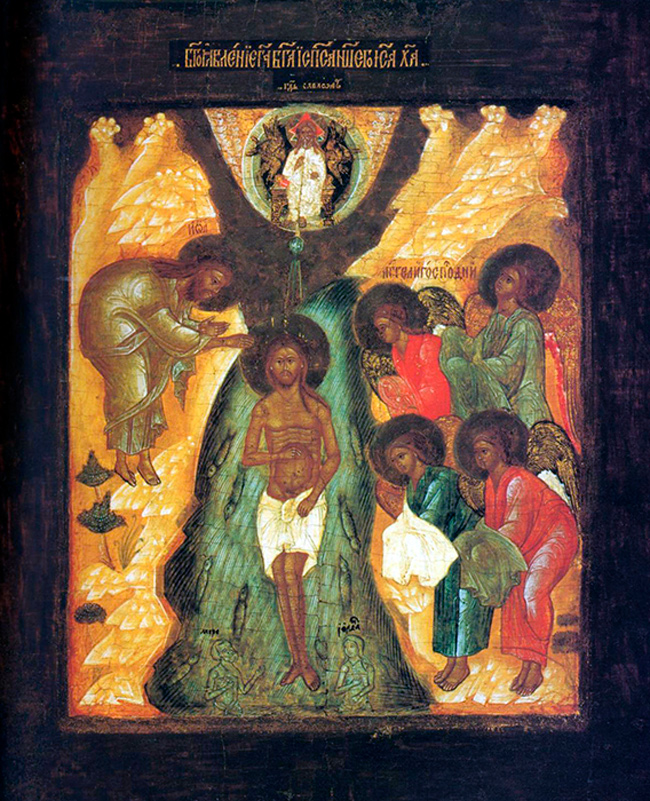
What, then, is Baptism? It is a sacrament by which a man, through the threefold immersion of the body into consecrated water, in the name of the Father, the Son, and the Holy Ghost, dies to the life of sin and the flesh, and is born anew into the life of the spirit. It therefore includes two acts—death and birth.
What is it then, that dies and is consigned to the grave?
If it is an infant who is baptized, what dies in him and is consigned to the grave is that original sin which he inherited from his first parents, Adam and Eve; if an adult, then what dies in him through Baptism and is consigned to the grave is not only the original sin, but all his own personal sins committed before baptism. After baptism man is free from eternal punishment not only for that original sin, but also for his own personal sins committed before baptism.
And what is born in him?
A new spiritual life, pure, innocent, the life which Adam and Eve lived in Eden before the fall. This is why Baptism is sometimes spoken of in Scripture as the “washing of regeneration” [Tit. 3:5][1]. From the moment of baptism, those present hear with their believing hearts that same voice of God the Father, which was heard from the openen heavens at the baptism of the Son of God: “This is my beloved Son, in Whom I am well pleased” [Matth. 3:17][2], for he who has just been baptized becomes the child of God and receives the right of calling on Him as on a Father [John 1:12-13[3]; Rom. 8:14-15[4]].
The question is sometimes asked, “If the original sin is the root and beginning of all our own personal sins, so that, were not that root of sin in us, neither would there be the offshoots therefrom, i. e. our own personal sins,—and if baptism really extirpates that original sin, root and branch, —if all this is so, why do people go on sinning after baptism? If we pull out of the soil with its roots any noxious weed, that weed will not appear again on the surface of the soil, after it has been cleared, will it?”… What answer can be given to such a question? This, to begin with: through Baptism we become as pure and innocent as Adam and Eve were in Eden before the fall. But Adam and Eve, if they were sinless in Eden before the fall, still were capable of sinning, otherwise they would not have sinned. This is why, even after Baptism has extirpated from our hearts the original sin, there still remains in us, as there was in Adam and Eve in their state of innocence, the ability to sin, and therefore, naturally, we sin. In the second place, I would direct your attention to Christ’s parable of the wheat and tares (Matth. 13:24-30)[5]. A householder cleared his field, dressed and ploughed it, and sowed in it good seed; yet, to the servant’s amazement, tares appeared amid the wheat. But the soil had nothing to do with that. The tares came up because an enemy came at the dead of night, when the servants were asleep, and sowed the tares amidst the wheat, and went his way. In the same manner, cannot the Evil One, our wicked, envious enemy, sow tares in the field of our soul, cleared and dressed, though it be, taking advantage of our heedlessness? Are we not told that he “walketh about as a roaring lion, seeking whom he may devour?” [1 Peter 5:8][6]. Lastly, even setting aside the enemy, there may be other reasons why tares can appear in our field, though it was cleared and dressed, as for instance: a bird may be flying over your field and drop the seed of some noxious weed, which it held in its bill; or—the wind may blow on to your cherished field a noxious weed or some evil seeds, and lo! tares grow up amidst the wheat. The same things may happen to our souls, though they were purified by Baptism: there are enough noxious seeds, and evil winds, aud evil birds, ready to do the evil work!
The Institution of the Sacrament of Baptism.
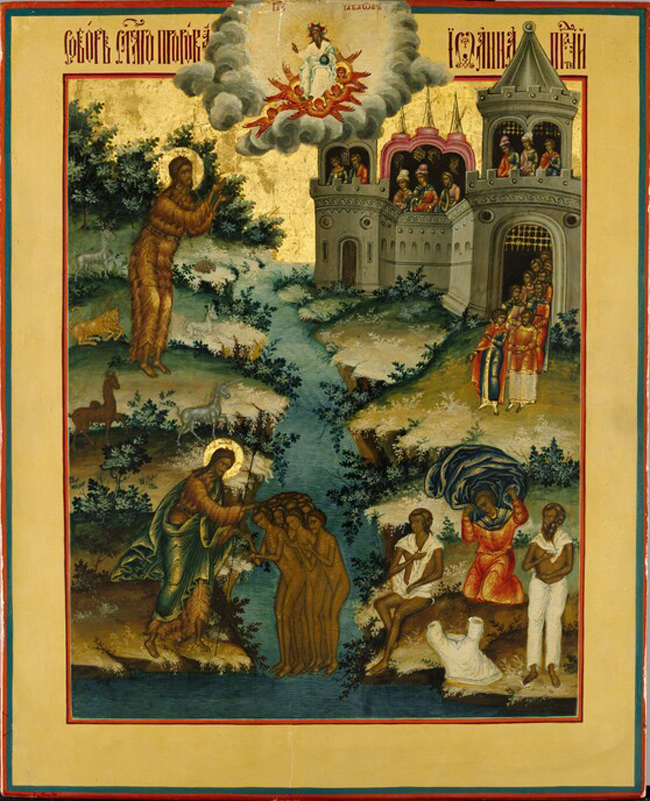
Three events are mentioned in Scripture, which appear to indicate the origin of Christian baptism. They are the following: a) St. John, the Precursor (Foreruner) of the Lord, baptized the Jews in the River Jordan [Mark 1:4-5][7].—b) Jesus Christ Himself received baptism from John in the Jordan [Matth. 3:13, 17][8].—c) Jesus Christ commanded the Apostles to baptize, saying to them: “All power is given unto me in heaven and in earth. Go ye therefore, and teach all nations, baptizing them in the name of the Father, and of the Son, and of the Holy Ghost” [Matth. 28:18-19][9]. But all these events took place not simultaneously, but at different times, some sooner, some later. Which of them ought we to consider as the real origin of the Christian sacrament, while each of them evidently bears a close relation to it?
- a) Baptism as administered by John was merely a preparation of men for Christian baptism, and served as a prototype of it, but was not yet the real Christian Baptism.
- b) The Baptism of Jesus Christ by John is undoubtedly the most nearly related to our Christian Baptism; still it cannot properly be considered as the origin and beginning of it; in the first place because it was John who baptized Him, and John’s baptism as has just been seen, was not yet Christian Baptism; and in the second place because Christ, the sinless Son of God, had no need either of repentance, to which John’s baptism disposed his hearers, or of the Christian Baptism, which, as we likewise have seen, extirpates both the original sin and a man’s own personal sins, committed before baptism.
- c) We shall then have to recognize as the origin and beginning of Christian Baptism these words of Christ: “All power is given unto me in heaven and in earth. Go ye therefore, and teach all nations, baptizing them in the name, of the Father, and of the Son, and of the Holy Ghost” [Matth. 28:18-19]. From this precise moment the Apostles, and their successors after them, began to baptize men not as John did, “unto repentance”, but in Christ’s spirit, “unto the remission of sins”. Of the necessity of such baptism mention is made many times—for instance: “Except a man be born of water and of the Spirit, he cannot enter into the Kingdom of God” [John 3:5][10]: or “He that believeth and is baptized shall be saved” [Mark 16:16] [11]
I shall now speak: 1] of the places where baptism must be performed; 2] of the age at which a person may be baptized; and 3] of the ceremonies which compose the rite of baptism,
The Places where Baptism may be performed.
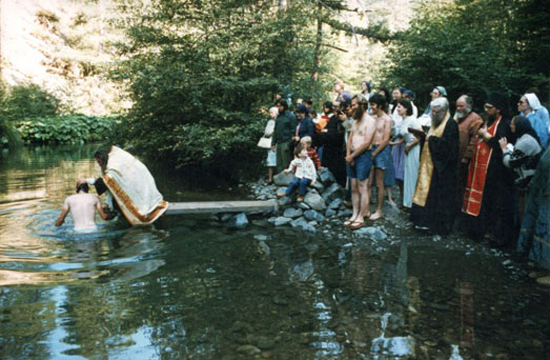
Originally baptism took place either under the open sky—in rivers, lakes, ponds, springs,—or in houses. This was the case especially in the times of persecution by Jews or heathens; is also took place under the open sky in times of peace, when whole multitudes were baptized at one time. But after the persecutions had ceased, it became customary to perform the rite preferably in churches, barring very exceptional occasions. Rulings 31 and 59 of the Sixth Ecumenic Council prescribe this, and allow baptism to be performed in private homes only in cases of extreme urgency, and then with the proviso that a clean room be set aside for the act. In ancient times a special place was constructed or set apart for the purpose—the so-called baptisterium—either in or near a church. If within the church,—or more correctly in a side chapel—a font was set apart with water and steps leading down into it; this was called a “great baptisterium,” to distinguish it from the “small baptisterium”, which was merely a large basin containing holy water. To this day there are churches in Serbia where a font, of metal or stone, stands in a corner, and by its side a small table, on which lie the register and a receptacle in the form of a little pillar, for the hair which is cut from the infants’ heads during the rite. In Russia baptism may be performed at home not only on account of an infant’s weak condition, but also when the parents’ residence is too far removed from the parish church. At one time the question was moved, whether baptism might be performed in private chapels or house churches. Some councils—for instance the Sixth (VIIth century), in its 31st ruling—and the Emperor Leo the Philosopher, authorized baptisms in private chapels. But the Patriarch of Constantinople Alexius (XIth century), probably in consequence of some abuses, forbade them, and was followed by our own Metropolitan Georgius of Kief (1072—79). At the present time the matter is left to the discretion of each diocesan bishop.
According to the doctrine of the Orthodox Church, may be baptized: infants, born of Christian parents, and adults, not Christians, who wish to become Christians. This doctrine is soundly and firmly based upon Scripture and sacred traditions. From Scripture, for instance, we know that Christ said to the Apostles: “Go ye, and teach all nations, baptizing them”[12], without specifying the age at which they should baptize people, that is to say, at any age. We know that He, Christ, Himself said to the Apostles: “Suffer little children, and forbid them not to come to me; for of such is the Kingdom of Heaven” [Matth. 19:14][13]: and these were also His own words: “Except a man be born of water and of the Spirit, he cannot enter into the Kingdom of God”[14]; no exception is made in favor of an infant who has died without baptism, uncleansed of the original sin. We know that the Apostles sometimes baptized entire families, and families must have included children and infants. We find the same thing in the Holy Fathers of the Church. Thus, for instance, St. Cyprian (III-d century), says: “If no one is forbidden from baptism, how much less a newborn babe, who has as yet committed no sin, and has none but the original sin?” Again, St. Gregory the Divine (IV-th century), writes: “Hast thou a babe?.. Give not the taint in him time to grow strong. Let him be sanctified in infancy (by baptism)”. The Councils confirm the same advice by their rulings—such as rulings 83 and 124 of Council of Carthage, and 84 of the Sixth Ecumenic Council. At Athens a newborn babe, until a Christian name has been given to it at baptism, is not called by the usual childish appellation of nepion or paidion; but a boy is called drakos, and a girl drakoula—“serpent”, because, until baptism, the original sin lurks in them, which was committed in Eden by our first parents at the instigation of the perfidious serpent—the Devil. The Little-Russians who live in the government of Tauris (Crimea), have a custom of keeping candles or lampads burning before the ikons night and day from an infant’s birth until baptism, that the Evil Powers may not change the child or in any way touch it. It is said that people there are always in a great hurry to baptize the child, to save the expense of the candles or oil. However that may be, the majority of Christians,—not the Orthodox alone, but those of other confessions also,—generally baptize in childhood or infancy; the only difference of opinion is on the exact age at which children ought to be baptized. In the church of Carthage it was customary to perform the rite on the 8-th day after birth. In Greece and Rome the child was usually named on the 8-th day and baptized on the 40-th, the rule being to perform the rite before Mass, so that the child might be given communion immediately, for which reason the priest and sponsors come to the ceremony without having touched food.
By the way—a word about this name of “sponsors”. The Russian name means literally “receivers, takers-up”, and is translated from the Greek “anadochos”; in familiar Greek speech a godfather is called “koumparos”. Does not the familiar Russian “koum” come from that? Or, it may be, from the Aramean word, “koumi”, which means “stand up!” because the sponsors, “take their stand” before the font in the neophyte’s place. The Aramean language was known in Palestine in the Apostles’ time (see Mark 5:41)[15]. However that may be, sponsors have been known in the Church of Christ from remotest antiquity. They are mentioned in the so-called “Apostolic Rulings”, which are accepted for guidance by the church (see Ruling 2 of the Vl-th Ecumenic Council; there are 85 in all.) They are referred to in the so-called “Apostolic Ordinances” (see Book III, ch. 16). They are mentioned in the Fathers and ancient writers, such as St. Dionysius the Areopagite (“Ecclesiastical Hierarchy”, ch. 2), Tertullian (“On Baptism”, ch. 18). According to our laws, the following persons can not be sponsors: 1) children (it is ordained by the decrees of the Holy Synod of 1836-7 that a godfather must not be younger than 15, or a godmother than 13), because they are not yet capable of pledging themselves for the neophyte’s faith, and do not themselves as yet know the Orthodox faith; 2) immoral and insane persons: the former because their mode of life disqualifies them for the honor; the latter because their mental condition incapacitates them from either pledging themselves for the neophyte’s faith or giving religious instruction; 3) persons of non-Orthodox confessions when the neophyte is Orthodox—for obvious reasons; 4) parents cannot stand sponsors for their own children. These rules, as well known, are not always strictly adhered to with us—except the last: parents never stand sponsors for their own children. But even in ancient times the rules were occasionally relaxed, from necessity. Thus, for instance, the Indian prince St. Josaphus stood sponsor for his own father, Avenirus (19-th of November). It is not customary with us for persons of the monastic order to act as sponsors; yet who would seem fitter for the duty than monks and nuns? From the point of view of sponsorship, it is so; but the monastic point of view is different. Sponsors are the most intimate guides and teachers of their godchildren in the faith and in life. The monk is specially fit for these lofty duties: he knows the doctrine; his life is, as a rule, on a higher plane than the layman’s. But, on the other hand, his position makes it difficult for him to reconcile his monastic duties with those of an instructor. To teach his godchildren, he would have either to receive them in his own cell-which, in that case, would be transformed into a sort, of secular schoolroom or to go to their houses. This is contrary to the monastic rule, and besides, he might become fond of secular life. Nevertheless, history records not a few cases of children taken from the baptismal font by monks. Thus Potamion, Bishop of Agrigentum, was godfather to the infant Gregory, later himself a bishop (VII-th cent.), commemorated on the 23 of November). Germanus, Patriarch of Constantinople (VIII-th cent.), was godfather to the infant Stephen, who became known under the name of the Venerable Martyr Stephen the Younger (28th of November). The Venerable Daniel of Pereyaslavl (died 1540), was godfather to the children of the Grand Duke (Veliki Kniaz) Vassili Vassilevitch. In fact several of our Patriarchs, Metropolitans, archbishops and bishops have been godfathers to the children of Tsars and princes. In Greece and in our own country, Russia, the Metropolitans Cyprian (1305) and Photius (1410), ruled that a boy could do with only a godfather and a girl with only a godmother. Sponsorship produces spiritual kinship; however it affects only the sponsors, the godchildren and their parents; it does not extend to all their relatives, like kinship of the flesh, and its only effect is to disqualify sponsors from marrying godchild or a godchild’s father or mother, or each other. In former times sponsors, in Russia, enjoyed particular respect in the families of their godchildren, and much of the feeling still survives among the common people—very properly, since it is written “honor thy father…” Among the Bulgars, the person who has been invited to stand godfather to the first child is accorded a sort of prescriptive right to stand in the same relation to all the children successively, so that to change the “gossip” without some particularly cogent reason, is a very serious insult to the first gossip.
(To be continued).
[1] But after that the kindness and love of God our Saviour toward man appeared, Not by works of righteousness which we have done, but according to his mercy he saved us, by the washing of regeneration, and renewing of the Holy Ghost; Which he shed on us abundantly through Jesus Christ our Saviour; That being justified by his grace, we should be made heirs according to the hope of eternal life. Titus 3:4-7
[2] And Jesus, when he was baptized, went up straightway out of the water: and, lo, the heavens were opened unto him, and he saw the Spirit of God descending like a dove, and lighting upon him: And lo a voice from heaven, saying, This is my beloved Son, in whom I am well pleased. Matthew 3:16-17
[3] He came unto his own, and his own received him not. But as many as received him, to them gave he power to become the sons of God, even to them that believe on his name: Which were born, not of blood, nor of the will of the flesh, nor of the will of man, but of God. And the Word was made flesh, and dwelt among us, (and we beheld his glory, the glory as of the only begotten of the Father,) full of grace and truth. John 1:11-14
[4] Therefore, brethren, we are debtors, not to the flesh, to live after the flesh. For if ye live after the flesh, ye shall die: but if ye through the Spirit do mortify the deeds of the body, ye shall live. For as many as are led by the Spirit of God, they are the sons of God. For ye have not received the spirit of bondage again to fear; but ye have received the Spirit of adoption, whereby we cry, Abba, Father. The Spirit itself beareth witness with our spirit, that we are the children of God: And if children, then heirs; heirs of God, and joint-heirs with Christ; if so be that we suffer with him, that we may be also glorified together. Romans 8:12-17
[5] Another parable put he forth unto them, saying, The kingdom of heaven is likened unto a man which sowed good seed in his field: But while men slept, his enemy came and sowed tares among the wheat, and went his way. But when the blade was sprung up, and brought forth fruit, then appeared the tares also. So the servants of the householder came and said unto him, Sir, didst not thou sow good seed in thy field? from whence then hath it tares? He said unto them, An enemy hath done this. The servants said unto him, Wilt thou then that we go and gather them up? But he said, Nay; lest while ye gather up the tares, ye root up also the wheat with them. Let both grow together until the harvest: and in the time of harvest I will say to the reapers, Gather ye together first the tares, and bind them in bundles to burn them: but gather the wheat into my barn. Matthew 13:24-30
[6] Humble yourselves therefore under the mighty hand of God, that he may exalt you in due time: Casting all your care upon him; for he careth for you. Be sober, be vigilant; because your adversary the devil, as a roaring lion, walketh about, seeking whom he may devour: Whom resist stedfast in the faith, knowing that the same afflictions are accomplished in your brethren that are in the world. 1 Peter 5:6-9
[7] The beginning of the gospel of Jesus Christ, the Son of God; As it is written in the prophets, Behold, I send my messenger before thy face, which shall prepare thy way before thee. The voice of one crying in the wilderness, Prepare ye the way of the Lord, make his paths straight. John did baptize in the wilderness, and preach the baptism of repentance for the remission of sins. And there went out unto him all the land of Judaea, and they of Jerusalem, and were all baptized of him in the river of Jordan, confessing their sins. Mark 1:1-5
[8] I indeed baptize you with water unto repentance: but he that cometh after me is mightier than I, whose shoes I am not worthy to bear: he shall baptize you with the Holy Ghost, and with fire: Whose fan is in his hand, and he will throughly purge his floor, and gather his wheat into the garner; but he will burn up the chaff with unquenchable fire. Then cometh Jesus from Galilee to Jordan unto John, to be baptized of him. But John forbad him, saying, I have need to be baptized of thee, and comest thou to me? And Jesus answering said unto him, Suffer it to be so now: for thus it becometh us to fulfil all righteousness. Then he suffered him. And Jesus, when he was baptized, went up straightway out of the water: and, lo, the heavens were opened unto him, and he saw the Spirit of God descending like a dove, and lighting upon him: And lo a voice from heaven, saying, This is my beloved Son, in whom I am well pleased. Matthew 3:11-17
[9] Then the eleven disciples went away into Galilee, into a mountain where Jesus had appointed them. And when they saw him, they worshipped him: but some doubted. And Jesus came and spake unto them, saying, All power is given unto me in heaven and in earth. Go ye therefore, and teach all nations, baptizing them in the name of the Father, and of the Son, and of the Holy Ghost: Teaching them to observe all things whatsoever I have commanded you: and, lo, I am with you alway, even unto the end of the world. Amen. Matthew 28:16-20
[10] Jesus answered, Verily, verily, I say unto thee, Except a man be born of water and of the Spirit, he cannot enter into the kingdom of God. That which is born of the flesh is flesh; and that which is born of the Spirit is spirit. John 3:5-6
[11] And he said unto them, Go ye into all the world, and preach the gospel to every creature. He that believeth and is baptized shall be saved; but he that believeth not shall be damned. And these signs shall follow them that believe; In my name shall they cast out devils; they shall speak with new tongues; They shall take up serpents; and if they drink any deadly thing, it shall not hurt them; they shall lay hands on the sick, and they shall recover. Mark 16:15-18
[12] And Jesus came and spake unto them, saying, All power is given unto me in heaven and in earth. Go ye therefore, and teach all nations, baptizing them in the name of the Father, and of the Son, and of the Holy Ghost: Teaching them to observe all things whatsoever I have commanded you: and, lo, I am with you alway, even unto the end of the world. Amen. Matthew 28 :18-20
[13] Then were there brought unto him little children, that he should put his hands on them, and pray: and the disciples rebuked them. But Jesus said, Suffer little children, and forbid them not, to come unto me: for of such is the kingdom of heaven. And he laid his hands on them, and departed thence. Matthew 19:13-15
[14] Nicodemus saith unto him, How can a man be born when he is old? can he enter the second time into his mother’s womb, and be born? Jesus answered, Verily, verily, I say unto thee, Except a man be born of water and of the Spirit, he cannot enter into the kingdom of God. John 3:4-5
[15] And when he was come in, he saith unto them, Why make ye this ado, and weep? the damsel is not dead, but sleepeth. And they laughed him to scorn. But when he had put them all out, he taketh the father and the mother of the damsel, and them that were with him, and entereth in where the damsel was lying. And he took the damsel by the hand, and said unto her, Talitha cumi; which is, being interpreted, Damsel, I say unto thee, arise. And straightway the damsel arose, and walked; for she was of the age of twelve years. And they were astonished with a great astonishment. And he charged them straitly that no man should know it; and commanded that something should be given her to eat. Mark 5:39-43
Russian Orthodox American Messenger, Vol. IV, No. 10, 15-28 May 1900, pp. 194–98

Pas de commentaire