From Lectures delivered by Hemogen Bishop of Pskof and Porkhof
Translated from the Russian by Zenaide A. Ragozin
Introduction
I will not explain to you on what occasion and with what object these lectures on theological themes are to be given: the occasion is known to you, and so is the object. I shall merely say a few words on the subject and character of the lectures, themselves, which I would commend to your indulgent attention.
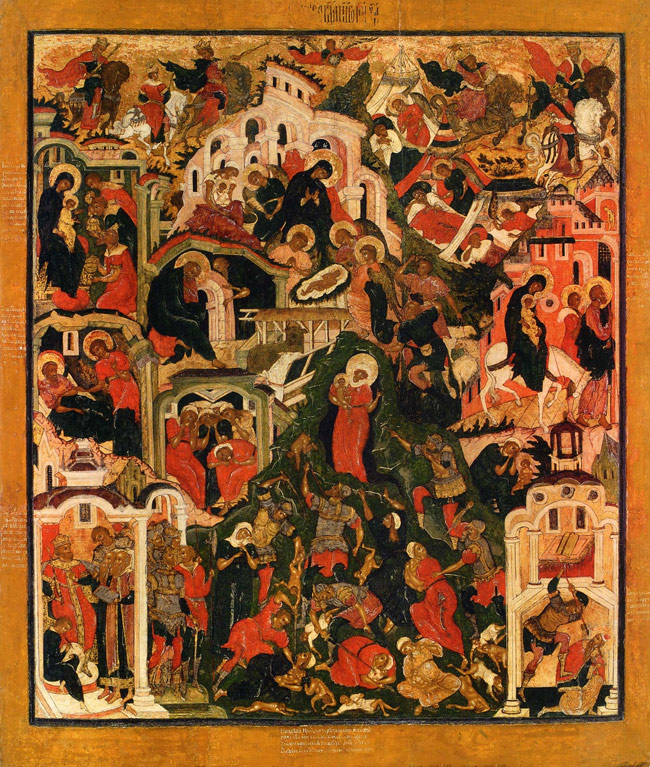
I have selected as my subject the doctrine of the Sacraments—for the following reasons: In the first place, it occupies a very prominent place in the domain of divinity and is more or less nearly connected with various branches of it, such as dogmatics, liturgies, church history. In tho second place, the Sacraments impart to us, in the Apostle’s words, “the divine power unto life and godliness” [2 Peter 1:3][1], and we are in the enjoyment of them, or of some of them, through all the course of our lives, from birth unto death, from the cradle unto the grave; they are absolutely indispensable to us all, if we are to obtain life everlasting. And yet many, especially among laymen, have only vague and confused notions on the Sacraments—to such an extent that not a few seem to have forgotten their own proper appellation, and speak of them now as “rites,” now as” ministrations.” It is my desire, as far as I am able, to fill this gap, to supply this defective knowledge. I do not, indeed, promise that my lectures shall lay before you the doctrine of the Sacraments in all its details, fulness and thoroughness: this would require of me too much leisure, which I cannot command, and would take too much of my hearers’ time. But I am convinced that the latter, while they will find in them much that is familiar, will also hear much that, until now, was unknown to them. I hardly think that I shall have time in the course of the Holy Quadragesima, to expound to you the doctrine of all the Sacraments. I shall be satisfied with myself and most grateful to you, if, with God’s help, I manage to treat of, and you to hear about, four or five Sacraments, viz. Baptism, Confirmation, Penance, Matrimony and, possibly—Extreme Unction. But I must, as a preliminary, explain to you the doctrine of the Sacraments generally. Therefore I beg you to attend. Let us begin, with the help of God.
What then is a sacrament? wherein do sacraments differ from other sacred acts? and why are there seven Sacraments, neither more nor less? These are the questions which saggest themselves first when we think of the Sacraments.
Let us answer them in their order:
1.) What is a sacrament? A sacrament, teacheth the Orthodox Church, is a sacred act by which under a visible form or sign, the Divine grace or virtue is invisibly imparted to man. Consequently, there are two aspects to every sacrament: the visible and the invisible. The prayers and all the rites which belong to the sacrament, are its visible aspect: every one of us can see and hear all that is done in the celebration of it. Looked at from this side, every sacrament is an object of study, of knowledge. The invisible aspect is the grace imparted by the sacrament. Looked at from this side, every sacrament is, in the true sense of the word, a “mystery”[2], not to be comprehended by any of us, and therefore—an object of reverent faith, not of investigating knowledge. Take, as an instance, the Sacrament of Baptism: who shall make clear to us, how, through the immersion of the body into water, a human soul is purified, how a material substance can cleanse the spirit? Call to mind Jesus Christ’s conversation with Nicodemus on the necessity of regeneration by baptism in order to obtain the Kingdom of Heaven. The teacher here was not an ordinary teacher or even one of the wisest and most gifted. He was not merely a teacher—He was the Light born of Light, Which illumineth all men—He was the Way, the Truth and the Life—the Son of God Himself. Nor was Nicodemus an ordinary disciple—he was a prince and teacher in Israel. What more would you have? And yet, what happened? They talked together long; but the question was not solved: the mystery remained a mystery, and Nicodemus, after giving all his attention to the words of the Heavenly Teacher, kept repeating “How can these things be?” [John 3 :9][3]. And what did the Savior then say to Nicodemus about the wind? “The wind bloweth where It lislelh, and thou hearest the voice thereof, but canst not tell whence it cometh, and whither it goeth” (ib. 8). We must say the same about the grace in the Sacrament of Baptism: grace undoubtedly “bloweth” in the sacrament, but we “cannot tell whence it cometh, and whither it goeth”. Really now—whence cometh it? Of course from God. But how? From God the Father, or from the Son, or from the Holy Ghost? or from all three Persons of the Most Holy Trinity, since they are, by their essence, indivisible? And if it cometh from all three Persons of the Trinity, what part, or what exact share does each person take in imparting the gift of grace? The more one thinks about it, the more incomprehensible the mystery becomes. Again—zohither goeth it? (meaning grace.) Of course to the person who is the recipient of grace. But how? How does water become the vehicle of divine grace? How can a substance, even though not coarse, yet still material, having the body, but not penetrating it, cleanse and purify a human being’s spiritual nature, with its intellect, its will, its feeling heart? Here again, the more one thinks of it, the more incomprehensible the mystery becomes. Or, take tire Sacrament of the Eucharist. It is beyond a doubt that, under the semblance of bread and wine, we partake of the Body and Blood of our Lord Jesus Christ. But here again we are confronted by an incomprehensible mystery: in what manner, in this sacrament, does the essence of the bread become changed into the essence of the Lord’s Body, and the essence of the wine into the essence’ of the Lord’s Blood? and how is only the semblance of the wine and bread left for our eyes and taste, to enable us to receive Communion, since, owing to our human nature, we can not eat human flesh or drink human blood? When Christ said to the Jews: “I am the living bread which came down from heaven: if any man eat of this bread, he shall live for ever; and the bread which I will give is my flesh”… [John 6:51][4], they began to dispute noisily among themselves, saying “How can this man give us his flesh to eat?” (ib. 52). And what did Christ do? He did not answer their question “how can he?” because whatever He might have said to explain the mystery, it would certainly have still remained incomprehensible to them. He merely said: “verily, verily I say unto you, except ye eat of the flesh of the Son of Man, and drink his blood, ye have no life in you. Whose eateth my flesh and drinketh my blood, hath eternal life” (ib. 53–54). And here again everything is to us mystery upon mystery incomprehensible. And we involuntarily think of the Blessed Augustine, Bishop of Hippo, how he one day sat by the sea and strove to solve the mystery of the Most Holy Trinity: how God can be one, and yet three. He thought and thought, pondered and brooded; but nothing grew clear in his brain—it was all impenetrable darkness. And as he sat there, a little boy, very fair to look upon, appeared quite near to him, and, picking up a shell, began to fill it with water from the sea, and to pour out the water upon the sand of the beach. “What art thou doing that for?” asked Augustine. —“I want” replied the child, to bale out the whole sea and pour it out upon the earth with this shell.”—” Foolish child!” exclaimed Augustine, “how thinkest thou to bale out the sea with this little shell? Thou wilt grow weary, expend all thy strength and break down, yet shall not the water in the sea grow less.” But the boy replied: “Sooner shall I bale out the sea with this little shell and pour out its waters upon the earth than thou, with thy small intellect, shalt fathom the great mystery: how God can be one, yet three?” He said and vanished. It was one of God’s angels, sent to bring the too curious Augustine to his senses.
We have, then, already formed some idea of the nature of the Sacraments. With this notion the notions of Christians of other confessions on the same subject fully agree. The Eastern Christians—Armenians, Copts, etc.—almost all agree in this, and, of the Western Christians—the Roman Catholics. The others differ more or less from the Orthodox doctrine. Thus for instance, the Anglican Church teaches that the Sacraments are only testimonies and signs of grace, not vehicles of the same. The Baptists hold them to be mere symbolical rites, which only betoken a person’s entrance into the Christian community and the union of its members among themselves.
2.) In what do the Sacraments differ from other sacred acts? In my opinion three essential differences are to be noted:
- All the Sacraments were, beyond a doubt, instituted by Jesus Himself, and exert on us a saving force in virtue of His merits and death on the cross. But who instituted the other sacred acts, such as Te-Deums, Requiem services, processions, etc.—that we do not know with any certainty. True, these things too have existed from remote antiquity, but neither the Scriptures nor sacred tradition, nor history inform us clearly, whether Christ Himself instituted them, or His Apostles, or, later, holy fathers of the church.
- Each sacrament, as we know from the Catechism, has a special action of divine grace attached to it[5]. Thus to Baptism belongs the grace of spiritually regenerating man; to Penance that of remitting sins; to the Eucharist that of intimately uniting man with Jesus Christ Himself, etc., etc. In every sacrament there undoubtedly abideth a special grace, but no one can define in what exactly it consists. I will give you an illustration. You have received holy Baptism. I ask you: “What grace have you received through Baptism?” You answer without the least hesitation: “Baptism has given me a new life by grace.” You have attended an evening service. I ask you: “What grace have you derived from the service?” You do not answer my question, because you do not know how to answer it.
- In each sacrament that particular grace is imparted to man which belongs to that particular Sacrament, if only the recipient be worthy: in Baptism you receive the grace of a new spiritual life—that and no other; in Confirmation you receive the grace of a force which develops and strengthens the spiritual life conferred by Baptism,—that and no other, etc., etc. But nothing of the kind can be said with absolute certainty of other sacred acts. Before departing on a long journey, I celebrate a special Te-Deum, that the Lord may bless my journey and help me to achieve the objects I have set to myself, and I hope that my prayer will not be vain; otherwise, if I had not that hope, I should not celebrate the Te-Deum… But can I say with certainty: “my journey shall be in every way prosperous and I shall not encounter any difficulties, any unpleasant adventures, because of my having celebrated this Te-Deum? No, I can not. You, before sending your son to school, celebrate a Te-Deum, praying that the Lord may help him to be successful in his studies. This is, in itself, a praiseworthy beginning, and you may and must hope that the Lord will hear and fulfil your prayer—yours and the child’s: if you did not, you would not have so prayed. But can you say with absolute certainty: “My little son will study well, because we had this Te-Deum sung?” No; of course you can not. The same thing is true of all other acts of worship, excepting only the Sacraments.
Of these there is the following remark to be added: the virtue of a sacrament does not depend on the faith of the recipient, nor on the merit of the celebrant. Should I, in receiving any one of the sacraments, disbelieve its virtue, it would take effect on me all the same, only it would serve not to my justification, but to my condemnation. The following occurrence is recorded of St. Gregory, Pope of Rome. Once, while he was celebrating the Liturgy and giving communion to the faithful, a woman approached him with the rest, but smiled as he uttered the words: “The handmaid of God partaketh of the precious and holy Body and Blood of our Lord Jesus Christ.” He asked her why she was smiling. She replied: “Holy Father, thou sayest that I partake of the Body of Christ? Yet I myself made this bread and brought it here, to be used at the Liturgy: how then can it be the Body of Christ?” St. Gregory only said to her: “If thou wishest to receive communion, do so; if not, stand aside.” She was going to receive it, but could not. The Pontiff again asked: “Why dost thou not receive communion?” She replied: “Because I now see that this is indeed human flesh and I cannot partake of it.” The Pontiff offered a silent prayer, and the woman then partook of the Body and Blood of Christ under the semblance of bread and wine. [6] This is confirmed by the Apostle Paul, where he says: “But let a man examine himself, and so let him eat of that bread, and drink of that cup. For he that eateth and drinketh unworthily, eateth and drinketh damnation to himself, not discerning the Lord’s Body” [I Cor. 11:28—29][7].
As regards the celebrant of the Sacraments, only two conditions are required in order that the latter may have their inherent virtue: ’that he be a legitimately ordained minister of the altar, not a pretender, nor under sentence of suspension, and that he celebrate the. rite not after some manner of his own invention, but exactly after the manner prescribed by the Church, even though he do not perform the act with due reverence. The reason of this is that he is not really the performer of the sacrament, but only the instrument of God in the performance of it. If I offer you a golden coin, there will be no change in the value of it, whether the hand on which I offer it be clean or soiled. If I lay in the earth a seed that has the vital principle in it, it will also not undergo any change, no matter what may be the condition of the hand with which I hold it. Man needs good tools in order that his work be well done. But God, the all-knowing and all-powerful, has no need of such tools. It goes without saying that the minister who celebrates a sacrament carelessly shall be made to answer for it heavily on the great Judgment Day, as it is said in the Scriptures: “Cursed be he that doeth the work of the Lord deceitfully” [Jeremiah 48:10][8].
3.) We Orthodox Christians acknowledge seven sacraments, no more, no less. Although it is not explicity said in the Scriptures that there are seven sacraments, that number is mentioned there, individually. Just so we find seven sacraments mentioned in the writings of the earliest Fathers of the Church. If they did not write expressly of seven sacraments, some of them, on special occasions, wrote on Baptism and the Eucharist, others on Confirmation and Penance, others again on Matrimony, and so forth[9], so that, if we read through all their writings, we shall arrive at the clear and firm conviction, that the early Church recognized seven sacraments. And since the 4th century many of the Fathers and teachers of the Church wrote of the Sacraments expressly as being seven. Therefore we, Orthodox Christians, acknowledge the number seven as that of the sacraments, on the ground of the Scriptures and of sacred tradition. But why seven, neither more nor less? To this question, of course, only lie could give a direct and conclusive answer, Whose pleasure it was to institute these seven sacraments—Jesus Christ Himself; while our answers can be only hypothetical.
The best solution of the question would seem to be this: that seven sacraments were instituted because that number answers all our spiritual needs. Each of us is a human being and a Christian. What then are the essential conditions of our existence, individually, as human beings? They are these: In order that a man may exist in the world, it is first of all necessary that he receive the gift of life, in other words—that he be born; for one who has not been born does not yet exist. But lol he is born. What is the next thing needed, in order that the life to which he is born may continue? Certain forces of nature are needed for that—sunlight, and warmth, and air, which are to develop and strengthen his organic life, come into being through birth: without sunlight and warmth the infant would freeze, while without air it could not breathe, consequently would die immediately after birth. Further, it needs food and drink: without them it would starve to death Here, then is a human being, born, and living through the enjoyment of sunlight and warmth, of air food and drink. But this life, from diverse causes, is subject to perturbations; the child falls ill: for the restoration of its health physicians are needed, and medical appliances. We require the same essential conditions in our capacity of Christians. In order to be a Christian, a man must first of all receive a new spiritual life, cleansed from the original sin with which every man is born into the world—a new birth, a spiritual birth. This second birth is given him by the Sacrament of Baptism. But, after receiving through Baptism a new spiritual life, the Christian forthwith feels the need of a force of grace, capable of developing and strengthening this new spiritual life, conferred through baptism. This developing and strengthening force is imparted to the Christian by the Sacrament of Confirmation; it is, in a way, a sort of spiritual light and warmth, of spiritual air, like the material sunlight and air which develop and strengthen the infant organism immediately after birth. The Christian further needs spiritual nourishment, as the infant, after being born, needs, next to sunlight, material food and drink. This spiritual nourishment is provided for the Christian in the Sacrament of the Eucharist. In the course of his life the Christian unavoidably encounters various infirmities and diseases, both of body and soul. Against those he needs medical assistance: that is supplied by two Sacraments—the Sacrament of Penance and that of Extreme Unction. Further, it is necessary that men, including Christians, should multiply upon the earth,—not as animals do, but with and by the blessing of God: “Be fruitful, and multiply, and replenish the earth”[10], the Lord said to our first parents when he created them. This blessing of God is conferred upon the Christian through the Sacrament of Matrimony. Lastly there is need of men having authority from God Himself to regenerate men spiritually, i. e. to baptize them, and impart to them the grace which is to develop their spiritual life and strengthen it with spiritual sustenance, to heal the sick, and invoke the blessing of God on them that enter the married state. Such authority is conferred through the Sacrament of Orders.
Thus the seven Sacraments completely satisfy all our spiritual needs; so that, should there be, let us say, eight of them, we should not know what use to make of the eighth, to what special spiritual need to apply it: it would be superfluous. While, should there be fewer than seven, many of our spiritual needs would remain unsatisfied. Omit, for instance, Confirmation: the Christian would be in the position of a man deprived, after birth, of light, warmth, and air. Take away the Eucharist—and you condemn the Christian to death by starvation, etc. etc.
Four of the seven Sacraments are or may be administered repeatedly in the course of a Christian’s life: they are Penance, the Eucharist, Matrimony (up to three times), and Extreme Unction. The other three—Baptism, Confirmation and Orders—cannot be repeated.
(To be continued)
[1] Simon Peter, a servant and an apostle of Jesus Christ, to them that have obtained like precious faith with us through the righteousness of God and our Saviour Jesus Christ: Grace and peace be multiplied unto you through the knowledge of God, and of Jesus our Lord, According as his divine power hath given unto us all things that pertain unto life and godliness, through the knowledge of him that hath called us to glory and virtue: Whereby are given unto us exceeding great and precious promises: that by these ye might be partakers of the divine nature, having escaped the corruption that is in the world through lust. 2 Peter 1:1-4
[2] The Russian word for. sacrament” is one that literally signifies. mystery.” (Translator’s note)
[3] Nicodemus saith unto him, How can a man be born when he is old? can he enter the second time into his mother’s womb, and be born? Jesus answered, Verily, verily, I say unto thee, Except a man be born of water and of the Spirit, he cannot enter into the kingdom of God. That which is born of the flesh is flesh; and that which is born of the Spirit is spirit. Marvel not that I said unto thee, Ye must be born again. The wind bloweth where it listeth, and thou hearest the sound thereof, but canst not tell whence it cometh, and whither it goeth: so is every one that is born of the Spirit. Nicodemus answered and said unto him, How can these things be? Jesus answered and said unto him, Art thou a master of Israel, and knowest not these things? Verily, verily, I say unto thee, We speak that we do know, and testify that we have seen; and ye receive not our witness. John 3:4-11
[4] Verily, verily, I say unto you, He that believeth on me hath everlasting life. I am that bread of life. Your fathers did eat manna in the wilderness, and are dead. This is the bread which cometh down from heaven, that a man may eat thereof, and not die. I am the living bread which came down from heaven: if any man eat of this bread, he shall live for ever: and the bread that I will give is my flesh, which I will give for the life of the world. The Jews therefore strove among themselves, saying, How can this man give us his flesh to eat? Then Jesus said unto them, Verily, verily, I say unto you, Except ye eat the flesh of the Son of man, and drink his blood, ye have no life in you. Whoso eateth my flesh, and drinketh my blood, hath eternal life; and I will raise him up at the last day. For my flesh is meat indeed, and my blood is drink indeed. He that eateth my flesh, and drinketh my blood, dwelleth in me, and I in him. As the living Father hath sent me, and I live by the Father: so he that eateth me, even he shall live by me. This is that bread which came down from heaven: not as your fathers did eat manna, and are dead: he that eateth of this bread shall live for ever. John 6:47-58
[5] Already St. Cyprian of Carthage described the Sacraments as vehicles of the life of spiritual grace.
[6] The Golden Legend: Readings on the Saints, Voragine trans. and ed. Ryan 1993, vol. 1, pp. 179–180.
[7] For as often as ye eat this bread, and drink this cup, ye do shew the Lord’s death till he come. Wherefore whosoever shall eat this bread, and drink this cup of the Lord, unworthily, shall be guilty of the body and blood of the Lord. But let a man examine himself, and so let him eat of that bread, and drink of that cup. For he that eateth and drinketh unworthily, eateth and drinketh damnation to himself, not discerning the Lord’s body. For this cause many are weak and sickly among you, and many sleep. For if we would judge ourselves, we should not be judged. 1 Corinthians 11:26-31
[8] Give wings unto Moab, that it may flee and get away: for the cities thereof shall be desolate, without any to dwell therein. Cursed be he that doeth the work of the LORD deceitfully, and cursed be he that keepeth back his sword from blood. Moab hath been at ease from his youth, and he hath settled on his lees, and hath not been emptied from vessel to vessel, neither hath he gone into captivity: therefore his taste remained in him, and his scent is not changed. Therefore, behold, the days come, saith the LORD, that I will send unto him wanderers, that shall cause him to wander, and shall empty his vessels, and break their bottles. Jeremiah 48:9-12
[9] Thus St. Cyprian, Bishop of Carthage (3-d cent. A. D.), wrote on four of the Sacraments—Baptism, Confirmation, Penance and the Eucharist.
[10] And God blessed Noah and his sons, and said unto them, Be fruitful, and multiply, and replenish the earth. And the fear of you and the dread of you shall be upon every beast of the earth, and upon every fowl of the air, upon all that moveth upon the earth, and upon all the fishes of the sea; into your hand are they delivered. Every moving thing that liveth shall be meat for you; even as the green herb have I given you all things. But flesh with the life thereof, which is the blood thereof, shall ye not eat. Genesis 9:1-4
Russian Orthodox American Messenger, Vol. IV, No. 9, 1-14 May 1900, pp. 174–79
Pas de commentaire